Property & Casualty Insurance Producer · 2026 Edition
Property & Casualty Insurance Producer — Complete Study Guide (2026)
The general portion every state's P&C exam tests — property, homeowners, auto, commercial, liability and workers' comp — with a 100-question full-length practice exam. Pair it with your state's law.
- All 10 chapters — property, dwelling, homeowners, auto, commercial, casualty and workers' comp — as one PDF + EPUB you keep
- A worked example and a key-numbers sheet closing each of the 10 chapters
- 100 practice questions, every answer reasoned out rather than keyed — none of them in the free bank on this site
$19.99one-time · lifetime download · no subscription
PDF + EPUB · English · 121 pages · $19.99 one-time
This book is written in English.
Instant download after payment — no account needed, no subscription.
14-day money-back guarantee: not satisfied for any reason? Email support@preppass.org within 14 days of purchase for a full refund. It's a download, so there is nothing to ship back. Refund policy
Look inside the book
Three real pages, rendered straight from the PDF you download — a reference page, a teaching page, and a worked question, always in that order. Nothing here was redrawn to look better.
- Quick referenceAppendix C — Glossary of Key P&C Terms · PDF page 117
A page you can turn back to: the numbers, deadlines or terms gathered in one place.
- How it's taughtSection II — insureds, insured location, exclusions · PDF page 42
An explanation page: the material taught in prose, in the order the exam tests it.
- A question, workedChapter 4 — The Dwelling Policy (DP) · PDF page 39
A practice question with its answer and the reasoning behind it — not just a key.
Studying for both? There's a pair price
- Life & Health Insurance Producer — Complete Study Guide (2026)$19.99
- Property & Casualty Insurance Producer — Complete Study Guide (2026)$19.99
Buy both: $29.99 — save $9.99 vs buying separately
Separately $39.98 · 24% off · One checkout, both items.
Already bought Life & Health Insurance Producer? Don't buy the bundle — it includes that book and you'd pay for it twice. Get Property & Casualty Insurance Producer on its own for $19.99. Property & Casualty Insurance Producer · What's in the bundle →
Exam inside two weeks?
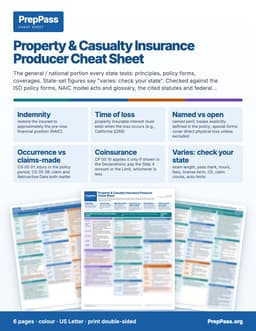
This guide is the teaching, read over weeks. If your exam is inside two weeks, the printable colour cheat sheet is the other product: the figures the exam turns on, laid out by section.
See the California Property & Casualty Insurance Producer cheat sheet PDF — $9.99 →
6 pages · US Letter · printable PDF · yours to keep
About the exam itself
| Administering body | No single body: each state's insurance department licenses property and casualty producers and sets its own exam, usually delivered by a testing vendor. California's is delivered by PSI Services LLC; Texas's by Pearson VUE. See the facts page for your state where PrepPass has one. What we read and found nothing in: PSI / California Department of Insurance — Candidate Information Bulletin for California Insurance License Examinees (revised March 2026) |
|---|---|
| Questions | Set by each state. California's exam is 150 questions. See the facts page for your state where PrepPass has one. What we read and found nothing in: PSI / California Department of Insurance — Candidate Information Bulletin for California Insurance License Examinees (revised March 2026) |
| Time limit | Set by each state. California allows 195 minutes; Texas's General Lines - Property & Casualty exam allows 150 minutes. See the facts page for your state where PrepPass has one. What we read and found nothing in: PSI / California Department of Insurance — Candidate Information Bulletin for California Insurance License Examinees (revised March 2026) |
| Passing score | Set by each state. California publishes 60%; Pearson VUE's Texas handbook publishes a scaled score of 70 on a 0–100 scale, which it says is not the percentage of questions answered correctly. See the facts page for your state where PrepPass has one. What we read and found nothing in: CDI — Examination Times and Number of Questions (CDI website table; stale on languages and, for time limits, disagrees with the CIB) |
| Fees | Set by each state. Pearson VUE's Texas handbook lists $49 per attempt for the General Lines - Property & Casualty exam. See the facts page for your state where PrepPass has one. What we read and found nothing in: Pearson VUE — Texas Insurance Licensing Candidate Handbook, October 2024 (#124400) |
| Languages offered | Set by each state; Pearson VUE's Texas handbook lists English and Spanish forms. See the facts page for your state where PrepPass has one. What we read and found nothing in: Pearson VUE — Texas Insurance Licensing Candidate Handbook, October 2024 (#124400) |
Questions buyers ask
- Is a study guide enough for the Property & Casualty Insurance Producer exam, or do I need a course?
- A book is exam review: it does not replace any education, training or experience your licensing body requires before you may sit the exam, so check those requirements first. For the exam content itself, this 121-page guide teaches the material chapter by chapter with 100 practice questions and explanations inside, and 324 more practice questions are free on PrepPass. A prep course adds live instruction and a set schedule; whether you need one beyond any required education is your call.
- What is the cheapest way to prepare for the Property & Casualty Insurance Producer exam?
- Start with what costs nothing: 324 practice questions on PrepPass, with explanations and no signup. If you want it taught in one file you keep, the full study guide is $19.99 once; the printable cheat sheet for the last days is $9.99. No subscription on any of them.
- Who administers the State Property and Casualty Insurance Producer Licensing Exams?
- No single body: each state's insurance department licenses property and casualty producers and sets its own exam, usually delivered by a testing vendor. California's is delivered by PSI Services LLC; Texas's by Pearson VUE. See the facts page for your state where PrepPass has one.
- How many questions are on the State Property and Casualty Insurance Producer Licensing Exams?
- Set by each state. California's exam is 150 questions. See the facts page for your state where PrepPass has one.
- How long is the State Property and Casualty Insurance Producer Licensing Exams?
- Set by each state. California allows 195 minutes; Texas's General Lines - Property & Casualty exam allows 150 minutes. See the facts page for your state where PrepPass has one.
- What is the passing score for the State Property and Casualty Insurance Producer Licensing Exams?
- Set by each state. California publishes 60%; Pearson VUE's Texas handbook publishes a scaled score of 70 on a 0–100 scale, which it says is not the percentage of questions answered correctly. See the facts page for your state where PrepPass has one.
- How much does the State Property and Casualty Insurance Producer Licensing Exams cost?
- Set by each state. Pearson VUE's Texas handbook lists $49 per attempt for the General Lines - Property & Casualty exam. See the facts page for your state where PrepPass has one.
- What languages is the State Property and Casualty Insurance Producer Licensing Exams offered in?
- Set by each state; Pearson VUE's Texas handbook lists English and Spanish forms. See the facts page for your state where PrepPass has one.
- Does the Property & Casualty Insurance Producer study guide come as a PDF?
- Yes — Property & Casualty Insurance Producer — Complete Study Guide (2026) downloads as PDF and EPUB, 121 pages. The download link is emailed the moment payment clears and does not expire.
- How much does the Property & Casualty Insurance Producer study guide cost?
- $19.99, once. There is no subscription and no account to create; the PDF and EPUB files are yours to keep.
- Are there free Property & Casualty Insurance Producer practice questions?
- Yes — 324 of them, free to use with no signup and an explanation on every one. They are separate from this study guide, which is what you are buying here. The same free, no-account system also has practice modes (adaptive, new questions, spaced review of misses, weak-topic focus, saved, my mistakes); a timed mock exam (150 questions, 180 minutes) with a score report by topic; a 10-question readiness check (about 5 minutes); 10 study chapters. None of it needs this study guide.
- Can I read part of the Property & Casualty Insurance Producer study guide before buying?
- Yes. A full chapter is free to read on this page — not a summary of one, the chapter itself.
- What is the difference between the Property & Casualty Insurance Producer study guide and the cheat sheet?
- The study guide ($19.99) teaches the material chapter by chapter and is meant to be read over weeks. The cheat sheet ($9.99, 6 pages) drops the teaching and keeps the figures: every number on the exam grouped by value so the confusable ones sit together, each reference page paired with a recall page that blanks the answers, and four routes by days left — 14, 7, 3, or tonight. They are separate purchases; neither replaces the other.
- Is there a cheaper way to buy the Property & Casualty Insurance Producer study guide with anything else?
- Yes. Life & Health + Property & Casualty is $29.99 for 2 files in one checkout — 24% less than the $39.98 those items cost bought separately today. It adds Life & Health Insurance Producer — Complete Study Guide (2026). The saving is measured against the items' real current prices; there is no struck-through "original" price on this site.
- Is this the official Property & Casualty Insurance Producer study guide?
- No. This is an independent study guide and is not affiliated with or endorsed by the exam's awarding body. It is written from ISO forms / NAIC model acts / NFIP / TRIA. Always confirm current requirements with the body that issues your licence.
Free Property & Casualty Insurance Producer practice questions and study chapters →
What's included — and what isn't
Included
- Property fundamentals, dwelling (DP) & homeowners (HO-2/3/4/5/6/8)
- Personal & commercial auto, CGL (occurrence vs claims-made)
- Workers' comp (exclusive remedy), casualty & liability doctrine
- Coinsurance, ISO forms, and the numbers the exam tests
- A 100-question full-length practice exam (general portion) with worked explanations
- PDF (print & tab it) + EPUB (phone / e-reader)
Not included
- No printed copy is shipped — this is a file you download and can print yourself
- No video course, instructor or tutoring comes with the book — the free videos on the site are separate
- Not your exam registration or the testing centre's fee, which you still pay to the official body
Contents
See 20 sections and the page each one starts on
- Chapter 1 — General Insurance Principlesp. 8
- Chapter 2 — Insurance Regulation, the Producer’s Legal Duties & Federal Lawp. 18
- Chapter 3 — Property Insurance Fundamentalsp. 28
- Chapter 4 — The Dwelling Policy (DP)p. 35
- Chapter 5 — Homeowners Insurance (HO Forms)p. 40
- Section I — Coverages A and Bp. 41
- Section I — Coverages C and Dp. 41
- Section I — special internal limits and scheduling valuablesp. 41
- Section II — Coverages E and Fp. 42
- Section II — insureds, insured location, exclusionsp. 42
- Chapter 6 — Commercial Property Insurancep. 47
- Chapter 7 — Auto Insurance — Personal and Commercialp. 53
- Chapter 8 — Casualty & Liability Insurancep. 60
- Chapter 9 — Workers’ Compensation Insurancep. 67
- Chapter 10 — How to Study Your State’s Rules (the State Portion)p. 73
- Practice Exam — 100 Questions (Full-Length General Portion)p. 77
- Answer Key with Explanationsp. 99
- Appendix A — Exam-Day Strategy: How to Attack a P&C Questionp. 111
- Appendix B — Rapid-Review Cram Sheet (50 High-Yield Facts)p. 113
- Appendix C — Glossary of Key P&C Termsp. 117
Taken from the PDF you download, with the page each one starts on — not typed here.
Read a chapter free, in full
One complete chapter, exactly as it ships in the eBook. Scroll the window to read it right here; no download, no email.
Read chapter 5 here, without leaving the page
We didn't give you the easy intro — the free chapter opens on one of the hardest-working parts of the book, so you can judge the teaching where the exam gets difficult.
The Homeowners (HO) policy is the most widely sold personal-lines property contract in the country and typically the largest single block on the general portion — about 15%. The package combines real-property, personal-property, loss-of-use, personal-liability, and medical-payments coverage in one contract with shared declarations, exclusions, and conditions. This chapter covers the standard HO forms, the four Section I property coverages, the two Section II liability coverages, exclusions, loss settlement, special internal limits, and the key conditions. These are ISO-standard, national forms; the state overlays (mandatory earthquake offers, wildfire moratoria, residual-market "FAIR" plans) belong to the state portion and are summarized in Chapter 10.
The standard HO forms at a glance
Carriers use the ISO Homeowners program or close proprietary equivalents:
- HO-2, Broad Form — dwelling and personal property on a named-peril basis (a list of roughly 16 perils).
- HO-3, Special Form — the workhorse owner-occupied contract. Open-peril on the dwelling and other structures; named-peril on personal property.
- HO-4, Contents Broad Form — the renter's/tenant's form. No dwelling coverage; protects the tenant's personal property, loss of use, liability, and medical payments.
- HO-5, Comprehensive Form — the broadest standard contract: open-peril on BOTH the dwelling AND personal property.
- HO-6, Unit-Owners Form — for condominium owners: interior building items, personal property, loss of use, liability, medical payments, and built-in loss-assessment coverage.
- HO-8, Modified Coverage Form — for older/historic homes whose replacement cost far exceeds market value; settles dwelling losses on an ACV or functional repair-cost basis.
Section I — Coverages A and B
- Coverage A — Dwelling: the dwelling on the residence premises, including attached structures and on-site building materials. Coverage A is the keystone because most other coverages are expressed as a percentage of it. The agent's first task is to determine the replacement cost of the dwelling with a cost estimator.
- Coverage B — Other Structures: detached structures separated by clear space (detached garage, shed, fence, gazebo). Provides an additional amount equal to 10% of Coverage A (a separate additional amount, not a sublimit). Structures rented to others or used for business are restricted/excluded.
Section I — Coverages C and D
- Coverage C — Personal Property: covers personal property owned or used by an insured anywhere in the world, automatically written at 50% of Coverage A on an owner-occupied HO-3 (different percentages apply on HO-4/HO-6, where Coverage C is the keystone). Off-premises personal property is covered, commonly up to 10% of Coverage C (or a stated minimum such as $1,000, whichever is greater).
- Coverage D — Loss of Use: pays the necessary increase in living costs above the normal baseline when a Section I peril makes the residence uninhabitable — additional living expense (ALE) for temporary lodging/meals, and fair rental value if the insured rented part of the home. Usually about 30% of Coverage A on an HO-3, payable for the shortest time to repair/replace or permanently relocate.
Section I — special internal limits and scheduling valuables
Within Coverage C, the form imposes special internal limits (sublimits) on classes of property that are easily stolen, hard to value, or invite moral hazard. Typical figures (edition-dependent) include roughly $200 on money/bullion; $1,500 on securities and on watercraft/trailers; $1,500 on theft of jewelry, watches, and furs; $2,500 on theft of firearms; $2,500 on theft of silverware; $2,500 on business property on premises. These caps apply per loss within the Coverage C limit — they are sublimits, not additional amounts, so they do not increase Coverage C. (Contrast Coverage B, which genuinely is a separate additional amount equal to 10% of Coverage A.) To insure valuables fully and on broader perils, add a Scheduled Personal Property endorsement (or a Personal Articles Floater): each item is listed at an appraised value, the deductible is generally waived, coverage is open-peril including mysterious disappearance, and the special-limit cap does not apply.
Section II — Coverages E and F
- Coverage E — Personal Liability: pays sums the insured is legally obligated to pay as damages for bodily injury or property damage caused by a covered occurrence, and includes a duty to defend with defense costs paid in addition to the limit. A common baseline limit is $100,000 per occurrence, though insureds routinely buy $300,000–$500,000 and pair the policy with a personal umbrella for $1 million or more.
- Coverage F — Medical Payments to Others: a small no-fault coverage paying reasonable medical expenses (typically within three years) for someone other than an insured injured on the insured location with permission, or off-premises by an insured, a residence employee, or an owned animal. Typical limits $1,000–$5,000 per person. It heads off small claims before they become lawsuits.
Section II — insureds, insured location, exclusions
An insured under Section II includes the named insured, resident spouse/partner, resident relatives, and others under age 21 in their care. An insured location includes the residence premises, other premises the insured uses in connection with it, vacant land, cemetery plots, and premises used temporarily (a hotel room, a vacation rental). Important Section II exclusions: business activities (a home daycare or for-profit venture needs a separate policy/endorsement), professional services, ownership/operation of most motor vehicles, watercraft over stated size/horsepower, and aircraft; intentional injury; communicable disease; molestation; controlled-substance offenses; injury to an insured; and obligations under workers' compensation (employee injuries belong on a WC policy).
Standard exclusions and companion coverages
Every HO form lists Section I exclusions that reveal the gaps needing separate coverage: earth movement (earthquake — needs an earthquake program/DIC), flood (needs NFIP or private flood), war/nuclear/government action, intentional loss, ordinance or law (add-back endorsement available), and wear and tear/settling/mold/vermin/faulty workmanship (inevitable, non-fortuitous). Some forms still cover an ensuing named peril (e.g., a fire that follows an excluded cause).
Loss settlement on the dwelling: 80% coinsurance and RC
The standard HO-3 dwelling loss-settlement clause uses an 80% coinsurance trigger. Carry Coverage A ≥ 80% of the dwelling's full replacement cost at the time of loss, and partial losses are paid at full replacement cost up to the limit with no depreciation deduction. Carry less than 80%, and the insurer pays the greater of (a) the ACV of the damaged part, or (b) the proportion the limit bears to 80% of full RC, up to the limit. To stay above the line as costs rise, insureds add Inflation Guard (auto-increases Coverage A), Extended Replacement Cost (pays a stated 25%/50% above the limit if needed), or Guaranteed Replacement Cost (removes the cap, subject to underwriting).
Personal-property settlement: ACV vs. RC
Unless endorsed, Coverage C settles on ACV (replacement cost minus depreciation). Most insureds add the Personal Property Replacement Cost endorsement, paying full RC for items actually replaced within a stated time (commonly 180 days). The endorsement still respects the special internal limits — adding it does not lift the jewelry-theft cap.
Mortgage clause, liberalization, and other conditions
The standard (union) mortgage clause protects the lender even when the insured's own claim would be denied; the insurer typically gives the mortgagee at least 10 days' notice for non-payment cancellation and more (often 30 days) for other cancellations, and the mortgagee may pay premium to keep the policy in force. The liberalization clause extends any broader form the insurer adopts during the term (without extra premium) automatically. Other conditions include appraisal (either party may demand it to resolve amount disputes), a suit-against-insurer time limit, an assignment condition (no transfer without consent), and subrogation/salvage rules.
### Key numbers & facts — Chapter 5 National ISO Homeowners concepts. Percentages are standard HO-3 defaults (edition-dependent). - HO-3 = open dwelling/other structures, named-peril contents (workhorse). HO-5 = open on both. HO-4 = renter's, no dwelling. HO-6 = condo + loss assessment. HO-8 = older homes, ACV. - Coverage B ≈ 10% of A (additional). Coverage C ≈ 50% of A (owner-occupied HO-3). Coverage D ≈ 30% of A. - Coverage E commonly $100,000 per occurrence; defense is in addition to the limit. - Coverage F (Med Pay) no-fault, ~$1,000–$5,000 per person, expenses within 3 years. - Special internal limits (typical): ~$200 money, $1,500 jewelry theft, $2,500 firearms theft, $2,500 silverware theft. - Dwelling loss settlement: 80% coinsurance trigger for full RC; below 80% → greater of ACV or the pro-rata amount. - Personal Property RC endorsement — replace within ~180 days; special limits still apply. - Excluded → companion coverage: earthquake (separate program), flood (NFIP), ordinance/law (endorsement). - State overlays (mandatory earthquake offer, wildfire moratorium, FAIR-type plans) are (state-set) — see Ch. 10.
Worked example
A homeowner's dwelling has a $400,000 replacement cost but she insured Coverage A for only $280,000 (70% of RC). A kitchen fire causes $60,000 of damage. Because she carries less than 80% of RC ($320,000 required), the RC settlement does not apply in full. The insurer pays the greater of the ACV of the damaged portion or the pro-rata amount: (280,000 ÷ 320,000) × 60,000 = $52,500 (before any deductible), versus the depreciated ACV of the damaged kitchen. She loses the depreciation/coinsurance shortfall for being under-insured — the reason Inflation Guard and periodic RC re-estimates matter.
Named exam traps
- HO-4 and HO-6 have no Coverage A percentage engine. On a renter's/condo form, Coverage C is the keystone, not 50% of a dwelling limit.
- Defense costs. On Coverage E, defense is outside (in addition to) the limit — a common wrong answer says it erodes the limit.
- Med Pay is no-fault and only for others. It does not pay the insured's own household members' medical bills.
- Scheduling doesn't lift Coverage C's RC vs. sublimit automatically. The Personal Property RC endorsement still respects special limits; only a Scheduled endorsement removes the sublimit for listed items.
- Earthquake/flood "must be in the HO." They are excluded — separate coverage required. Any answer covering flood under the HO is wrong.
Sources: ISO Homeowners program forms (HO-2/3/4/5/6/8) and standard endorsements; NFIP for the flood exclusion. State-specific homeowners overlays are treated in Chapter 10.
Before you buy
- How do I get it?
- Pay, and the download appears on this page straight away. The links are also emailed to you. No account is required.
- What if it isn't for me?
- Email us within 14 days for a full refund, no questions asked.
- Is the free practice going away?
- No. Every practice question, the timed mock and the free chapters on this site stay free. This book is the studying half, not a gate around the free half.
- Can I read it on my phone?
- Yes — the EPUB is for phones and e-readers, the PDF is for printing and tabbing. You get both.
The details
The general portion every state's P&C exam tests — property, homeowners, auto, commercial, liability and workers' comp — with a 100-question full-length practice exam. Pair it with your state's law.
- Format: PDF + EPUB download · 121 pages
- 100 practice questions in the book, with a full answer key
- 324 free practice questions for this exam on PrepPass, included at no cost
- $19.99 one-time — no subscription
- 14-day money-back guarantee · refund policy
- Cross-referenced against: ISO forms / NAIC model acts / NFIP / TRIA
- Last updated: September 2026
- Verified from the official source(ISO forms / NAIC model acts / NFIP / TRIA)
- 324 free practice questions
- Instant download, yours for life
An insurance pre-license course runs $100–$500. This book teaches the same exam — same rules, verified to current standards — for a one-time $19.99 you keep for life.
Why buy the book when the practice is free?
Our practice questions and timed mock stay free — nothing on the site moves behind this book. The $19.99 book is the studying half: the material itself, taught in order, in a file you own.
- Systematic teaching — every exam section explained chapter by chapter, start to finish, not just questions
- Print it & tab it — a paper-ready PDF you can highlight, mark up, and bring to your study table
- Study anywhere, offline — EPUB on your phone or e-reader; no wifi, no browser tabs
- Everything in one place — the chapters and the practice questions in one file
- Yours for life — one-time $19.99, instant download, no subscription
And it's risk-free: 14-day money-back guarantee — not satisfied? Email us for a full refund, no questions asked. See the refund policy.
Also free on PrepPass for Property & Casualty Insurance Producer
Beside this guide, PrepPass has a free study system for the same exam. It needs no account, and buying the guide does not unlock or change it: 324 practice questions with explanations; practice modes (adaptive, new questions, spaced review of misses, weak-topic focus, saved, my mistakes); a timed mock exam (150 questions, 180 minutes) with a score report by topic; a 10-question readiness check (about 5 minutes); 10 study chapters.
Progress is saved in your browser; a free account keeps it across devices. The readiness gauge reflects your own practice, not a prediction of the real exam result. How the practice works
14-day money-back guarantee · full refund, no questions asked.
One-time purchase, lifetime access to the download. The eBook is the full Property & Casualty Insurance Producer study guide in PDF and EPUB. Educational summary, not professional or legal advice — always confirm the current rules with the official source. Last updated: September 2026.