Property & Casualty Insurance Practice Test
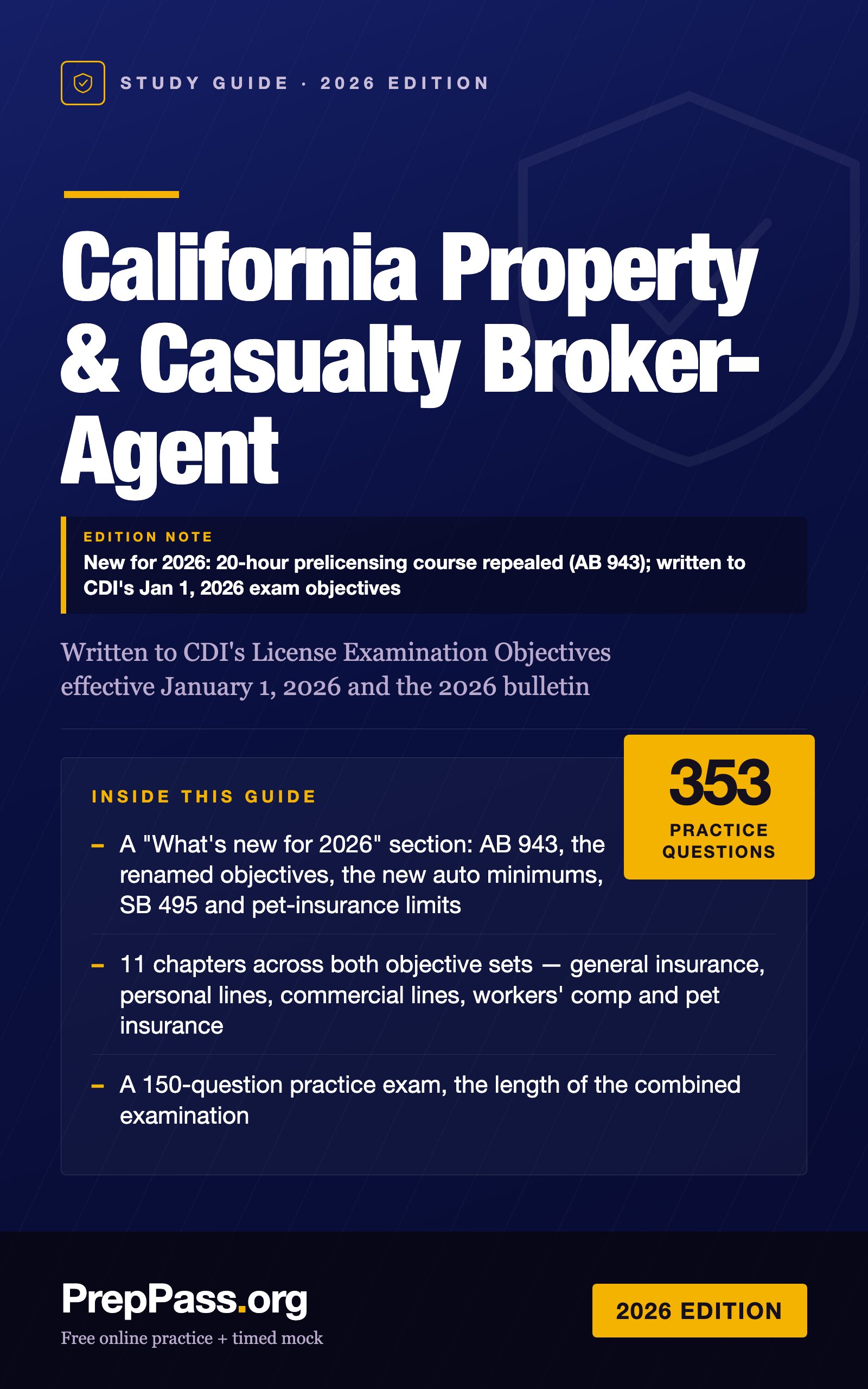
Practice stays free. The full California Property & Casualty Broker-Agent study guide is the material itself, taught start to finish — a downloadable PDF + EPUB you keep.
| Administering body | California Department of Insurance (CDI), Producer Licensing Bureau — exam delivered by PSI Services LLC |
|---|---|
| Questions | 150 questions |
| Time limit | 195 minutes |
| Passing score | 60% |
| Fees |
Source: CDI — Licensing Fees |
| Languages offered | English · Spanish · Simplified Chinese · Vietnamese · Korean · Tagalog |
Frequently asked questions
How many California Property & Casualty practice questions?+
531 original practice questions across all 11 topics of the California Department of Insurance Property & Casualty Broker-Agent license exam, with California Insurance Code citations on 215 of them.
Is the P&C practice test free?+
Yes, completely free. No signup, no credit card. Unlimited practice rounds and a 150-question timed mock exam included.
Are these real CDI P&C exam questions?+
No. All questions are original prose authored from the California Insurance Code, Title 10 CCR, Civil Code, Labor Code, Vehicle Code, and standard ISO insurance form concepts. We never copy from real exams or paid prep providers.
What's the passing score for the California P&C Broker-Agent exam?+
60%, and CDI publishes no sectional or per-subject cut score — a failing candidate gets a per-topic diagnostic, which is a diagnostic, not a cut score. The real CDI exam is 150 multiple-choice questions over 195 minutes at a PSI testing center.
What does the P&C Broker-Agent license let me sell?+
Auto insurance (personal + commercial), homeowners, dwelling, commercial property, casualty/liability (CGL), and workers' compensation insurance — to California residents and businesses.
Is the California P&C exam offered in Vietnamese or Chinese?+
Yes — AB 451 (Stats. 2023, ch. 136) legally requires CDI to offer producer license exams in English, Spanish, Simplified Chinese, Vietnamese, Korean and Tagalog.
Should I take the P&C license or Personal Lines license first?+
P&C is broader (commercial + personal). Personal Lines is narrower (residential + personal auto only) and has a shorter exam (~100q vs ~150q). As of 2026 (AB 943) both require only the 12-hour ethics course for prelicensing. Many agents start with whichever matches the business they want to write first; many upgrade Personal Lines → P&C later.
Is there a study guide for the Property & Casualty Insurance Producer?+
Yes. PrepPass sells California Property & Casualty Broker-Agent Study Guide — 2026 Edition, a PDF + EPUB download, $24.99 one-time; the practice on this page stays free without it. See the study guide →
Sample practice questions
A few real questions from this free bank, with full explanations. Use the practice tool above for the whole set.
- 1. Personal Auto Policy
An applicant asks her broker for the minimum bodily injury and property damage liability limits that satisfy California's financial responsibility law for a private passenger auto. Which combination meets the statutory minimum?
- a.$30,000 / $60,000 / $15,000
- b.$10,000 / $20,000 / $3,000
- c.$25,000 / $50,000 / $10,000
- d.$15,000 / $30,000 / $5,000
Answer: a
Explanation: Effective January 1, 2025, Senate Bill 1107 (the Protect California Drivers Act) raised California's compulsory auto liability minimum to 30/60/15 — $30,000 per person for bodily injury, $60,000 per accident for bodily injury, and $15,000 for property damage — amending Vehicle Code §16056. The former 15/30/5 limits (in effect 1967–2024) no longer satisfy the financial-responsibility law. The other options are below the current minimum, so they do not satisfy the law.
Source: Cal. Veh. Code §16056; Cal. Ins. Code §11580.1(b)
- 2. California Insurance Code & Ethics
A California consumer wants to file a regulatory complaint about a full-service HMO. The complaint should be filed with:
- a.The Federal Trade Commission
- b.The Department of Managed Health Care (DMHC)
- c.The California Department of Insurance (CDI)
- d.The California Public Utilities Commission
Answer: b
Explanation: Full-service HMOs operate under the Knox-Keene Health Care Service Plan Act and are regulated by the Department of Managed Health Care. The CDI regulates traditional indemnity and PPO products but not HMOs.
Source: Cal. Health & Safety Code §1340 (Knox-Keene); Cal. Ins. Code §106
- 3. Commercial Lines
Which of the following risks is MOST likely to be INELIGIBLE for a standard Businessowners Policy?
- a.A 6,000-square-foot retail boutique
- b.A 12-unit apartment building
- c.A large automobile manufacturing plant
- d.An accountant's office occupying 4,000 square feet
Answer: c
Explanation: BOPs are designed for small-to-mid-sized risks such as small retail stores, offices, and small habitational risks. Heavy manufacturers (especially of automobiles), banks, large hotels, and businesses involving auto repair or service stations are typically ineligible and must be written on separate commercial lines forms.
Source: ISO Businessowners Policy — eligibility (typical)
- 4. Homeowners Policy (HO)
Coverage E (Personal Liability) on an HO-3 extends to the "insured location." Which of the following would NOT meet the definition of an insured location?
- a.The residence premises shown in the declarations
- b.A 200-acre commercial farm rented to others for profit
- c.A vacant lot owned by the insured
- d.A hotel room temporarily occupied by the insured while traveling
Answer: b
Explanation: The HO definition of insured location includes the residence premises, other premises the insured occasionally occupies, vacant land owned or rented by the insured, individual cemetery plots, and temporary residences (such as hotel rooms). It excludes premises rented to others as a regular business venture and farms or other premises used for business — which is exactly what choice B describes.
Source: ISO Homeowners — Definition of insured location
- 5. Workers Compensation
An employee is injured at work when a delivery driver from an unrelated company runs a red light and hits him. The WC insurer pays his medical bills and disability. What right does the insurer have against the at-fault driver?
- a.Subrogation — the insurer may step into the employee's shoes and sue the third-party driver to recover what it paid
- b.The insurer may double-bill both the driver and the employee
- c.The insurer must wait until the employee dies before pursuing any recovery
- d.None — workers' compensation is the exclusive remedy and forecloses any recovery from third parties
Answer: a
Explanation: Workers' compensation is the exclusive remedy against the EMPLOYER, not against unrelated third parties. Labor Code §3852 lets the WC insurer subrogate against the third party who caused the injury and recover what it paid in benefits, either by filing its own action, joining the employee's lawsuit, or asserting a lien on the employee's recovery.
Source: Cal. Labor Code §3852 (subrogation)
- 6. Property Insurance Fundamentals
A warehouse with a $1,200,000 replacement cost is insured for $810,000 under a 90 percent coinsurance clause. A covered fire causes $150,000 of damage and the policy carries no deductible. The insurer pays:
- a.$150,000
- b.$135,000
- c.$112,500
- d.$101,250
Answer: c
Explanation: The coinsurance formula is the amount carried divided by the amount required, times the loss. The amount required is 90 percent of $1,200,000, or $1,080,000, and $810,000 / $1,080,000 = 0.75, so 0.75 x $150,000 = $112,500. Multiplying the loss by the 90 percent coinsurance figure gives $135,000 and is the most common wrong turn, because the clause compares the limit carried with the amount required, not the loss with the percentage.
- 7. Dwelling Policy (DP)
Fire damages a dwelling insured on a basic form. Rebuilding the damaged portion costs $60,000, depreciation on it is $18,000, and the deductible is $1,000. The insurer pays:
- a.$42,000
- b.$41,000
- c.$60,000
- d.$59,000
Answer: b
Explanation: The basic form settles building losses at actual cash value, which is replacement cost minus depreciation: $60,000 less $18,000 is $42,000. The deductible then comes off that settlement, leaving a check for $41,000. Taking the deductible off replacement cost and ignoring depreciation would produce $59,000, which is not how the basic form settles a loss.
- 8. Personal Auto Policy
Under Part D of the Personal Auto Policy, collision coverage pays for damage to the insured's vehicle caused by:
- a.Fire, theft, and falling objects striking the car
- b.Injuries to pedestrians struck by the insured
- c.Impact with another vehicle or object, or upset
- d.Damage the insured causes to another person's car
Answer: c
Explanation: Collision coverage pays for damage to the insured's own auto from colliding with another vehicle or object or from overturning (upset), regardless of fault. Other-than-collision (comprehensive) coverage handles losses such as fire, theft, falling objects, glass breakage, and animal strikes. Damage the insured causes to someone else's car is a liability (Part A) matter, not Part D.
- 9. Casualty & Liability Insurance
A delivery driver rear-ends a car while making scheduled company deliveries. The employer is held liable for the driver's negligence under the doctrine of:
- a.res ipsa loquitur, as the facts speak for themselves
- b.assumption of risk transferred to the employer
- c.vicarious liability for an employee's acts on the job
- d.absolute liability for an ultrahazardous activity
Answer: c
Explanation: Vicarious liability imputes one party's negligence to another because of their relationship, most often employer to employee for acts within the scope of employment, which scheduled deliveries plainly are. Res ipsa loquitur is an inference of negligence drawn from the nature of an accident, not a way of transferring one person's negligence to another. Ordinary driving is not an ultrahazardous activity, so absolute liability does not reach it.
- 10. Commercial Lines
A dry cleaner wants coverage for customers' garments held at its shop. The form designed for that exposure is:
- a.a fine arts floater
- b.a garagekeepers coverage form
- c.the stock item of its property form
- d.a bailee customers form
Answer: d
Explanation: A bailee customers form is the inland marine answer for a business holding other people's goods for cleaning, repair or processing, and it responds for the customers' property whether or not the bailee is legally liable for the damage. The stock item on a property form covers goods the insured owns for sale, not customers' clothing. A fine arts floater insures works of art, and garagekeepers is the parallel coverage for customers' vehicles.