MBLEx Massage Therapy Exam Practice Test
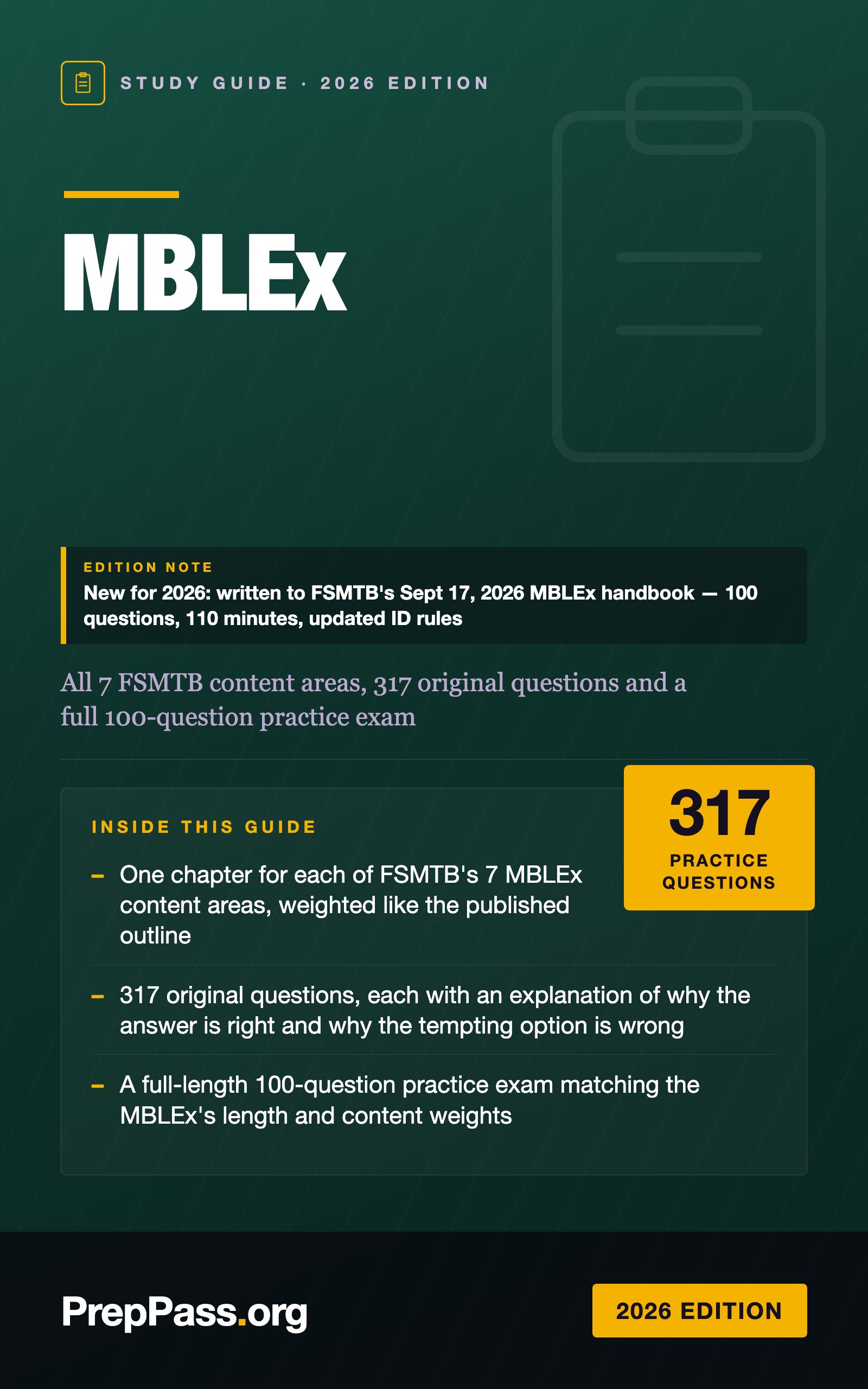
Practice stays free. The full MBLEx (Massage & Bodywork Licensing Examination) study guide is the material itself, taught start to finish — a downloadable PDF + EPUB you keep.
Frequently asked questions
How many MBLEx Massage & Bodywork Licensing Exam practice questions are here?+
A full bank of original MBLEx Massage & Bodywork Licensing Exam practice questions across the official content areas, weighted like the real exam, with explanations. Free, no signup.
What is the MBLEx Massage & Bodywork Licensing Exam exam like?+
A multiple-choice exam. Practice by topic here, then take the full timed mock exam to gauge readiness.
Are these the real exam questions?+
No. Every question is 100% original, written from public primary sources with explanations. We never copy real exam questions or paid prep material.
Can I study in Chinese or Spanish?+
PrepPass practice is in English, 中文 and Español. The official exam is in English — switch the question language to English any time to rehearse the exact terminology you'll see on test day.
Is there a study guide for the MBLEx Massage & Bodywork Licensing Exam?+
Yes. PrepPass sells MBLEx Study Guide — 2026 Edition, a PDF + EPUB download, $19.99 one-time; the practice on this page stays free without it. See the study guide →
Sample practice questions
A few real questions from this free bank, with full explanations. Use the practice tool above for the whole set.
- 1. Anatomy & Physiology
In a healthy adult, where does most red blood cell production (hematopoiesis) take place?
- a.In the liver
- b.In red bone marrow
- c.In the spleen only
- d.In the lymph nodes
Answer: b
Explanation: In adults, red bone marrow found in bones such as the sternum, pelvis, and vertebrae is the primary site of red blood cell production. The liver and spleen are major sites during fetal development but not the principal producers after birth.
- 2. Kinesiology
A muscle that opposes and relaxes to allow the action of the prime mover is called the:
- a.Antagonist
- b.Agonist
- c.Synergist
- d.Fixator
Answer: a
Explanation: The antagonist opposes the movement of the prime mover (agonist) and lengthens as the agonist shortens. For example, when the biceps flexes the elbow, the triceps acts as the antagonist.
- 3. Kinesiology
Movement of a limb away from the midline of the body is termed:
- a.Adduction
- b.Flexion
- c.Rotation
- d.Abduction
Answer: d
Explanation: Abduction moves a body part away from the midline (for example, raising the arm out to the side). Adduction is the opposite movement, bringing the limb back toward the midline.
- 4. Pathology & Contraindications
A local contraindication means that the therapist should:
- a.Cancel the entire session
- b.Proceed normally over the whole body
- c.Avoid the specific affected area but may massage elsewhere
- d.Apply deeper pressure only to the affected area
Answer: c
Explanation: A local contraindication (such as an open wound, localized rash, bruise, or varicose vein) means the affected area is avoided while the rest of the body can generally be treated safely. A general contraindication, by contrast, means the whole session should be postponed.
- 5. Benefits & Effects of Soft-Tissue Techniques
Effleurage is best described as:
- a.Gliding strokes that warm tissue and encourage venous and lymphatic return
- b.Rapid percussive tapping on the tissue
- c.Deep static compression held over a trigger point
- d.Rhythmic kneading and lifting of muscle tissue
Answer: a
Explanation: Effleurage consists of smooth gliding strokes, often used to begin and end a session, spread lubricant, warm the tissue, and promote venous and lymphatic return. Percussion is tapotement, and kneading/lifting is petrissage.
- 6. Client Assessment & Treatment Planning
The primary purpose of a pre-session health intake and interview is to:
- a.Identify contraindications and tailor the treatment plan to the client
- b.Diagnose the client's medical conditions
- c.Determine the client's ability to pay
- d.Fulfill a formality with no clinical value
Answer: a
Explanation: The intake gathers health history to screen for contraindications, cautions, and client goals so the session can be individualized and safe. Massage therapists do not diagnose; findings that need it are referred to appropriate providers.
- 7. Client Assessment & Treatment Planning
During postural assessment, a client's ears sit noticeably in front of the shoulders. This most likely indicates:
- a.Excessive lumbar lordosis
- b.Forward head posture
- c.Genu valgum
- d.A leg-length discrepancy
Answer: b
Explanation: When the head is carried anterior to the shoulders, it is described as forward head posture, often associated with tight suboccipital and upper trapezius muscles. Postural observation guides, but does not diagnose, the treatment plan.
- 8. Ethics, Boundaries, Laws & Regulations
Proper draping during a massage session primarily serves to:
- a.Protect the client's privacy, warmth, and professional boundaries
- b.Speed up the session
- c.Replace the need for client consent
- d.Allow the therapist to skip hand washing
Answer: a
Explanation: Draping maintains client modesty, comfort, and warmth and reinforces professional boundaries; only the area being worked is undraped. It is a core ethical and safety standard, not a substitute for consent or hygiene.
- 9. Ethics, Boundaries, Laws & Regulations
Informed consent requires that, before treatment begins, the client:
- a.Signs a waiver giving up all rights
- b.Agrees to a fixed number of future sessions
- c.Understands the proposed treatment and voluntarily agrees, and may withdraw at any time
- d.Allows the therapist to work any area without further discussion
Answer: c
Explanation: Informed consent means the client understands the nature, benefits, and risks of the proposed treatment and freely agrees to it. Consent is ongoing: the client may modify or withdraw it at any point during the session.
- 10. Professional Practice
A client asks the therapist to diagnose the cause of their shoulder pain. The appropriate response is to:
- a.Provide a specific medical diagnosis
- b.Explain that diagnosis is outside the scope of practice and refer to a qualified provider
- c.Prescribe medication for the pain
- d.Guarantee that massage will cure the condition
Answer: b
Explanation: Diagnosing medical conditions and prescribing medication are outside a massage therapist's scope of practice. The therapist should stay within scope and refer the client to a physician or appropriate provider for diagnosis.