Florida Real Estate Broker Exam Practice Test
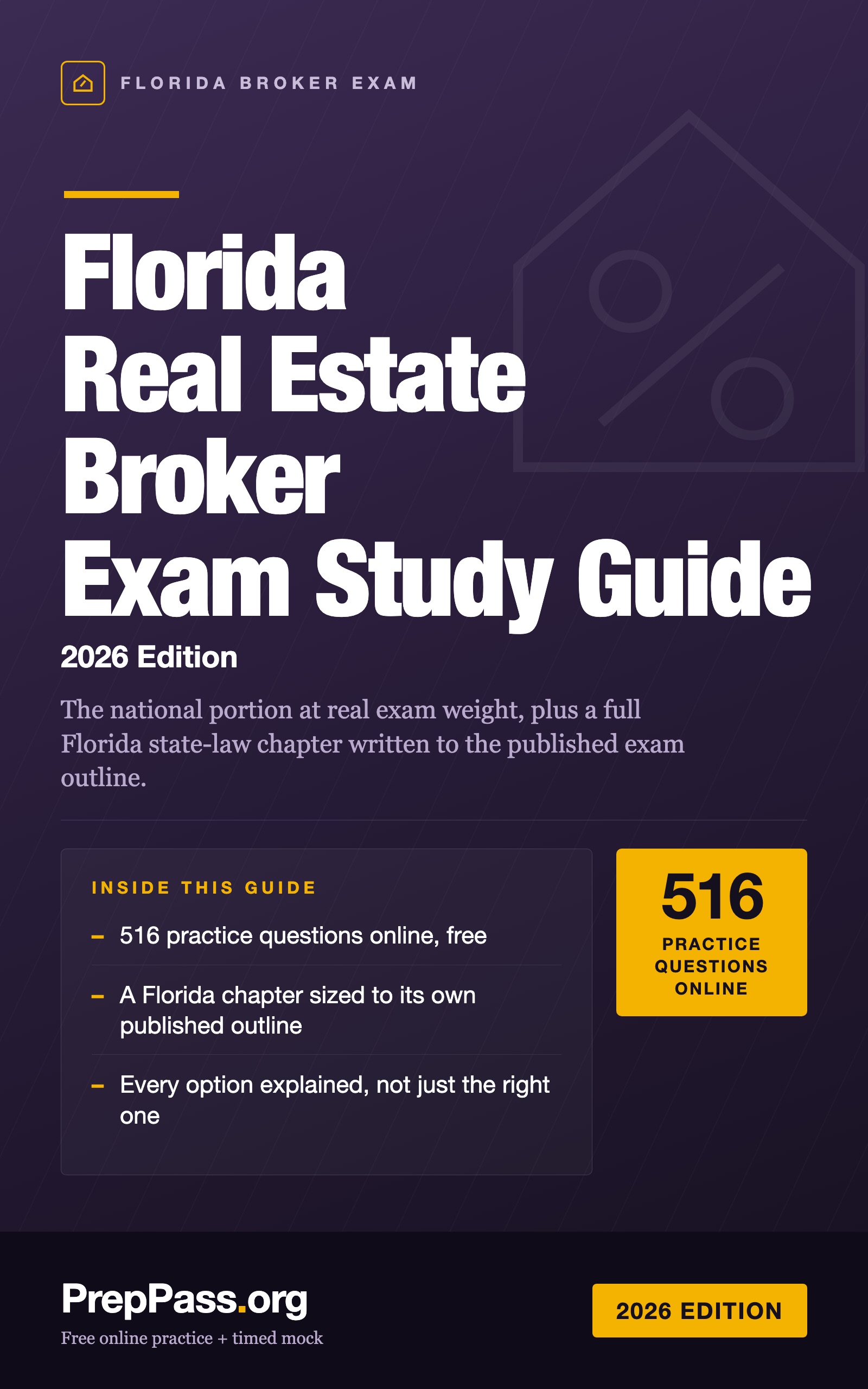
In the Florida Real Estate Broker guide: A 60-question practice exam on the national principles, with a key that explains all four options and not just the right one. Practice here stays free.
| Administering body | Florida Department of Business and Professional Regulation (Florida Real Estate Commission) — exam delivered by Pearson VUE Source: Florida DBPR — Candidate Information Booklet, Real Estate Broker Examination (effective March 2024) |
|---|---|
| Questions | 100 questions Source: Florida DBPR — Candidate Information Booklet, Real Estate Broker Examination (effective March 2024) |
| Time limit | 210 minutes Source: Florida DBPR — Candidate Information Booklet, Real Estate Broker Examination (effective March 2024) |
| Passing score | 75 of 100 correct Source: Florida DBPR — Candidate Information Booklet, Real Estate Broker Examination (effective March 2024) |
| Fees |
|
| Languages offered | Not published by Florida Department of Business and Professional Regulation (Florida Real Estate Commission) What we read and found nothing in: Florida DBPR — Candidate Information Booklet, Real Estate Broker Examination (effective March 2024) |
Frequently asked questions
How many Florida Real Estate Broker Exam practice questions are here?+
A full bank of original Florida Real Estate Broker Exam practice questions across the official content areas, weighted like the real exam, with explanations. Free, no signup.
What is the Florida Real Estate Broker Exam exam like?+
About 100 questions, 210 minutes, and you need 75% to pass. Practice by topic here, then take the full timed mock exam to gauge readiness.
Are these the real exam questions?+
No. Every question is 100% original, written from public primary sources with explanations. We never copy real exam questions or paid prep material.
Can I study in Chinese or Spanish?+
PrepPass practice is in English, 中文 and Español. The official exam is in English — switch the question language to English any time to rehearse the exact terminology you'll see on test day.
Is there a study guide for the Florida Real Estate Broker Exam?+
Yes. PrepPass sells Florida Real Estate Broker Exam Study Guide (2026), a PDF + EPUB download, $19.99 one-time; the practice on this page stays free without it. See the study guide →
Sample practice questions
A few real questions from this free bank, with full explanations. Use the practice tool above for the whole set.
- 1. Property Ownership
A commercial tenant bolts custom display shelving to the walls to run a retail store. Absent any agreement to the contrary, what is the usual character of that shelving?
- a.A permanent fixture that automatically belongs to the landlord
- b.Real property that must be conveyed with the building
- c.A trade fixture the tenant may remove before the lease ends
- d.An easement appurtenant to the leased space
Answer: c
Explanation: Items a commercial tenant installs to conduct business are trade fixtures. Even though they are attached, the law lets the tenant remove them before the lease ends (repairing any damage), because the tenant's intent was to use them in the business, not to improve the landlord's property permanently. This is an exception to the general rule that attached items become part of the realty. It is not an easement, which is a right to use another's land, not an object.
- 2. Contracts
An affiliated licensee tells a buyer a roof is five years old, having never checked, and it turns out to be fifteen. The licensee did not know the truth. This is:
- a.Actual fraud, because the statement was false
- b.Negligent misrepresentation of a material fact
- c.Puffing, since roof age is only an opinion
- d.A latent defect that only the seller must disclose
Answer: b
Explanation: Stating a specific fact without knowing whether it is true, and being wrong, is negligent misrepresentation; the licensee had a duty either to verify the age or to say it was unverified. Actual fraud requires knowledge of the falsity or a reckless disregard for the truth intended to deceive, which these facts do not show. Roof age is a verifiable fact, not an opinion, so puffing does not apply; puffing covers non-factual sales talk. A latent defect is a hidden physical problem the seller knows of, whereas the issue here is the licensee's own unverified statement, and the supervising broker shares that exposure.
- 3. General Principles of Agency
A licensee with no signed buyer agreement spends weeks advising a buyer on strategy, recommending an offer price, and negotiating terms on the buyer's behalf. A court would most likely find:
- a.No agency, since no fee was discussed
- b.An implied agency created by the licensee's conduct
- c.A transaction brokerage that carries no duties beyond honesty
- d.A subagency of the seller created through the listing brokerage
Answer: b
Explanation: Courts look at what the parties actually did, not at what paperwork exists. Advising on strategy, recommending price, and negotiating are the acts of a representative, so an implied agency arises from conduct and brings fiduciary duties with it. Silence about a fee changes nothing, since agency comes from the relationship rather than from payment. Subagency would require the listing side to offer it and this firm to accept it. A non-agency transaction brokerage must be established deliberately; a licensee cannot back into it after behaving like an advocate.
- 4. Practice of Real Estate
A tenant with limited mobility asks permission to widen a bathroom doorway in his rented unit and offers to pay for the work himself. How does fair housing law treat this?
- a.The landlord must perform and pay for the doorway work
- b.The landlord may refuse because it alters the structure
- c.It is a modification made at the tenant's expense
- d.It is an accommodation that the landlord must fund fully
Answer: c
Explanation: Widening a doorway physically alters the unit, so it is a reasonable modification. The landlord must permit it, and the tenant generally bears the cost, sometimes under an agreement to restore the interior at move-out where that is reasonable. Requiring the landlord to pay confuses modifications with accommodations, which are rule or policy changes the provider does absorb. Refusing outright because the work is structural is not allowed, since permission may not be withheld for a needed and reasonable alteration done in a workmanlike manner. Calling the request an accommodation misapplies a term reserved for changes to rules rather than to the building.
- 5. Financing
A buyer formally assumes the seller's existing loan, and the lender never signs a release of the seller. If the buyer later defaults, whom may the lender pursue?
- a.Both the buyer and the seller, who remains secondarily liable
- b.Only the seller, who signed the original promissory note
- c.Only the buyer, because assumption transfers all liability
- d.Neither, because the lender's remedy is the property alone
Answer: a
Explanation: In an assumption the buyer becomes primarily liable on the debt, but the seller who signed the note stays secondarily liable unless the lender grants a written release, usually through a novation that substitutes the buyer and discharges the seller. So the lender may look to both. Believing that assumption alone shifts every obligation is the classic error. The seller is not the only target either, since the buyer has promised to pay. And the lender is not limited to the collateral, because a personal promise to repay still exists on the note.
- 6. Valuation and Market Analysis
A comparable sold for $400,000, but the seller paid $12,000 of the buyer's closing costs as a concession. The subject's likely sale involves no concessions at all. How should this be handled?
- a.Adjust the comparable downward for the concession
- b.Adjust the comparable upward by the same concession amount
- c.Ignore concessions, which are financing rather than value items
- d.Adjust the subject downward instead
Answer: a
Explanation: Financing terms and seller concessions are the first element of comparison, applied before location and physical characteristics. A concession inflates the recorded price above what the property alone commanded, so the comparable's price is adjusted downward toward a cash-equivalent figure. Adjusting upward compounds the distortion the concession created. Concessions are never ignored, because a market with heavy concessions can show recorded prices well above true cash-equivalent value, which is exactly what regulators and lenders watch for. The subject is not adjusted; it is the unknown. Brokers reviewing a grid should confirm the agent verified terms of sale, not just the recorded price.
- 7. Property Ownership
A buyer is comparing a condominium unit with a cooperative apartment. Which description correctly states what the cooperative buyer actually receives?
- a.Shares in the corporation plus a proprietary lease on the unit
- b.A recorded deed to the airspace and an HOA membership
- c.Fee title to the unit plus a share of the common elements
- d.A life estate in the unit that ends when the owner moves
Answer: a
Explanation: A cooperative buyer purchases stock in the corporation that owns the entire building and receives a proprietary lease conferring the right to occupy a particular unit, so the interest acquired is personal property rather than real property. Fee title to a unit together with an undivided interest in the common elements describes a condominium, where the deed conveys the unit's airspace and the owner joins the association. Limited common elements such as an assigned balcony or parking stall serve one unit while remaining part of the commonly owned property. A life estate belongs to neither form and would not end merely because the owner moved out.
- 8. Property Management
An investor sells an apartment building in the middle of the tenants' one-year written leases. What happens to those leases when the deed is delivered at closing?
- a.They continue; the buyer takes title subject to them
- b.They terminate automatically once the deed is delivered
- c.They convert to month-to-month tenancies at the buyer's option
- d.They end unless every tenant signs a new lease at closing
Answer: a
Explanation: A lease creates an interest in the property, so a sale does not end it. The buyer takes title subject to the existing leases, steps into the landlord's position, and must honor the terms, which is why buyers review the rent roll and collect estoppel certificates before closing and why the parties must follow the state's rule for transferring the tenants' security deposits to the new owner. Delivery of the deed changes the landlord, not the tenancy, and a buyer cannot unilaterally convert leases to month-to-month or force tenants to re-sign. The lease itself remains valid so long as it had competent parties, an adequate description of the premises, a term, rent, and a lawful purpose.
- 9. Transfer of Title
A seller deeds a parcel to one buyer and later deeds the same parcel to a second buyer, who records first. Which framework decides who owns the land?
- a.A federal recording statute applied in all fifty states
- b.The state's recording act, race, notice, or race-notice
- c.The order in which the two deeds were signed and dated
- d.The county recorder's discretion over competing claims
Answer: b
Explanation: Priority between competing grantees is governed by the recording act of the state where the land lies, and the schemes differ: a pure race state protects whoever records first, a notice state protects a later purchaser who took without notice of the earlier deed, and a race-notice state protects one who took without notice and recorded first. No federal statute governs land recording. Signing dates do not decide the contest, which is precisely why a public recording system exists. Recorders act ministerially and have no power to resolve claims. Because the gap between closing and recording is the danger zone, a broker should press for prompt recording.
- 10. Valuing Real Property
An appraiser attributes a Florida home's loss in value to a landfill newly opened across the road. This is:
- a.Physical deterioration, which is generally curable
- b.Functional obsolescence, which is generally incurable
- c.External obsolescence, which is generally incurable
- d.Functional obsolescence, which is generally curable
Answer: c
Explanation: External obsolescence, sometimes called economic obsolescence, is a loss in value caused by forces outside the property's own boundaries, such as a nearby nuisance, a change in the neighborhood, or a downturn in the local economy. Because the owner cannot remove the landfill, external obsolescence is generally treated as incurable. Functional obsolescence arises from the design or utility of the improvement itself, such as an outdated floor plan or too few bathrooms, and may be curable or incurable depending on cost. Physical deterioration is ordinary wear and tear and deferred maintenance, most of which is curable.