Regulations: CFTC and NFA Rules
The regulations part is scored separately, and you need at least 70 percent on it as well as on market knowledge. This survey lists the rules that come up most.
Registration and membership
An FCM accepts customer orders and customer money; an introducing broker accepts orders but may not hold customer funds. Associated persons are the individuals who solicit or supervise. Passing the Series 3 is not registration, and a pass lapses after a registration gap of more than two years. NFA Bylaw 1101 keeps Members from doing customer business with non-Members that must be registered.
Opening and handling accounts
NFA Compliance Rule 2-30 requires customer information — name, address, occupation, income, net worth, age and trading experience — and risk disclosure at or before account opening. Discretion requires written authorization except over time and price, and an AP needs two years of registration to exercise it. Orders are time-stamped to the nearest minute.
Pools, advisors and promotional material
CPOs and CTAs deliver a Disclosure Document filed with NFA at least 21 days before use and usable for twelve months; performance covers five years plus year-to-date. Promotional material must balance any mention of profit with an equally prominent discussion of risk and be approved in writing before first use.
Where to go deeper
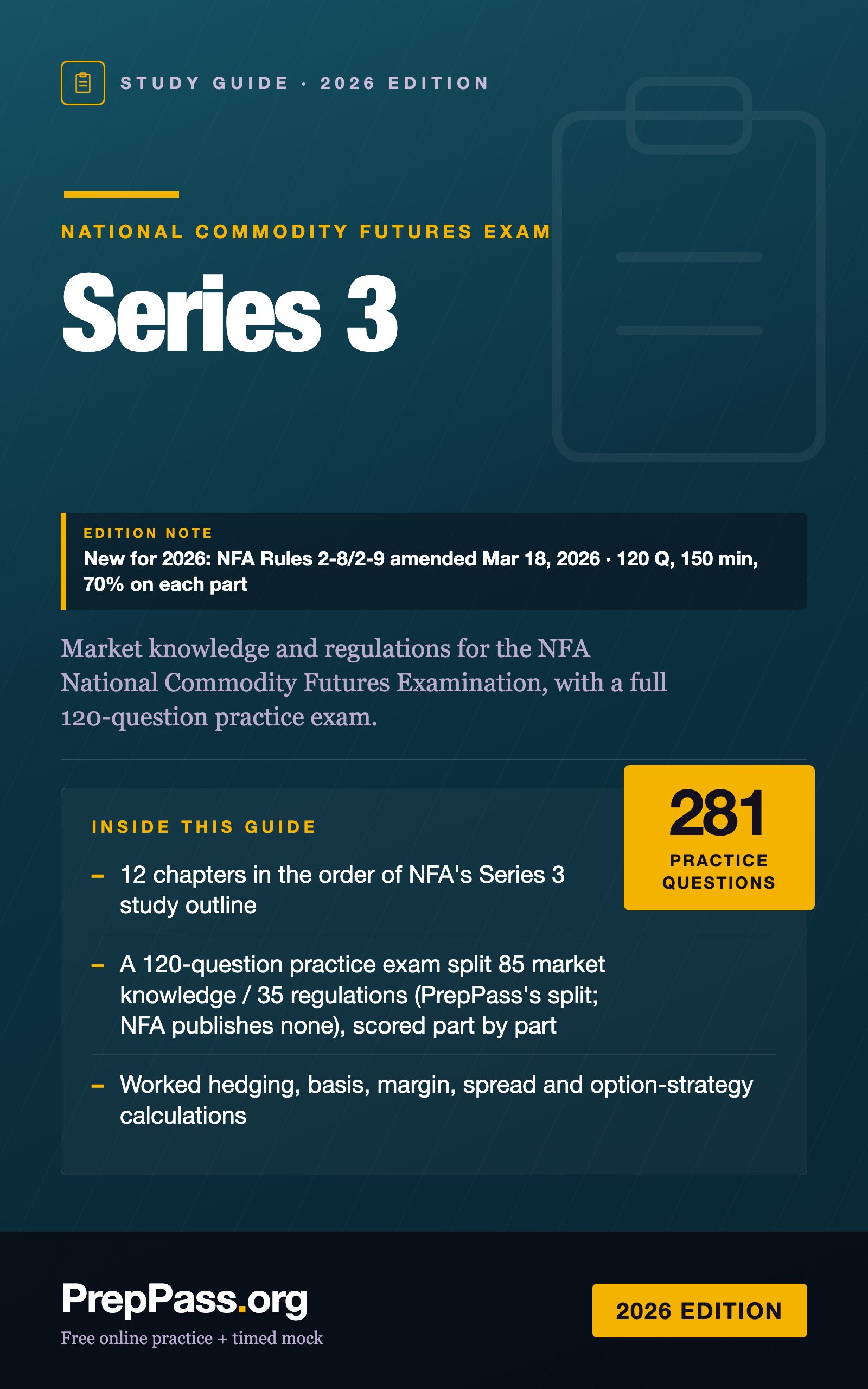
The PrepPass Series 3 Study Guide covers capital and reporting requirements, guaranteed IBs, position reporting, bunched orders, NFA arbitration, disciplinary procedures and CFTC enforcement, each sourced to the current rule text, with quizzes and a 35-question regulations section in its practice exam.
Keep going: the full Series 3 — National Commodity Futures Exam guide covers every section of the exam. Series 3 Study Guide — 2026 Edition — PDF + EPUB, $24.99 · 14-day refund →
Practice stays free. The full Series 3 — National Commodity Futures Exam study guide is the material itself, taught start to finish — a downloadable PDF + EPUB you keep.