Study guide · 2026 Edition
Series 3 Study Guide — 2026 Edition
PrepPass's independent 2026 study guide for the Series 3 — National Commodity Futures Exam is 414 pages including 421 practice questions with a full answer key, PDF + EPUB, $24.99 one-time; it is not affiliated with the exam provider. The book does not include PrepPass's separate online timed mock for this exam (100 questions, 125 minutes). The book also prints its own practice exam, which is separate.
Edition: Rebuilt Oct 2026 on NFA's study outline · Rules 2-8/2-9 amended Mar 18, 2026 · 120 Q, 150 min, 70% each part
- Length
- 414 pages
- Practice questions in the book
- 421
- PrepPass online timed mock
- 100 questions · 125 min
- Exam facts checked, file updated
- October 2026
- Delivery
- PDF + EPUB · English · instant download
What is in the Series 3 — National Commodity Futures Exam study guide?
Exam facts last checked October 2026 against the exam body's published sources.
The real exam: National Commodity Futures Examination (Series 3) — 125 questions (120 scored, 5 unscored pretest) · 150 minutes · Passing score: 70%.
Market knowledge and regulations for the NFA National Commodity Futures Examination, written to NFA's study outline, with worked calculations and two full 120-question practice exams.
Exam fee: $140 per attempt, paid to FINRA. A retake pays it again. This guide: $24.99, one time.
Exam facts, who it suits and what changed
To prepare for the Series 3 — National Commodity Futures Exam, cover every topic on the exam body's current content outline and practise with timed questions. The exam itself (National Commodity Futures Examination (Series 3)): 125 questions (120 scored, 5 unscored pretest), 150 minutes, passing score 70%.
About the exam itself
| Administering body | National Futures Association (NFA) Source: FINRA — Series 3 – National Commodities Futures Exam |
|---|---|
| Questions | 125 questions (120 scored, 5 unscored pretest) Source: NFA — Study Outline for Futures Industry Exams (Series 3 section and exam table) |
| Time limit | 150 minutes Source: NFA — Study Outline for Futures Industry Exams (Series 3 section and exam table) |
| Passing score | 70% Source: NFA — Study Outline for Futures Industry Exams (Series 3 section and exam table) |
| Fees |
Source: NFA — Study Outline for Futures Industry Exams (Series 3 section and exam table) |
| Languages offered | Not published by NFA and FINRA What we read and found nothing in: NFA — Study Outline for Futures Industry Exams (Series 3 section and exam table) |
Look inside the book
Three real pages, rendered straight from the PDF you download — a reference page, a teaching page, and a worked question, always in that order. Nothing here was redrawn to look better.
- Quick referenceChapter 1 — Futures Trading Theory and the Structure of Futures Markets · PDF page 29
A page you can turn back to: the numbers, deadlines or terms gathered in one place.
- How it's taughtSection I — FCMs and introducing brokers (9 questions) · PDF page 402
An explanation page: the material taught in prose, in the order the exam tests it.
- A question, workedPart 1 — Market Knowledge (85 questions) · PDF page 323
A practice question with its answer and the reasoning behind it — not just a key.
Exam inside two weeks?
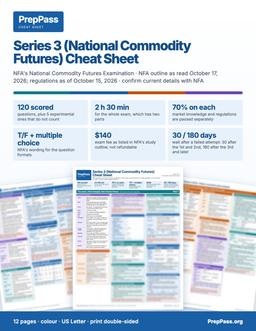
This guide is the teaching, read over weeks. If your exam is inside two weeks, the printable colour cheat sheet is the other product: the figures the exam turns on, laid out by section.
See the Series 3 — National Commodity Futures Exam cheat sheet PDF — $9.99 →
12 pages · US Letter · printable PDF · yours to keep
What's included — and what isn't
Included
- An exam-review guide for candidates entering or working in the futures industry: terms are defined as they appear, but it assumes everyday market vocabulary and basic arithmetic, not a first course in trading
- 12 chapters in the order of NFA's Series 3 study outline as read on October 17, 2026
Not included
- No printed copy is shipped — this is a file you download and can print yourself
- No video course, instructor or tutoring comes with the book — the free videos on the site are separate
Everything included, and everything that isn't
Included
- Two full 120-question practice exams, each split 85 market knowledge / 35 regulations (PrepPass's split; NFA publishes none), scored part by part
- Step-by-step worked calculations: margin and variation, basis and hedges in the markets the outline names, spreads, speculative profit and return, option strategies and option spreads
- Current NFA and CFTC rules, including Rules 2-8, 2-9 and 3-1 as amended March 18, 2026, and the pending small-pool exemption proposal
- A common-mistakes list in every chapter, a formula and numbers sheet, a key-terms table and an exam-facts table
- 421 original questions, each with a worked explanation citing its source
- PDF + EPUB you keep
Not included
- Not your exam registration or the testing centre's fee, which you still pay to the official body
Contents
See 28 sections and the page each one starts on
- Chapter 1 — Futures Trading Theory and the Structure of Futures Marketsp. 11
- Chapter 2 — Futures and Options Terminologyp. 37
- Chapter 3 — Margins, Option Premiums, Price Limits, Settlement, Delivery, Exercise and Assignmentp. 57
- Chapter 4 — Orders, Customer Accounts and Price Analysisp. 87
- Chapter 5 — Hedging and Basis Calculationsp. 116
- Chapter 6 — Spreadingp. 144
- Chapter 7 — Speculating in Futures: Profit, Loss and Returnp. 160
- Chapter 8 — Options: Hedging, Speculating and Spreadingp. 176
- Chapter 9 — Registration, NFA Membership and Opening Customer Accountsp. 204
- Chapter 10 — FCMs and Introducing Brokersp. 231
- Chapter 11 — Commodity Pool Operators, Commodity Trading Advisors and Promotional Materialp. 257
- Chapter 12 — Arbitration, NFA Discipline and CFTC Enforcementp. 281
- Part 1, A: futures theory, 1-18 Chapters 1 and 2 market structure, terminologyp. 304
- Part 1, B: margins, limits, 19-30 Chapter 3 delivery, exercisep. 304
- Part 1, C: orders and price 31-40 Chapter 4 analysisp. 304
- Part 1, D: hedging and basis 41-55 Chapter 5p. 304
- Part 1, E: spreading 56-64 Chapter 6p. 304
- Part 1, F: speculation, profit, 65-72 Chapter 7 loss and returnp. 304
- Part 1, G: options strategies 73-85 Chapter 8p. 304
- Part 2, H: registration, NFA 1-11 Chapter 9 membership, customer accountsp. 304
- Part 2, I: FCMs and 12-20 Chapter 10 introducing brokersp. 304
- Part 2, J: CPOs, CTAs, 21-28 Chapter 11 promotional materialp. 304
- Part 2, K: arbitration, 29-35 Chapter 12 discipline, enforcementp. 304
- Part 1 — Market Knowledge (85 questions)p. 304
- Part 2 — Regulations (35 questions)p. 334
- Section I — FCMs and introducing brokers (9 questions)p. 336
- Appendix A — The exam at a glance, in one tablep. 404
- Appendix B — Terms the exam expects you to use preciselyp. 405
Taken from the PDF you download, with the page each one starts on — not typed here.
Read a chapter free, in full
One complete chapter, exactly as it ships in the eBook. Scroll the window to read it right here; no download, no email.
Read chapter 5 here, without leaving the page
The free chapter is Chapter 5, hedging and basis calculations: worked examples at the pace of the whole book, which defines its terms in Chapters 1 and 2 and assumes everyday market vocabulary and basic arithmetic.
This is the chapter the market-knowledge part is built around. NFA's outline gives it three headings — short and long hedging, the basis, and hedging calculations — and then lists examples in grains, livestock, foodstuffs, metals, energy, lumber, Treasury notes and bonds, T-bills and 3-month SOFR, municipals, currencies and stock indices[1]. Every one of those examples is solved with the same small set of rules. Learn the rules, then practice until the sign of the basis never trips you.
The basis
Definition and sign
Basis is the difference between the cash (spot) price of a commodity and the price of the nearest futures contract for the same or a related commodity, typically calculated as cash minus futures[2].
Basis = cash price − futures price
If cash is $4.10 and futures are $4.35, the basis is −$0.25, spoken "25 under." If cash is $4.50 and futures $4.35, the basis is +$0.15, "15 over." Merchants quote cash prices this way: a basis quote is an offer or sale of a cash commodity in terms of the difference above or below a futures price, such as "10 cents over December corn"[2].
How the basis is determined
The CFTC notes that the basis is usually computed against the futures contract next to expire and may reflect differences in time, product form, grade or location[2]. In practice, four things set a local basis:
- Transportation costs. A futures contract prices the commodity at its delivery points[2]. A grain elevator far from a delivery point pays less for grain than the futures price, because someone must pay to ship it to where the contract is priced. Farther away, weaker basis; closer to demand, stronger basis.
- Variation in grades. Futures price the par grade[2]. A cash lot of better quality commands a premium; a lower grade, a discount[2]. That difference shows up in the basis.
- Time and carrying charges. A cash price today compared with a futures price for a later month reflects the cost of carrying the commodity until then[2]. That is why the basis in a normal market tends to strengthen (move toward zero) as delivery approaches: the remaining carrying cost shrinks.
- Local supply and demand. A local shortage strengthens the basis; a local glut weakens it.
Strengthening and weakening
Because the basis is a signed number, describe changes by direction rather than by "wider" or "narrower," which are ambiguous when the basis crosses zero:
- Strengthening — the basis becomes more positive (or less negative): −30 to −10, or +5 to +20. Cash is gaining on futures.
- Weakening — the basis becomes more negative (or less positive): −10 to −30, or +20 to +5. Cash is losing ground to futures.
NFA's outline also uses "narrowing or widening basis" in the spread section[1]. When you meet those words, translate them into strengthening or weakening by writing out the numbers.
Basis risk
Basis risk is the risk of an unexpected widening or narrowing of the basis between the time a hedge is placed and the time it is lifted[2]. A hedge converts price risk into basis risk. Price risk is large and unpredictable; basis risk is usually smaller and more predictable, because transportation, grade and carrying costs change slowly. That trade is the whole economic reason to hedge.
Long the basis, short the basis
The CFTC's definitions give the two positions their names:
- Long the basis — a person who has bought the spot commodity and hedged with a sale of futures[2]. This is the short hedger: long cash, short futures.
- Short the basis — the purchase of futures as a hedge against a commitment to sell in the cash market[2]. This is the long hedger, who is effectively short cash (committed to deliver, or needing to buy) and long futures.
The names tell you who benefits from a basis change, exactly as "long" and "short" do for prices:
Long the basis (short hedger) gains when the basis strengthens. Short the basis (long hedger) gains when the basis weakens.
Prove it once, then trust it. The short hedger owns cash and is short futures. If the basis strengthens, cash has risen relative to futures: the cash side gained more (or lost less) than the futures side lost (or gained). The hedger is long the thing that outperformed.
Short hedging
A short (selling) hedge sells futures to protect against falling prices[2]. Typical short hedgers are farmers, producers and holders of inventory[1].
Net price received
For a short hedger who sells the cash commodity and buys back the futures on the same day:
Net sale price = cash price received + futures gain (or − futures loss) = futures price when the hedge was placed + basis when the hedge is lifted
The second line is the shortcut: the hedge locks in the original futures price, and the basis at the end is added to it.
Worked example — basis strengthens. In June a farmer expects to harvest 30,000 bushels and sells six 5,000-bushel December futures at $4.80. Her local basis for harvest delivery has typically been 40 under.
In October she sells the cash corn at $4.15 when December futures are $4.45.
- Basis at lift: $4.15 − $4.45 = −$0.30 (30 under), stronger than the −$0.40 she expected.
- Futures gain: $4.80 − $4.45 = $0.35.
- Net price: $4.15 + $0.35 = $4.50 — which equals $4.80 + (−$0.30).
- The 10-cent basis improvement adds $0.10 × 30,000 = $3,000 compared with the $4.40 she had planned on.
Worked example — basis weakens. Same hedge, but at harvest cash is $3.95 and futures $4.45 (basis 50 under). Net price = $3.95 + $0.35 = $4.30 = $4.80 − $0.50. The weaker basis cost her 10 cents compared with the expected $4.40.
Holders of inventory
An elevator that buys grain and stores it is long the basis while it carries the grain. Worked example. In October an elevator buys corn at $4.05 when March futures are $4.55 (basis −50) and sells March futures to hedge. In February it sells the corn at $4.60 when March futures are $4.70 (basis −10).
- Cash gain: $4.60 − $4.05 = +$0.55.
- Futures loss: $4.55 − $4.70 = −$0.15.
- Net result: +$0.40 per bushel — exactly the 40-cent strengthening of the basis, from −50 to −10.
A storage hedger does not care where prices go; it earns the basis change, which is its payment for storing.
Long hedging
A long (buying) hedge buys futures to protect against increases in the cost of commodities[2]. Typical long hedgers are processors, manufacturers and exporters[1].
Net price paid
Net purchase price = cash price paid − futures gain (or + futures loss) = futures price when the hedge was placed + basis when the hedge is lifted
It is the same shortcut. A long hedger, being short the basis, wants that closing basis to be as weak (as negative) as possible.
Worked example. In March a feed manufacturer knows it will buy 50,000 bushels of soybeans in July. It buys July futures at $11.60 when its expected July basis is +$0.20. In July it buys cash at $12.30 when futures are $12.00.
- Basis at lift: $12.30 − $12.00 = +$0.30 (stronger than the expected +$0.20).
- Futures gain: $12.00 − $11.60 = +$0.40.
- Net purchase price: $12.30 − $0.40 = $11.90 = $11.60 + $0.30.
- The long hedger expected $11.80 and paid 10 cents more, because the basis strengthened against it.
Anticipatory hedges
A hedge placed before the hedger has the cash position — a processor buying futures for next quarter's needs, or a farmer selling futures before planting — is an anticipatory hedge. The CFTC's definition of a hedger covers someone who buys or sells futures "as a temporary substitute for a cash transaction that will occur later"[2]. An exporter that has agreed to sell grain abroad at a fixed price but has not yet bought it is short the cash commodity and hedges by buying futures.
Effect of the basis on the commodity actually delivered or purchased
Hedgers rarely deliver on futures; they buy and sell in their local cash market and offset their futures. That is why the local basis, not the futures price alone, determines the outcome. If a hedger does deliver against futures, the price received is the futures invoice price[2] adjusted for any grade premium or discount[2] — and the hedger bears the cost of getting the commodity to a delivery point[2]. A hedger far from a delivery point usually does better selling locally and buying back futures.
Hedging calculations: a method that never fails
For any hedge question, write four lines:
| Cash | Futures | Basis | |
|---|---|---|---|
| Start | price | price | cash − futures |
| End | price | price | cash − futures |
| Change | ± | ± | ± |
Then:
- Mark which side the hedger is long and which short.
- Gain or loss on each side = change × (+1 if long, −1 if short).
- Net result = sum of the two sides = basis change × (+1 if long the basis, −1 if short the basis).
- Net price = the actual cash price ± the futures result.
Worked example — the full table. A cattle feeder will sell 40,000 pounds of cattle in four months. She sells one 40,000-pound futures contract at $1.92 per pound when cash is $1.86.
| Cash | Futures | Basis | |
|---|---|---|---|
| Start | $1.86 | $1.92 short | −$0.06 |
| End | $1.78 | $1.81 buy back | −$0.03 |
| Change | −$0.08 | +$0.11 gain | +$0.03 (stronger) |
She is long the basis (long cattle, short futures), so she gains the 3-cent strengthening. Net price = $1.78 + $0.11 = $1.89 per pound = $1.92 + (−$0.03). In dollars: 40,000 × $1.89 = $75,600.
The basis in financial markets
Financial futures have a basis too, and the same arithmetic applies. What differs is what drives it.
Carry: short-term versus long-term rates
For a financial instrument, carrying costs are the cost of financing — the short-term rate — and the "income" of carrying is the instrument's own return. When financing costs less than the instrument earns, the CFTC calls it positive carry; when it costs more, negative carry[2]. With a positive yield curve (long-term rates above short-term)[2], holding a long-term bond financed at short-term rates earns positive carry, so deferred bond futures can trade below nearby futures and below cash. This is why financial markets often look "inverted" without any shortage — the outline's "short-term rates vs. long-term rates"[1].
Interest-rate hedges
Debt prices fall when yields rise[3], so:
- An investor holding Treasury notes or bonds (long cash) fears rising rates and sells note or bond futures — a short hedge.
- A borrower planning to issue debt or take a floating-rate loan fears rising rates and sells interest-rate futures (T-bill, SOFR, note or bond futures, depending on the maturity) — an anticipatory short hedge.
- An investor who will receive cash later and fears falling rates buys interest-rate futures — an anticipatory long hedge.
Treasury bills are short-term zero-coupon obligations of up to one year; notes run more than one and up to ten years; bonds more than ten[2]. Match the hedge to the maturity of the risk: short-term borrowing costs are hedged with short-term-rate contracts, long-term bond holdings with bond futures. Rates are measured in basis points; one basis point is 1/100 of one percent[2]. Don't confuse this with "the basis."
Cross-hedging: municipals and other close substitutes
A cross-hedge hedges a cash position with futures on a different but price-related commodity[2]. A dealer holding municipal bonds, for example, may hedge with Treasury futures or a municipal-bond-index contract because the prices tend to move together. Cross-hedges carry extra basis risk: the two prices can diverge for reasons that have nothing to do with the general level of rates. The hedge ratio — the value of futures bought or sold relative to the value of the cash position — is computed to minimize that basis risk[2].
Currencies
An exchange rate is the price of one currency in terms of another[2]. Currency hedges follow the ordinary rules once you ask "who is long the foreign currency?"
- A U.S. exporter that will receive euros in three months is long euros and fears the euro will fall; it sells euro futures.
- A U.S. importer that must pay yen in three months is short yen and fears the yen will rise; it buys yen futures.
Worked example. An importer owes ¥50,000,000 in 90 days. Today the spot rate and the futures price are both $0.006800 per yen (basis zero), so the bill would cost $340,000 at today's rate. The importer buys yen futures at $0.006800. At payment the spot rate is $0.007050 and futures are $0.007070, a basis of −$0.000020.
- Cash cost rose by $0.000250 × 50,000,000 = $12,500, to $352,500.
- Futures gained $0.000270 × 50,000,000 = $13,500.
- Net cost: $352,500 − $13,500 = $339,000 — slightly better than $340,000, because the basis weakened and the importer, a long hedger, is short the basis. Check: $0.006800 + (−$0.000020) = $0.006780 × 50,000,000 = $339,000.
Stock indices
Portfolio insurance is the CFTC's name for using stock index futures or options to protect a stock portfolio against market declines[2]. A manager holding stocks sells stock index futures (a short hedge); a manager expecting cash to invest who fears a rally buys them (an anticipatory long hedge). The number of contracts is set by the hedge ratio: portfolio value divided by the value of one futures contract, adjusted for how closely the portfolio tracks the index[2].
Worked example. A $6,000,000 portfolio moves in line with an index whose futures trade at 4,800 with a $50 multiplier. One contract is worth 4,800 × $50 = $240,000. Contracts to sell: $6,000,000 ÷ $240,000 = 25.
Sources cited in this excerpt
- Study Outline for Futures Industry Exams (Series 3 – National Commodity Futures Examination). National Futures Association, 2026-10-17. https://www.nfa.futures.org/registration-membership/study-outlines/index.html
- CFTC Glossary. U.S. Commodity Futures Trading Commission, 2026-10-17. https://www.cftc.gov/LearnAndProtect/EducationCenter/CFTCGlossary/index.htm
- Understanding Pricing and Interest Rates. U.S. Department of the Treasury, Bureau of the Fiscal Service (TreasuryDirect), 2026-10-17. https://www.treasurydirect.gov/marketable-securities/understanding-pricing/
Questions buyers ask
How do I get it?
Pay, and the download appears on this page straight away. The links are also emailed to you. No account is required.
What if it isn't for me?
Email us within 14 days for a full refund, no questions asked.
Is the free practice going away?
No. Every practice question, the timed mock and the free chapters on this site stay free. This book is the studying half, not a gate around the free half.
More questions (19)
Can I read it on my phone?
Yes — the EPUB is for phones and e-readers, the PDF is for printing and tabbing. You get both.
What has changed on the Series 3 — National Commodity Futures Exam?
Rebuilt Oct 2026 on NFA's study outline · Rules 2-8/2-9 amended Mar 18, 2026 · 120 Q, 150 min, 70% each part.
Which outline is the Series 3 — National Commodity Futures Exam based on?
NFA's Study Outline for Futures Industry Exams, Series 3 section (a general listing of major subject areas; NFA prints no topic weights and no split of the 120 questions between the two parts), in force from as read on October 17, 2026; NFA prints no revision date on it. Check National Futures Association (NFA) for the current outline before you book.
Is a study guide enough for the Series 3 — National Commodity Futures Exam, or do I need a course?
Check eligibility first — per National Futures Association (NFA): anyone applying to NFA as an associated person or Member must provide evidence of passing the Series 3 within the past two years, and a pass stays usable beyond that unless there is a break of more than two years in registration. A book does not replace those requirements. For the exam content itself, this 414-page guide teaches the material chapter by chapter with 421 practice questions and explanations inside, and 102 more practice questions are free on PrepPass. A prep course adds live instruction and a set schedule; whether you need one beyond any required education is your call.
What is the cheapest way to prepare for the Series 3 — National Commodity Futures Exam?
Start with what costs nothing: 102 practice questions on PrepPass, with explanations and no signup. If you want it taught in one file you keep, the full study guide is $24.99 once; the printable cheat sheet for the last days is $9.99. No subscription on any of them.
What happens if I fail the Series 3 — National Commodity Futures Exam?
You can retake it under National Futures Association (NFA)'s rule: after failing within the past two years, wait at least 30 days before the second and third attempts and at least 180 days before the fourth and each later attempt; NFA sets no limit on the number of attempts. Confirm the current policy with National Futures Association (NFA) before you book.
Who administers the National Commodity Futures Examination (Series 3)?
National Futures Association (NFA). FINRA's Series 3 page calls it an NFA exam administered by FINRA.
How many questions are on the National Commodity Futures Examination (Series 3)?
125 questions (120 scored, 5 unscored pretest). NFA lists 120 questions and says candidates also receive 5 additional experimental questions that do not count toward their grades. NFA does not say how many fall in each of the two parts.
How long is the National Commodity Futures Examination (Series 3)?
150 minutes
What is the passing score for the National Commodity Futures Examination (Series 3)?
70%. 70 percent is required on each of the two parts, market knowledge and regulations; passing one part does not offset failing the other.
How much does the National Commodity Futures Examination (Series 3) cost?
$140 — Exam fee (FINRA, per attempt). NFA's exam table lists $140 for the Series 3. NFA says fees are not refundable.
What languages is the National Commodity Futures Examination (Series 3) offered in?
Not published by NFA and FINRA. NFA's outline and FINRA's page name no exam language; the only language provision found is 60 extra minutes for exams longer than two hours when requested in advance by a candidate with limited English proficiency.
Does the Series 3 — National Commodity Futures Exam study guide come as a PDF?
Yes — Series 3 Study Guide — 2026 Edition downloads as PDF and EPUB, 414 pages. The download link is emailed the moment payment clears and does not expire.
How much does the Series 3 — National Commodity Futures Exam study guide cost?
$24.99, once. There is no subscription and no account to create; the PDF and EPUB files are yours to keep.
Are there free Series 3 — National Commodity Futures Exam practice questions?
Yes — 102 of them, free to use with no signup and an explanation on every one. They are separate from this study guide, which is what you are buying here. The same free, no-account system also has practice modes (adaptive, new questions, spaced review of misses, weak-topic focus, saved, my mistakes); a timed mock exam (100 questions, 125 minutes) with a score report by topic; a 10-question readiness check (about 5 minutes); 5 study chapters. None of it needs this study guide.
Can I read part of the Series 3 — National Commodity Futures Exam study guide before buying?
Yes. A full chapter is free to read on this page — not a summary of one, the chapter itself.
What is the difference between the Series 3 — National Commodity Futures Exam study guide and the cheat sheet?
The study guide ($24.99) teaches the material chapter by chapter and is meant to be read over weeks. The cheat sheet ($9.99, 12 pages) drops the teaching and keeps the figures: every number on the exam grouped by value so the confusable ones sit together, each reference page paired with a recall page that blanks the answers, and four routes by days left — 14, 7, 3, or tonight. They are separate purchases; neither replaces the other.
Is there a cheaper way to buy the Series 3 — National Commodity Futures Exam study guide with anything else?
Yes. Series 3 — National Commodity Futures Exam + Cheat Sheet is $27.99 for 2 files in one checkout — 19% less than the $34.98 those items cost bought separately today. It adds Series 3 — National Commodity Futures Exam — Cheat Sheet (2026). The saving is measured against the items' real current prices; there is no struck-through "original" price on this site.
Is this the official Series 3 — National Commodity Futures Exam study guide?
No. This is an independent study guide and is not affiliated with or endorsed by the exam's awarding body. It is written from NFA Study Outline for Futures Industry Exams and NFA Rulebook, FINRA Series 3 exam page, CFTC regulations (eCFR) and the Commodity Exchange Act, read October 2026. Always confirm current requirements with the body that issues your licence.
Why buy the book when the practice is free?
Our practice questions and timed mock stay free — nothing on the site moves behind this book. The $24.99 book is the studying half: the material itself, taught in order, in a file you own.
- Systematic teaching — every exam section explained chapter by chapter, start to finish, not just questions
- Print it & tab it — a paper-ready PDF you can highlight, mark up, and bring to your study table
- Study anywhere, offline — EPUB on your phone or e-reader; no wifi, no browser tabs
- Everything in one place — the chapters and the practice questions in one file
- Yours for life — one-time $24.99, instant download, no subscription
The details
- Verified from the official source(NFA Study Outline for Futures Industry Exams and NFA Rulebook, FINRA Series 3 exam page, CFTC regulations (eCFR) and the Commodity Exchange Act, read October 2026)
- 102 free practice questions
A Series 3 exam prep course runs $150–$500. This book teaches the same exam — same rules, verified to current standards — for a one-time $24.99 you keep for life.
Also free on PrepPass for Series 3 — National Commodity Futures Exam
Beside this guide, PrepPass has a free study system for the same exam. It needs no account, and buying the guide does not unlock or change it: 102 practice questions with explanations; practice modes (adaptive, new questions, spaced review of misses, weak-topic focus, saved, my mistakes); a timed mock exam (100 questions, 125 minutes) with a score report by topic; a 10-question readiness check (about 5 minutes); 5 study chapters.
Progress is saved in your browser; a free account keeps it across devices. The readiness gauge reflects your own practice, not a prediction of the real exam result. How the practice works
One-time purchase, lifetime access to the download. The eBook is the full Series 3 — National Commodity Futures Exam study guide in PDF and EPUB. Educational summary, not professional or legal advice — always confirm the current rules with the official source. Last updated: October 2026.