CSLB C-20 HVAC · Ấn bản 2026
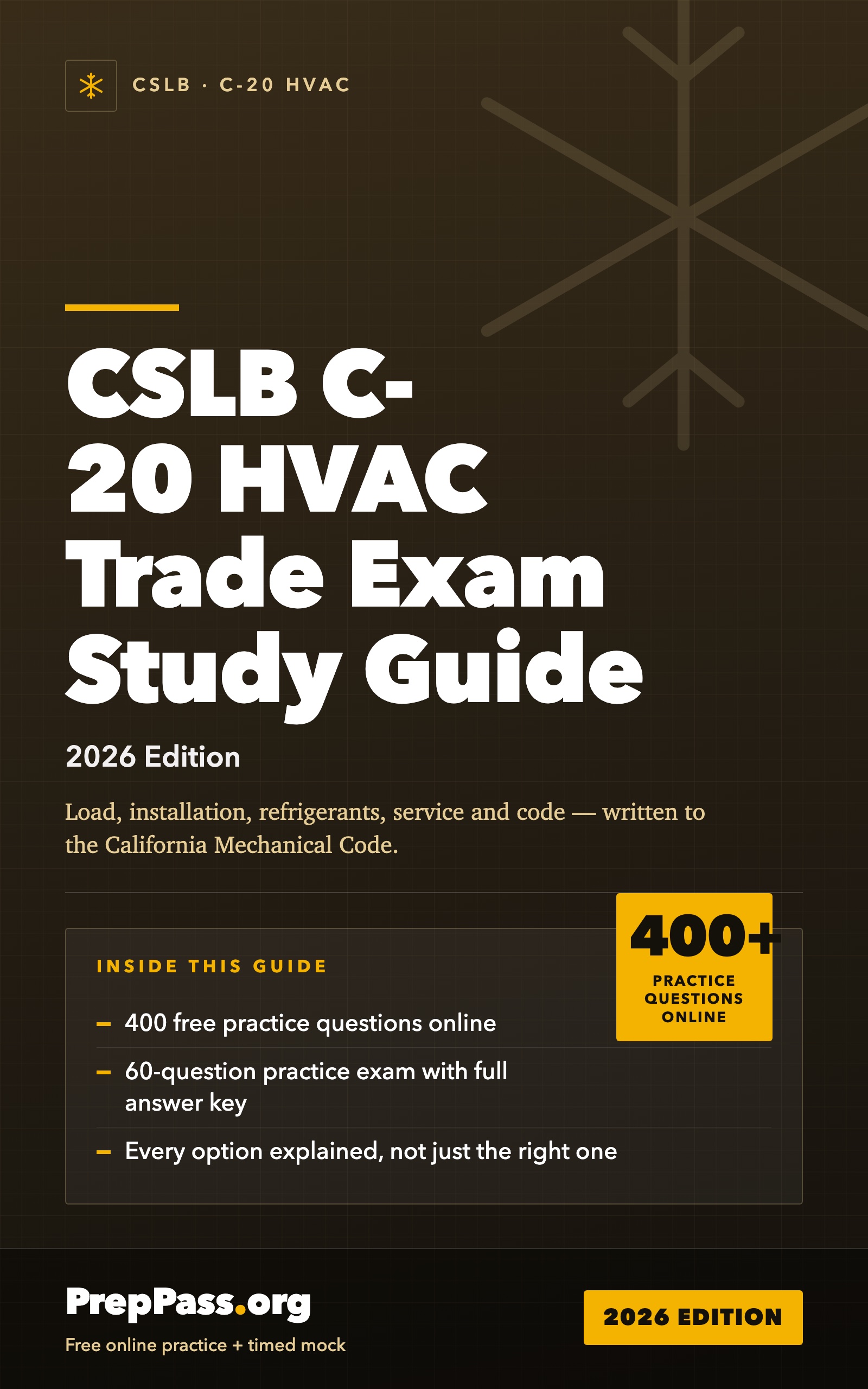
CSLB C-20 HVAC Trade Exam Study Guide (2026)
Load calculation, installation, refrigerants, service and code — written to the California Mechanical Code and the A2L transition, not to an R-22 era textbook.
- 60 câu hỏi luyện tập trong sách, kèm đáp án đầy đủ
- 100 trang giảng giải theo từng chương — không phải một đống câu hỏi
- Đối chiếu với California Mechanical Code · Title 24 · EPA 608 · Cal/OSHA Title 8 · 16 CCR §832.20
PDF + EPUB · tiếng Anh · 100 trang · $14.99 trả một lần
Sách này được viết bằng tiếng Anh — tệp PDF và EPUB bạn tải về đều bằng tiếng Anh.
Tải ngay sau khi thanh toán — không cần tài khoản, không thuê bao. Chính sách hoàn tiền
Ôn cả hai môn? Có giá combo
- CSLB C-20 HVAC Trade Exam Study Guide (2026)$14.99
- CSLB Law & Business — Complete Study Guide (2026)$24.99
Bạn giữ lại $9.99. Một lần thanh toán, hai cuốn sách, đủ cả PDF và EPUB.
Đã mua CSLB Law & Business rồi? Đừng mua combo — combo có sẵn cuốn đó và bạn sẽ trả tiền hai lần. Mua riêng CSLB C-20 HVAC với giá $14.99. CSLB C-20 HVAC · Combo gồm gì →
Xem bên trong cuốn sách
Ba trang thật, kết xuất thẳng từ tệp PDF bạn sẽ tải — một trang giảng giải, một câu hỏi có lời giải, và một trang tra cứu. Không trang nào được vẽ lại cho đẹp.
- Trang tra cứu nhanhChapter 2 — Installation of Warm-Air Heating and Cooling Systems · Trang 23 của PDF
Một trang để lật lại: các con số, mốc thời hạn hoặc thuật ngữ gom về một chỗ.
- Cách giảng dạyChapter 2 — Installation of Warm-Air Heating and Cooling Systems · Trang 28 của PDF
Trang giảng giải: kiến thức được trình bày bằng văn xuôi, theo trình tự kỳ thi kiểm tra.
- Một câu hỏi có lời giảiChapter 4 — Service and Troubleshooting · Trang 50 của PDF
Một câu luyện tập kèm đáp án và lập luận đằng sau — không chỉ là đáp án.
Có gì — và không có gì
Bao gồm
- Written to the current California Mechanical and Energy Codes, with cycle-dependent figures flagged
- The refrigerant transition as it stands now — R-454B and R-32 charge limits, leak detection, POE oil
- A 60-question practice exam drawn from the same bank you drill online
- Every answer explains all four options — why the key is right and why each of the other three loses
- A worked example at the end of every chapter
- Quick-reference cheat sheet, glossary, and exam-day strategy appendices
- PDF (print & tab it) + EPUB (phone / e-reader)
Không bao gồm
- Không gửi bản in — đây là tệp bạn tải về và có thể tự in
- Sách không kèm khoá video, giảng viên hay kèm riêng — video miễn phí trên trang là phần khác
- Không bao gồm lệ phí đăng ký thi hay phí trung tâm khảo thí — bạn vẫn nộp cho cơ quan chính thức
Mục lục
Xem 12 chương và trang bắt đầu của từng chương
- Chapter 1 — Load Calculation and System Designtr. 7
- Part 6 — the Energy Code — sets minimum equipment efficiency, ducttr. 14
- Part 6 = Energy Code; Part 4 = Mechanical; 3 = Electrical; 5 =tr. 15
- Chapter 2 — Installation of Warm-Air Heating and Cooling Systemstr. 18
- Chapter 3 — The Refrigeration Cycle and Refrigerantstr. 33
- Chapter 4 — Service and Troubleshootingtr. 43
- Chapter 5 — Safety, Codes, and the C-20 Scopetr. 52
- Practice Exam — 60 Questionstr. 62
- Answer Key and Explanationstr. 76
- Appendix A — Quick-Reference Cheat Sheettr. 89
- Appendix B — Glossary of Key Termstr. 94
- Appendix C — Exam-Day Strategytr. 98
Lấy từ chính tệp PDF bạn tải về, kèm trang bắt đầu của từng phần — không phải gõ tay ở đây.
Đọc miễn phí trọn một chương
Trọn vẹn một chương, đúng như trong eBook. Cuộn cửa sổ để đọc ngay tại đây; không cần tải, không cần email.
Đọc chương 2 ngay tại đây, không rời trang
Chúng tôi không đưa phần mở đầu dễ dãi — chương miễn phí mở thẳng vào một trong những phần đậm đặc nhất của cuốn sách, để bạn đánh giá cách dạy ở đúng chỗ kỳ thi trở nên khó.
This is the biggest chapter because it is the biggest block on the exam, and because it is where the code has the most to say about what you do with your hands. A furnace that fires beautifully in a closet with no combustion air is a carbon monoxide event waiting for a cold snap. A line set brazed without nitrogen runs fine for a season and then plugs a TXV.
2.1 Combustion Air
The purpose of combustion air is to supply oxygen for complete, safe combustion — not to cool the control board, not to raise supply temperature. Starve it and combustion goes incomplete, producing soot and carbon monoxide.
The code method sizes required air on the total BTU/hr input of the appliances in the space and the volume of the space, and on whether air comes from indoors or outdoors. Put a 100,000 BTU/hr furnace in a closet inside a tight modern house and the interior volume may simply not contain enough air to support combustion, no matter how good the flame looks when you light it. The remedy is engineered openings sized by the code method. This applies in existing work as much as new, and interior air being "dry" has nothing to do with it — the issue is oxygen quantity.
When the two-opening method brings combustion air from outdoors, the geometry is fixed: one opening within 12 inches of the top of the enclosure and one within 12 inches of the bottom. The high opening relieves warm buoyant air; the low opening supplies denser cool air. Two high openings leave the bottom without supply; two low openings give the buoyant air no path. A bedroom or bathroom is not an acceptable source.
The 12-inch dimension, the required opening areas, and the volume method are CMC values (the combustion-air chapter — Chapter 7 in the UMC/CMC organization) and are cycle-dependent. Verify in the adopted edition.
Direct-vent sealed-combustion appliances pipe their own air from outdoors, which is why one is well suited to a garage workshop: the burner never breathes garage air, which may carry gasoline or solvent vapors. It still condenses in most cases, still needs a drain, and still needs a disconnect. And it never licenses you to take return air from a garage.
2.2 Venting
Type B gas vent is double-wall metal vent listed for listed Category I gas appliances — natural-draft equipment with draft hoods producing relatively low-temperature, non-condensing flue gas. Not for oil appliances with barometric dampers, not for solid fuel, not for high-temperature incinerators.
Category IV condensing appliances are vented with listed plastic pipe such as PVC or CPVC. The reason is chemistry, not convenience: a condensing appliance cools flue gas below its dew point, and the acidic condensate that forms would destroy metal vent. Its flue temperature is low, not high — which is exactly why it condenses — and it vents under positive pressure, which Type B is not rated for.
Vent connectors on natural-draft equipment slope up. A single-wall connector running horizontally to the vertical vent must slope upward toward the vent, commonly at least 1/4 inch per foot (CMC figure — cycle-dependent). Buoyant flue gas needs continuous rise or it stalls and spills at the draft hood. A level run offers no rise; sloping toward the appliance sends flue gas and moisture back into the equipment; a "trap" in a connector would just pocket soot.
All flues and vents terminate outdoors, at listed heights and clearances from windows, doors, and air intakes. Never into an attic, a crawl space, or a return duct. On a sidewall-vented condensing furnace, the governing concern is exactly that separation. Concentric and two-pipe terminations follow the manufacturer's spacing, not a rule that both pipes sit at the same height; the vent slopes back toward the furnace so condensate drains to the appliance; and terminating below grade invites blockage by leaves, snow, and standing water.
The orphaned water heater. This scenario separates candidates who have thought about it from those who have not. You replace an 80% furnace with a condensing model. The old furnace shared a Type B vent with a natural-draft water heater. The condensing furnace leaves that vent entirely. What must be evaluated is whether the water heater alone can still vent safely in a vent sized for two appliances. A vent now grossly oversized for one small appliance may never establish draft, and the water heater spills flue gas into the building. That is the open question — not whether the B-vent can serve the condensing furnace, which it plainly cannot.
Key Numbers & Facts — Combustion Air and Venting - Combustion air sized on appliance input + space volume + indoor vs. outdoor source. - Two-opening outdoor method: one within 12 in of the top, one within 12 in of the bottom (cycle-dependent). Bedrooms/bathrooms are not acceptable sources. - Type B = Category I. Category IV condensing = listed PVC/CPVC (acidic condensate, low flue temperature, positive pressure). - Natural-draft connector slopes UP toward the vent (commonly ≥ 1/4 in per foot). - Terminate outdoors at listed clearances from openings and intakes. - Pulling a furnace off a common vent orphans the water heater — re-evaluate its draft.
2.3 Refrigerant Line Sets
Size the line set from the manufacturer's tables — system capacity, total line length, vertical rise — not by matching what was there, not by insulation color, not by breaker size. Undersizing the suction line is the classic long-run mistake: it adds pressure drop over the whole run, lowering pressure at the compressor and cutting mass flow and capacity.
Insulate the suction line; usually leave the liquid line bare. The suction line carries cold vapor below the dew point of surrounding air, so bare tubing sweats onto the building and picks up heat that raises superheat at the compressor. Insulation does not change velocity and does not "hold in" pressure.
Support horizontal runs at regular intervals with hangers that do not crush the insulation. Supporting only the ends allows sag, vibration fatigue and joint failure; resting tubing on framing lets it chafe and work-harden; taping it to the drain line supports nothing.
Vertical lift changes the problem. Condenser 20 feet above the evaporator: lifting liquid costs static head, and that pressure drop consumes subcooling — enough of it and you get flash gas at the metering device. Evaporator above the condenser with a 25-foot suction riser: now the concern is oil, which must be carried up by vapor velocity. A properly formed trap at the base of the riser collects oil until velocity carries it up as a slug. Oversizing the riser lowers velocity and makes oil return worse.
Brazing. Flow dry nitrogen through the tubing at a low, steady trickle just sufficient to displace the air — not a high-pressure blast (which chills the joint and blows the filler out), not unregulated cylinder pressure (which can rupture thin-wall tubing), and not a purge afterward (by then the scale has formed). Without it, oxygen forms copper oxide scale inside the tube, and flakes break loose, plug the metering device and load the drier.
Pressure test, then evacuate — in that order. Leaks are found with pressure, because a vacuum cannot push anything out for a detector to find. Test with dry nitrogen through a regulator with a relief device — never shop air (moisture and oil even through a dryer), never oxygen (with oil residue it can ignite violently), never refrigerant mixed with air (unrecoverable and potentially combustible). Then pull the vacuum.
Evacuation target: 500 microns or lower, verified by isolating the pump and watching the gauge. Readings of 2,000 or 5,000 microns still leave water vapor; short hold times prove nothing; a compound manifold gauge cannot distinguish 29 inches of mercury from a genuinely deep vacuum. Follow the manufacturer's stated procedure.
Read the decay test, because it is a diagnosis in itself:
- Rises then levels off → moisture still boiling off and reaching equilibrium. Keep pumping; break the vacuum with nitrogen and pump again.
- Rises steadily toward atmospheric without leveling → a leak, in the system or at your connections.
- Barely moves → dry and tight. Charge it.
Use large-diameter hoses with both ports open and remove valve cores where permitted: at deep vacuum the gas is extremely thin, and small hoses and cores choke the flow badly enough to prevent reaching target at all. Put the micron gauge at the system, not at the pump.
Then open both service valves fully so the factory charge fills the circuit. Starting a compressor with the valves closed runs it into a vacuum and can damage the motor; opening only the liquid valve starves the compressor while flooding the low side.
Filter drier direction matters. The screen and media are arranged for one flow direction. Installed backwards on a cooling-only system, debris the drier already trapped washes off the outlet screen toward the metering device. The desiccant still adsorbs moisture either way — the failure is mechanical.
Flare connections on mini-splits: deburr, form a clean flare, and torque the nut to specification. Overtightening splits or extrudes the flare into a leak that shows up months later. Pipe dope is not a flare sealant. A previously compressed flare has work-hardened and will not reseal.
Refrigerant class changes the job. A system using R-454B — an A2L refrigerant — is mildly flammable, so the listed equipment carries charge limits, leak detection and mitigation provisions the installer must not defeat. (There is no blanket "ten feet from a window" setback, and brazing alloy is chosen for the joint and base metals, not the safety class.) More on A2Ls in Chapter 3.
Key Numbers & Facts — Line Sets - Size from manufacturer tables (capacity, length, rise). Insulate the suction line. Support at intervals. - Condenser above evaporator → static lift consumes subcooling. Evaporator above condenser → trap at the base of the suction riser. - Braze with a low, steady dry-nitrogen trickle or get copper oxide scale. - Pressure test FIRST (regulated dry nitrogen with relief), THEN evacuate. Never air, oxygen, or refrigerant-plus-air. - Evacuate to ≈ 500 microns, verified with the pump isolated. Decay: rise-then-level = moisture; steady climb = leak. - Open both service valves fully. Install the drier in the marked direction. - A2L: follow listed charge limits and mitigation features.
2.4 Condensate
Route condensate to an approved point of disposal — treated under the plumbing code as indirect waste to an approved receptor. Not into a plumbing vent (which obstructs it), not onto the ground under the unit, not into a crawl space (vapor barrier or no), not onto a roof.
Secondary protection where a leak would do damage. An air handler in an attic above a finished ceiling requires an auxiliary drain pan with its own drain, or a water-level shutoff device (float switch). A condensate pump can serve the primary drain but does not by itself satisfy the secondary requirement, and a single primary drain provides no backup when it clogs. (CMC requirements — verify the adopted edition.)
Draw-through coils need a trap. The pan sits on the suction side of the blower, so the drain outlet is under negative pressure and, without a water seal, the blower pulls air in through the drain instead of letting water out. The trap does not make the pan drain faster; it makes it drain at all. Depth is based on the unit's static pressure. (Refrigerant never reaches the condensate pan — it is inside sealed tubing.)
Slope and support the line. Sags across an attic hold water, restrict flow, and back water into the pan until the float switch trips. That symptom is the drain telling you something: clear the blockage and verify the trap and slope — do not remove the switch, wire it to an alarm, or fit one that lets water climb higher.
Condensing furnace condensate is acidic. A neutralizer raises its pH so it does not attack metallic drain piping. It does not filter particulate, reduce volume, or prevent freezing.
Key Numbers & Facts — Condensate - Indirect waste to an approved receptor. Never a plumbing vent, crawl space, roof, or the ground under the unit. - Attic above a finished ceiling → auxiliary pan with its own drain OR a water-level shutoff. - Draw-through coil → trap required (drain under negative pressure). Continuous fall, no sags. - Repeat float-switch trips = clear the drain, never defeat the switch. - Condensing-furnace condensate is acidic → neutralizer.
Trước khi mua
- Nhận sách thế nào?
- Thanh toán xong, mục tải xuống hiện ngay trên trang này. Liên kết cũng được gửi qua email. Không cần tài khoản.
- Nếu sách không hợp thì sao?
- Gửi email trong vòng 14 ngày để được hoàn tiền đầy đủ, không cần lý do.
- Phần luyện tập miễn phí có bị bỏ không?
- Không. Mọi câu hỏi luyện tập, bài thi thử tính giờ và các chương miễn phí trên trang vẫn miễn phí. Cuốn sách là nửa "học", không phải hàng rào quanh phần miễn phí.
- Đọc trên điện thoại được không?
- Được — EPUB cho điện thoại và máy đọc sách, PDF để in và dán tab. Bạn nhận cả hai.
Chi tiết
Load calculation, installation, refrigerants, service and code — written to the California Mechanical Code and the A2L transition, not to an R-22 era textbook.
- Format: PDF + EPUB download · 100 pages
- 60 practice questions in the book, with a full answer key
- 400 free practice questions for this exam on PrepPass, included at no cost
- $14.99 one-time — no subscription
- 14-day money-back guarantee · refund policy
- Cross-referenced against: California Mechanical Code · Title 24 · EPA 608 · Cal/OSHA Title 8 · 16 CCR §832.20
- Last updated: September 2026
- Đối chiếu từ nguồn chính thức(California Mechanical Code · Title 24 · EPA 608 · Cal/OSHA Title 8 · 16 CCR §832.20)
- 400 câu hỏi luyện tập miễn phí
- Tải ngay, thuộc về bạn trọn đời
Một CSLB exam prep course có giá $200–$800. Cuốn sách này dạy cùng một kỳ thi — cùng quy định, đối chiếu theo chuẩn hiện hành — chỉ với $14.99 trả một lần, thuộc về bạn trọn đời.
Vì sao mua sách khi phần luyện tập miễn phí?
Câu hỏi luyện tập và bài thi thử tính giờ vẫn miễn phí — không có gì trên trang bị giấu sau cuốn sách này. Cuốn sách $14.99 là nửa "học": chính phần kiến thức, dạy theo trình tự, trong một tệp thuộc về bạn.
- Dạy có hệ thống — mọi phần thi giảng theo từng chương, từ đầu đến cuối, không chỉ là câu hỏi
- In ra & dán nhãn — PDF sẵn sàng để in, tô đậm, ghi chú và mang tới bàn học
- Học mọi nơi, ngoại tuyến — EPUB trên điện thoại hay máy đọc sách; không cần wifi, không cần tab trình duyệt
- Tất cả một chỗ — các chương, thẻ tóm tắt từng chương và câu hỏi luyện tập trong một tệp
- Của bạn trọn đời — trả một lần $14.99, tải ngay, không thuê bao
Và không rủi ro: Đảm bảo hoàn tiền 14 ngày — không hài lòng? Email cho chúng tôi để hoàn tiền đầy đủ, không cần lý do. Xem chính sách hoàn tiền.
Đảm bảo hoàn tiền 14 ngày · hoàn tiền đầy đủ, không cần lý do.
Mua một lần, truy cập tải về trọn đời. eBook là trọn bộ hướng dẫn ôn CSLB C-20 HVAC ở dạng PDF và EPUB. Bản tóm tắt mang tính giáo dục, không phải tư vấn chuyên môn hay pháp lý — luôn xác nhận quy định hiện hành với nguồn chính thức. Cập nhật lần cuối: September 2026.