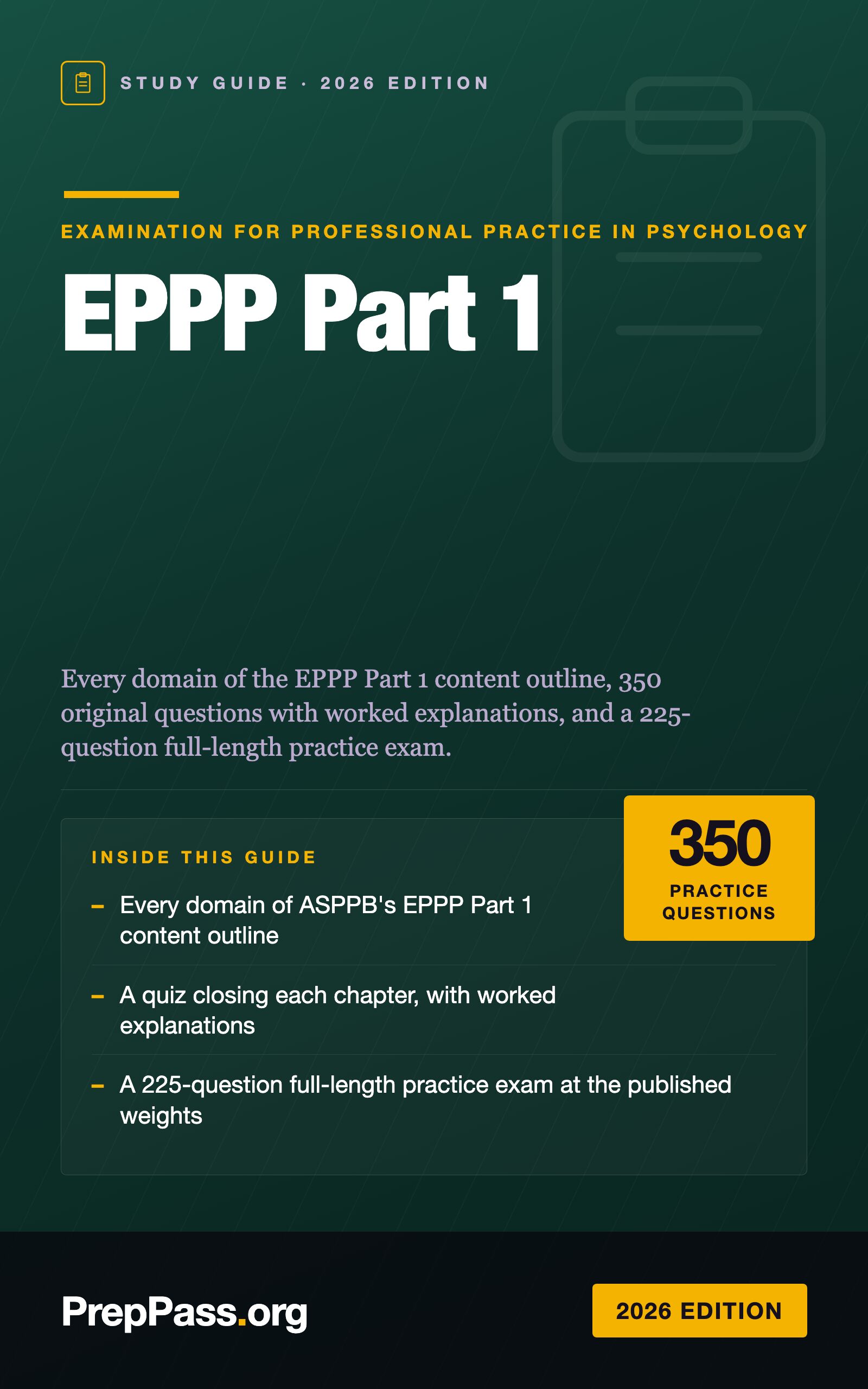
EPPP Part 1 — Examination for Professional Practice in Psychology · Ấn bản 2026
EPPP Part 1 Study Guide — 2026 Edition
Every domain of the EPPP Part 1 content outline, 350 original questions with worked explanations, and a 225-question full-length practice exam.
- 350 câu hỏi luyện tập gốc, mỗi câu kèm lời giải, trong một bản PDF + EPUB bạn giữ
PDF + EPUB · tiếng Anh · 246 trang · $19.99 trả một lần
Sách này được viết bằng tiếng Anh — tệp PDF và EPUB bạn tải về đều bằng tiếng Anh.
Tải ngay sau khi thanh toán — không cần tài khoản, không thuê bao.
Đảm bảo hoàn tiền 14 ngày: không hài lòng vì bất kỳ lý do gì? Email support@preppass.org trong vòng 14 ngày kể từ khi mua để được hoàn tiền đầy đủ. Chính sách hoàn tiền
Thử 10 câu trước — miễn phí
Trả lời hết 10 câu, nộp bài xong sẽ thấy lời giải từng câu — kèm phần trong sách này dạy nội dung đó. Khoảng 5 phút, không cần đăng ký.
Bắt đầu 10 câu miễn phíXem bên trong cuốn sách
Ba trang thật, kết xuất thẳng từ tệp PDF bạn sẽ tải — lần lượt là một trang tra cứu, một trang giảng giải, và một câu hỏi có lời giải. Không trang nào được vẽ lại cho đẹp.
- Trang tra cứu nhanhPart 2 · Trang 178 của PDF
Một trang để lật lại: các con số, mốc thời hạn hoặc thuật ngữ gom về một chỗ.
- Cách giảng dạyChapter 7: Research methods and statistics · Trang 116 của PDF
Trang giảng giải: kiến thức được trình bày bằng văn xuôi, theo trình tự kỳ thi kiểm tra.
- Một câu hỏi có lời giảiChapter 7: Research methods and statistics · Trang 124 của PDF
Một câu luyện tập kèm đáp án và lập luận đằng sau — không chỉ là đáp án.
Về chính kỳ thi này
| Cơ quan quản lý | Association of State and Provincial Psychology Boards (ASPPB) — kỳ thi do Pearson VUE tổ chức |
|---|---|
| Số câu hỏi | 225 câu hỏi (175 câu tính điểm, 50 câu thử nghiệm không tính điểm) |
| Thời gian làm bài | 255 phút |
| Điểm đậu | Điểm quy đổi 500 trên thang 200–800 |
| Lệ phí |
|
| Ngôn ngữ thi | Tiếng Anh · Tiếng Pháp |
Có gì — và không có gì
Bao gồm
- Every domain of ASPPB's EPPP Part 1 content outline
- A quiz closing each chapter, with worked explanations
- A 225-question full-length practice exam at the published weights
- 350 original questions, each explained and cited to its source
- Research methods and statistics worked step by step
- PDF + EPUB you keep
Không bao gồm
- Không gửi bản in — đây là tệp bạn tải về và có thể tự in
- Sách không kèm khoá video, giảng viên hay kèm riêng — video miễn phí trên trang là phần khác
- Không bao gồm lệ phí đăng ký thi hay phí trung tâm khảo thí — bạn vẫn nộp cho cơ quan chính thức
Mục lục
Xem 12 phần và trang bắt đầu của từng phần
- Chapter 2: Cognitive-affective bases of behaviortr. 20
- Chapter 3: Social and cultural bases of behaviortr. 35
- Chapter 4: Growth and lifespan developmenttr. 53
- Chapter 5: Assessment and diagnosistr. 70
- Chapter 7: Research methods and statisticstr. 112
- Chapter 8: Ethical, legal, and professional issuestr. 126
- Practice Examtr. 148
- Part 1tr. 148
- Part 2tr. 166
- Part 3tr. 186
- Part 4tr. 204
- Part 5tr. 224
Lấy từ chính tệp PDF bạn tải về, kèm trang bắt đầu của từng phần — không phải gõ tay ở đây.
Đọc miễn phí trọn một chương
Trọn vẹn một chương, đúng như trong eBook. Cuộn cửa sổ để đọc ngay tại đây; không cần tải, không cần email.
Đọc chương 2 ngay tại đây, không rời trang
Chúng tôi không đưa phần mở đầu dễ dãi — chương miễn phí mở thẳng vào một trong những phần đậm đặc nhất của cuốn sách, để bạn đánh giá cách dạy ở đúng chỗ kỳ thi trở nên khó.
This domain carries 13% of the Part 1–Knowledge exam[1], making it one of the larger content areas. The Knowledge portion of the exam contains 225 items, of which 175 are scored and 50 are unscored pretest items[2]. The eight subareas below move from intelligence and learning through memory, motivation, and emotion, into the building blocks of cognition and the relations among thought, feeling, and behavior. The exam rarely asks you to recite a theory's name; it hands you a vignette and asks which principle best explains what happened, which interpretation of a score is defensible, or which distinction a clinician is missing.
The questions in this domain are almost entirely applied. Instead of asking for a definition, the exam describes a child, a client, an employee, or a test score and asks which principle explains the case or which next step is most defensible. That makes discrimination practice the highest-yield study move: generalization versus discrimination, negative reinforcement versus punishment, emotion versus mood, temperament versus mood, an attention problem versus an ability problem. Each section below ends with the trap — the wrong answer the exam most wants you to pick.
KN6 — Major research-based theories and models of intelligence and their application
The concept: intelligence models disagree about structure. One family of models proposes a single general factor underlying performance across different mental tasks, plus narrower task-specific abilities. Another family divides intelligence into fluid ability — solving novel problems and spotting patterns in unfamiliar material — and crystallized ability — using acquired knowledge and vocabulary. A third family argues for multiple relatively independent abilities, such as verbal, spatial, and interpersonal strengths, that a single score cannot capture. Application is where the exam lives: a psychologist uses an intelligence test to make a decision — school placement, service eligibility, a diagnostic opinion — and that decision is only as good as the evidence behind the test.
Why it matters: test scores change lives. A misread score can place a child in the wrong classroom track or deny services to someone who qualifies. Professional standards for testing exist precisely because interpretation carries consequences[3]. The exam expects you to treat every score as an estimate, not a verdict.
How it is tested: vignettes about score interpretation and test selection. The exam loves the standard error of measurement: because every observed score contains error, a score of 106 with a standard error of 5 means the true score probably falls within a band around 106, not exactly on it[4]. It also tests whether you can match validity evidence to the intended use — evidence that scores predict a future criterion, such as later grades, is what you need when the claim is about forecasting[5] — and whether you notice when two scorers disagree, which is a problem of consistency across raters[6].
The trap: treating the observed score as the person's exact ability, and treating reliability as validity. A test can yield perfectly consistent scores and still not measure what you need it to measure. Another trap: assuming a test validated for one purpose is automatically valid for another.
KN7 — Major research-based theories, models, and principles of learning and their application
The concept: learning models explain how behavior changes with experience. In classical conditioning, a neutral stimulus paired with a meaningful one comes to elicit a response on its own[7]; the learned response can spread to similar stimuli (generalization), be narrowed to one stimulus (discrimination), or fade when the pairing stops (extinction). In operant conditioning, consequences shape behavior: reinforcement increases behavior and punishment decreases it, with positive meaning a stimulus is added and negative meaning one is removed[7]. Beyond these, observational learning holds that people acquire new behaviors by watching models[7], and cognitive accounts add mental maps, insight, and expectations to the picture.
Why it matters: behavior change is the working end of psychology — parenting guidance, classroom management, skills training, and exposure-based treatments all run on these principles.
How it is tested: vignettes that ask which principle is operating. A child bitten by one dog who now fears all dogs and the park shows generalization. A supervisor whose nagging stops when reports arrive on time — and whose nagging therefore stays stopped — is a negative reinforcement arrangement for the supervisor's own behavior, and the employee's timely reports were strengthened by the removal of an aversive condition.
The trap: negative reinforcement is not punishment. Negative means something was taken away; reinforcement means the behavior increased. If the behavior went down, you are looking at punishment, not negative reinforcement. A second trap: confusing extinction — a learned response fading when reinforcement stops — with ordinary forgetting.
KN8 — Major research-based theories and models of memory and their application
The concept: memory models describe a pipeline and a workshop. The classic pipeline moves information from brief sensory registers through a limited short-term store into long-term storage, with attention and rehearsal controlling what gets through[8]. The workshop view emphasizes working memory — actively holding and manipulating a few chunks of information at once — and depth of processing: material encoded by meaning is retained better than material encoded by surface features[8]. Forgetting is usually interference or retrieval failure rather than erasure[8], and memory is constructive — recall rebuilds the past and can incorporate errors. In trauma, memory behaves differently from ordinary forgetting: unwanted, vivid recollections can intrude unbidden, and such symptoms usually begin within 3 months of the traumatic event[9]. Similarly, repeated intrusive thoughts that consume hours and disrupt daily life reflect an obsessive-compulsive pattern, not a memory encoding deficit[10].
Why it matters: clients present with cognitive complaints — "my memory is failing" — and the psychologist must distinguish a storage problem from an attention problem, a retrieval problem, or intrusive re-experiencing.
How it is tested: vignettes asking what kind of memory phenomenon a case shows. The exam rewards distinguishing recognition from recall, encoding failure from retrieval failure, and intrusive symptoms from ordinary forgetting.
The trap: assuming that a vivid memory is an accurate memory, and that forgetting means the trace is gone. Confidence and accuracy are loosely coupled, and most forgetting is a retrieval problem, not a storage problem.
KN9 — Major research-based theories and models of motivation and their application
The concept: motivation models answer why people start, persist, or quit. Intrinsic motivation comes from interest and enjoyment in the activity itself; extrinsic motivation comes from separable rewards or pressures. Need-based models arrange motives in hierarchies, from basic physiological and safety needs up through belonging and self-actualization[11], or group them into autonomy, competence, and relatedness as core psychological nutrients. Expectancy models say effort follows the belief that effort leads to performance and performance leads to a valued outcome. Goal-setting research adds a practical edge: specific, challenging but reachable goals, paired with feedback, reliably outperform vague "do your best" instructions.
Why it matters: engagement decides outcomes — in therapy, in school, and at work. A brilliant treatment plan fails if the client does not return, and a training program fails if employees do not practice.
How it is tested: vignettes asking which principle predicts or explains behavior. The student who reads extra articles out of curiosity shows intrinsic motivation; the one who reads only for bonus points shows extrinsic motivation. The manager who replaces "do your best" with clear targets and feedback is applying goal-setting.
The trap: assuming more reward always means more motivation. Rewards can crowd out intrinsic interest when they make a previously enjoyable activity feel like paid labor — the overjustification pattern. A second trap: confusing arousal with motivation; being keyed up is not the same as being directed toward a goal.
KN10 — Major research-based theories and models of emotion and their application
The concept: emotions have three intertwined components — physiological arousal, expressive behavior, and subjective feeling. Theories differ on the order of operations. One account says bodily changes come first and the feeling follows. Another says the brain generates arousal and feeling simultaneously. A third says arousal plus a cognitive label determines the emotion: the same pounding heart is labeled fear in a dark parking lot and exertion after sprinting for a bus[11]. Emotions are typically brief and directed at something; moods are more diffuse and longer-lasting. Anxiety disorders, the emotional disorders the exam references most, are common: about a third of U.S. adolescents and adults experience an anxiety disorder at some point in their lives[12].
Why it matters: emotion regulation is central to clinical work, and mislabeling an emotion as a mood — or vice versa — leads to the wrong intervention and the wrong expectations about duration.
How it is tested: vignettes that fit one theory better than the others, and cases that require separating a brief object-directed emotion from a diffuse mood state.
The trap: reading the expression as the feeling. People smile when they are not happy and cry when they are moved, not sad. A second trap: treating emotions as deliberate choices rather than rapid, partly automatic responses that can then be regulated.
KN11 — Elements of cognition, including sensation and perception, attention, language, information processing, visual-spatial processing, executive functioning
The concept: cognition has separable elements the exam can probe one at a time. Sensation is detection — the raw pickup of light, sound, and pressure — while perception is interpretation, shaped by expectations and context. Attention comes in flavors: selective (filtering one stream), divided (splitting across streams), and sustained (holding focus over time). Language covers comprehension and production. Information processing describes the stages from input through encoding to response. Visual-spatial processing handles where things are and how they relate in space. Executive functioning is the control panel: planning, inhibiting impulses, shifting strategies, and monitoring performance. These elements dissociate in disorders: attention-deficit/hyperactivity disorder is one of the most common disorders diagnosed in children[13], autism spectrum disorder affects how people interact with others, communicate, learn, and behave[14], and schizophrenia symptoms fall into three main categories — psychotic, negative, and cognitive — with the cognitive category covering disorganized thinking and trouble concentrating[15].
Why it matters: differential diagnosis lives here. A child who cannot finish work may have an attention problem, a language problem, or an ability problem — and each points somewhere different.
How it is tested: vignettes describing a deficit, asking which element is impaired or which symptom category it reflects. Disorganized thinking and poor concentration in schizophrenia point to the cognitive category, not the negative one.
The trap: confusing an attention or executive problem with low intelligence. A person can have strong reasoning ability and still fail tasks that demand sustained focus. A second trap: mixing up sensation and perception — detecting a stimulus versus interpreting it.
KN12 — Relations among cognitions/beliefs, behavior, affect, temperament, and mood
The concept: thoughts, feelings, and actions form a loop, not a line. Beliefs shape how situations are interpreted, interpretations color affect, affect biases behavior, and behavior creates consequences that confirm or revise beliefs. Temperament is the early-appearing, biologically flavored style of reactivity — how intense, how adaptable, how persistent — while mood is a longer-lasting affective background and emotion is the brief foreground reaction. The loop matters clinically because depression, one of the most common mental disorders in the United States[16], shows the loop running in a harsh register: self-critical thoughts deepen low mood, low mood narrows behavior, and narrowed behavior confirms the thoughts. Bipolar patterns show mood itself swinging between elevation and depression, a condition that usually requires ongoing management, though an effective plan helps people manage symptoms and improve quality of life[17].
Why it matters: case formulation is the practical payoff. If you see only the mood and miss the beliefs maintaining it, or only the behavior and miss the temperament underneath, the plan targets the wrong link.
How it is tested: vignettes asking about directionality — does the case show thoughts influencing mood, mood influencing thoughts, or both — and items separating temperament (trait-like, early) from mood (state-like, longer) from emotion (brief, reactive).
The trap: one-way causation. The exam's favorite wrong answer says thoughts affect mood but mood never affects thoughts, or behavior is just an output. The loop runs both directions.
Sources cited in this excerpt
- EPPP Exam Topics — EPPP (Part 1-Knowledge) domains and weights. ASPPB. https://asppb.net/exams/asppb-examination-for-professional-psychology-eppp/eppp-exam-topics/
- EPPP Candidate Handbook (January 2026). ASPPB. https://asppb.net/wp-content/uploads/EPPP-Candidate-Handbook_01.2026.pdf
- Testing and Assessment. American Psychological Association — APA Testing Office (public page). https://www.apa.org/science/programs/testing
- Psychological Assessment (journal manuscript — classical test theory). American Psychological Association — PsycNet (peer-reviewed journal manuscript). https://psycnet.apa.org/manuscript/2019-45061-001.pdf
- 6c. Research Design Part 3 — Evaluating Measurement Quality: Reliability, Validity, and Trustworthiness. Kwantlen Polytechnic University (open textbook via Pressbooks). https://kpu.pressbooks.pub/researchmethodscrim/chapter/6c-research-design-part-3-evaluating-measurement-quality-reliability-validity-and-trustworthiness/
- Reliability and Validity of Measurement — Research Methods in Psychology. eCampusOntario (open textbook, CC BY-NC-SA). https://ecampusontario.pressbooks.pub/researchmethods/chapter/reliability-and-validity-of-measurement/
- Ch. 6 Summary - Psychology | OpenStax. OpenStax, Rice University (open textbook, CC BY). https://openstax.org/books/psychology/pages/6-summary
- Ch. 8 Summary - Psychology 2e | OpenStax. OpenStax, Rice University (open textbook, CC BY). https://openstax.org/books/psychology-2e/pages/8-summary
- Post-Traumatic Stress Disorder (PTSD) - National Institute of Mental Health (NIMH). https://www.nimh.nih.gov/health/publications/post-traumatic-stress-disorder-ptsd
- Obsessive-Compulsive Disorder - National Institute of Mental Health (NIMH). https://www.nimh.nih.gov/health/publications/obsessive-compulsive-disorder-when-unwanted-thoughts-or-repetitive-behaviors-take-over
- Ch. 10 Summary - Psychology 2e | OpenStax. OpenStax, Rice University (open textbook, CC BY). https://openstax.org/books/psychology-2e/pages/10-summary
- Anxiety Disorders - National Institute of Mental Health (NIMH). https://www.nimh.nih.gov/health/topics/anxiety-disorders
- Attention-Deficit/Hyperactivity Disorder (ADHD) - National Institute of Mental Health (NIMH). https://www.nimh.nih.gov/health/topics/attention-deficit-hyperactivity-disorder-adhd
- Autism Spectrum Disorder - National Institute of Mental Health (NIMH). https://www.nimh.nih.gov/health/publications/autism-spectrum-disorder
- Schizophrenia - National Institute of Mental Health (NIMH). https://www.nimh.nih.gov/health/publications/schizophrenia
- Depression - National Institute of Mental Health (NIMH). https://www.nimh.nih.gov/health/topics/depression
- Bipolar Disorder - National Institute of Mental Health (NIMH). https://www.nimh.nih.gov/health/topics/bipolar-disorder
Trước khi mua
- Nhận sách thế nào?
- Thanh toán xong, mục tải xuống hiện ngay trên trang này. Liên kết cũng được gửi qua email. Không cần tài khoản.
- Nếu sách không hợp thì sao?
- Gửi email trong vòng 14 ngày để được hoàn tiền đầy đủ, không cần lý do.
- Phần luyện tập miễn phí có bị bỏ không?
- Không. Mọi câu hỏi luyện tập, bài thi thử tính giờ và các chương miễn phí trên trang vẫn miễn phí. Cuốn sách là nửa "học", không phải hàng rào quanh phần miễn phí.
- Đọc trên điện thoại được không?
- Được — EPUB cho điện thoại và máy đọc sách, PDF để in và dán tab. Bạn nhận cả hai.
Chi tiết
Every domain of the EPPP Part 1 content outline, 350 original questions with worked explanations, and a 225-question full-length practice exam.
- Format: PDF + EPUB download · 246 pages
- 350 practice questions in the book, with a full answer key
- 123 free practice questions for this exam on PrepPass, included at no cost
- $19.99 one-time — no subscription
- 14-day money-back guarantee · refund policy
- Cross-referenced against: ASPPB's published EPPP Part 1 content outline and candidate handbook
- Last updated: September 2026
- Đối chiếu từ nguồn chính thức(ASPPB's published EPPP Part 1 content outline and candidate handbook)
- 123 câu hỏi luyện tập miễn phí
- Tải ngay, thuộc về bạn trọn đời
Một EPPP prep program có giá $429–$1,799. Cuốn sách này dạy cùng một kỳ thi — cùng quy định, đối chiếu theo chuẩn hiện hành — chỉ với $19.99 trả một lần, thuộc về bạn trọn đời.
Vì sao mua sách khi phần luyện tập miễn phí?
Câu hỏi luyện tập và bài thi thử tính giờ vẫn miễn phí — không có gì trên trang bị giấu sau cuốn sách này. Cuốn sách $19.99 là nửa "học": chính phần kiến thức, dạy theo trình tự, trong một tệp thuộc về bạn.
- Dạy có hệ thống — mọi phần thi giảng theo từng chương, từ đầu đến cuối, không chỉ là câu hỏi
- In ra & dán nhãn — PDF sẵn sàng để in, tô đậm, ghi chú và mang tới bàn học
- Học mọi nơi, ngoại tuyến — EPUB trên điện thoại hay máy đọc sách; không cần wifi, không cần tab trình duyệt
- Tất cả một chỗ — các chương và câu hỏi luyện tập trong một tệp
- Của bạn trọn đời — trả một lần $19.99, tải ngay, không thuê bao
Và không rủi ro: Đảm bảo hoàn tiền 14 ngày — không hài lòng? Email cho chúng tôi để hoàn tiền đầy đủ, không cần lý do. Xem chính sách hoàn tiền.
Đảm bảo hoàn tiền 14 ngày · hoàn tiền đầy đủ, không cần lý do.
Mua một lần, truy cập tải về trọn đời. eBook là trọn bộ hướng dẫn ôn EPPP Part 1 — Examination for Professional Practice in Psychology ở dạng PDF và EPUB. Bản tóm tắt mang tính giáo dục, không phải tư vấn chuyên môn hay pháp lý — luôn xác nhận quy định hiện hành với nguồn chính thức. Cập nhật lần cuối: September 2026.