Esthetician (State Board) · Ấn bản 2026
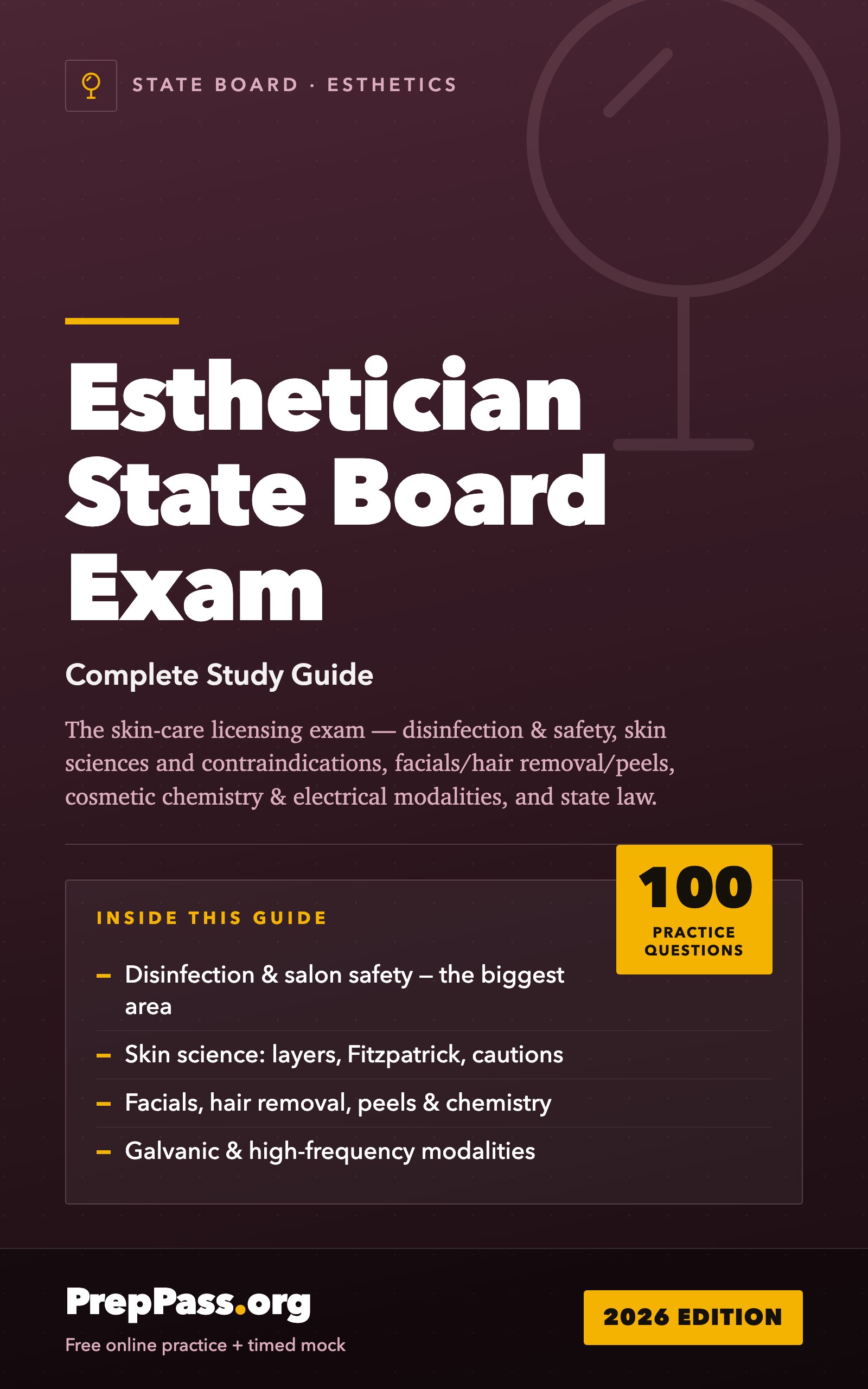
Esthetician State Board Exam — Complete Study Guide (2026)
The skin-care licensing exam — disinfection & safety, skin sciences and contraindications, facials/hair removal/peels, cosmetic chemistry & electrical modalities, and state law.
- 55 câu hỏi luyện tập trong sách, kèm đáp án đầy đủ
- 47 trang giảng giải theo từng chương — không phải một đống câu hỏi
- Đối chiếu với standard esthetics/skin-science references / EPA disinfection / OSHA BBP & HazCom / NIC & state esthetics board outlines
PDF + EPUB · tiếng Anh · 47 trang · $14.99 trả một lần
Sách này được viết bằng tiếng Anh — tệp PDF và EPUB bạn tải về đều bằng tiếng Anh.
Tải ngay sau khi thanh toán — không cần tài khoản, không thuê bao. Chính sách hoàn tiền
Xem bên trong cuốn sách
Ba trang thật, kết xuất thẳng từ tệp PDF bạn sẽ tải — một trang giảng giải, một câu hỏi có lời giải, và một trang tra cứu. Không trang nào được vẽ lại cho đẹp.
- Một câu hỏi có lời giảiPractice Exam (55 Questions) · Trang 26 của PDF
Một câu luyện tập kèm đáp án và lập luận đằng sau — không chỉ là đáp án.
- Trang tra cứu nhanhPractice Exam (55 Questions) · Trang 38 của PDF
Một trang để lật lại: các con số, mốc thời hạn hoặc thuật ngữ gom về một chỗ.
- Cách giảng dạyPractice Exam (55 Questions) · Trang 39 của PDF
Trang giảng giải: kiến thức được trình bày bằng văn xuôi, theo trình tự kỳ thi kiểm tra.
Có gì — và không có gì
Bao gồm
- Disinfection, infection control & salon safety (the biggest exam area)
- Skin sciences: layers, conditions, Fitzpatrick, and key contraindications
- Facials, hair removal, chemical peels, and cosmetic chemistry
- Electrical modalities (galvanic, high-frequency) and their contraindications
- 55 original practice questions with answer explanations
- PDF (print & tab it) + EPUB (phone / e-reader)
Không bao gồm
- Không gửi bản in — đây là tệp bạn tải về và có thể tự in
- Sách không kèm khoá video, giảng viên hay kèm riêng — video miễn phí trên trang là phần khác
- Không bao gồm lệ phí đăng ký thi hay phí trung tâm khảo thí — bạn vẫn nộp cho cơ quan chính thức
Mục lục
Xem 6 chương và trang bắt đầu của từng chương
- Chapter 1 — Disinfection, Infection Control & Safetytr. 5
- Chapter 2 — Skin Sciences: Structure, Conditions & Contraindicationstr. 10
- Chapter 3 — Facial Treatments, Hair Removal & Client Servicestr. 15
- Chapter 4 — Cosmetic Chemistry & Electrical Modalitiestr. 19
- Chapter 5 — Law, Scope of Practice & Establishment Rulestr. 22
- Practice Exam (55 Questions)tr. 26
Lấy từ chính tệp PDF bạn tải về, kèm trang bắt đầu của từng phần — không phải gõ tay ở đây.
Đọc miễn phí trọn một chương
Trọn vẹn một chương, đúng như trong eBook. Cuộn cửa sổ để đọc ngay tại đây; không cần tải, không cần email.
Đọc chương 2 ngay tại đây, không rời trang
Chúng tôi không đưa phần mở đầu dễ dãi — chương miễn phí mở thẳng vào một trong những phần đậm đặc nhất của cuốn sách, để bạn đánh giá cách dạy ở đúng chỗ kỳ thi trở nên khó.
About a quarter of the exam tests whether you understand the skin you are working on — how it is built, what it does, how it ages, how hair grows, and, above all, when a condition belongs to a physician rather than to you. Many of these questions describe skin and ask whether you treat, modify, or refer. Learning the anatomy and the lesion vocabulary is what lets you describe skin accurately without ever crossing into diagnosis.
The Layers of the Skin
Skin has three main layers.
The epidermis is the outermost layer and is where every esthetic service takes place. From deepest to most superficial, its layers are the stratum basale, spinosum, granulosum, lucidum, and corneum. An easy anchor: the basale sits against the dermis (it builds), and the corneum faces the world (it sheds). Cell division and melanin production happen in the stratum basale; the stratum corneum is dead, keratinized tissue that you cleanse and exfoliate; the stratum lucidum is a clear layer found only on the palms and soles. [verify — the lucidum is classically described as present only in thick, glabrous skin.]
The dermis lies below and is divided into the papillary and reticular layers. It holds collagen and elastin, blood vessels, nerve endings, sebaceous and sudoriferous glands, and hair follicles. This is where skin's structure and firmness live.
The subcutaneous (subcutis) layer beneath the dermis is adipose tissue that insulates, cushions, and gives the face its contour; its loss with age drives hollowing and sagging.
Because superficial services affect only the epidermis, they improve texture and tone but cannot rebuild dermal structure — which is precisely why a deep wrinkle is not something a superficial peel can "remove," and why over-promising that result is both a marketing problem and a scope problem.
What the Skin Does, and How It Renews
The skin protects, provides sensation, regulates temperature through blood flow and perspiration, excretes waste through sweat, secretes sebum, and absorbs a limited amount of what is applied to it. Sebum and perspiration form the acid mantle, a thin film with a pH around 4.5–5.5 that discourages microbial growth and slows water loss. Highly alkaline (high-pH) cleansers strip that mantle and leave skin tight and reactive, which is why choosing a cleanser near the skin's own pH matters.
Epidermal cells are produced in the basal layer and take roughly a month in a young adult to migrate to the surface and shed — a cycle that slows with age. That slowdown is the main reason mature skin looks duller: dead cells linger and light no longer reflects evenly, which is also why appropriate exfoliation helps mature skin and why over-exfoliation backfires.
Keep two ideas separate: skin type reflects genetically determined oil production, while a skin condition such as dehydration (a lack of water), sensitivity, or congestion can occur in any type and changes over time. Oily and dehydrated skin is common and normal.
Fitzpatrick Types, Pigmentation, and Photodamage
The Fitzpatrick scale classifies skin by its response to ultraviolet light, from Type I (always burns, never tans) to Type VI (deeply pigmented, rarely burns). It predicts more than sunburn: higher Fitzpatrick types have melanocytes that respond vigorously to inflammation, so aggressive exfoliation, heat, or trauma can trigger post-inflammatory hyperpigmentation (PIH) that is worse than the original concern. Protocols for higher types start conservatively, progress slowly, and always pair with daily broad-spectrum sun protection.
Melasma is a hormonally influenced hyperpigmentation appearing as symmetrical patches on the cheeks, forehead, and upper lip; it is aggravated by both UV and heat, so sun protection is the foundation of any protocol and steam and hot towels are limited. UVA (longer wavelength) reaches the dermis and drives aging and pigment change; UVB (shorter) primarily causes burning; both raise skin-cancer risk, which is what "broad spectrum" on a label means. Intrinsic aging is genetically programmed; extrinsic aging comes from sun, smoking, and pollution — and it is the part a client can actually control.
Lesions, Disorders, and Knowing When to Refer
Primary lesions are present when a condition first appears — macules, papules, pustules, vesicles, wheals, tubercles. Secondary lesions develop as it progresses or heals — crusts, scales, fissures, excoriations, ulcers, scars. You describe these; you never diagnose them.
Common findings within scope: open comedones (blackheads) are follicular contents oxidized dark by air; closed comedones (whiteheads) are trapped below the surface; milia are keratin-filled cysts with no follicular opening; telangiectasia are dilated capillaries seen as red lines; sebaceous hyperplasia is enlarged sebaceous glands.
The referral line is critical for the exam. Mild acne is within scope, but deep painful nodules and cysts (grade IV) must never be extracted — they are medical. Rosacea, eczema with broken or weeping skin, active herpes simplex, and anything crusted, spreading, or suspiciously changing all call for referral. A mole showing asymmetry, irregular borders, color variation, larger diameter, or recent change is avoided entirely; you encourage the client to see a physician without naming a diagnosis. And you obtain physician clearance for high-risk histories: uncontrolled diabetes, recent facial surgery or procedures, active cancer treatment, and photosensitizing medications.
Hair Growth and Its Cycle
Hair grows from a follicle nourished by the dermal papilla and cycles through three phases: anagen (active growth, hair fully attached), catagen (short transition, follicle shrinks), and telogen (resting, then shedding). Waxing gives its longest-lasting result during anagen, because the hair is removed with the fullest structure attached. Because follicles cycle independently, regrowth is staggered — clients see stubble sooner than expected and benefit from a regular rebooking schedule.
Two commonly confused terms: hirsutism is excessive terminal hair in a male pattern on a woman (often hormonal); hypertrichosis is excessive growth in areas not normally hair-bearing. All esthetic hair removal (waxing, tweezing, threading) is temporary; permanent removal by electrolysis or laser falls under different licensing.
### Key Facts — Chapter 2 - Three layers: epidermis (services happen here), dermis (collagen/elastin, glands, vessels), subcutis (fat/contour). - Epidermis deep→surface: basale, spinosum, granulosum, lucidum, corneum. Basale builds, corneum sheds; lucidum only on palms/soles. [verify] - Superficial services reach only the epidermis — they cannot rebuild the dermis. - Acid mantle pH ≈ 4.5–5.5; cell turnover ≈ one month in youth and slows with age. - Type = oil (genetic); condition = e.g., dehydration (water), can occur in any type. - Fitzpatrick I→VI; higher types → higher PIH risk → start gentle + daily SPF. Melasma = symmetrical, worsened by UV and heat. - UVA ages (deep), UVB burns (surface); "broad spectrum" covers both. - Primary vs. secondary lesions; never extract cysts/nodules; refer rosacea, eczema flares, herpes, changing moles. - Hair cycle anagen (best for waxing) / catagen / telogen; esthetic removal is temporary.
Worked scenario. A Fitzpatrick V client wants "the strongest possible peel" to erase acne marks fast. The instinct to go strong is exactly backward: her melanocytes react to inflammation, so an aggressive treatment risks darkening the very marks she wants gone. The professional answer is to start conservatively, progress gradually, and anchor the plan to daily broad-spectrum SPF, while setting the expectation that safe fading takes a series, not one session. You do not refuse her outright (darker skin can absolutely be treated) — you treat it correctly for her type.
Named exam traps.
- Reversed layer order. The basale is deep (builds); the corneum is on top (sheds). If a sequence starts with "corneum" going down, it's the wrong direction unless it explicitly says superficial-to-deep.
- "Type vs. condition." Oily skin can also be dehydrated. Skin type doesn't flip day to day; conditions do.
- "UVB is the deep, aging ray." No — UVA is deep/aging; UVB burns the surface.
- "Higher Fitzpatrick tolerates any strength." The opposite — higher types need more caution.
- Extracting a cyst / nodule or abrading a changing mole — both are referral situations, never a service.
Trước khi mua
- Nhận sách thế nào?
- Thanh toán xong, mục tải xuống hiện ngay trên trang này. Liên kết cũng được gửi qua email. Không cần tài khoản.
- Nếu sách không hợp thì sao?
- Gửi email trong vòng 14 ngày để được hoàn tiền đầy đủ, không cần lý do.
- Phần luyện tập miễn phí có bị bỏ không?
- Không. Mọi câu hỏi luyện tập, bài thi thử tính giờ và các chương miễn phí trên trang vẫn miễn phí. Cuốn sách là nửa "học", không phải hàng rào quanh phần miễn phí.
- Đọc trên điện thoại được không?
- Được — EPUB cho điện thoại và máy đọc sách, PDF để in và dán tab. Bạn nhận cả hai.
Chi tiết
The skin-care licensing exam — disinfection & safety, skin sciences and contraindications, facials/hair removal/peels, cosmetic chemistry & electrical modalities, and state law.
- Format: PDF + EPUB download · 47 pages
- 55 practice questions in the book, with a full answer key
- 100 free practice questions for this exam on PrepPass, included at no cost
- $14.99 one-time — no subscription
- 14-day money-back guarantee · refund policy
- Cross-referenced against: standard esthetics/skin-science references / EPA disinfection / OSHA BBP & HazCom / NIC & state esthetics board outlines
- Last updated: August 2026
- Đối chiếu từ nguồn chính thức(standard esthetics/skin-science references / EPA disinfection / OSHA BBP & HazCom / NIC & state esthetics board outlines)
- Tải ngay, thuộc về bạn trọn đời
Vì sao mua sách khi phần luyện tập miễn phí?
Câu hỏi luyện tập và bài thi thử tính giờ vẫn miễn phí — không có gì trên trang bị giấu sau cuốn sách này. Cuốn sách $14.99 là nửa "học": chính phần kiến thức, dạy theo trình tự, trong một tệp thuộc về bạn.
- Dạy có hệ thống — mọi phần thi giảng theo từng chương, từ đầu đến cuối, không chỉ là câu hỏi
- In ra & dán nhãn — PDF sẵn sàng để in, tô đậm, ghi chú và mang tới bàn học
- Học mọi nơi, ngoại tuyến — EPUB trên điện thoại hay máy đọc sách; không cần wifi, không cần tab trình duyệt
- Tất cả một chỗ — các chương, thẻ tóm tắt từng chương và câu hỏi luyện tập trong một tệp
- Của bạn trọn đời — trả một lần $14.99, tải ngay, không thuê bao
Và không rủi ro: Đảm bảo hoàn tiền 14 ngày — không hài lòng? Email cho chúng tôi để hoàn tiền đầy đủ, không cần lý do. Xem chính sách hoàn tiền.
Đảm bảo hoàn tiền 14 ngày · hoàn tiền đầy đủ, không cần lý do.
Mua một lần, truy cập tải về trọn đời. eBook là trọn bộ hướng dẫn ôn Esthetician (State Board) ở dạng PDF và EPUB. Bản tóm tắt mang tính giáo dục, không phải tư vấn chuyên môn hay pháp lý — luôn xác nhận quy định hiện hành với nguồn chính thức. Cập nhật lần cuối: August 2026.