Real Estate Salesperson · Ấn bản 2026
Real Estate Salesperson Exam — Complete Study Guide (2026)
The national (general) portion — updated for the 2024 NAR settlement rules.
- 0 câu hỏi luyện tập trong sách, kèm đáp án đầy đủ
- 174 trang giảng giải theo từng chương — không phải một đống câu hỏi
- Đối chiếu với PSI / Pearson VUE national content outline
$14.99trả một lần · tải trọn đời · không thuê bao
PDF + EPUB · tiếng Anh · 174 trang · $14.99 trả một lần
Sách này được viết bằng tiếng Anh — tệp PDF và EPUB bạn tải về đều bằng tiếng Anh.
Tải ngay sau khi thanh toán — không cần tài khoản, không thuê bao.
Đảm bảo hoàn tiền 14 ngày: không hài lòng vì bất kỳ lý do gì? Email support@preppass.org trong vòng 14 ngày kể từ khi mua để được hoàn tiền đầy đủ. Đây là bản tải xuống nên không phải gửi trả gì cả. Chính sách hoàn tiền
Xem bên trong cuốn sách
Ba trang thật, kết xuất thẳng từ tệp PDF bạn sẽ tải — lần lượt là một trang tra cứu, một trang giảng giải, và một câu hỏi có lời giải. Không trang nào được vẽ lại cho đẹp.
- Trang tra cứu nhanhSection 1–36, boustrophedonic ("ox-plow") — Sec. 1 in the NE corner, Sec. · Trang 96 của PDF
Một trang để lật lại: các con số, mốc thời hạn hoặc thuật ngữ gom về một chỗ.
- Cách giảng dạySection 1–36, boustrophedonic ("ox-plow") — Sec. 1 in the NE corner, Sec. · Trang 100 của PDF
Trang giảng giải: kiến thức được trình bày bằng văn xuôi, theo trình tự kỳ thi kiểm tra.
- Một câu hỏi có lời giảiSection 1–36, boustrophedonic ("ox-plow") — Sec. 1 in the NE corner, Sec. · Trang 35 của PDF
Một câu luyện tập kèm đáp án và lập luận đằng sau — không chỉ là đáp án.
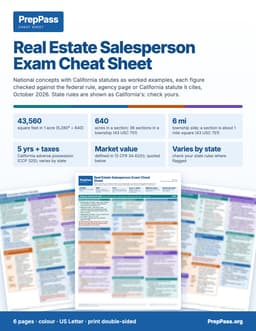
Thi trong vòng hai tuần?
Sách này là phần giảng dạy, đọc trong nhiều tuần. Nếu bạn thi trong vòng hai tuần, bảng tra cứu màu in được là sản phẩm còn lại: các con số then chốt, xếp theo từng phần.
6 trang · US Letter · PDF in được · giữ vĩnh viễn
Về chính kỳ thi này
| Cơ quan quản lý | Không có một cơ quan duy nhất: mỗi tiểu bang cấp phép nhân viên bất động sản và tự đặt kỳ thi. Trong 49 kỳ thi tiểu bang PrepPass đã đối chiếu nguồn, 23 do PSI tổ chức, 23 do Pearson VUE, 3 do đơn vị khác, chính cơ quan quản lý, hoặc không nêu đơn vị. Hãy xem trang dữ kiện của tiểu bang bạn. Những trang chúng tôi đã đọc và không tìm thấy: Pearson VUE — Alaska Real Estate Candidate Handbook #092200 (July 2026, rev 06/2026) |
|---|---|
| Số câu hỏi | Do từng tiểu bang quy định. 45 trên 49 tiểu bang công bố số câu của kỳ thi salesperson, từ 100 đến 154 câu (một số con số gồm câu thử nghiệm không tính điểm). Ở 4 tiểu bang còn lại, tài liệu của tiểu bang không công bố một con số duy nhất hoặc mâu thuẫn nhau. Hãy xem trang dữ kiện của tiểu bang bạn. Những trang chúng tôi đã đọc và không tìm thấy: Pearson VUE — Alaska Real Estate Candidate Handbook #092200 (July 2026, rev 06/2026) |
| Thời gian làm bài | Do từng tiểu bang quy định. 45 trên 49 tiểu bang công bố một giới hạn thời gian cho kỳ thi salesperson, từ 90 đến 270 phút. 4 tiểu bang còn lại tính giờ riêng cho từng kỳ thi hoặc từng phần, hoặc không công bố giới hạn chung. Hãy xem trang dữ kiện của tiểu bang bạn. Những trang chúng tôi đã đọc và không tìm thấy: Pearson VUE — Alaska Real Estate Candidate Handbook #092200 (July 2026, rev 06/2026) |
| Điểm đậu | Do từng tiểu bang quy định. Trong 49 tiểu bang, 19 tiểu bang công bố mức phần trăm, từ 70% đến 75%; 11 tiểu bang công bố điểm quy đổi 70 hoặc 75 trên thang 0–100, không phải phần trăm số câu đúng; 8 tiểu bang công bố số câu đúng hoặc số điểm, có nơi theo từng phần; 11 tiểu bang không có điểm đậu mà PrepPass có thể nêu. Hãy xem trang dữ kiện của tiểu bang bạn. Những trang chúng tôi đã đọc và không tìm thấy: Pearson VUE — Alaska Real Estate Candidate Handbook #092200 (July 2026, rev 06/2026) |
| Lệ phí | Do từng tiểu bang quy định: thường gồm lệ phí thi trả cho đơn vị tổ chức và phí giấy phép trả cho tiểu bang. 49 trên 49 bảng dữ kiện tiểu bang liệt kê các khoản phí đã công bố. Hãy xem trang dữ kiện của tiểu bang bạn. Những trang chúng tôi đã đọc và không tìm thấy: Pearson VUE — Alaska Real Estate Candidate Handbook #092200 (July 2026, rev 06/2026) |
| Ngôn ngữ thi | Do từng tiểu bang quy định. Trong 49 tiểu bang, 4 tiểu bang nêu tiếng Anh và ít nhất một ngôn ngữ khác; 45 tiểu bang không nêu ngôn ngữ thi. Hãy xem trang dữ kiện của tiểu bang bạn. Những trang chúng tôi đã đọc và không tìm thấy: Pearson VUE — Alaska Real Estate Candidate Handbook #092200 (July 2026, rev 06/2026) |
Có gì — và không có gì
Bao gồm
- All 8 national-portion sections, weighted like the real exam
- Updated for the 2024 NAR settlement practice changes
- Every national exam section taught to the source, with worked examples
- Every tested number in a per-chapter cram box
- Worked real-estate math with the formulas you actually need
- PDF (print & tab it) + EPUB (phone / e-reader)
Không bao gồm
- Không gửi bản in — đây là tệp bạn tải về và có thể tự in
- Sách không kèm khoá video, giảng viên hay kèm riêng — video miễn phí trên trang là phần khác
- Không bao gồm lệ phí đăng ký thi hay phí trung tâm khảo thí — bạn vẫn nộp cho cơ quan chính thức
Mục lục
Xem 1 phần và trang bắt đầu của từng phần
- Section 1–36, boustrophedonic ("ox-plow") — Sec. 1 in the NE corner, Sec.tr. 26
Lấy từ chính tệp PDF bạn tải về, kèm trang bắt đầu của từng phần — không phải gõ tay ở đây.
Đọc miễn phí trọn một chương
Trọn vẹn một chương, đúng như trong eBook. Cuộn cửa sổ để đọc ngay tại đây; không cần tải, không cần email.
Đọc chương 8 ngay tại đây, không rời trang
Real-estate math is the part most candidates fear — so that's the chapter you can read free: the exam's math patterns, worked step by step. If the teaching works here, it works everywhere.
Introduction
Math is the section candidates fear most and lose points on least — if they prepare. About seven questions (roughly 9% of the national portion) are pure calculation: area, valuation, financing, commissions, prorations, and investment returns. None of it is hard math. Every problem on this exam reduces to arithmetic you already know — multiplication, division, and percentages — dressed up in real estate vocabulary. The candidates who miss these points almost never miss because the math is too advanced. They miss because they mislabel the numbers, forget a conversion, or answer the question the problem didn't ask.
The good news is that math is the most reliable part of the whole exam. Statutes get amended and agency rules shift, but an acre has been 43,560 square feet for a very long time and will be on test day. A discount point is 1% of the loan no matter what year you sit the exam. Once you own a handful of formulas and a disciplined method for reading a word problem, these seven questions become the easiest points on the test — the ones you can bank while other candidates are guessing.
This chapter teaches the formulas you must memorize, then walks through each family of problem the way it appears on the exam: land area and legal-description acreage, property valuation (CMA adjustments, GRM, NOI, and capitalization), commissions, loan and financing costs, closing-statement math and prorations, and finally investment and property-management calculations. Every figure that the exam actually tests is collected in the Key numbers & formulas box so you can drill it cold.
Learning objectives
After working through this chapter you should be able to:
- Convert between square feet and acres (1 acre = 43,560 sq ft) and read acreage out of a legal description (1 section = 640 acres = 1 square mile; 1 township = 36 sections).
- Apply the single master relationship behind almost every real estate math problem — Part = Whole × Rate — and rearrange it to solve for any one of the three.
- Value income property with GRM, build Net Operating Income (NOI) correctly (excluding debt service), and use the cap rate relationship (Cap rate = NOI ÷ Value) to solve for value, NOI, or rate.
- Adjust comparables in a CMA in the right direction (adjust the comparable, never the subject).
- Compute commissions and splits, and solve a net-to-seller problem.
- Compute interest, LTV, discount points, loan fees, and prepayment penalties, and read an amortized payment from a factor.
- Build a closing statement: down payment, PITI, prorations (360-day banker's year), debits and credits, transfer tax, recording fees, and net to seller.
- Compute ROI / cash-on-cash return, appreciation, and cost-recovery (depreciation), and simple property-management budget figures.
- Compute adjusted basis and capital gain, and apply the §121 principal-residence exclusion ($250k/$500k, 2-of-5-year) and the §1031 like-kind exchange (45-day / 180-day, boot) at a conceptual level.
Part A — The one method that solves most problems
Before any specific formula, learn the engine underneath them. The overwhelming majority of real estate math problems are a single relationship in disguise:
Part = Whole × Rate
Some study guides draw this as a "T" (or a circle) with the Part on top and the Whole and Rate on the bottom. Cover the value you're solving for:
- Solving for the Part? Multiply: Whole × Rate.
- Solving for the Whole? Divide: Part ÷ Rate.
- Solving for the Rate? Divide: Part ÷ Whole.
Every one of these is the same T:
| Problem type | "Part" | "Whole" | "Rate" |
|---|---|---|---|
| Commission | commission $ | sale price | commission % |
| Interest (annual) | interest $ | loan balance | interest rate |
| Cap rate | NOI | property value | cap rate |
| Property tax | tax $ | assessed value | tax rate |
| Percentage of list | sale price | list price | % of list |
| Down payment / LTV | loan amount | price or value | loan-to-value % |
If you can identify which two of the three numbers a problem gives you, the T tells you whether to multiply or divide. That single habit prevents the most common exam error: dividing when you should multiply.
A discipline that saves points. Before you compute, write down what the question is actually asking for and its units. "Monthly interest" is not "annual interest." "Net to seller" is not "sale price." "Acres" is not "square feet." Most wrong answers on this section are the right arithmetic applied to the wrong target, and the exam deliberately lists those near-miss numbers as distractors.
Source: PSI/Pearson VUE national real estate content outline — "Real estate calculations," the math domain of the salesperson national portion.
Part B — Area: square footage and acreage
Rectangles, triangles, and square footage
Area problems are just geometry with a real estate label.
- Rectangle / square: Area = Length × Width.
- Triangle (a corner lot, a gable end): Area = ½ × Base × Height.
- Volume (rare, for cubic-foot problems): Length × Width × Height.
Keep all measurements in the same unit before multiplying. If a lot is given in feet, work in square feet; convert to acres only at the end.
Example. A rectangular lot measures 150 ft by 200 ft. Its area is 150 × 200 = 30,000 square feet. To express that in acres, divide by 43,560: 30,000 ÷ 43,560 = 0.69 acre (rounded). If a builder needs 8,000 sq ft per home, the lot holds 30,000 ÷ 8,000 = 3 homes (you round down — you can't build a fraction of a required lot).
The acre and the government survey
Two conversions are worth memorizing because the exam leans on them:
- 1 acre = 43,560 square feet.
- 1 section = 640 acres = 1 square mile (a section is 5,280 ft × 5,280 ft). A township = 36 sections = 36 square miles (6 miles by 6 miles).
Legal-description problems from the Public Land Survey System (Rectangular Survey) ask you to compute the acreage of a fraction of a section. The trick is simple: each "of" in the description means multiply, and you multiply the fractions by 640.
Example. How many acres is "the NW ¼ of the SE ¼ of Section 14"? Read it right to left, multiplying: ¼ × ¼ × 640 = 640 ÷ 16 = 40 acres. A three-part description — "the S ½ of the NW ¼ of the NE ¼" — is ½ × ¼ × ¼ × 640 = 640 ÷ 32 = 20 acres.
Exam trap: the more fractions in the description, the smaller the parcel. Candidates who add the fractions instead of multiplying get a wildly wrong (too large) answer — which is exactly the distractor the exam supplies.
Source: U.S. Public Land Survey System standard section/township dimensions; national exam "property description / calculations."
Part C — Valuation math
CMA and adjusting comparables
A Comparative Market Analysis (CMA) estimates value by comparing the subject property to recently sold, similar properties and adjusting their prices for differences. The single rule the exam tests is the direction of the adjustment:
Always adjust the comparable, never the subject. If the comparable is superior to the subject (it has something the subject lacks), subtract that value from the comparable's price. If the comparable is inferior, add.
A memory hook: CBS — "Comparable Better, Subtract."
Example. The subject has no garage. A comparable sold for $310,000 and has a garage valued at $15,000. The comparable is superior, so subtract: $310,000 − $15,000 = $295,000 adjusted value contributed by that comp. If a different comparable lacks a fireplace the subject has (worth $4,000), you add: it is inferior, so its price is adjusted up.
Gross Rent Multiplier (GRM) and Gross Income Multiplier (GIM)
For small income properties, a quick value estimate uses a multiplier applied to gross rent or income (no expenses subtracted). Two versions are tested, and they are distinguished by the income figure in the denominator — memorize the split exactly as Chapter 3 states it:
GRM (Gross Rent Multiplier) uses MONTHLY gross rent: GRM = Sale Price ÷ Monthly Gross Rent → Value = GRM × Monthly Gross Rent. GIM (Gross Income Multiplier) uses ANNUAL gross income: GIM = Sale Price ÷ Annual Gross Income → Value = GIM × Annual Gross Income.
Watch the units — this is the whole game. GRM is monthly; GIM is annual; they differ by a factor of 12, and the exam will offer both as answer choices. Both use gross figures (subtracting expenses is what makes it the cap-rate/NOI approach instead).
Example. Comparable properties sell at a monthly GRM of 120. The subject rents for $2,000 per month. Estimated value = 120 × $2,000 = $240,000. The same property expressed with an annual GIM: annual income $24,000 × a GIM of 10 = the same $240,000 (note the annual GIM is the monthly GRM ÷ 12).
NOI, cap rate, and income capitalization
For larger income property, value rests on Net Operating Income and the capitalization rate. Build NOI in the correct order — and note what is excluded:
- Potential Gross Income (PGI) — rent if 100% occupied, plus other income.
- Subtract vacancy and collection loss → Effective Gross Income (EGI).
- Subtract operating expenses (property taxes, insurance, management, maintenance, utilities, reserves) → Net Operating Income (NOI).
NOI = Effective Gross Income − Operating Expenses. Critically, NOI does NOT subtract debt service (mortgage principal and interest), income taxes, or depreciation. Those are financing and ownership costs, not operating costs. This exclusion is the most-tested idea in the whole valuation family.
Then the capitalization relationship — another Part = Whole × Rate T:
Cap Rate = NOI ÷ Value, so Value = NOI ÷ Cap Rate, and NOI = Value × Cap Rate.
An inverse relationship worth stating in words: for a given NOI, a higher cap rate means a lower value (buyers demanding more return will pay less), and a lower cap rate means a higher value.
Worked example. A 10-unit building rents for $1,200 per unit per month.
- PGI = 10 × $1,200 × 12 = $144,000.
- Vacancy/collection loss at 5% = $7,200 → EGI = $136,800.
- Operating expenses = $52,800 → NOI = $136,800 − $52,800 = $84,000.
- At a market cap rate of 7%, Value = $84,000 ÷ 0.07 = $1,200,000.
Note that the building's mortgage payment never entered the calculation — that is the point. If the exam hands you a "$6,000/month mortgage" figure in an NOI problem, it is a distractor.
Assessed value and property taxes
Property tax is assessed value times a tax rate. Assessed value is often a percentage (the assessment ratio) of market value, and rates are frequently quoted in mills:
1 mill = $1 per $1,000 of assessed value = 0.001. So a rate of 25 mills = $25 per $1,000 = 0.025.
Example. A home has a market value of $400,000 and is assessed at an 80% assessment ratio: assessed value = $400,000 × 0.80 = $320,000. At a tax rate of 25 mills, annual tax = $320,000 × 0.025 = $8,000 (equivalently, $320,000 ÷ 1,000 × 25 = $8,000). Monthly, that's $8,000 ÷ 12 = $666.67, the figure that later feeds the "T" in PITI.
Note: assessment ratios and mill rates are set locally and vary widely by state and county — the exam problem always gives you the ratio and the rate. Never assume one.
Equity
Equity = Market Value − Total Loans (liens).
Example. A home worth $400,000 carries a first mortgage balance of $250,000. Owner's equity = $150,000. As the loan amortizes and (usually) the value appreciates, equity grows from both directions.
Source: national exam "valuation and market analysis" and "real estate calculations" domains.
Part D — Commission and compensation
Commission is the friendliest T on the exam:
Commission = Sale Price × Commission Rate.
Commission rates are fully negotiable and set by agreement — there is no standard or legally fixed rate — so the problem always supplies the percentage. The complexity, when it comes, is in the splits: total commission → split between the listing brokerage and the cooperating (selling) brokerage → split again between each brokerage and its agent.
Worked example. A house sells for $450,000 at a 6% commission.
- Total commission = $450,000 × 0.06 = $27,000.
- Listing and selling brokerages split 50/50 → $13,500 each.
- The listing agent's contract gives the agent 60% of the brokerage's share → $13,500 × 0.60 = $8,100 to the agent; the brokerage keeps $5,400.
Work the splits in order and label each number. The exam's distractors are usually the intermediate figures ($27,000 or $13,500) offered as if they were the agent's take-home.
Net-to-seller (a reverse commission problem). When a seller wants to net a specific amount after paying commission and costs, you cannot just add the commission on top — the commission is a percentage of the unknown selling price. Solve algebraically:
Sale Price = (Desired Net + Payoff + Other Costs) ÷ (1 − Commission Rate).
Example. A seller wants to net $94,000 after a 6% commission (no other costs). Price = $94,000 ÷ (1 − 0.06) = $94,000 ÷ 0.94 = $100,000. Check: $100,000 × 6% = $6,000 commission; $100,000 − $6,000 = $94,000. ✓ A fuller version: seller wants $200,000 net after a 6% commission, $4,000 in closing costs, and a $120,000 loan payoff → Price = ($200,000 + $120,000 + $4,000) ÷ 0.94 = $324,000 ÷ 0.94 = $344,680.85.
Source: national exam "agency / brokerage" and "real estate calculations."
Trước khi mua
- Nhận sách thế nào?
- Thanh toán xong, mục tải xuống hiện ngay trên trang này. Liên kết cũng được gửi qua email. Không cần tài khoản.
- Nếu sách không hợp thì sao?
- Gửi email trong vòng 14 ngày để được hoàn tiền đầy đủ, không cần lý do.
- Phần luyện tập miễn phí có bị bỏ không?
- Không. Mọi câu hỏi luyện tập, bài thi thử tính giờ và các chương miễn phí trên trang vẫn miễn phí. Cuốn sách là nửa "học", không phải hàng rào quanh phần miễn phí.
- Đọc trên điện thoại được không?
- Được — EPUB cho điện thoại và máy đọc sách, PDF để in và dán tab. Bạn nhận cả hai.
Chi tiết
The national (general) portion — updated for the 2024 NAR settlement rules.
- Format: PDF + EPUB download · 174 pages
- 0 practice questions in the book, with a full answer key
- 398 free practice questions for this exam on PrepPass, included at no cost
- $14.99 one-time — no subscription
- 14-day money-back guarantee · refund policy
- Cross-referenced against: PSI / Pearson VUE national content outline
- Last updated: August 2026
- Đối chiếu từ nguồn chính thức(PSI / Pearson VUE national content outline)
- 398 câu hỏi luyện tập miễn phí
- Tải ngay, thuộc về bạn trọn đời
Một real estate pre-license course có giá $100–$400. Cuốn sách này dạy cùng một kỳ thi — cùng quy định, đối chiếu theo chuẩn hiện hành — chỉ với $14.99 trả một lần, thuộc về bạn trọn đời.
Vì sao mua sách khi phần luyện tập miễn phí?
Câu hỏi luyện tập và bài thi thử tính giờ vẫn miễn phí — không có gì trên trang bị giấu sau cuốn sách này. Cuốn sách $14.99 là nửa "học": chính phần kiến thức, dạy theo trình tự, trong một tệp thuộc về bạn.
- Dạy có hệ thống — mọi phần thi giảng theo từng chương, từ đầu đến cuối, không chỉ là câu hỏi
- In ra & dán nhãn — PDF sẵn sàng để in, tô đậm, ghi chú và mang tới bàn học
- Học mọi nơi, ngoại tuyến — EPUB trên điện thoại hay máy đọc sách; không cần wifi, không cần tab trình duyệt
- Tất cả một chỗ — các chương và câu hỏi luyện tập trong một tệp
- Của bạn trọn đời — trả một lần $14.99, tải ngay, không thuê bao
Và không rủi ro: Đảm bảo hoàn tiền 14 ngày — không hài lòng? Email cho chúng tôi để hoàn tiền đầy đủ, không cần lý do. Xem chính sách hoàn tiền.
Đảm bảo hoàn tiền 14 ngày · hoàn tiền đầy đủ, không cần lý do.
Mua một lần, truy cập tải về trọn đời. eBook là trọn bộ hướng dẫn ôn Real Estate Salesperson ở dạng PDF và EPUB. Bản tóm tắt mang tính giáo dục, không phải tư vấn chuyên môn hay pháp lý — luôn xác nhận quy định hiện hành với nguồn chính thức. Cập nhật lần cuối: August 2026.