Sách ôn thi · Ấn bản 2026
Series 6 — Funds & Variable Contracts Study Guide (2026)
Seventeen chapters written to FINRA's Series 6 content outline.
- Độ dài
- 788 trang (287 trang giảng giải + ngân hàng câu hỏi)
- Câu hỏi luyện tập trong sách
- 1,096
- Thi thử trực tuyến PrepPass
- 50 câu · 90 phút
- Đối chiếu thông tin và cập nhật tệp
- tháng 10 năm 2026
- Giao hàng
- PDF + EPUB · tiếng Anh · tải ngay
Vui lòng đọc trước khi mua: This is an independent study aid, not affiliated with or endorsed by FINRA, the SEC, MSRB, or any test-delivery vendor (including Prometric).
Đọc phần còn lại của thông báo
Securities rules change and many dollar figures (contribution limits, phase-outs) are indexed or were recently updated; every rule and figure here is written to the current level, but confirm the current-year figures before you rely on any of them.
Về cuốn sách này
Seventeen chapters written to FINRA's Series 6 content outline: mutual funds, variable annuities and life, 529s and the 1940 Act, with the pricing and suitability math worked step by step.
Lệ phí thi: $100 mỗi lần thi, nộp cho FINRA. Thi lại phải nộp lại. Cuốn sách này: $24.99, trả một lần.
Thông tin kỳ thi, ai nên dùng và thay đổi
Về chính kỳ thi này
| Cơ quan quản lý | Financial Industry Regulatory Authority (FINRA) Nguồn: FINRA — Series 6 – Investment Company and Variable Contracts Products Representative Exam (IR) |
|---|---|
| Số câu hỏi | 55 câu hỏi (50 câu tính điểm, 5 câu thử nghiệm không tính điểm) |
| Thời gian làm bài | 90 phút |
| Điểm đậu | FINRA (scale range) không công bố Những trang chúng tôi đã đọc và không tìm thấy: FINRA — Series 6 – Investment Company and Variable Contracts Products Representative Exam (IR) |
| Lệ phí |
Nguồn: FINRA — Series 6 – Investment Company and Variable Contracts Products Representative Exam (IR) |
| Ngôn ngữ thi | FINRA không công bố Những trang chúng tôi đã đọc và không tìm thấy: FINRA — Series 6 – Investment Company and Variable Contracts Products Representative Exam (IR) |
Xem bên trong cuốn sách
Ba trang thật, kết xuất thẳng từ tệp PDF bạn sẽ tải — lần lượt là một trang tra cứu, một trang giảng giải, và một câu hỏi có lời giải. Không trang nào được vẽ lại cho đẹp.
- Trang tra cứu nhanhAppendix — Question Bank 1,096 practice questions with answers and explanations · Trang 722 của PDF
Một trang để lật lại: các con số, mốc thời hạn hoặc thuật ngữ gom về một chỗ.
- Cách giảng dạyAppendix — Question Bank 1,096 practice questions with answers and explanations · Trang 731 của PDF
Trang giảng giải: kiến thức được trình bày bằng văn xuôi, theo trình tự kỳ thi kiểm tra.
- Một câu hỏi có lời giảiChapter 1 — Bringing Securities to Market: Registration, Prospectuses and Exemptions · Trang 22 của PDF
Một câu luyện tập kèm đáp án và lập luận đằng sau — không chỉ là đáp án.
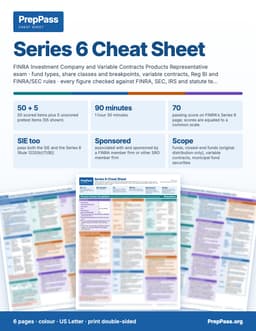
Thi trong vòng hai tuần?
Sách này là phần giảng dạy, đọc trong nhiều tuần. Nếu bạn thi trong vòng hai tuần, bảng tra cứu màu in được là sản phẩm còn lại: các con số then chốt, xếp theo từng phần.
6 trang · US Letter · PDF in được · giữ vĩnh viễn
Có gì — và không có gì
Bao gồm
- Seventeen chapters organised by topic, from new issues and communications to complaints and arbitration, with a table mapping them to FINRA's outline
- Every chapter closes with a key-facts box and a named exam-traps list
Không bao gồm
- Không gửi bản in — đây là tệp bạn tải về và có thể tự in
- Sách không kèm khoá video, giảng viên hay kèm riêng — video miễn phí trên trang là phần khác
Toàn bộ phần bao gồm và không bao gồm
Bao gồm
- Mutual-fund pricing worked step by step: NAV, public offering price, sales charges, breakpoints, letters of intent and rights of accumulation
- Variable annuities and variable life: the separate account, accumulation and annuity units, the assumed interest rate and 1035 exchanges
- Dated 2026 changes called out: the $300 gift limit, the new intraday margin standards, the ABLE account limit, FINRA Rule 3290
- 287 pages of teaching, then a question bank of 1096 practice questions, grouped by topic, with answers and explanations
- PDF (print & tab it) + EPUB (phone / e-reader)
Không bao gồm
- Không bao gồm lệ phí đăng ký thi hay phí trung tâm khảo thí — bạn vẫn nộp cho cơ quan chính thức
Mục lục
Xem 19 phần và trang bắt đầu của từng phần
- Chapter 1 — Bringing Securities to Market: Registration, Prospectuses and Exemptionstr. 11
- Chapter 2 — Communications with the Public: Advertising, Sales Literature, Seminars and Giftstr. 26
- Chapter 3 — The Investment Company Act of 1940: How a Fund Is Built and Policedtr. 42
- Chapter 4 — Mutual Funds: Types, Structure, Objectives and Feestr. 58
- Chapter 5 — NAV, Offering Price and Sales Charges: Pricing and Breakpoint Mathtr. 73
- Chapter 6 — Redemption, Exchanges, Withdrawal Plans, and How Funds and Shareholders Are Taxedtr. 86
- Chapter 7 — Closed-End Funds, Unit Investment Trusts, ETFs, Other Packaged Products and Government Poolstr. 101
- Chapter 8 — Variable Annuitiestr. 116
- Chapter 9 — Variable Life Insurancetr. 132
- Chapter 10 — Municipal Fund Securities, 529 Plans and ABLE Accountstr. 140
- Chapter 11 — Retirement Plans, Employer Plans, ERISA, Wealth Events, and Gift and Estate Taxtr. 154
- Chapter 12 — Opening Accounts, Authorizations, Privacy and Supervisiontr. 172
- Part 1. Privacy notices and opt-out (17 CFR 248.4 to 248.15):tr. 189
- Chapter 13 — Suitability, Regulation Best Interest and Portfolio Analysistr. 195
- Chapter 14 — Securities Products, Tax Rules and Financial Statementstr. 221
- Chapter 15 — Records, Confirmations, Statements and Account Transferstr. 244
- Chapter 16 — Orders, Execution, Settlement and Margintr. 259
- Chapter 17 — Errors, Complaints, Arbitration and the Regulatory Processtr. 277
- Appendix — Question Bank 1,096 practice questions with answers and explanationstr. 288
Lấy từ chính tệp PDF bạn tải về, kèm trang bắt đầu của từng phần — không phải gõ tay ở đây.
Đọc miễn phí trọn một chương
Trọn vẹn một chương, đúng như trong eBook. Cuộn cửa sổ để đọc ngay tại đây; không cần tải, không cần email.
Đọc chương 14 ngay tại đây, không rời trang
Chúng tôi không đưa phần mở đầu dễ dãi — chương miễn phí mở thẳng vào một trong những phần đậm đặc nhất của cuốn sách, để bạn đánh giá cách dạy ở đúng chỗ kỳ thi trở nên khó.
The Series 6 outline lists equities, debt, options, Treasuries, agency securities and money market instruments under the product knowledge section, and it lists the tax and financial statement topics beside them. A representative who cannot explain these cannot make a suitable recommendation, so this chapter works through each product, then the tax rules that apply to gains and losses, then the financial statements.
14.1 Equity securities
Common stock
Common stock is ownership. Holders have residual claims on assets and earnings, voting rights (statutory or cumulative), preemptive rights if the charter grants them, the right to inspect the books, and a share of dividends if declared. They are paid last in a liquidation, after creditors and preferred holders. Dividends are not guaranteed; the board declares them.
| Term | Meaning |
|---|---|
| Authorized, issued, outstanding, treasury | Authorized is the maximum the charter allows; issued has been sold; outstanding = issued less treasury; treasury stock is repurchased stock that does not vote or receive dividends |
| Statutory voting | One vote per share per director seat, no cumulating |
| Cumulative voting | Shares x number of seats can be put all on one candidate, helping minority holders |
| Stock split | More shares, lower price; no change in total value or the company's equity |
| Reverse split | Fewer shares, higher price |
| Stock dividend | Additional shares paid to holders; same total value |
Example 1. Splits. A holder owns 300 shares at $90 ($27,000). In a 3-for-2 split the holder has 300 x 3/2 = 450 shares at $90 x 2/3 = $60 ($27,000). In a 1-for-5 reverse split the holder has 300 / 5 = 60 shares at $90 x 5 = $450 ($27,000).
Example 2. Dividend yield and the ex-date. A stock pays $0.60 each quarter and trades at $48. Annual dividend $2.40; yield = 2.40 / 48 = 5.0%. Under Rule 11140, the stock goes ex-dividend on the record date under the T+1 settlement cycle (for ordinary dividends below 25% of the stock's value); a buyer who purchases on or after the ex-date does not receive the dividend. Chapter 16 covers the dividend calendar.
Preferred stock
Preferred has a fixed dividend, ranks ahead of common in dividends and liquidation, usually has no vote, and trades mainly on yield and the issuer's credit.
| Type | Feature |
|---|---|
| Cumulative | Missed dividends accumulate as "arrears" and must be paid before any common dividend |
| Non-cumulative | Missed dividends are lost |
| Participating | Shares in extra earnings beyond the stated dividend |
| Convertible | Convertible into common at a set ratio |
| Callable | The issuer can redeem, usually at a premium |
| Putable | The holder can force redemption |
| Adjustable-rate | Dividend resets with a reference rate |
Preferred prices move opposite to interest rates, as bond prices do. The par value is typically $25 or $100.
Example 3. Preferred yield. A $100 par, 5% preferred pays $5 a year. At a market price of $80, current yield = 5 / 80 = 6.25%. If the price rises to $100, the yield is 5.00%.
Example 4. Convertible parity. A convertible bond with $1,000 par is convertible at $40 a share: conversion ratio = $1,000 / $40 = 25 shares. If the stock trades at $45, parity (conversion value) = 25 x $45 = $1,125. The bond will trade at or above parity. If the bond trades at $1,150 the premium over parity is $25.
ADRs, rights and warrants
- American depositary receipts (ADRs) are receipts issued by a US depositary bank for shares of a foreign company held by a custodian abroad. They trade in dollars, pay dividends in dollars, and carry currency risk and foreign-market risk. Sponsored ADRs involve the issuer; unsponsored do not. Foreign withholding tax may apply on dividends.
- Rights are short-term (usually 30 to 60 days) offers to existing holders to buy new shares at a subscription price below market, in proportion to existing holdings, protecting preemptive rights. They are issued on a rights offering.
- Warrants are long-term (years, sometimes perpetual) options to buy stock at a fixed price above the market price at issue. They are often attached to a bond or preferred issue as a "sweetener".
Example 5. Value of a right. The stock trades at $50 cum-rights. The subscription price is $40, and 4 rights plus $40 buy one share. Value of a right while the stock still carries the right = (50 - 40) / (4 + 1) = $2.00. After the stock goes ex-rights, it should trade near $48. Then the value of one right = (48 - 40) / 4 = $2.00. The holder who sells the rights gets the same economic value as exercising them.
14.2 Debt securities
A bond is a loan. The issuer promises to pay interest (the coupon) and return the principal (par, face) at maturity. Bonds are quoted as a percentage of par, so a quote of 98 is $980 per $1,000 bond.
| Term | Meaning |
|---|---|
| Coupon rate | Annual interest as a percentage of par |
| Current yield | Annual interest / current market price |
| Yield to maturity (YTM) | The annual return if held to maturity, including the gain or loss against par and reinvestment of coupons at the same rate |
| Yield to call (YTC) | The same, assuming the bond is called on the first call date |
| Nominal yield | Coupon yield |
| Discount / par / premium | Price below / equal / above par |
The relationships to memorize:
- Price and yield move in opposite directions.
- Premium bond: coupon rate > current yield > YTM (and YTC lower still if the call price is below the bond's price).
- Discount bond: coupon rate < current yield < YTM.
- Par bond: coupon = current yield = YTM.
- Longer maturity and lower coupon mean more price sensitivity (greater duration) for a given rate change.
- Callable bonds: the investor is hurt when rates fall because the bond is called at a time of lower rates (call risk and reinvestment risk), so callable bonds pay more.
- Basis point: 0.01%. A move of 50 basis points is 0.50%.
Example 6. Current yield and yield to maturity. A 6% coupon, 10-year bond with $1,000 par trades at 95 ($950).
- Annual interest = 6% x $1,000 = $60.
- Current yield = 60 / 950 = 6.32%.
- Approximate YTM = (60 + (1,000 - 950) / 10) / ((1,000 + 950) / 2) = (60 + 5) / 975 = 6.67%. The exact YTM, solved by present value, is 6.70%. The exam asks for the order (coupon 6.00% < current yield 6.32% < YTM 6.70%), not for the exact solve.
Example 7. Accrued interest. The bond above is a corporate bond with a 6% coupon paid January 1 and July 1, and the trade settles April 15. Corporate and municipal bonds count interest on a 30/360 basis (30-day months, 360-day year): January 1 to April 15 is 3 x 30 + 14 = 104 days. Accrued interest = $1,000 x 0.06 x 104 / 360 = $17.33 per bond. The buyer pays the price plus accrued interest, and receives the full coupon on July 1. Treasury notes and bonds use actual days/actual days. A bond that trades "flat" (bonds in default, income bonds) has no accrued interest added.
Types of corporate bonds.
| Type | Feature |
|---|---|
| Secured / mortgage / equipment trust | Backed by specific assets |
| Debenture | Unsecured; backed by the issuer's credit |
| Subordinated debenture | Ranks below other debt |
| Convertible | Convertible to stock |
| Zero-coupon | Sold at a deep discount; no interest paid; accretion is taxable each year as phantom income |
| Income / adjustment bond | Pays interest only if earned |
| Floating rate | Coupon resets |
| Callable / puttable / extendable | Call and put features |
| High yield ("junk") | Rated below BBB-/Baa3 |
| Investment grade | BBB-/Baa3 and above |
Seniority in liquidation: secured creditors, then unsecured creditors (debentures), then subordinated debt, then preferred stock, then common stock. Bondholders are creditors, with a claim in bankruptcy, while stockholders are owners.
Municipal bonds were covered in Chapter 1 (official statements, and the issuance process) and Chapter 10 (municipal fund securities). The key tax point: interest on most municipal bonds is exempt from federal income tax and, if the investor lives in the issuing state, from state tax. General obligation (GO) bonds are backed by taxing power; revenue bonds by the revenue of the project. Municipal bond interest is tax-exempt, but a gain on sale is taxable as a capital gain.
Bond ratings. Moody's Aaa/Aa/A/Baa are investment grade; Ba and below are speculative. S&P and Fitch use AAA/AA/A/BBB. A rating change moves price.
14.3 Options
An option is a contract giving the holder the right, but not the obligation, to buy (call) or sell (put) the underlying at the strike price until expiration. A standard equity option covers 100 shares. Standardized listed options are issued and guaranteed by the Options Clearing Corporation (OCC). The buyer pays a premium to the seller (writer).
| Position | Market view | Maximum gain | Maximum loss | Breakeven |
|---|---|---|---|---|
| Long call | Bullish | Unlimited | Premium paid | Strike + premium |
| Short (naked) call | Neutral to bearish | Premium received | Unlimited | Strike + premium |
| Long put | Bearish | Strike - premium (stock goes to zero) | Premium paid | Strike - premium |
| Short put | Neutral to bullish | Premium received | Strike - premium | Strike - premium |
In, at and out of the money. A call is in the money if the stock is above the strike; a put is in the money if the stock is below the strike. Intrinsic value = the amount in the money (zero if not). Time value (extrinsic value) = premium - intrinsic value; it goes to zero at expiration.
Example 8. Long call. A customer buys 2 contracts of an XYZ 50 call at 3.00.
- Cost = 2 x 100 x $3 = $600; this is the maximum loss.
- Breakeven = $50 + $3 = $53.
- If XYZ is $58 at expiration the intrinsic value is $8, so the profit is (8 - 3) x 200 = $1,000.
- If XYZ is $50 or lower at expiration the options expire worthless and the loss is $600.
Example 9. Long put. Buy a 50 put at 3.00. Breakeven = 50 - 3 = $47. The maximum gain (stock to zero) = (50 - 3) x 100 = $4,700 per contract; the maximum loss is $300.
Hedging and income strategies.
| Strategy | Construction | Purpose | Result |
|---|---|---|---|
| Covered call | Own the stock, sell a call | Income; limits upside | Breakeven = stock cost - premium; gain capped at strike + premium - cost |
| Protective put | Own the stock, buy a put | Insurance for a long position | Loss limited to cost + premium - strike; breakeven = stock cost + premium |
| Married put | Buy stock and put together | Same | Same |
| Collar | Own the stock, buy a put, sell a call | Protect downside, give up upside; may be low-cost | |
| Long straddle | Buy call and put, same strike and expiry | Profits from a big move either way | Two breakevens: strike plus total premium and strike minus total premium |
| Spread | Buy and sell options of the same type | Defined risk and reward |
Example 10. Covered call. An investor buys 100 XYZ at $48 and sells a 50 call for $2.
- Breakeven = 48 - 2 = $46.
- Maximum gain = (50 + 2 - 48) x 100 = $400 (if the stock is called away at 50).
- Maximum loss = (48 - 2) x 100 = $4,600 if the stock goes to zero.
Example 11. Straddle. Buy a 50 call at 3 and a 50 put at 2. Total premium $5. Breakevens: 50 + 5 = $55 and 50 - 5 = $45. The maximum loss is $500, at a stock price of exactly $50 at expiration.
Example 12. Bull call spread. Buy a 50 call at 5, sell a 60 call at 2. Net debit $3. Maximum loss = $300; maximum gain = (10 - 3) x 100 = $700; breakeven = 50 + 3 = $53. A debit spread has a maximum loss equal to the net debit.
Other rules. Options accounts require approval and the Options Disclosure Document, and approval by a Registered Options Principal or another principal the rule permits (Rule 2360(b)(16)); a suitability standard applies to each level. Exercise of a stock option settles in the standard stock cycle, which is one business day after exercise (OCC T+1 conversion, effective 2024-05-28). Index options settle in cash. LEAPS are long-dated options. Margin on options is in Chapter 16.
Câu hỏi người mua thường hỏi
Nhận sách thế nào?
Thanh toán xong, mục tải xuống hiện ngay trên trang này. Liên kết cũng được gửi qua email. Không cần tài khoản.
Nếu sách không hợp thì sao?
Gửi email trong vòng 14 ngày để được hoàn tiền đầy đủ, không cần lý do.
Phần luyện tập miễn phí có bị bỏ không?
Không. Mọi câu hỏi luyện tập, bài thi thử tính giờ và các chương miễn phí trên trang vẫn miễn phí. Cuốn sách là nửa "học", không phải hàng rào quanh phần miễn phí.
Thêm câu hỏi (1)
Đọc trên điện thoại được không?
Được — EPUB cho điện thoại và máy đọc sách, PDF để in và dán tab. Bạn nhận cả hai.
Vì sao mua sách khi phần luyện tập miễn phí?
Câu hỏi luyện tập và bài thi thử tính giờ vẫn miễn phí — không có gì trên trang bị giấu sau cuốn sách này. Cuốn sách $24.99 là nửa "học": chính phần kiến thức, dạy theo trình tự, trong một tệp thuộc về bạn.
- Dạy có hệ thống — mọi phần thi giảng theo từng chương, từ đầu đến cuối, không chỉ là câu hỏi
- In ra & dán nhãn — PDF sẵn sàng để in, tô đậm, ghi chú và mang tới bàn học
- Học mọi nơi, ngoại tuyến — EPUB trên điện thoại hay máy đọc sách; không cần wifi, không cần tab trình duyệt
- Tất cả một chỗ — các chương và câu hỏi luyện tập trong một tệp
- Của bạn trọn đời — trả một lần $24.99, tải ngay, không thuê bao
Chi tiết
- Đối chiếu từ nguồn chính thức(FINRA content outline / SEC rules / Investment Company Act of 1940)
- 1,096 câu hỏi luyện tập miễn phí
Một Series 6 exam prep course có giá $150–$500. Cuốn sách này dạy cùng một kỳ thi — cùng quy định, đối chiếu theo chuẩn hiện hành — chỉ với $24.99 trả một lần, thuộc về bạn trọn đời.
Mua một lần, truy cập tải về trọn đời. eBook là trọn bộ hướng dẫn ôn Series 6 ở dạng PDF và EPUB. Bản tóm tắt mang tính giáo dục, không phải tư vấn chuyên môn hay pháp lý — luôn xác nhận quy định hiện hành với nguồn chính thức. Cập nhật lần cuối: October 2026.