Sách ôn thi · Ấn bản 2026
Series 63 — Securities Agent State Law Study Guide (2026)
Twelve chapters that teach the Uniform Securities Act section by section, with the conduct rules around it, written to NASAA's June 2023 test specifications.
- Độ dài
- 769 trang (182 trang giảng giải + ngân hàng câu hỏi)
- Câu hỏi luyện tập trong sách
- 1,084
- Thi thử trực tuyến PrepPass
- 60 câu · 75 phút
- Đối chiếu thông tin và cập nhật tệp
- tháng 10 năm 2026
- Giao hàng
- PDF + EPUB · tiếng Anh · tải ngay
Vui lòng đọc trước khi mua: This is an independent study aid, not affiliated with or endorsed by NASAA, FINRA, the SEC, any state securities Administrator, or any test-delivery vendor (including Prometric).
Đọc phần còn lại của thông báo
State securities law changes, varies by state, and differs between the 1956 and 2002 model Uniform Securities Acts; every rule and figure here is written to the model level Series 63 tests, but confirm the current rules and your state's adopted version before relying on any figure.
Về cuốn sách này
Lệ phí thi: $147 mỗi lần thi, nộp cho FINRA. Thi lại phải nộp lại. Cuốn sách này: $24.99, trả một lần.
Thông tin kỳ thi, ai nên dùng và thay đổi
Về chính kỳ thi này
| Cơ quan quản lý | North American Securities Administrators Association (NASAA) — kỳ thi do FINRA tổ chức Nguồn: FINRA — Series 63 – Uniform Securities Agent State Law Exam |
|---|---|
| Số câu hỏi | 65 câu hỏi (60 câu tính điểm, 5 câu thử nghiệm không tính điểm) Nguồn: FINRA — Series 63 – Uniform Securities Agent State Law Exam |
| Thời gian làm bài | 75 phút Nguồn: FINRA — Series 63 – Uniform Securities Agent State Law Exam |
| Điểm đậu | đúng 43 trên 60 câu Nguồn: FINRA — Series 63 – Uniform Securities Agent State Law Exam |
| Lệ phí |
Nguồn: NASAA — Exam FAQs |
| Ngôn ngữ thi | Tiếng Anh Nguồn: NASAA — Exam FAQs |
Xem bên trong cuốn sách
Ba trang thật, kết xuất thẳng từ tệp PDF bạn sẽ tải — lần lượt là một trang tra cứu, một trang giảng giải, và một câu hỏi có lời giải. Không trang nào được vẽ lại cho đẹp.
- Trang tra cứu nhanhAppendix — Question Bank 1,084 practice questions with answers and explanations · Trang 647 của PDF
Một trang để lật lại: các con số, mốc thời hạn hoặc thuật ngữ gom về một chỗ.
- Cách giảng dạyChapter 3 — Broker-dealers, agents, registration and the uniform forms · Trang 38 của PDF
Trang giảng giải: kiến thức được trình bày bằng văn xuôi, theo trình tự kỳ thi kiểm tra.
- Một câu hỏi có lời giảiAppendix — Question Bank 1,084 practice questions with answers and explanations · Trang 321 của PDF
Một câu luyện tập kèm đáp án và lập luận đằng sau — không chỉ là đáp án.
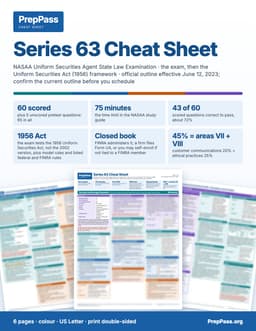
Thi trong vòng hai tuần?
Sách này là phần giảng dạy, đọc trong nhiều tuần. Nếu bạn thi trong vòng hai tuần, bảng tra cứu màu in được là sản phẩm còn lại: các con số then chốt, xếp theo từng phần.
6 trang · US Letter · PDF in được · giữ vĩnh viễn
Có gì — và không có gì
Bao gồm
- Twelve chapters that teach the Uniform Securities Act section by section, with the 1956 and 2002 Act differences flagged
- Every chapter closes with a key-facts box and a named exam-traps list
Không bao gồm
- Không gửi bản in — đây là tệp bạn tải về và có thể tự in
- Sách không kèm khoá video, giảng viên hay kèm riêng — video miễn phí trên trang là phần khác
Toàn bộ phần bao gồm và không bao gồm
Bao gồm
- NASAA's eight subject areas, with the official weights printed in the exam-at-a-glance table
- The marquee traps: agent must register versus exempt, exempt security versus exempt transaction, discretion versus time and price
- The Administrator's powers and the civil and criminal remedies
- 182 pages of teaching, then a question bank of 1084 practice questions, grouped by topic, with answers and explanations
- PDF (print & tab it) + EPUB (phone / e-reader)
Không bao gồm
- Không bao gồm lệ phí đăng ký thi hay phí trung tâm khảo thí — bạn vẫn nộp cho cơ quan chính thức
Mục lục
Xem 13 phần và trang bắt đầu của từng phần
- Chapter 1 — The Uniform Securities Act, its versions, and where it reachestr. 11
- Chapter 2 — Investment advisers and their representativestr. 18
- Chapter 3 — Broker-dealers, agents, registration and the uniform formstr. 28
- Chapter 4 — What a security is, and how securities get registered, exempted or preemptedtr. 46
- Chapter 5 — Antifraud, the Administrator’s powers, and civil and criminal liabilitytr. 65
- Chapter 6 — What customers must be told, what may not be said, and the standard of caretr. 81
- Chapter 7 — Opening accounts: new-account information, margin and optionstr. 95
- Chapter 8 — Communications with the public: advertising, social media, tombstones and bank lobbiestr. 105
- Chapter 9 — How the industry gets paid: fees, commissions, markups, disclosure and wrap accountstr. 117
- Chapter 10 — Custody, discretion, trading authority and the standard of caretr. 129
- Chapter 11 — Conflicts, prohibited conduct and the NASAA liststr. 143
- Chapter 12 — SIPC, prudent investing, privacy and recordkeepingtr. 169
- Appendix — Question Bank 1,084 practice questions with answers and explanationstr. 183
Lấy từ chính tệp PDF bạn tải về, kèm trang bắt đầu của từng phần — không phải gõ tay ở đây.
Đọc miễn phí trọn một chương
Trọn vẹn một chương, đúng như trong eBook. Cuộn cửa sổ để đọc ngay tại đây; không cần tải, không cần email.
Đọc chương 9 ngay tại đây, không rời trang
Chúng tôi không đưa phần mở đầu dễ dãi — chương miễn phí mở thẳng vào một trong những phần đậm đặc nhất của cuốn sách, để bạn đánh giá cách dạy ở đúng chỗ kỳ thi trở nên khó.
This chapter covers advisory fees, commissions, markups, disclosure of compensation (including soft dollars and referral fees) and wrap fee programs.
Why compensation gets its own chapter: it is where the interests of the seller and the customer diverge most plainly. Every rule below does one of three things. It caps what may be charged, forces it to be disclosed, or bans a payment that would skew advice.
9.1 Advisory fees
Fee structures
| Structure | How it works | Main concern |
|---|---|---|
| Asset-based fee | A percentage of assets under management, billed quarterly or monthly | Incentive to gather assets and to discourage withdrawals or paying off a mortgage |
| Hourly or fixed (flat) fee | Planning engagements | Reasonableness; refund of unearned prepaid fees |
| Performance-based fee | Share of capital gains or appreciation | Incentive to take excessive risk; limited by Advisers Act section 205 |
| Commission-based | Paid by product issuers | Conflict of interest; also may require broker-dealer registration (Chapter 3) |
| Fee plus commission | Hybrid | Disclose both; avoid double-charging |
Reasonableness and disclosure
A fee must be reasonable. NASAA Model Rule 102(a)(4)-1(j) names charging a client an unreasonable advisory fee as an unethical practice, and the broker-dealer list does the same for unreasonable fees (statement of policy item 1.m). Factors regulators consider: the fees other advisers charge for similar services; the nature and extent of services; and the size of the account. There is no single percentage cap.
Fees must be disclosed in the adviser's brochure (Form ADV Part 2A, delivered under SEC Rule 204-3 at or before entering the contract and annually thereafter), with the method of billing, whether fees are negotiable, and whether fees are billed in advance or in arrears. The written advisory contract must set out the services, the fee and how it is calculated, the duration, and the procedure for termination (Model Rule 102(a)(4)-1(p)). Fees paid in advance must be refunded pro rata on termination for the unearned portion. Under the NASAA model rules, an adviser that has custody, or that requires payment of fees of more than $500 per client six or more months in advance, files an audited balance sheet (Model Rule 203(c)-1(a)); an adviser with discretionary authority but no custody files a balance sheet that need not be audited (203(c)-1(b)), in each case within 90 days after fiscal year-end. The matching minimum net worth is $35,000 with custody, $10,000 with discretion but no custody, and a positive net worth for prepayment of more than $500 per client six or more months in advance (Model Rule 202(d)-1).
Performance-based fees (Advisers Act section 205)
Section 205(a)(1) generally prohibits an adviser from entering a contract that provides for compensation based on a share of capital gains or capital appreciation of the client's funds. The reason is the incentive to speculate with someone else's money when the adviser shares the upside and not the downside. The exceptions that matter:
- Contracts with a qualified client (Rule 205-3). A qualified client has at least a stated amount under management with the adviser, or a net worth above a stated amount (excluding the primary residence), or is a qualified purchaser, or is an executive officer, director or similar person of the adviser (or an employee who participates in investment activities and has worked for at least 12 months). The dollar thresholds are adjusted for inflation every five years. By an SEC order dated April 28, 2026 (Release IA-6961; 91 FR 23520, May 1, 2026), effective June 29, 2026, the test became at least $1,400,000 under the adviser's management (measured immediately after entering the contract) or a net worth of more than $2,700,000 (the adviser must reasonably believe this immediately before the contract; the primary residence is excluded). The old figures were $1,100,000 and $2,200,000. The order is not generally retroactive: a contract that satisfied the conditions in effect when it was entered into stays valid, but a person who becomes a new party to it later is tested under the conditions then in effect (Rule 205-3(c)(1)).
- A fulcrum fee: a fee that increases and decreases proportionately with the investment record measured against an index, over a specified period (section 205(b)(2)).
- Certain contracts with business development companies and with non-US residents.
Other points tested:
- The prohibition covers sharing in capital gains or appreciation. A fee that is a percentage of assets under management is not a performance fee, even if the assets rise.
- For performance fees the client must typically be told of the risks (incentive to take risks, valuation issues, and possible higher fees overall).
- Federal covered advisers follow section 205 as federal law. State-registered advisers are subject to section 205 through the state rule (Model Rule 102(a)(4)-1(r)), which applies the federal standard.
- The adviser may not receive compensation on the basis of a share of capital gains in a client's account for a contract that is not exempt. Penalty: the contract may be void under section 215 of the Advisers Act.
Worked example — an asset-based fee
An adviser charges 1.25% a year on $480,000, billed quarterly in advance. Annual fee = 480,000 x 0.0125 = $6,000. Quarterly = $1,500. If the client terminates after the first month of a quarter has passed, the unearned portion is two months of three: $1,000 is refunded (assuming a pro rata refund and no other charges).
Scenario 1: the performance fee
An adviser tells a client with $400,000 in liquid assets and $900,000 net worth: "I charge 20% of your gains each year and nothing on losses." The client has no other assets.
Analysis. Under the thresholds now in force, $400,000 managed is below $1.4 million and net worth of $900,000 is below $2.7 million, and the client is not a qualified purchaser. The client is not a qualified client. The performance fee is prohibited. Under the old thresholds the answer would also have been "no." The adviser should use an asset-based fee.
9.2 Commissions
A commission is what a broker-dealer charges for acting as agent: executing a trade for a customer's account and receiving a fee for the service, without selling from its own inventory.
Reasonableness: FINRA Rule 2121 and the 5% policy
FINRA Rule 2121 says a member must buy or sell securities at a price that is fair, taking into consideration all relevant circumstances including market conditions, expenses involved, and the fact that the member is entitled to a profit; if acting as agent, the commission must be fair. Supplementary Material .01 contains the 5% Policy. Points confirmed in the text:
- It is a guide, not a rule. There is no safe harbor at or below 5% and no automatic violation above it. "A mark-up pattern of 5% or even less may be considered unfair or unreasonable."
- It applies to all securities, including fixed income, in these transactions: a riskless principal trade (the firm buys in the market to fill a customer order it already has), a sale from inventory, a purchase from a customer (the "markdown"), agency commission, and certain proceeds transactions.
- The factors for fairness: the type of security; the availability of the security in the market (thinly traded securities justify more); the price (a lower price generally supports a higher percentage); the amount of money involved (small trades justify a higher percentage); disclosure; the pattern of markups; and the nature of the member's business.
- Disclosure helps but does not cure. Telling the customer the markup beforehand is a factor, but it does not justify an unfair one.
- The key figure is the markup over the prevailing market price. In the absence of other evidence, the member's own contemporaneous cost is the best evidence of the prevailing market price.
- Excessive expenses cannot be used to justify a high markup.
- Public offerings at the stated price are outside the policy. Supplementary Material .01(d) says the Mark-Up Policy "is not applicable to the sale of securities where a prospectus or offering circular is required to be delivered and the securities are sold at the specific public offering price." The price is fixed and disclosed in the prospectus, so there is no dealer-set markup to test. The exclusion does not depend on whether the buyer is retail or institutional, and it covers the selling dealer as well as the underwriter.
Commissions from the customer's side
- A commission of 2% on a $15,000 trade = $300.
- A commission can be negotiated; a firm may charge different customers different rates, but it must not discriminate unfairly and should apply a published schedule consistently.
- Breakpoints (Chapter 6 context): mutual fund sales charges decline as the amount invested grows. FINRA Rule 2341 sets the outer limits: aggregate sales charges not above 8.5% of the offering price for funds without an asset-based sales charge (lower if the fund lacks specified features such as rights of accumulation or quantity discounts), an asset-based sales charge of no more than 0.75% of average net assets per year, and service fees of no more than 0.25% a year. A fund that has a sales charge or total sales-related charges and service fees above 0.25% of average net assets cannot be called "no-load."
- Breakpoint and letter-of-intent disclosure. NASAA's Statement of Policy on dishonest or unethical practices in connection with investment company shares (adopted April 27, 1997, item A.3) treats it as unethical, in soliciting investment company shares, to fail to disclose to a customer any relevant (i) sales charge discount on purchases at or above a breakpoint, or (ii) letter of intent feature, if available, that will reduce the sales charge. Example: a customer plans to invest $48,000 in a fund family whose sales charge falls at $50,000. The agent must tell the customer about the breakpoint discount and any letter of intent, so the customer can decide whether to invest more. Saying nothing is the violation.
- 12b-1 fees pay for distribution and shareholder services out of fund assets. FINRA Rule 2341(d) limits the asset-based sales charge to .75 of 1% per year of average net assets and the service fees to .25 of 1% per year; these are two separate caps, and together they give the 1.00% annual ceiling used in exam questions.
Worked example — is the commission within the 5% guide?
A customer buys $15,000 of stock through an agent. The firm charges $300. $300 / $15,000 = 2.0%. This sits well below the 5% guide but must still be fair in light of the factors. For a $1,000 trade of a thinly traded $2 stock, a $50 commission (5%) is within the guide; $90 (9%) would invite scrutiny.
9.3 Markups and markdowns
When a broker-dealer acts as principal, it sells from, or buys for, its own account. It earns a markup (the difference between the price paid by the customer and the prevailing market price) when it sells to a customer, and a markdown when it buys from one. Customers must be told whether the firm acted as agent or principal on the confirmation (SEC Rule 10b-10). The firm that makes a market and sells to the customer owes disclosure of that role.
Computations
Markup is based on prevailing market price (the firm's contemporaneous cost is the best evidence if no other).
- Percentage markup = (price to customer - prevailing market price) / prevailing market price.
- Dollar markup = per-share markup x shares.
Example 1 (inventory sale). Prevailing market price $48; the customer pays $50 for 200 shares. Per-share markup = $2. Dollar markup = 2 x 200 = $400. Percentage = 2 / 48 = 4.17% (4.1667%).
Example 2 (riskless principal). Customer orders 100 shares. The firm buys at $20 and immediately sells to the customer at $21. Markup = $1 per share = $100 = 1 / 20 = 5.00%. Because the firm filled an existing order with a simultaneous purchase, its cost is the prevailing market price. A 5.00% markup is at the guide and would call for scrutiny of the factors, particularly on a low-priced security.
Example 3 (markdown or cost basis). The firm bought at 11.40 and sold at 12.00 on 1,000 shares. Markup = $0.60 x 1,000 = $600 = 0.60 / 11.40 = 5.26%, which is above the guide.
(All three computations were checked with a script.)
Where else markups appear
- Municipal and fixed income markups are judged under MSRB Rule G-30 and FINRA 2121 respectively. A different test than equities, but the same fairness principle. [not in scope for the state-law exam]
- Markups on inactive or low-priced securities and penny stocks attract more attention: broker-dealers must disclose compensation on penny stock sales (Rule 15g-4) and the NASAA statement of policy lists charging unreasonable prices (item 1.k) as unethical.
- Charging a price not reasonably related to the market is a violation of FINRA Rules 2010 and 2121, and it is a dishonest practice under the state act (section 204(a)(2)(G)).
Scenario 2: the thin bond
A firm buys a thinly traded corporate bond at 82 and sells it to a retiree at 90 minutes later. The firm tells the customer, "We are acting as principal." There is no mention of the markup.
Analysis. Markup = 8 / 82 = 9.76%. Disclosure that it acted as principal is required, but the markup is far above the 5% guide with no strong justification, and the disclosure did not mention the amount. The firm must be able to justify it using the factors (thin trading, size, etc.). It likely cannot. Cost is the best evidence of prevailing market because the sale followed the purchase. The price is not reasonably related to the market.
Câu hỏi người mua thường hỏi
Nhận sách thế nào?
Thanh toán xong, mục tải xuống hiện ngay trên trang này. Liên kết cũng được gửi qua email. Không cần tài khoản.
Nếu sách không hợp thì sao?
Gửi email trong vòng 14 ngày để được hoàn tiền đầy đủ, không cần lý do.
Phần luyện tập miễn phí có bị bỏ không?
Không. Mọi câu hỏi luyện tập, bài thi thử tính giờ và các chương miễn phí trên trang vẫn miễn phí. Cuốn sách là nửa "học", không phải hàng rào quanh phần miễn phí.
Thêm câu hỏi (1)
Đọc trên điện thoại được không?
Được — EPUB cho điện thoại và máy đọc sách, PDF để in và dán tab. Bạn nhận cả hai.
Vì sao mua sách khi phần luyện tập miễn phí?
Câu hỏi luyện tập và bài thi thử tính giờ vẫn miễn phí — không có gì trên trang bị giấu sau cuốn sách này. Cuốn sách $24.99 là nửa "học": chính phần kiến thức, dạy theo trình tự, trong một tệp thuộc về bạn.
- Dạy có hệ thống — mọi phần thi giảng theo từng chương, từ đầu đến cuối, không chỉ là câu hỏi
- In ra & dán nhãn — PDF sẵn sàng để in, tô đậm, ghi chú và mang tới bàn học
- Học mọi nơi, ngoại tuyến — EPUB trên điện thoại hay máy đọc sách; không cần wifi, không cần tab trình duyệt
- Tất cả một chỗ — các chương và câu hỏi luyện tập trong một tệp
- Của bạn trọn đời — trả một lần $24.99, tải ngay, không thuê bao
Chi tiết
- Đối chiếu từ nguồn chính thức(Uniform Securities Act / NASAA test specifications and model rules)
- 1,084 câu hỏi luyện tập miễn phí
Một Series 63 exam prep course có giá $150–$500. Cuốn sách này dạy cùng một kỳ thi — cùng quy định, đối chiếu theo chuẩn hiện hành — chỉ với $24.99 trả một lần, thuộc về bạn trọn đời.
Mua một lần, truy cập tải về trọn đời. eBook là trọn bộ hướng dẫn ôn Series 63 ở dạng PDF và EPUB. Bản tóm tắt mang tính giáo dục, không phải tư vấn chuyên môn hay pháp lý — luôn xác nhận quy định hiện hành với nguồn chính thức. Cập nhật lần cuối: October 2026.