Sách ôn thi · Ấn bản 2026
Series 66 — Uniform Combined State Law — Complete Study Guide (2026)
Nineteen chapters that follow NASAA's four content areas, law first.
- Độ dài
- 747 trang (193 trang giảng giải + ngân hàng câu hỏi)
- Câu hỏi luyện tập trong sách
- 1,161
- Thi thử trực tuyến PrepPass
- 100 câu · 150 phút
- Đối chiếu thông tin và cập nhật tệp
- tháng 10 năm 2026
- Giao hàng
- PDF + EPUB · tiếng Anh · tải ngay
Vui lòng đọc trước khi mua: This is an independent study aid, not affiliated with or endorsed by NASAA, FINRA, or Prometric.
Đọc phần còn lại của thông báo
The Series 66 is a NASAA exam administered by FINRA; this guide is authored from the public Uniform Securities Act, NASAA model rules, and the Investment Advisers Act of 1940. Some dollar thresholds (the qualified-client net worth/AUM figures, the gift-tax exclusion) are indexed and change — this guide teaches the underlying rules and flags indexed figures to 'verify current year'; it is general educational information, not legal or investment advice.
Về cuốn sách này
Nineteen chapters that follow NASAA's four content areas, law first: the Uniform Securities Act, NASAA model rules and the Investment Advisers Act of 1940, plus the economics and product knowledge the Series 66 tests.
Lệ phí thi: $177 mỗi lần thi, nộp cho FINRA. Thi lại phải nộp lại. Cuốn sách này: $24.99, trả một lần.
Thông tin kỳ thi, ai nên dùng và thay đổi
Về chính kỳ thi này
| Cơ quan quản lý | North American Securities Administrators Association (NASAA) — kỳ thi do FINRA tổ chức |
|---|---|
| Số câu hỏi | 110 câu hỏi (100 câu tính điểm, 10 câu thử nghiệm không tính điểm) |
| Thời gian làm bài | 150 phút |
| Điểm đậu | đúng 73 trên 100 câu |
| Lệ phí |
Nguồn: NASAA — Exam FAQs |
| Ngôn ngữ thi | Tiếng Anh Nguồn: NASAA — Exam FAQs |
Xem bên trong cuốn sách
Ba trang thật, kết xuất thẳng từ tệp PDF bạn sẽ tải — lần lượt là một trang tra cứu, một trang giảng giải, và một câu hỏi có lời giải. Không trang nào được vẽ lại cho đẹp.
- Trang tra cứu nhanhAppendix — Question Bank 1,161 practice questions with answers and explanations · Trang 628 của PDF
Một trang để lật lại: các con số, mốc thời hạn hoặc thuật ngữ gom về một chỗ.
- Cách giảng dạyChapter 14 — Equity and Valuation Common stock, ADRs and shareholder rights · Trang 153 của PDF
Trang giảng giải: kiến thức được trình bày bằng văn xuôi, theo trình tự kỳ thi kiểm tra.
- Một câu hỏi có lời giảiAppendix — Question Bank 1,161 practice questions with answers and explanations · Trang 356 của PDF
Một câu luyện tập kèm đáp án và lập luận đằng sau — không chỉ là đáp án.
Thi trong vòng hai tuần?
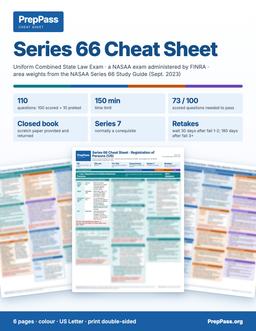
Sách này là phần giảng dạy, đọc trong nhiều tuần. Nếu bạn thi trong vòng hai tuần, bảng tra cứu màu in được là sản phẩm còn lại: các con số then chốt, xếp theo từng phần.
6 trang · US Letter · PDF in được · giữ vĩnh viễn
Có gì — và không có gì
Bao gồm
- Nineteen chapters covering NASAA's four content areas, law first (45%), with a table mapping the chapters to the official weights
- Every chapter closes with a key-facts box and a named exam-traps list
Không bao gồm
- Không gửi bản in — đây là tệp bạn tải về và có thể tự in
- Sách không kèm khoá video, giảng viên hay kèm riêng — video miễn phí trên trang là phần khác
Toàn bộ phần bao gồm và không bao gồm
Bao gồm
- Registration of broker-dealers, agents, advisers and representatives, exempt securities versus exempt transactions, Administrator powers, the Investment Advisers Act of 1940 and fiduciary duty
- Worked math: Sharpe ratio, beta, CAPM, taxable-equivalent yield, duration, time value of money
- Prohibited and unethical business practices, the most heavily tested trap area
- 193 pages of teaching, then a question bank of 1161 practice questions, grouped by topic, with answers and explanations
- PDF (print & tab it) + EPUB (phone / e-reader)
Không bao gồm
- Không bao gồm lệ phí đăng ký thi hay phí trung tâm khảo thí — bạn vẫn nộp cho cơ quan chính thức
Mục lục
Xem 21 phần và trang bắt đầu của từng phần
- Chapter 1 — Federal Law Foundationstr. 11
- Section 15: broker-dealers register with the SEC, join a self-regulatorytr. 21
- Chapter 2 — Adviser Registration and Compliance Investment adviser representatives, qualificationtr. 24
- Chapter 3 — Broker-Dealer and Agent Registration, Records and Supervisiontr. 33
- Chapter 4 — The State Act, 1956 and 2002, and Communicationstr. 42
- Chapter 5 — Conduct, AML, Privacy, Seniors and Due Diligencetr. 54
- Chapter 6 — FINRA Rules and Regulation Best Interesttr. 64
- Chapter 7 — Client Types and Profilingtr. 70
- Chapter 8 — Strategies and Techniques Modern portfolio theory and the efficient frontiertr. 78
- Chapter 9 — Taxation Income tax brackets and marginal rates (2026)tr. 85
- Chapter 10 — Retirement Plans and ERISA Retirement plan types and 2026 limitstr. 95
- Chapter 11 — Education, Health, Ownership and Estatetr. 107
- Chapter 12 — Trading and Returns Order types and how they executetr. 119
- Chapter 13 — Cash and Fixed Income Insured deposits and the money markettr. 130
- Chapter 14 — Equity and Valuation Common stock, ADRs and shareholder rightstr. 142
- Chapter 15 — Offerings and Equity Compensationtr. 151
- Chapter 16 — Pooled Products and Derivatives Unit investment trusts, ETFs and REITstr. 160
- Chapter 17 — Annuities, Insurance, Alternatives and Digital Assetstr. 172
- Chapter 18 — Quantitative Methodstr. 181
- Chapter 19 — Financial Ratios and Valuation Modelstr. 188
- Appendix — Question Bank 1,161 practice questions with answers and explanationstr. 194
Lấy từ chính tệp PDF bạn tải về, kèm trang bắt đầu của từng phần — không phải gõ tay ở đây.
Đọc miễn phí trọn một chương
Trọn vẹn một chương, đúng như trong eBook. Cuộn cửa sổ để đọc ngay tại đây; không cần tải, không cần email.
Đọc chương 18 ngay tại đây, không rời trang
Chúng tôi không đưa phần mở đầu dễ dãi — chương miễn phí mở thẳng vào một trong những phần đậm đặc nhất của cuốn sách, để bạn đánh giá cách dạy ở đúng chỗ kỳ thi trở nên khó.
Time value of money: future value, present value, NPV and IRR
Money received sooner is worth more than money received later, because it can be invested. All the formulas below use one idea: moving a dollar amount across time at a rate of return.
Future value
FV = PV x (1 + r)^n
Worked example. $10,000 invested at 6% a year for 8 years: $10,000 x 1.06^8 = $10,000 x 1.5938 = $15,938.48.
If interest compounds quarterly the rate per period is 6% / 4 = 1.5% and there are 8 x 4 = 32 periods: $10,000 x 1.015^32 = $16,103.24. More frequent compounding gives a larger amount.
Rule of 72. Years to double is about 72 divided by the annual rate in percent. At 6%, 72 / 6 = 12 years. Check: $10,000 x 1.06^12 = $20,121.96. The rule is an approximation that works best between 6% and 10%.
Present value
PV = FV / (1 + r)^n
Worked example. A client wants $20,000 in 5 years and can earn 7%. PV = $20,000 / 1.07^5 = $20,000 / 1.4026 = $14,259.72. The client needs $14,259.72 today.
Present value of a series. To receive $1,000 at the end of each year for 5 years with a 6% discount rate, discount each payment: $943.40 + $890.00 + $839.62 + $792.09 + $747.26 = $4,212.36.
A higher discount rate gives a lower present value; a longer time gives a lower present value.
Net present value
NPV is the sum of the present values of all cash flows, including the initial outlay, discounted at the required rate of return.
Worked example. A project costs $10,000 now and returns $3,000, $4,000 and $5,000 at the end of years 1, 2 and 3. The required return is 8%.
| Year | Cash flow | Discount factor | Present value |
|---|---|---|---|
| 0 | -$10,000 | 1.0000 | -$10,000.00 |
| 1 | $3,000 | 1/1.08 | $2,777.78 |
| 2 | $4,000 | 1/1.08^2 | $3,429.36 |
| 3 | $5,000 | 1/1.08^3 | $3,969.16 |
| NPV | +$176.29 |
NPV is positive, so the project earns more than 8% and adds value. Decision rule: accept if NPV is greater than zero; reject if negative. The profitability index (present value of inflows / outlay) is 10,176.29 / 10,000 = 1.018.
Internal rate of return
IRR is the discount rate at which NPV equals zero. There is no direct formula. Solve by trying rates.
Worked example (same project).
| Trial rate | NPV |
|---|---|
| 8% | +$176.29 |
| 9% | -$20.07 |
| 10% | -$210.37 |
The sign changes between 8% and 9%, so the IRR is just under 9%. Linear interpolation between 8% and 10%: 8% + 2% x 176.29 / (176.29 + 210.37) = 8% + 0.91% = 8.91%. Refining gives IRR = 8.90%. At 8.90%, NPV is almost exactly zero.
Decision rule: accept if IRR is greater than the required return (8.90% > 8%: accept). The NPV and IRR rules agree here.
When NPV and IRR disagree. For mutually exclusive projects of different size or cash-flow timing, IRR can rank the projects differently than NPV. NPV assumes cash flows are reinvested at the required rate; IRR assumes reinvestment at the IRR itself, which is less realistic. A project with cash flows that change sign more than once can have more than one IRR. In these cases NPV is the better guide because it measures the dollar value added.
Where it appears in advice. IRR is used to compare investments with irregular cash flows, such as private equity. The money-weighted return of a portfolio with deposits and withdrawals is an IRR.
Key facts — Time value of money: future value, present value, NPV and IRR - FV = PV x (1 + r)^n; PV = FV / (1 + r)^n. - Rule of 72: doubling time = 72 / rate. - NPV > 0: accept. IRR > required return: accept. - IRR is the rate at which NPV = 0. - NPV is preferred when NPV and IRR conflict.
Exam traps
- Using the annual rate with monthly periods.
- Forgetting the initial outlay in NPV.
- Assuming a higher IRR project is always better than a larger project with a higher NPV.
Descriptive statistics: mean, median, mode, range and standard deviation
Mean, median, mode and range
Worked example. A fund's monthly returns (in percent) over seven months: 4, 8, 6, 5, 3, 8, 9.
- Sort: 3, 4, 5, 6, 8, 8, 9.
- Mean = (4 + 8 + 6 + 5 + 3 + 8 + 9) / 7 = 43 / 7 = 6.14.
- Median = the middle value of the sorted list = 6. With an even count, the median is the average of the two middle values; for 2, 4, 7, 9 the median is (4 + 7) / 2 = 5.5.
- Mode = the most frequent value = 8.
- Range = highest minus lowest = 9 - 3 = 6.
The median is not changed by an outlier; the mean is. If the last value were 90, the mean would jump while the median would stay at 6.
Arithmetic and geometric mean. The arithmetic mean averages the returns. The geometric mean gives the true compound rate. A fund that gains 50% one year and loses 50% the next has an arithmetic mean of (50% + (-50%)) / 2 = 0%, but $100 becomes $150 then $75. The geometric mean is the square root of (1.50 x 0.50) minus 1 = square root of 0.75 minus 1 = -13.40% a year. The geometric mean is always at most the arithmetic mean, and the gap grows with volatility.
Standard deviation, calculated by hand
Standard deviation (SD) measures how far returns scatter around their mean. It is the square root of the variance.
Worked example. Four annual returns: 10%, 4%, -2%, 8%.
- Mean = (10 + 4 - 2 + 8) / 4 = 5.
- Deviations from the mean: 5, -1, -7, 3.
- Squared deviations: 25, 1, 49, 9. Sum = 84.
- Population variance (divide by n = 4) = 84 / 4 = 21. SD = square root of 21 = 4.58%.
- Sample variance (divide by n - 1 = 3) = 84 / 3 = 28. SD = square root of 28 = 5.29%.
Use the sample SD when the returns are a sample of a longer record (the usual case for a fund's history); use the population SD when the data are the whole group.
Interpretation. For a roughly normal distribution, about 68% of outcomes fall within one SD of the mean, 95% within two, and 99.7% within three. A fund with a mean return of 8% and an SD of 12% has a 68% range of -4% to 20% and a 95% range of -16% to 32%.
Coefficient of variation = SD / mean, the risk per unit of return. Fund A has mean 8%, SD 12%: 1.50. Fund B has mean 6%, SD 6%: 1.00. Fund B has less risk per unit of return.
Key facts — Descriptive statistics: mean, median, mode, range and standard deviation - Mean is sensitive to outliers; median is not. - Range = highest - lowest. - Population SD divides by n; sample SD divides by n - 1. - About 68%, 95%, 99.7% within 1, 2, 3 SDs for normally distributed returns. - Geometric mean is at most the arithmetic mean.
Exam traps
- Reading SD as a loss measure. It measures dispersion in both directions.
- Using the arithmetic mean to describe multi-year growth.
- A data set can have no mode, or more than one mode.
Covariance, correlation and combined risk
Covariance measures whether two assets tend to move together. Correlation rescales covariance to a number between -1 and +1:
Correlation = covariance(X, Y) / (SD of X x SD of Y)
Worked example. Annual returns of two funds over four years (in percent):
| Year | Fund X | Fund Y |
|---|---|---|
| 1 | 10 | 6 |
| 2 | 4 | 3 |
| 3 | -2 | 5 |
| 4 | 8 | -2 |
| Mean | 5 | 3 |
- Deviations of X: 5, -1, -7, 3. Deviations of Y: 3, 0, 2, -5.
- Products: 5 x 3 = 15; -1 x 0 = 0; -7 x 2 = -14; 3 x -5 = -15. Sum = -14.
- Sample covariance = -14 / 3 = -4.667.
- SD of X (sample) = 5.29 (from the earlier example). Squared deviations of Y: 9, 0, 4, 25 = 38; variance = 38 / 3 = 12.667; SD of Y = 3.56.
- Correlation = -4.667 / (5.29 x 3.56) = -0.248.
The correlation is weakly negative. Combining the funds should reduce portfolio risk.
Why correlation matters: a two-asset portfolio. Portfolio SD is not the weighted average of the SDs. For weights w1 and w2:
SD(portfolio) = square root of [ (w1 x SD1)^2 + (w2 x SD2)^2 + 2 x w1 x w2 x SD1 x SD2 x correlation ]
With 60% in a stock fund (SD 20%) and 40% in a bond fund (SD 10%), correlation 0.3:
- (0.60 x 20)^2 = 144
- (0.40 x 10)^2 = 16
- 2 x 0.60 x 0.40 x 20 x 10 x 0.3 = 28.8
- Variance = 144 + 16 + 28.8 = 188.8. SD = 13.74%.
The weighted average of the SDs is 0.6 x 20 + 0.4 x 10 = 16%. Diversification cut the risk to 13.74%. If the correlation were +1, the portfolio SD would equal 16%, so there would be no diversification benefit. The lower the correlation, the larger the benefit; at -1 risk can be eliminated with the right weights. Diversification reduces unsystematic risk only; it cannot reduce market risk.
R-squared is the square of the correlation with a benchmark: the share of a fund's movement explained by the benchmark. A correlation of 0.9 gives R-squared of 0.81, meaning 81%.
R-squared is usually read together with tracking error, the amount by which a fund's returns deviate from its benchmark's. A high R-squared says the fund moves with the benchmark. A low tracking error says its returns stay close to the benchmark's. An adviser who wants to know how closely a fund follows its index looks at both: R-squared close to 1 (100%) and a small tracking error describe an index-like fund. Sharpe ratio and standard deviation describe risk-adjusted return and volatility, and beta describes sensitivity to the market; none of them measures how closely a fund follows a benchmark.
Key facts — Covariance, correlation and combined risk - Correlation ranges from -1 to +1. Covariance has no fixed range. - Portfolio SD is less than the weighted average SD unless correlation is +1. - R-squared = correlation squared. - R-squared plus tracking error measure how closely a fund follows its benchmark.
Exam traps
- Correlation of zero means no linear relationship, not no risk.
- A negative covariance does not mean negative returns.
- Diversification does not remove systematic risk.
Câu hỏi người mua thường hỏi
Nhận sách thế nào?
Thanh toán xong, mục tải xuống hiện ngay trên trang này. Liên kết cũng được gửi qua email. Không cần tài khoản.
Nếu sách không hợp thì sao?
Gửi email trong vòng 14 ngày để được hoàn tiền đầy đủ, không cần lý do.
Phần luyện tập miễn phí có bị bỏ không?
Không. Mọi câu hỏi luyện tập, bài thi thử tính giờ và các chương miễn phí trên trang vẫn miễn phí. Cuốn sách là nửa "học", không phải hàng rào quanh phần miễn phí.
Thêm câu hỏi (1)
Đọc trên điện thoại được không?
Được — EPUB cho điện thoại và máy đọc sách, PDF để in và dán tab. Bạn nhận cả hai.
Vì sao mua sách khi phần luyện tập miễn phí?
Câu hỏi luyện tập và bài thi thử tính giờ vẫn miễn phí — không có gì trên trang bị giấu sau cuốn sách này. Cuốn sách $24.99 là nửa "học": chính phần kiến thức, dạy theo trình tự, trong một tệp thuộc về bạn.
- Dạy có hệ thống — mọi phần thi giảng theo từng chương, từ đầu đến cuối, không chỉ là câu hỏi
- In ra & dán nhãn — PDF sẵn sàng để in, tô đậm, ghi chú và mang tới bàn học
- Học mọi nơi, ngoại tuyến — EPUB trên điện thoại hay máy đọc sách; không cần wifi, không cần tab trình duyệt
- Tất cả một chỗ — các chương và câu hỏi luyện tập trong một tệp
- Của bạn trọn đời — trả một lần $24.99, tải ngay, không thuê bao
Chi tiết
- Đối chiếu từ nguồn chính thức(Uniform Securities Act, NASAA test specifications and model rules, and the Investment Advisers Act of 1940)
- 1,161 câu hỏi luyện tập miễn phí
Một Series 66 prep course có giá $400–$800. Cuốn sách này dạy cùng một kỳ thi — cùng quy định, đối chiếu theo chuẩn hiện hành — chỉ với $24.99 trả một lần, thuộc về bạn trọn đời.
Mua một lần, truy cập tải về trọn đời. eBook là trọn bộ hướng dẫn ôn NASAA Series 66 (Uniform Combined State Law) ở dạng PDF và EPUB. Bản tóm tắt mang tính giáo dục, không phải tư vấn chuyên môn hay pháp lý — luôn xác nhận quy định hiện hành với nguồn chính thức. Cập nhật lần cuối: October 2026.