Sách ôn thi · Ấn bản 2026
Series 7 — General Securities Representative Study Guide (2026)
Thirty-three chapters written to FINRA's Series 7 content outline.
- Độ dài
- 1,031 trang (528 trang giảng giải + ngân hàng câu hỏi)
- Câu hỏi luyện tập trong sách
- 1,176
- Thi thử trực tuyến PrepPass
- 125 câu · 225 phút
- Đối chiếu thông tin và cập nhật tệp
- tháng 10 năm 2026
- Giao hàng
- PDF + EPUB · tiếng Anh · tải ngay
Vui lòng đọc trước khi mua: This is an independent study aid, not affiliated with or endorsed by FINRA, the SEC, MSRB, the OCC, or any test-delivery vendor (including Prometric).
Đọc phần còn lại của thông báo
Securities rules change and many figures (contribution limits, gift limits) are indexed or were recently updated; confirm the current rules before you rely on any figure.
Về cuốn sách này
Thirty-three chapters written to FINRA's Series 7 content outline: options, margin, municipals, bonds and every product a representative recommends, with the math worked step by step.
Lệ phí thi: $395 mỗi lần thi, nộp cho FINRA. Thi lại phải nộp lại. Cuốn sách này: $24.99, trả một lần.
Thông tin kỳ thi, ai nên dùng và thay đổi
Về chính kỳ thi này
| Cơ quan quản lý | Financial Industry Regulatory Authority (FINRA) Nguồn: FINRA — Series 7 – General Securities Representative Exam (GS) |
|---|---|
| Số câu hỏi | 130 câu hỏi (125 câu tính điểm, 5 câu thử nghiệm không tính điểm) |
| Thời gian làm bài | 225 phút |
| Điểm đậu | FINRA (scale range) không công bố Những trang chúng tôi đã đọc và không tìm thấy: FINRA — Series 7 – General Securities Representative Exam (GS) |
| Lệ phí |
Nguồn: FINRA — Series 7 – General Securities Representative Exam (GS) |
| Ngôn ngữ thi | FINRA không công bố Những trang chúng tôi đã đọc và không tìm thấy: FINRA — Series 7 – General Securities Representative Exam (GS) |
Xem bên trong cuốn sách
Ba trang thật, kết xuất thẳng từ tệp PDF bạn sẽ tải — lần lượt là một trang tra cứu, một trang giảng giải, và một câu hỏi có lời giải. Không trang nào được vẽ lại cho đẹp.
- Trang tra cứu nhanhSection 7 — Government securities, CMOs and CDs · Trang 29 của PDF
Một trang để lật lại: các con số, mốc thời hạn hoặc thuật ngữ gom về một chỗ.
- Cách giảng dạyChapter 8 — Margin Accounts and Margin Calculations · Trang 240 của PDF
Trang giảng giải: kiến thức được trình bày bằng văn xuôi, theo trình tự kỳ thi kiểm tra.
- Một câu hỏi có lời giảiSection 1 — FINRA Rule 2210: the master rule for communications · Trang 16 của PDF
Một câu luyện tập kèm đáp án và lập luận đằng sau — không chỉ là đáp án.
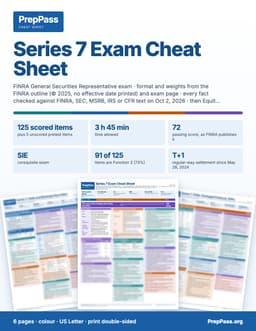
Thi trong vòng hai tuần?
Sách này là phần giảng dạy, đọc trong nhiều tuần. Nếu bạn thi trong vòng hai tuần, bảng tra cứu màu in được là sản phẩm còn lại: các con số then chốt, xếp theo từng phần.
6 trang · US Letter · PDF in được · giữ vĩnh viễn
Có gì — và không có gì
Bao gồm
- Thirty-three chapters organised by topic, with a table mapping them to FINRA's four outline functions; most of the book is the recommendation and product knowledge that is most of the exam
- Key-facts boxes and named exam-traps lists inside the chapters
Không bao gồm
- Không gửi bản in — đây là tệp bạn tải về và có thể tự in
- Sách không kèm khoá video, giảng viên hay kèm riêng — video miễn phí trên trang là phần khác
Toàn bộ phần bao gồm và không bao gồm
Bao gồm
- The options math worked step by step: breakeven, maximum gain and loss, spreads, straddles, hedging
- Margin and Regulation T, bond and municipal math, MSRB rules, packaged products and customer accounts
- Dated 2026 changes called out: the $300 gift limit, the new intraday margin standards, FINRA Rule 3290 (approved, no effective date yet)
- 528 pages of teaching, then a question bank of 1176 practice questions, grouped by topic, with answers and explanations
- PDF (print & tab it) + EPUB (phone / e-reader)
Không bao gồm
- Không bao gồm lệ phí đăng ký thi hay phí trung tâm khảo thí — bạn vẫn nộp cho cơ quan chính thức
Mục lục
Xem 60 phần và trang bắt đầu của từng phần
- Chapter 1 — Communications, Contact Rules and Protecting Customers From Fraudtr. 12
- Section 1 — FINRA Rule 2210: the master rule for communicationstr. 12
- Section 2 — Seminars, lectures and other group forumstr. 19
- Section 3 — Investment company and variable contract communicationstr. 21
- Section 4 — Options communications and the Options Disclosure Documenttr. 23
- Section 5 — Municipal securities advertising: MSRB Rule G-21tr. 26
- Section 6 — Research reports and quiet periodstr. 27
- Section 7 — Government securities, CMOs and CDstr. 29
- Section 9 — Identity theft (Regulation S-ID), AML red flags and senior investorstr. 35
- Chapter 2 — How New Securities Reach the Markettr. 39
- Section 2.1 The sequence of a registered corporate offeringtr. 39
- Section 2.2 IPO communications and the anti- abuse rulestr. 47
- Section 2.3 Underwriters, syndicates and the spreadtr. 51
- Section 2.4 Municipal primary offeringstr. 56
- Section 2.5 Other statutes touching an offeringtr. 60
- Section 2.6 FINRA rules for offerings and firm arrangementstr. 63
- Section 2.7 — Exempt Offerings, Private Placements and Resalestr. 66
- Chapter 3 — Opening and Maintaining Customer Accountstr. 83
- Section 3.1 — Account types: day trading, prime brokerage, DVP/RVP, advisorytr. 83
- Section 3.2 — Account registration typestr. 87
- Section 3.3 — Opening an account: FINRA Rule 4512 and the new account formtr. 91
- Section 3.4 — Retirement plans: IRAstr. 94
- Section 3.5 — Employer plans, ERISA, and equity compensationtr. 98
- Section 3.6 — Education savings: 529 plans and Coverdell ESAstr. 104
- Section 3.7 — Wealth events, decedent accounts, and changes in registrationtr. 107
- Section 3.8 — Customer screening: CIP, KYC, residency, insiders and industry employeestr. 109
- Section 3.9 — Privacy and information security: Regulation S-Ptr. 113
- Section 3.10 — Authority to act: POA, trading authorization, discretion, entity documentstr. 116
- Section 3.11 — Putting it together: the account- opening sequencetr. 119
- Chapter 4 — Knowing the Customer, Recommending, and Supervising the Accounttr. 120
- Section 1 — The essential facts about every customertr. 120
- Section 2 — The financial factors and how each steers a recommendationtr. 123
- Section 3 — Investment objectivestr. 128
- Section 4 — Suitability under Rule 2111, and what Reg BI replacedtr. 129
- Section 5 — Strategies, “hold” recommendations, and verifying accreditation and sophisticationtr. 132
- Section 6 — Regulation Best Interest, Form CRS, and Rule 2214tr. 135
- Section 7 — Principal review, approvals and documentationtr. 141
- Section 8 — Receipt, delivery and safeguarding of cash, checks and securitiestr. 144
- Section 9 — Refusing, restricting and closing accountstr. 148
- Chapter 5 — Trading, Orders and Market Structuretr. 153
- Section 1 — Taking the order: solicited, unsolicited, and the order tickettr. 153
- Section 2 — Quotes: what a price on the screen meanstr. 156
- Section 3 — Basic order types, and what triggers whattr. 158
- Section 4 — Special orders and instructions Instruction What it doestr. 162
- Section 5 — Short salestr. 164
- Section 6 — Securities lending, hard-to-borrow stocks, and failstr. 167
- Section 7 — Best execution, interpositioning and order handlingtr. 169
- Section 8 — Execution mechanics: priority, precedence, crossing, auctionstr. 171
- Section 9 — Market makers, principal vs agency, riskless principal, and markupstr. 173
- Section 10 — Halts, limit up-limit down, and circuit breakerstr. 176
- Section 11 — Alternative trading systems, OTC quotations, and automated executiontr. 179
- Chapter 6 — Delivery, Settlement and Trade Reportingtr. 182
- Chapter 7 — Errors, Complaints, Disputes and Disciplinetr. 196
- Chapter 8 — Margin Accounts and Margin Calculationstr. 208
- Chapter 9 — Conduct, Registration, Customer Protection and the Tax and Economic Backdroptr. 237
- Chapter 10 — Matching Securities to the Customer, and Portfolio Theorytr. 266
- Chapter 11 — Annual Reports, Corporate Actions and Tender- Offer Informationtr. 274
- Chapter 12 — Reading Financial Statements: Statements, Inventory, Depreciation and Ratiostr. 283
- Chapter 13 — Debt Instruments: Money Market, Corporate Bonds, Structured Products, Foreign Debt, Ratings and Convertiblestr. 296
- Chapter 14 — Bond Yields, Price Behavior, Accrued Interest and the Tax Treatment of Taxable Debttr. 312
Lấy từ chính tệp PDF bạn tải về, kèm trang bắt đầu của từng phần — không phải gõ tay ở đây. Danh sách này là phần đầu trong 101 tiêu đề của tệp.
Đọc miễn phí trọn một chương
Trọn vẹn một chương, đúng như trong eBook. Cuộn cửa sổ để đọc ngay tại đây; không cần tải, không cần email.
Đọc chương 22 ngay tại đây, không rời trang
The free chapter is Options, the hardest and highest-yield part of the Series 7, so you can judge the teaching exactly where the exam decides pass or fail.
The Series 7 asks you for three numbers on every strategy: maximum gain, maximum loss and breakeven. If you can produce them for the positions in this chapter, with the arithmetic, you have the option questions that account for a large share of the exam. All examples use standard 100-share contracts and ignore commissions. Premiums are per share; multiply by 100 for dollars.
Start with the four basic positions
| Position | Outlook | Maximum gain | Maximum loss | Breakeven |
|---|---|---|---|---|
| Long call | Bullish | Unlimited | Premium paid | Strike + premium |
| Short call (uncovered) | Neutral to bearish | Premium received | Unlimited | Strike + premium |
| Long put | Bearish | (Strike − premium) × 100: stock to zero | Premium paid | Strike − premium |
| Short put | Neutral to bullish | Premium received | (Strike − premium) × 100: stock to zero | Strike − premium |
Two reflexes make the rest easy. First, the breakeven for any single option is strike ± premium (plus for calls, minus for puts), whether you bought or sold it. Second, the buyer's maximum loss is the writer's maximum gain, and the reverse.
Covered call writing (and the covered put)
A covered call is long 100 shares plus a short call on the same shares. The stock covers the call: if the call is assigned, the customer delivers shares already owned.
The purpose is income and a small cushion against loss. The cost is that upside is capped at the strike.
Worked example. A customer buys 100 XYZ at 48 and sells one XYZ 50 call for 3.
| Item | Calculation | Result |
|---|---|---|
| Breakeven | Stock cost − premium = 48 − 3 | $45 |
| Maximum gain | (Strike − cost + premium) × 100 = (50 − 48 + 3) × 100 | $500 |
| Maximum loss | (Cost − premium) × 100 = (48 − 3) × 100 | $4,500 (stock goes to zero) |
If XYZ finishes at 52 the call is assigned: the customer sells at 50 and keeps the 3. The gain is $500, not the $700 the stock alone would have produced. If XYZ finishes at 47, the call expires, the customer keeps the $300, and the stock has lost $100: net +$200. Maximum gain occurs at any price from 50 up.
A covered call is considered a conservative strategy but not a risk-free one. The loss on the stock is cushioned only by the premium. The risk the exam wants named is opportunity cost: giving up gains above the strike.
A covered put is the mirror image: short 100 shares plus a short put. The short put is "covered" in the sense that if it is assigned, the customer buys the stock at the strike and uses it to close the short position. The short stock is unprotected on the upside, so the loss is unlimited if the stock rises. The gain is limited to the premium plus any gap between the short-sale price and the strike: maximum gain = premium + (short price − strike) × 100.
Example. Short 100 at 40, sell one 40 put at 2. Breakeven = 40 + 2 = 42. Maximum gain = $200 (the premium) if the stock falls: the put is assigned at 40, the customer buys 100 at 40 and uses them to close the short position, which was opened at 40, leaving only the premium. Maximum loss is unlimited above 42.
A cash-secured put (short put with cash set aside to buy the stock) is not a "covered put" in the exam's sense, but its numbers equal those of a short put.
Protective put and protective call (hedging with options)
A protective put is long stock plus long put. It sets a floor under a position: the customer can sell at the strike no matter how far the stock falls. Think of it as insurance: the premium is the price of the policy.
Example. A customer owns 100 XYZ bought at 60 and buys a 55 put for 2.50.
- Breakeven = 60 + 2.50 = 62.50.
- Maximum loss = (60 − 55 + 2.50) × 100 = $750, no matter how low the stock goes.
- Maximum gain: unlimited (stock rises, put expires).
Compare with a covered call: the covered call pays the customer premium and limits gains; the protective put costs the customer premium and limits losses.
A protective call is short stock plus long call. It caps the loss on a short sale. Example: short 100 at 40, buy a 45 call for 1.50. Breakeven = 40 − 1.50 = 38.50. Maximum loss = (45 − 40 + 1.50) × 100 = $650. Maximum gain = (40 − 1.50) × 100 = $3,850 if the stock goes to zero.
Hedging a portfolio with index options
Index puts hedge a diversified portfolio because the index moves with it. The number of contracts is:
Contracts = portfolio value ÷ (index level × multiplier), then adjusted for the portfolio's beta.
Illustration (hypothetical index level). A $1,000,000 portfolio that tracks the broad market, with a broad-based index at 5,000 and a $100 multiplier. Each contract covers 5,000 × 100 = $500,000 of index value, so 2 puts hedge the portfolio. If the portfolio's beta against the index is 1.2, the hedge ratio is 1,000,000 × 1.2 ÷ 500,000 = 2.4, or about 2 or 3 contracts. The hedge is imperfect (basis risk): the portfolio may fall by more or less than the index. Index options are cash-settled, which is convenient, and if the market rises the portfolio profits while the puts lose their premium.
Collars
A collar is long stock, long put (below the market), short call (above the market). The short call premium pays for all or part of the put. The customer gives up upside above the call strike in return for a floor under the put strike.
Example. A customer buys 100 XYZ at 50, buys one 45 put for 1.50, and sells one 55 call for 2.
- Net option cost = 1.50 − 2.00 = a 0.50 credit. Effective cost per share = 50 − 0.50 = 49.50.
- Maximum gain = 55 − 49.50 = 5.50, or $550.
- Maximum loss = 49.50 − 45 = 4.50, or $450.
- Breakeven = $49.50.
When the premiums are equal, the collar costs nothing: a "zero-cost" collar. Collars are used for concentrated stock positions where the customer wants protection without cash outlay. Note that a collar is a hedge, not a speculation: both gain and loss are capped.
Spreads
A spread is the purchase of one option and sale of another of the same type (both calls or both puts) on the same underlying stock. The classification:
| Type | What differs | Also called |
|---|---|---|
| Vertical | Different strikes, same expiration | Price spread |
| Horizontal | Same strike, different expirations | Calendar or time spread |
| Diagonal | Different strikes and different expirations | Combination of the above |
A debit spread costs money to open (the long option is the more expensive). A credit spread receives money (the short option is the more expensive). A trader with a debit spread wants the spread to widen; a trader with a credit spread wants it to narrow.
For a vertical spread, maximum gain + maximum loss = difference between the strikes (× 100). Use this to check your work.
Debit spreads
Bull call spread. Buy the lower-strike call, sell the higher-strike call. Example: buy 50 call at 6, sell 55 call at 3.
- Net debit = 6 − 3 = 3, or $300. This is the maximum loss, reached if the stock is at or below 50 at expiration.
- Maximum gain = (55 − 50 − 3) × 100 = $200, reached at or above 55.
- Breakeven = 50 + 3 = 53.
- Check: 300 + 200 = 500 = 5 points × 100.
Bear put spread. Buy the higher-strike put, sell the lower-strike put. Example: buy 55 put at 4, sell 50 put at 1.50.
- Net debit = 2.50, or $250 (maximum loss, at or above 55).
- Maximum gain = (55 − 50 − 2.50) × 100 = $250, at or below 50.
- Breakeven = 55 − 2.50 = 52.50.
Credit spreads
Bear call spread. Sell the lower-strike call, buy the higher-strike call. Example: sell 50 call at 5, buy 55 call at 2.
- Net credit = 3, or $300 (maximum gain, if the stock is at or below 50).
- Maximum loss = (55 − 50 − 3) × 100 = $200, at or above 55.
- Breakeven = 50 + 3 = 53.
Bull put spread. Sell the higher-strike put, buy the lower-strike put. Example: sell 50 put at 3, buy 45 put at 1.
- Net credit = 2, or $200 (maximum gain, stock at or above 50).
- Maximum loss = (50 − 45 − 2) × 100 = $300, at or below 45.
- Breakeven = 50 − 2 = 48.
A quick way to classify. For calls, buying the lower strike is a debit and bullish; selling the lower strike is a credit and bearish. For puts, buying the higher strike is a debit and bearish; selling the higher strike is a credit and bullish. The exam tests this by giving you positions and asking whether the spread is a debit or credit and bullish or bearish.
Margin. A debit spread requires the customer to pay the net debit in full. A credit spread requires a deposit of the difference between the strikes less the credit, which equals the maximum loss: the bear call spread above needs ($500 − $300) = $200 in addition to the credit received.
Calendar and diagonal spreads
A calendar (time or horizontal) spread sells a near-term option and buys a longer-dated option of the same strike. It profits from the faster decay of the near-term option. It is a debit spread because the longer-dated option is worth more.
Example. Sell the March 50 call at 1.50, buy the June 50 call at 3.50. Net debit = 2.00 ($200), which is the maximum loss for the position at the time the near-term option expires. The best result occurs if the stock is near 50 when the March option expires: the short option expires worthless and the long June call retains time value.
A diagonal spread changes both strike and month (for example, buy the June 50 call, sell the March 55 call). It combines a vertical and a calendar view and is a debit or credit depending on the prices.
Straddles, strangles and combinations
A straddle is a call and a put on the same stock with the same strike and same expiration. A strangle is a call and a put with the same expiration but different strikes, usually both out of the money. A combination is any other call-and-put pair, including different strikes and/or different expirations.
A long position is a bet on volatility: the customer profits if the stock moves a lot in either direction. A short position is a bet on little movement.
Long straddle. Buy a 50 call at 3 and a 50 put at 2.50.
- Total premium = 5.50, or $550: the maximum loss, at exactly 50 at expiration.
- Upper breakeven = 50 + 5.50 = 55.50; lower breakeven = 50 − 5.50 = 44.50.
- Maximum gain: unlimited on the upside; (50 − 5.50) × 100 = $4,450 on the downside.
Short straddle. Sell both: maximum gain $550 (stock at 50), unlimited loss on the upside, and loss down to (50 − 5.50) × 100 = $4,450 on the downside. The breakevens are the same 44.50 and 55.50.
Long strangle. Buy a 55 call at 1.50 and a 45 put at 1.00.
- Total premium = 2.50, or $250 (maximum loss, anywhere between 45 and 55).
- Upper breakeven = 55 + 2.50 = 57.50; lower breakeven = 45 − 2.50 = 42.50.
A strangle costs less than a straddle but needs a larger move to profit. A short strangle collects less, but has a wider zone where the writer keeps the whole premium; the risk is large moves either way and, on the upside, unlimited.
For a long straddle, strangle or combination: breakeven points = strikes ± total premium. For a short one, the same points apply, but they bound the profit zone instead of the loss zone.
Câu hỏi người mua thường hỏi
Nhận sách thế nào?
Thanh toán xong, mục tải xuống hiện ngay trên trang này. Liên kết cũng được gửi qua email. Không cần tài khoản.
Nếu sách không hợp thì sao?
Gửi email trong vòng 14 ngày để được hoàn tiền đầy đủ, không cần lý do.
Phần luyện tập miễn phí có bị bỏ không?
Không. Mọi câu hỏi luyện tập, bài thi thử tính giờ và các chương miễn phí trên trang vẫn miễn phí. Cuốn sách là nửa "học", không phải hàng rào quanh phần miễn phí.
Thêm câu hỏi (1)
Đọc trên điện thoại được không?
Được — EPUB cho điện thoại và máy đọc sách, PDF để in và dán tab. Bạn nhận cả hai.
Vì sao mua sách khi phần luyện tập miễn phí?
Câu hỏi luyện tập và bài thi thử tính giờ vẫn miễn phí — không có gì trên trang bị giấu sau cuốn sách này. Cuốn sách $24.99 là nửa "học": chính phần kiến thức, dạy theo trình tự, trong một tệp thuộc về bạn.
- Dạy có hệ thống — mọi phần thi giảng theo từng chương, từ đầu đến cuối, không chỉ là câu hỏi
- In ra & dán nhãn — PDF sẵn sàng để in, tô đậm, ghi chú và mang tới bàn học
- Học mọi nơi, ngoại tuyến — EPUB trên điện thoại hay máy đọc sách; không cần wifi, không cần tab trình duyệt
- Tất cả một chỗ — các chương và câu hỏi luyện tập trong một tệp
- Của bạn trọn đời — trả một lần $24.99, tải ngay, không thuê bao
Chi tiết
- Đối chiếu từ nguồn chính thức(FINRA content outline / SEC, FINRA, MSRB and OCC rules)
- 1,176 câu hỏi luyện tập miễn phí
Một Series 7 exam prep course có giá $300–$900. Cuốn sách này dạy cùng một kỳ thi — cùng quy định, đối chiếu theo chuẩn hiện hành — chỉ với $24.99 trả một lần, thuộc về bạn trọn đời.
Mua một lần, truy cập tải về trọn đời. eBook là trọn bộ hướng dẫn ôn Series 7 ở dạng PDF và EPUB. Bản tóm tắt mang tính giáo dục, không phải tư vấn chuyên môn hay pháp lý — luôn xác nhận quy định hiện hành với nguồn chính thức. Cập nhật lần cuối: October 2026.