Sách ôn thi · Ấn bản 2026
SHRM-CP — Complete Study Guide (2026)
Written to SHRM's 2026 Body of Applied Skills and Knowledge (BASK).
Phiên bản: Written to SHRM's 2026 BASK, which merged two competencies into Inclusive Mindset and expanded AI content.
- Độ dài
- 487 trang
- Câu hỏi luyện tập trong sách
- 481
- Thi thử trực tuyến PrepPass
- 50 câu · 82 phút
- Đối chiếu thông tin và cập nhật tệp
- tháng 10 năm 2026
- Giao hàng
- PDF + EPUB · tiếng Anh · tải ngay
Vui lòng đọc trước khi mua: This is an independent study aid, not affiliated with or endorsed by SHRM; SHRM-CP and SHRM BASK are SHRM marks used only to identify the exam this guide helps you prepare for.
Đọc phần còn lại của thông báo
It is written from SHRM's 2026 BASK and 2026 Certification Handbook, read in September 2026 and re-checked 2026-10-15. The US employment-law content is general information, not legal advice — employment law changes and varies by state; confirm the current law with the EEOC, DOL or counsel before you rely on it.
Về cuốn sách này
Written to SHRM's 2026 Body of Applied Skills and Knowledge (BASK): seven chapters with a quiz after each, two 134-question practice exams, six domain practice sets, and 481 original questions with worked, cited explanations.
Thông tin kỳ thi, ai nên dùng và thay đổi
Về chính kỳ thi này
| Cơ quan quản lý | Society for Human Resource Management (SHRM) — kỳ thi do Prometric tổ chức Nguồn: SHRM — 2026 SHRM Certification Handbook (SHRM-CP, SHRM-SCP), revised May 2026 (PDF) |
|---|---|
| Số câu hỏi | 134 câu hỏi (110 câu tính điểm, 24 câu thử nghiệm không tính điểm) Nguồn: SHRM — 2026 SHRM Certification Handbook (SHRM-CP, SHRM-SCP), revised May 2026 (PDF) |
| Thời gian làm bài | 220 phút Nguồn: SHRM — 2026 SHRM Certification Handbook (SHRM-CP, SHRM-SCP), revised May 2026 (PDF) |
| Điểm đậu | SHRM không công bố Những trang chúng tôi đã đọc và không tìm thấy: SHRM — 2026 SHRM Certification Handbook (SHRM-CP, SHRM-SCP), revised May 2026 (PDF) |
| Lệ phí |
|
| Ngôn ngữ thi | Tiếng Anh · Tiếng Ả Rập · Tiếng Hàn |
Xem bên trong cuốn sách
Ba trang thật, kết xuất thẳng từ tệp PDF bạn sẽ tải — lần lượt là một trang tra cứu, một trang giảng giải, và một câu hỏi có lời giải. Không trang nào được vẽ lại cho đẹp.
- Trang tra cứu nhanhAppendix C — Federal employment-law quick reference · Trang 475 của PDF
Một trang để lật lại: các con số, mốc thời hạn hoặc thuật ngữ gom về một chỗ.
- Cách giảng dạyPractice exam — Section 1: behavioral competencies · Trang 273 của PDF
Trang giảng giải: kiến thức được trình bày bằng văn xuôi, theo trình tự kỳ thi kiểm tra.
- Một câu hỏi có lời giảiChapter 4 — Business: Business Acumen, Consultation and Analytical Aptitude · Trang 104 của PDF
Một câu luyện tập kèm đáp án và lập luận đằng sau — không chỉ là đáp án.
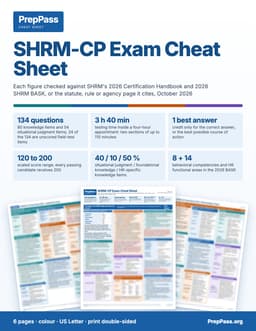
Thi trong vòng hai tuần?
Sách này là phần giảng dạy, đọc trong nhiều tuần. Nếu bạn thi trong vòng hai tuần, bảng tra cứu màu in được là sản phẩm còn lại: các con số then chốt, xếp theo từng phần.
6 trang · US Letter · PDF in được · giữ vĩnh viễn
Có gì — và không có gì
Bao gồm
- Seven chapters: the three behavioral clusters and three HR knowledge domains of the 2026 BASK
- A quiz closing each chapter: 109 questions with worked explanations
Không bao gồm
- Không gửi bản in — đây là tệp bạn tải về và có thể tự in
- Sách không kèm khoá video, giảng viên hay kèm riêng — video miễn phí trên trang là phần khác
Toàn bộ phần bao gồm và không bao gồm
Bao gồm
- Two 134-question practice exams, each in two sections of 67, at SHRM's published weights, plus six domain practice sets of 14 to 20 questions
- 481 original situational-judgment and knowledge questions in all, each explained and cited
- Exam review, not an introduction: written for people who already know the basic vocabulary of HR (job description, performance review, benefits enrollment, discipline), such as HR coursework or work in or beside an HR function
- US employment law from the statutes and eCFR, with a federal-law quick-reference appendix
- PDF + EPUB you keep
Không bao gồm
- Không bao gồm lệ phí đăng ký thi hay phí trung tâm khảo thí — bạn vẫn nộp cho cơ quan chính thức
Mục lục
Xem 14 phần và trang bắt đầu của từng phần
- Chapter 1 — Leadership (I): Leadership & Navigation and Ethical Practicetr. 10
- Chapter 2 — Leadership (II): Inclusive Mindsettr. 40
- Chapter 3 — Interpersonal: Relationship Management and Communicationtr. 71
- Chapter 4 — Business: Business Acumen, Consultation and Analytical Aptitudetr. 101
- Chapter 5 — People: Strategy, Talent, Rewards and Developmenttr. 133
- Chapter 7 — Workplacetr. 212
- Section 1 1–67 Behavioral 1–4tr. 244
- Practice exam — Section 1: behavioral competenciestr. 245
- Practice Exam 2tr. 329
- Practice exam 2 — Section 1: behavioral competenciestr. 330
- Practice exam 2 — Section 2: HR knowledgetr. 372
- Appendix A — The exam at a glancetr. 460
- Appendix B — BASK terms used preciselytr. 462
- Appendix C — Federal employment-law quick referencetr. 464
Lấy từ chính tệp PDF bạn tải về, kèm trang bắt đầu của từng phần — không phải gõ tay ở đây.
Đọc miễn phí trọn một chương
Trọn vẹn một chương, đúng như trong eBook. Cuộn cửa sổ để đọc ngay tại đây; không cần tải, không cần email.
Đọc chương 5 ngay tại đây, không rời trang
The free chapter is Chapter 5, People: strategy, talent, rewards and development, at the book's usual pace for a mid-level chapter: terms defined as they appear, with the exam traps called out.
The People domain carries 19% of the exam[1]. It is the first of the three HR knowledge domains, and its five functional areas are HR Strategy, Talent Acquisition, Employee Engagement & Retention, Learning & Development, and Total Rewards[2]. Its questions are knowledge items that turn on a definition, threshold, deadline or formula; the wrong options are the neighboring ones.
Learn each boundary, each number with the law it belongs to, and what each formula divides by. All federal figures in this chapter were read from the U.S. Code or the eCFR on 2026-09-28. Many states set stricter rules; where that matters, the text says so.
5.1 HR Strategy
HR Strategy covers developing, implementing, managing and evaluating the strategic direction the organization needs to succeed and to create value for its stakeholders[2]. At the SHRM-CP level the emphasis is operational: you use systems thinking to understand how the organization works[2], and you give HR leaders "timely and accurate information required for strategic decision-making"[2].
Strategic planning processes and frameworks
The BASK describes strategic planning as four stages: formulation, goal setting, implementation and evaluation[2]. It lists the analysis frameworks as PESTLE, SWOT, industry analysis, location-specific analysis, scenario planning, the growth-share matrix, real-time analysis and blue ocean[2].
The growth-share matrix (the BCG matrix) sorts a company's business units by market growth and market share. The two quadrants that come up most often are cash cows, which generate income for the corporation, and stars, which generate growth[3]. It compares business units, so it does not fit a single-business firm[3].
Systems thinking
A system is a set of related parts. Change one part and the others respond, which is why the BASK's examples are interdependence, the need for feedback, and the differentiation of units[2]. The open-systems model treats the organization as a feedback loop: it takes in resources from its environment, transforms them, and returns outputs to that environment[3].
A commission redesign, for example, changes who applies for sales jobs, how long they stay and what payroll must calculate. Questions ask where else a change will show up.
Project management
The BASK lists several project management approaches (traditional, Lean Six Sigma, agile and critical chain among them)[2]. It also lists four tools: critical path analysis, Gantt charts, variance analysis and outcome monitoring[2].
- Critical path method. List every task, map which tasks depend on which, and find the longest chain of dependent tasks. That chain is the critical path. If any task on it is late, the whole project is late[4]. Tasks off the critical path have slack: a short delay in one of them does not move the end date[4].
- Gantt chart. Bars on a timeline show each task's planned and actual dates. It is easy to read, but it does not always show how tasks depend on each other[4]. The trap: a question about which tasks drive the finish date wants the critical path, not the Gantt chart.
Workforce planning
Workforce planning makes the strategy concrete in headcount. It rests on two forecasts. The demand forecast estimates how many people the organization will need by a future date. The internal supply forecast estimates how many current employees will still be available to fill those jobs by then[4]. The gap between them becomes the plan. Few organizations plan this way; many simply refill jobs as people leave[3]. The trap: counting people you already employ is supply; estimating what the business will need is demand.
5.2 Talent Acquisition
Talent Acquisition covers identifying, attracting and building a workforce that meets the organization's needs[2]. It is the most law-heavy area.
Employee value proposition and employment brand
The employee value proposition (EVP) is what the organization offers in return for an employee's work. The BASK's examples are culture, opportunity for growth, purpose and varied assignments[2]. The employment brand is how the market perceives that offer. A recruitment brand should be positive and also accurate[4].
Job analysis
Every later step depends on job analysis, the study of the tasks a job requires[4]. It produces two documents:
- the job description, which lists the tasks and responsibilities; and
- the job specification, which lists the skills, knowledge and abilities the person needs[4].
The BASK names three analysis techniques: task inventory analysis, the critical incident technique and the position analysis questionnaire[2].
Job analysis also carries legal weight. When the federal agencies review a selection procedure, they take into account whether "a thorough job analysis was conducted"[5]. The trap: description and specification are easy to swap. Duties belong in the description; qualifications belong in the specification.
Sourcing and recruiting
Applicants come from two pools. The internal labor market is the organization's current employees; the external labor market is everyone else[4].
A realistic job preview (RJP) tells candidates about the job's real conditions so they can judge the fit before accepting[4]. The BASK lists it among its retention examples, with employee suggestion mechanisms, identifying the causes of turnover and predictive attrition analysis[2]: poorly matched candidates select themselves out, which lowers early turnover.
Selection assessment
Selection usually works as a series of successive hurdles. A candidate who clears one step moves to the next, and can be rejected at any of them[4]. The BASK's methods run from ability and personality tests to "AI-based skill and competency matching; scoring; manually- or AI-generated interview guides"[2].
Interviews. A structured interview asks every candidate the same prepared questions and scores the answers on a standard rating system[6]. Research finds that structured interviews predict job performance better than unstructured ones[6]. The BASK expects you to keep hiring lawful, including avoiding illegal interview questions[2]. Before an offer, the ADA bars asking whether an applicant has a disability; asking whether the applicant can perform the job's functions is allowed[7].
Validity under the Uniform Guidelines. The Uniform Guidelines on Employee Selection Procedures apply to any test or other procedure "used as a basis for any employment decision"[5]. A procedure that has adverse impact is treated as discriminatory unless it has been validated[5]. The Guidelines accept three kinds of validity study[5]:
- Criterion-related: empirical data that scores predict, or significantly correlate with, important elements of job performance[5].
- Content: the test's content represents important aspects of job performance[5]; this also fits a knowledge or skill that is a necessary prerequisite for the job[5].
- Construct: the procedure measures identifiable characteristics shown to be important for successful performance[5].
The most tested detail is the limit on content validity. A test that relies on inferences about mental processes cannot rest solely or mainly on content validity. The Guidelines name intelligence, aptitude, personality, common sense, judgment and leadership as examples[5]. A typing test built from the documents clerks actually produce can be content-validated. A general reasoning test for supervisors cannot; it needs criterion-related (or construct) evidence.
Adverse impact is screened with the four-fifths indicator from Chapter 2 (its legal status is contested; see section 2.3): a group's selection rate below 80% of the highest group's rate is generally regarded as evidence of adverse impact[5].
Employment categories
The BASK lists full-time, part-time, contract, temporary, intern and gig workers. Category affects legal counts: WARN excludes part-time employees from its 100-employee test[8]. Employee versus contractor status turns on economic reality, not the label; the federal test is in flux, so this book does not teach one.
Job offer contingencies and pre-employment screening
The BASK's offer contingencies are background investigations, credit checks, and physical or psychological evaluations[2]. The CP indicator is to conduct "appropriate pre-employment screening"[2], and "appropriate" has legal content.
Background reports (FCRA). When an employer buys a background or credit report from a consumer reporting agency, the Fair Credit Reporting Act sets three steps:
- Before ordering the report, give the applicant a clear and conspicuous written disclosure "in a document that consists solely of the disclosure"[9].
- Get the applicant's written authorization. It may appear on the disclosure document[9].
- Before taking adverse action based even partly on the report, give the applicant a copy of the report and the written summary of rights[9].
The trap: burying the disclosure inside the job application. The statute requires a stand-alone document. State and local law may be stricter.
Medical examinations (ADA). An employer may require a medical examination after making an offer and before the job starts. It may make the offer conditional on the results, but only if all entering employees in the job category are examined[7]. Results go in separate, confidential medical files[7]. The order is the test point: offer first, then the exam.
Lie detectors. The Employee Polygraph Protection Act bars most private employers from requiring, requesting or suggesting a lie detector test[10].
Form I-9
Every new hire completes Form I-9, which verifies identity and employment authorization. The timing is exact:
- Section 1 (employee): at the time of hire[11], which means the first day of work for pay[12].
- Section 2 (employer): within three business days of the hire[11]. If the job lasts less than three business days, Section 2 must be completed at the time of hire[11].
- Retention: three years after the date of hire or one year after employment ends, whichever is later[11].
Example: start on a holiday-free Monday, Section 2 due by the end of Thursday.
Onboarding
Onboarding turns a hire into a productive, committed employee. The BASK's approaches are orientation, a buddy system, personalization, digital assistants and specialized training[2]. A formal orientation covers the company's history, values, policies and customers[4]. That is only the start. The HR team and the manager should also check in with the new hire during the first few months[3]. The trap is treating the first-day orientation session as the whole onboarding process.
Talent acquisition metrics and technology
The BASK names four metrics: cost per hire, time to fill, the applicant-to-interview-to-offer ratio, and candidate yield from proactive sourcing[2]. Candidate experience depends on a streamlined application, few interview rounds and frequent communication[2]; some applicants are also customers[4].
AI in recruiting. The BASK's technologies include the applicant tracking system (ATS), digital assistants and AI-supported résumé screening[2]. An ATS scans and tracks applications, matching keywords against a job's requirements[4]. Two points matter:
- The law does not change because a tool is automated. An AI screen used to decide who advances is a selection procedure under the Uniform Guidelines[5]. Its selection rates can be checked with the four-fifths indicator (status contested; see section 2.3), and if it has adverse impact, it needs validity evidence.
- The people using the tool create risks too. NIST's generative AI profile names "Human-AI Configuration" as a risk. It covers interactions that lead people into "automation bias, over-reliance" on the system[13].
5.3 Employee Engagement & Retention
This functional area covers keeping talent, strengthening the relationship between employees and the organization, and setting appropriate performance expectations[2].
Job attitudes
The BASK names four job attitudes: engagement, satisfaction, commitment and involvement[2].
- Job satisfaction is a pleasurable or positive emotional state that comes from how a person appraises the job[14]. It is about feelings toward the job.
- Job involvement is how interested a person is in the assigned tasks and how committed they are to doing them[14]. It is about the work itself.
- Organizational commitment is how strongly a person identifies with the organization and is involved in it[14]. It is about the employer.
A nurse devoted to her own work who would leave for a better offer is high on involvement, low on commitment.
Measuring engagement and retention
The BASK's assessment methods are focus groups, stay interviews, surveys and engagement software[2]. A stay interview asks a current employee what keeps them and what might make them leave, while there is still time to act.
Among the retention metrics the BASK names are quality of hire, voluntary turnover rate, turnover at a specific location or level, and vacancy rate[2]. In Bureau of Labor Statistics terms, quits are separations the employee chose; retirements are counted separately[15]. A separation rate is separations divided by employment, times 100[16]. At the CP level you monitor changes in these metrics and make sure leadership knows about them[2].
Job design
The BASK expects you to spot chances to make jobs more engaging, naming job enrichment and job enlargement[2]. The three classic techniques differ in direction:
| Technique | What changes | Keyword |
|---|---|---|
| Job enlargement | More tasks of a similar level are added[4] | Breadth (horizontal) |
| Job enrichment | More autonomy, responsibility and decision authority are added[4] | Depth (vertical) |
| Job rotation | The worker moves between jobs over time; it is also called cross-training[4] | Movement |
Enrichment has generally been found to raise satisfaction and to reduce absenteeism and turnover[4]. The trap: a question that adds "more duties" is not enrichment unless those duties include planning, deciding or checking one's own work.
Workplace flexibility
The flexibility programs the BASK names are telecommuting, alternative schedules and job sharing. In job sharing, two people split the tasks, responsibilities and hours of one full-time job[4].
Performance management
Performance management falls under this functional area in the BASK. At the CP level you train stakeholders to use the performance management system[2]; effective appraisal rests on goal setting and frequent feedback.
Sources cited in this excerpt
- 2026 SHRM Certification Handbook. https://www.shrm.org/content/dam/en/shrm/credentials/shrm-certification/2026_shrm_certification-handbook.pdf
- 2026 SHRM Body of Applied Skills and Knowledge (SHRM BASK). https://www.shrm.org/content/dam/en/shrm/credentials/shrm-certification/bask/shrm-bask.pdf
- Principles of Management (OpenStax). OpenStax, Rice University. https://assets.openstax.org/oscms-prodcms/media/documents/principles-management_-_WEB.pdf
- Introduction to Business 2e (OpenStax). OpenStax, Rice University. https://assets.openstax.org/oscms-prodcms/media/documents/Introduction_to_Business_2e_-_WEB.pdf
- 29 CFR Part 1607 (Uniform Guidelines on Employee Selection Procedures (1978)). Office of the Federal Register / GPO, eCFR. https://www.ecfr.gov/api/versioner/v1/full/2026-09-25/title-29.xml?part=1607
- Psychology 2e (OpenStax). OpenStax, Rice University. https://assets.openstax.org/oscms-prodcms/media/documents/Psychology2e_WEB.pdf
- 42 U.S.C. § 12112 (ADA discrimination). Office of the Law Revision Counsel, U.S. House of Representatives. https://uscode.house.gov/view.xhtml?req=granuleid:USC-prelim-title42-section12112&num=0&edition=prelim
- 29 U.S.C. § 2101 (WARN Act § 2 (definitions)). Office of the Law Revision Counsel, U.S. House of Representatives. https://uscode.house.gov/view.xhtml?req=granuleid:USC-prelim-title29-section2101&num=0&edition=prelim
- 15 U.S.C. § 1681b (Fair Credit Reporting Act § 604). Office of the Law Revision Counsel, U.S. House of Representatives. https://uscode.house.gov/view.xhtml?req=granuleid:USC-prelim-title15-section1681b&num=0&edition=prelim
- 29 U.S.C. § 2002 (Employee Polygraph Protection Act § 3). Office of the Law Revision Counsel, U.S. House of Representatives. https://uscode.house.gov/view.xhtml?req=granuleid:USC-prelim-title29-section2002&num=0&edition=prelim
- 8 CFR § 274a.2 (Verification of identity and employment authorization (Form I-9)). Office of the Federal Register / GPO (eCFR). https://www.ecfr.gov/api/versioner/v1/full/2026-09-25/title-8.xml?part=274a§ion=274a.2
- 8 CFR § 274a.1 (Definitions (employment verification)). Office of the Federal Register / GPO (eCFR). https://www.ecfr.gov/api/versioner/v1/full/2026-09-25/title-8.xml?part=274a§ion=274a.1
- NIST AI 600-1, Artificial Intelligence Risk Management Framework: Generative Artificial Intelligence Profile. National Institute of Standards and Technology. https://nvlpubs.nist.gov/nistpubs/ai/NIST.AI.600-1.pdf
- Organizational Behavior (OpenStax). OpenStax, Rice University. https://assets.openstax.org/oscms-prodcms/media/documents/organizational-behavior_-_WEB.pdf
- Job Openings and Labor Turnover Survey — Data Definitions. U.S. Bureau of Labor Statistics. https://www.bls.gov/jlt/jltdef.htm
- Handbook of Methods: Job Openings and Labor Turnover Survey — Calculation. U.S. Bureau of Labor Statistics. https://www.bls.gov/opub/hom/jlt/calculation.htm
Câu hỏi người mua thường hỏi
Nhận sách thế nào?
Thanh toán xong, mục tải xuống hiện ngay trên trang này. Liên kết cũng được gửi qua email. Không cần tài khoản.
Nếu sách không hợp thì sao?
Gửi email trong vòng 14 ngày để được hoàn tiền đầy đủ, không cần lý do.
Phần luyện tập miễn phí có bị bỏ không?
Không. Mọi câu hỏi luyện tập, bài thi thử tính giờ và các chương miễn phí trên trang vẫn miễn phí. Cuốn sách là nửa "học", không phải hàng rào quanh phần miễn phí.
Thêm câu hỏi (1)
Đọc trên điện thoại được không?
Được — EPUB cho điện thoại và máy đọc sách, PDF để in và dán tab. Bạn nhận cả hai.
Vì sao mua sách khi phần luyện tập miễn phí?
Câu hỏi luyện tập và bài thi thử tính giờ vẫn miễn phí — không có gì trên trang bị giấu sau cuốn sách này. Cuốn sách $24.99 là nửa "học": chính phần kiến thức, dạy theo trình tự, trong một tệp thuộc về bạn.
- Dạy có hệ thống — mọi phần thi giảng theo từng chương, từ đầu đến cuối, không chỉ là câu hỏi
- In ra & dán nhãn — PDF sẵn sàng để in, tô đậm, ghi chú và mang tới bàn học
- Học mọi nơi, ngoại tuyến — EPUB trên điện thoại hay máy đọc sách; không cần wifi, không cần tab trình duyệt
- Tất cả một chỗ — các chương và câu hỏi luyện tập trong một tệp
- Của bạn trọn đời — trả một lần $24.99, tải ngay, không thuê bao
Chi tiết
- Đối chiếu từ nguồn chính thức(SHRM's 2026 Body of Applied Skills and Knowledge (BASK) and 2026 SHRM Certification Handbook, with U.S. statutes, the eCFR and EEOC, DOL and NLRB guidance)
- 402 câu hỏi luyện tập miễn phí
Một SHRM-CP prep course có giá $820–$1,599. Cuốn sách này dạy cùng một kỳ thi — cùng quy định, đối chiếu theo chuẩn hiện hành — chỉ với $24.99 trả một lần, thuộc về bạn trọn đời.
Mua một lần, truy cập tải về trọn đời. eBook là trọn bộ hướng dẫn ôn SHRM-CP (SHRM Certified Professional) ở dạng PDF và EPUB. Bản tóm tắt mang tính giáo dục, không phải tư vấn chuyên môn hay pháp lý — luôn xác nhận quy định hiện hành với nguồn chính thức. Cập nhật lần cuối: October 2026.