Sách ôn thi · Ấn bản 2026
SIE — Securities Industry Essentials Study Guide (2026)
Twenty-seven chapters written to FINRA's SIE content outline, with the working shown on every calculation and a practice question bank behind them.
- Độ dài
- 845 trang (358 trang giảng giải + ngân hàng câu hỏi)
- Câu hỏi luyện tập trong sách
- 1,149
- Thi thử trực tuyến PrepPass
- 75 câu · 105 phút
- Đối chiếu thông tin và cập nhật tệp
- tháng 10 năm 2026
- Giao hàng
- PDF + EPUB · tiếng Anh · tải ngay
Về cuốn sách này
Lệ phí thi SIE: $100 mỗi lần thi, nộp cho FINRA. Thi lại phải nộp lại. Cuốn sách này: $24.99, trả một lần.
Thông tin kỳ thi, ai nên dùng và thay đổi
Về chính kỳ thi này
| Cơ quan quản lý | Financial Industry Regulatory Authority (FINRA) — kỳ thi do Prometric tổ chức |
|---|---|
| Số câu hỏi | 80 câu hỏi (75 câu tính điểm, 5 câu thử nghiệm không tính điểm) Nguồn: FINRA — Securities Industry Essentials (SIE) Examination Content Outline (PDF, © 2025 FINRA) |
| Thời gian làm bài | 105 phút Nguồn: FINRA — Securities Industry Essentials (SIE) Examination Content Outline (PDF, © 2025 FINRA) |
| Điểm đậu | Điểm quy đổi 70 trên thang 0–100 Nguồn: FINRA — SIE Exam and Exam Restructuring Frequently Asked Questions (FAQ) |
| Lệ phí |
|
| Ngôn ngữ thi | FINRA không công bố Những trang chúng tôi đã đọc và không tìm thấy: FINRA — Securities Industry Essentials Exam (SIE) |
Xem bên trong cuốn sách
Ba trang thật, kết xuất thẳng từ tệp PDF bạn sẽ tải — lần lượt là một trang tra cứu, một trang giảng giải, và một câu hỏi có lời giải. Không trang nào được vẽ lại cho đẹp.
- Trang tra cứu nhanhChapter 7 — Bonds: Pricing, Yields, Corporates, Treasuries and Municipals · Trang 137 của PDF
Một trang để lật lại: các con số, mốc thời hạn hoặc thuật ngữ gom về một chỗ.
- Cách giảng dạySection 32 Criminal: entities Fine up to $25 million · Trang 327 của PDF
Trang giảng giải: kiến thức được trình bày bằng văn xuôi, theo trình tự kỳ thi kiểm tra.
- Một câu hỏi có lời giảiChapter 5 — Rights, Warrants, ADRs and Convertible Securities · Trang 90 của PDF
Một câu luyện tập kèm đáp án và lập luận đằng sau — không chỉ là đáp án.
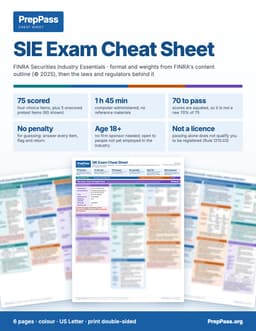
Thi trong vòng hai tuần?
Sách này là phần giảng dạy, đọc trong nhiều tuần. Nếu bạn thi trong vòng hai tuần, bảng tra cứu màu in được là sản phẩm còn lại: các con số then chốt, xếp theo từng phần.
6 trang · US Letter · PDF in được · giữ vĩnh viễn
Có gì — và không có gì
Bao gồm
- Twenty-seven chapters in the teaching order of FINRA's SIE content outline: regulators, capital markets, products and their risks, trading and customer accounts, conduct and registration
- Every chapter closes with a key-facts box and a named exam-traps list
Không bao gồm
- Không gửi bản in — đây là tệp bạn tải về và có thể tự in
- Sách không kèm khoá video, giảng viên hay kèm riêng — video miễn phí trên trang là phần khác
Toàn bộ phần bao gồm và không bao gồm
Bao gồm
- Worked examples with the working shown where the exam asks for arithmetic: bond pricing and yield, accrued interest, options breakeven, margin, settlement dates
- A chapter on taking the exam: format, retake waiting periods, a study plan and the ten most common confusions
- Dated rule changes called out, including the end of the pattern-day-trader rule and T+1 settlement
- 358 pages of teaching, then a question bank of 1149 practice questions, grouped by topic, with answers and explanations
- PDF (print & tab it) + EPUB (phone / e-reader)
Không bao gồm
- Không bao gồm lệ phí đăng ký thi hay phí trung tâm khảo thí — bạn vẫn nộp cho cơ quan chính thức
Mục lục
Xem 32 phần và trang bắt đầu của từng phần
- Chapter 1 — Who Regulates the Markets and Who Works in Themtr. 9
- Chapter 2 — Capital Markets, Offerings and Registrationtr. 24
- Chapter 3 — The Economy, the Federal Reserve and Company Financialstr. 47
- Chapter 4 — Common and Preferred Stocktr. 66
- Chapter 5 — Rights, Warrants, ADRs and Convertible Securitiestr. 88
- Chapter 6 — Corporate Actions, Buybacks and Proxiestr. 98
- Chapter 7 — Bonds: Pricing, Yields, Corporates, Treasuries and Municipalstr. 107
- Chapter 8 — Agency and Mortgage Securities, Municipal Variations, Money Market and Ratingstr. 127
- Chapter 9 — Investment Companies: Mutual Funds, ETFs, Closed-End Funds and UITstr. 143
- Chapter 10 — What Funds, Annuities and Trades Costtr. 164
- Chapter 11 — Municipal Fund Securities, Partnerships, REITs, Hedge Funds and Exchange-Traded Productstr. 176
- Chapter 12 — Options: Calls, Puts, Strategies, the OCC and Opening an Accounttr. 187
- Chapter 13 — Investment Risks and How to Reduce Themtr. 205
- Chapter 14 — Where Securities Trade: Venues, Market Makers, Regulation NMS, Best Execution, Reporting and Haltstr. 214
- Chapter 15 — Orders, Quotes and Positionstr. 228
- Chapter 16 — Clearing, Settlement and Failed Tradestr. 236
- Chapter 17 — Return, Cost Basis, Tax and Benchmarkstr. 243
- Chapter 18 — Margin and Short Salestr. 251
- Chapter 19 — Knowing the Customer, Recommendations, Regulation Best Interest and Form CRStr. 267
- Chapter 20 — Account Types, IRAs and Retirement Planstr. 284
- Chapter 21 — Anti-Money Laundering: FinCEN, OFAC, Structuring and the PATRIOT Acttr. 293
- Chapter 22 — Confirmations, Statements, Customer Mail, Continuity Plans and Safeguarding Customer Assetstr. 301
- Chapter 23 — Market Manipulation, Insider Trading and Fraudtr. 308
- Section 32 Criminal: entities Fine up to $25 milliontr. 314
- Chapter 24 — Conduct Rules: Customer Funds, Trading Practices and Cooperation with Regulatorstr. 317
- Chapter 25 — Who May Work in the Industry: Qualification, Registration and Disqualificationtr. 331
- Chapter 26 — Hiring, Disclosure, Reporting and Municipal Personnel Rulestr. 340
- Chapter 27 — Taking the SIE: Format, Chapter Map, Study Plan and Ten Confusionstr. 349
- Section 1: Capital Markets (16%)tr. 351
- Section 2: Products and Their Risks (44%)tr. 351
- Section 4: Regulatory Framework (9%)tr. 353
- Appendix — Question Bank 1,149 practice questions with answers and explanationstr. 359
Lấy từ chính tệp PDF bạn tải về, kèm trang bắt đầu của từng phần — không phải gõ tay ở đây.
Đọc miễn phí trọn một chương
Trọn vẹn một chương, đúng như trong eBook. Cuộn cửa sổ để đọc ngay tại đây; không cần tải, không cần email.
Đọc chương 17 ngay tại đây, không rời trang
Chúng tôi không đưa phần mở đầu dễ dãi — chương miễn phí mở thẳng vào một trong những phần đậm đặc nhất của cuốn sách, để bạn đánh giá cách dạy ở đúng chỗ kỳ thi trở nên khó.
Every investment is judged by what it returns and by what is left after tax. This chapter defines total return, shows how cost basis is set and changed, explains the wash-sale rule and the short-term and long-term capital-gains treatment, and closes with the benchmarks and indices used to judge a portfolio. Dividend types and dates are in Chapter 4.
Words you need
- Return. What an investment earned over a period, usually stated as a percentage of what was put in.
- Income. Cash an investment pays out while you hold it: dividends from stock, interest from bonds.
- Capital gain / capital loss. The profit or loss when you sell for more or less than your cost basis. It is "realized" only when you sell; before then it is "unrealised".
- Total return. Income plus change in price, over the period, as a percentage of the starting value.
- Dividend. A distribution of a company's profit to its shareholders, set by the board of directors.
- Cost basis. What you are treated as having paid for a security. Gain or loss is sale proceeds minus basis.
- Holding period. How long you owned the security. It decides whether a gain is short term or long term.
- Wash sale. Selling at a loss and buying the same or a substantially identical security within a 30-day window around the sale.
- Benchmark. A standard, often an index, against which a portfolio's results are compared.
- Index. A published number that tracks the prices of a defined group of securities. You cannot buy an index directly; funds copy it.
Components of return
An investor can earn money from a security in two ways.
- Income. Dividends or interest paid in cash while you hold it.
- Capital appreciation. The price rises, so you could sell for more than you paid.
Total return = (income + change in price) / starting price.
Worked example. You buy 100 shares at $50 ($5,000). Over the year you receive $1.80 per share in dividends and the price rises to $56.
| Piece | Calculation | Amount |
|---|---|---|
| Income | 100 × $1.80 | $180 |
| Capital gain (unrealized until sold) | 100 × ($56 − $50) | $600 |
| Total | $180 + $600 | $780 |
| Total return | $780 / $5,000 | 15.6% |
The two pieces carry different risks. Income from a stable company is steadier; price change is volatile. Growth-oriented investors lean on appreciation, income-oriented investors on cash payments. A bond held to maturity returns income and a return of principal, with any gain or loss depending on purchase price (Chapter 7).
The exam also separates nominal return (before inflation) from real return (after). With a nominal return of 7.4% and inflation of 3.0%, the approximate real return is 7.4% − 3.0% = 4.4%.
Cost basis
Gain or loss on a sale is proceeds minus cost basis. Basis starts as the price you paid plus commissions and fees, and changes with events such as stock dividends, splits and return of capital.
How you acquired the shares changes the basis
| How acquired | Basis |
|---|---|
| Purchase | Cost plus commissions |
| Gift | The donor's basis carries over to you. If you sell at a loss, your loss is measured from the lower of that basis and the market value at the date of the gift (IRC §1015) |
| Inheritance | Fair market value on the date of death (a "step-up" or "step-down"), and the holding period is automatically long term |
| Stock dividend or split | Original basis divided over the larger number of shares |
| Reinvested dividends | Each reinvestment is a new purchase at its own cost |
When you hold several lots
If you bought shares at different prices, you must say which you are selling.
Worked example. You hold three lots of 100 shares: bought at $30, $40 and $50. You sell 100 shares at $55.
| Method | Lot treated as sold | Basis | Gain |
|---|---|---|---|
| FIFO (first in, first out), the default for stock | $30 lot | $3,000 | $2,500 |
| Specific identification (you name the lot before settlement) | $50 lot | $5,000 | $500 |
| Specific identification | $40 lot | $4,000 | $1,500 |
| Average cost (available for mutual fund shares) | all lots | $40 average | $1,500 |
Average basis: (3,000 + 4,000 + 5,000) / 300 = $40. The same sale produces a gain anywhere from $500 to $2,500 depending on the method, which is why the choice matters. Choosing the highest-basis lot defers tax now; it does not remove it.
Broker reporting of basis
Since the Emergency Economic Stabilization Act of 2008, brokers must report cost basis to the investor and the IRS on Form 1099-B for "covered" securities. Covered means acquired on or after 1 January 2011 for stock, 1 January 2012 for mutual fund shares and dividend-reinvestment plan shares, and 1 January 2014 for most bonds and options. For older "non-covered" securities the broker may not report basis, and the investor must keep records. The broker's default method is FIFO for stock and average cost for mutual funds unless the customer chooses another in time.
The wash-sale rule
The tax law does not allow you to sell at a loss and keep the position. If you buy the same or a substantially identical security within 30 days before or after the sale (a 61-day window including the sale day), the loss is disallowed for now. It is added to the basis of the replacement shares, and the holding period carries over.
Worked example. You sold 100 shares for $5,000 that had cost $7,000: a loss of $2,000. Fifteen days later you buy 100 shares at $48 ($4,800). The $2,000 loss is disallowed. New basis = $4,800 + $2,000 = $6,800, or $68 per share. If you later sell at $60, the gain or loss is $6,000 − $6,800 = a $800 loss, which you can use.
Worked example (partial). You sell 300 shares at a $3,000 loss ($10 a share) and buy back 100 shares within 30 days. Only the replaced one-third is disallowed: 100 × $10 = $1,000 disallowed, $2,000 allowed as a loss now.
The rule applies to purchases in an IRA or by a spouse as well. It affects losses only; gains are never "washed".
Capital-gains tax: short term and long term
| Holding period | Class | Tax treatment |
|---|---|---|
| One year or less | Short term | Taxed as ordinary income at the investor's marginal rate |
| More than one year | Long term | Taxed at preferential rates of 0%, 15% or 20% depending on taxable income |
The holding period starts the day after you acquire the security and includes the day you sell. A purchase on 10 March 2025 and a sale on 10 March 2026 is a one-year hold, which is still short term. A sale on 11 March 2026 is long term.
Higher-income investors may also owe the 3.8% net investment income tax on investment income above statutory thresholds of $200,000 (single) and $250,000 (married filing jointly) of modified adjusted gross income. These NIIT thresholds are set by statute (IRC §1411) and are not indexed; the income brackets for the 0/15/20% rates are indexed annually and are not stated here.
Netting. Gains and losses are netted within each class, then across classes. If losses exceed gains, up to $3,000 of the net loss a year can offset ordinary income (and $1,500 if married filing separately); the rest carries forward to later years indefinitely (IRC §1211(b)).
Worked example. A $600 gain on shares held 8 months is short term. At a 24% marginal rate the tax is $600 × 0.24 = $144. The same $600 gain after 14 months, at 15%, is $90. Waiting saved $54.
Municipal bond interest is generally federally tax-exempt, but a capital gain on selling a municipal bond is taxable like any other gain.
Benchmarks and indices
A benchmark answers: "compared with what?" A portfolio return of 6% sounds acceptable. If the right benchmark returned 11%, it is not.
| Index | What it tracks | How it is weighted |
|---|---|---|
| S&P 500 | About 500 large U.S. companies | Market capitalization (price × shares outstanding) |
| Dow Jones Industrial Average | 30 large U.S. companies | Price weighted |
| Nasdaq Composite | Most stocks listed on the Nasdaq exchange | Market-cap weighted |
| Russell 2000 | 2,000 smaller U.S. companies | Market-cap weighted |
| MSCI EAFE | Developed markets outside the U.S. and Canada | Market-cap weighted |
| Bloomberg U.S. Aggregate Bond Index | Investment-grade U.S. bonds | Market-value weighted |
The index must match the portfolio. Comparing a bond fund with the S&P 500, or a small-cap fund with the Dow, tells you nothing.
How weighting changes the answer
Three stocks, A, B and C, with prices $100, $50 and $30. Shares outstanding: A 10 million, B 100 million, C 200 million. Market capitalizations: A $1,000m, B $5,000m, C $6,000m, total $12,000m.
Stock A rises from $100 to $110; the others do not move.
| Weighting | Calculation | Index change |
|---|---|---|
| Price weighted | Sum of prices 180 → 190, so 190/180 − 1 | +5.56% |
| Market-cap weighted | Total cap 12,000 → 12,100, so 12,100/12,000 − 1 | +0.83% |
| Equal weighted | (10% + 0% + 0%) / 3 | +3.33% |
The price-weighted index is moved most by the highest-priced stock, regardless of company size. The cap-weighted index is moved most by the biggest companies. This is why the Dow can be influenced by a high-priced stock that is small in value, a favorite exam point.
Index funds and ETFs try to match an index; active managers try to beat it. A fund's gap from the benchmark is its tracking difference.
Key facts — Return and tax - Total return = income + price change, as a percentage of the starting price. - Gain or loss = proceeds − cost basis. Gift: donor's basis carries over. Inheritance: market value at death and long-term treatment. - Default basis method: FIFO for stock, average cost for mutual funds. Specific identification must be made before settlement. - Wash sale: loss disallowed if the same or substantially identical security is bought within 30 days before or after. Loss is added to the new basis. - Capital gain is short term if held one year or less, long term if more than one year. Capital losses offset gains plus $3,000 of ordinary income; the rest carries forward. - Price-weighted (Dow) versus cap-weighted (S&P 500). Compare a portfolio with a benchmark that matches it.
Exam traps
- "Total return is only the price change." It includes income.
- "A gain on a stock held exactly one year is long term." It must be held more than one year.
- "The wash-sale rule applies to gains." Only to losses, and the disallowed loss is added to the new basis, not lost forever.
- "Inherited stock keeps the decedent's basis." It is stepped to market value at death.
- "The Dow weights companies by size." It weights by share price.
Câu hỏi người mua thường hỏi
Nhận sách thế nào?
Thanh toán xong, mục tải xuống hiện ngay trên trang này. Liên kết cũng được gửi qua email. Không cần tài khoản.
Nếu sách không hợp thì sao?
Gửi email trong vòng 14 ngày để được hoàn tiền đầy đủ, không cần lý do.
Phần luyện tập miễn phí có bị bỏ không?
Không. Mọi câu hỏi luyện tập, bài thi thử tính giờ và các chương miễn phí trên trang vẫn miễn phí. Cuốn sách là nửa "học", không phải hàng rào quanh phần miễn phí.
Thêm câu hỏi (1)
Đọc trên điện thoại được không?
Được — EPUB cho điện thoại và máy đọc sách, PDF để in và dán tab. Bạn nhận cả hai.
Vì sao mua sách khi phần luyện tập miễn phí?
Câu hỏi luyện tập và bài thi thử tính giờ vẫn miễn phí — không có gì trên trang bị giấu sau cuốn sách này. Cuốn sách $24.99 là nửa "học": chính phần kiến thức, dạy theo trình tự, trong một tệp thuộc về bạn.
- Dạy có hệ thống — mọi phần thi giảng theo từng chương, từ đầu đến cuối, không chỉ là câu hỏi
- In ra & dán nhãn — PDF sẵn sàng để in, tô đậm, ghi chú và mang tới bàn học
- Học mọi nơi, ngoại tuyến — EPUB trên điện thoại hay máy đọc sách; không cần wifi, không cần tab trình duyệt
- Tất cả một chỗ — các chương và câu hỏi luyện tập trong một tệp
- Của bạn trọn đời — trả một lần $24.99, tải ngay, không thuê bao
Chi tiết
- Đối chiếu từ nguồn chính thức(FINRA SIE content outline / SEC, FINRA, MSRB and OCC rules)
- 1,149 câu hỏi luyện tập miễn phí
Một FINRA SIE exam prep course có giá $150–$500. Cuốn sách này dạy cùng một kỳ thi — cùng quy định, đối chiếu theo chuẩn hiện hành — chỉ với $24.99 trả một lần, thuộc về bạn trọn đời.
Mua một lần, truy cập tải về trọn đời. eBook là trọn bộ hướng dẫn ôn FINRA SIE (Securities Industry Essentials) ở dạng PDF và EPUB. Bản tóm tắt mang tính giáo dục, không phải tư vấn chuyên môn hay pháp lý — luôn xác nhận quy định hiện hành với nguồn chính thức. Cập nhật lần cuối: October 2026.