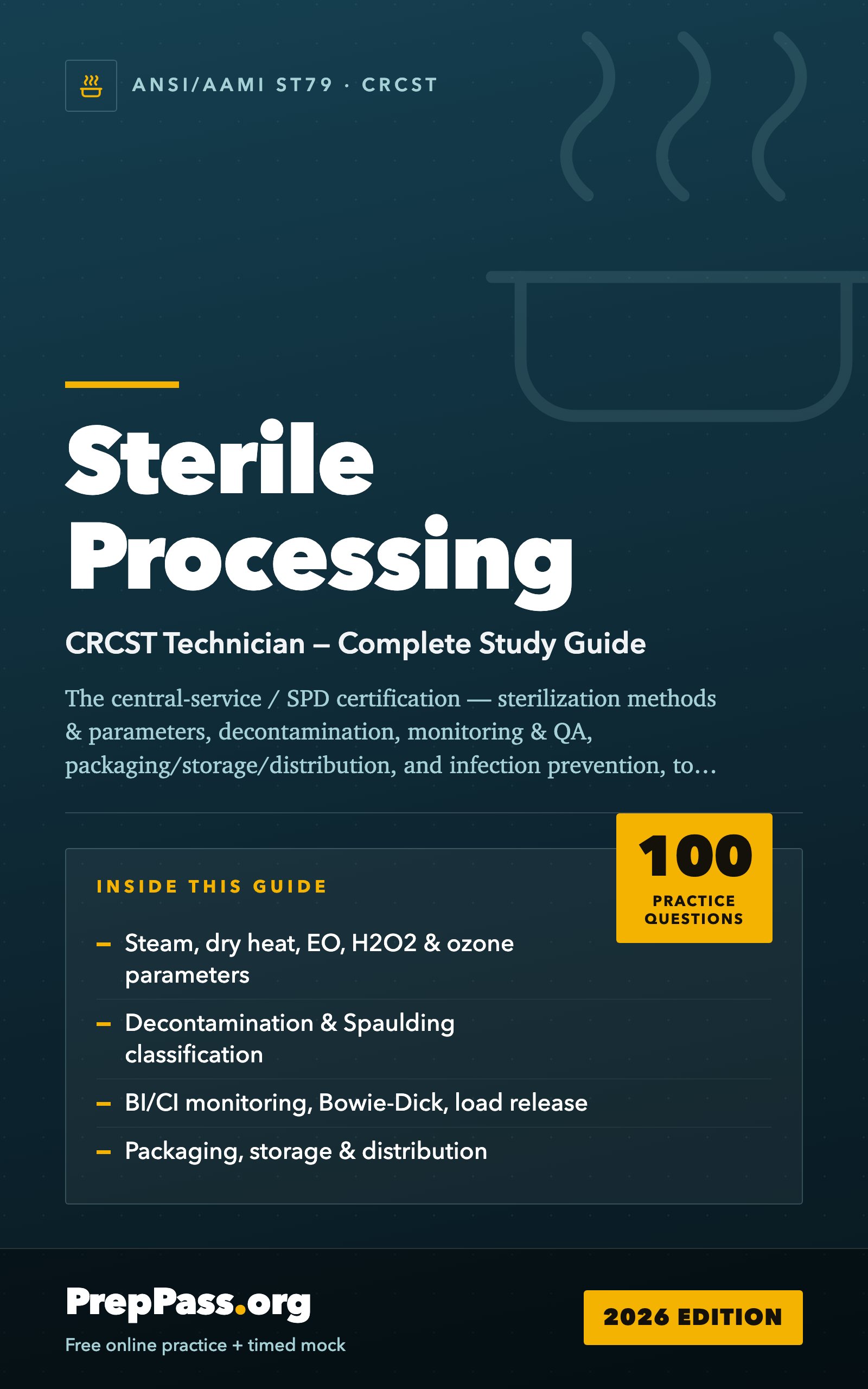
Sterile Processing Technician (CRCST) · Ấn bản 2026
Sterile Processing Technician (CRCST) — Complete Study Guide (2026)
The central-service / SPD certification — one chapter per HSPA content area: departmental considerations; decontamination; preparation & packaging; sterilization; sterile storage & transport; patient care equipment; professional practice.
- Cả bảy mảng nội dung CRCST của HSPA trong một bản PDF + EPUB bạn giữ — gồm cả hai mảng bản cũ không có chương nào
- Mỗi chương trong bảy chương đều khép lại bằng bảng số liệu phải thuộc, danh sách bẫy đề và một tình huống giải sẵn
- Một đề thi thử đầy đủ ở cuối sách, phân bổ theo trọng số bảy mảng, kèm lập luận cho từng đáp án
PDF + EPUB · tiếng Anh · 137 trang · $14.99 trả một lần
Sách này được viết bằng tiếng Anh — tệp PDF và EPUB bạn tải về đều bằng tiếng Anh.
Tải ngay sau khi thanh toán — không cần tài khoản, không thuê bao. Chính sách hoàn tiền
Có gì — và không có gì
Bao gồm
- One chapter per HSPA content area — all seven, including departmental considerations and patient care equipment
- Sterilization methods & parameters (steam, dry heat, EO, H2O2, ozone)
- Decontamination, cleaning, and the Spaulding classification
- Monitoring & QA: biological/chemical indicators, Bowie-Dick, load release
- Sterile storage, transport, inventory, and distribution
- A 70-question practice exam weighted to the seven areas, with a written explanation for every answer
- An appendix naming every exam figure this book will not state, and where HSPA publishes it
- PDF (print & tab it) + EPUB (phone / e-reader)
Không bao gồm
- Không gửi bản in — đây là tệp bạn tải về và có thể tự in
- Sách không kèm khoá video, giảng viên hay kèm riêng — video miễn phí trên trang là phần khác
- Không bao gồm lệ phí đăng ký thi hay phí trung tâm khảo thí — bạn vẫn nộp cho cơ quan chính thức
Đọc miễn phí trọn một chương
Trọn vẹn một chương, đúng như trong eBook. Cuộn cửa sổ để đọc ngay tại đây; không cần tải, không cần email.
Đọc chương 6 ngay tại đây, không rời trang
Chúng tôi không đưa phần mở đầu dễ dãi — chương miễn phí mở thẳng vào một trong những phần đậm đặc nhất của cuốn sách, để bạn đánh giá cách dạy ở đúng chỗ kỳ thi trở nên khó.
HSPA Section 6 — published weight 5%.
Sterile processing does not only process instruments. In most facilities the department also cleans, tracks, stages, and distributes the reusable patient care equipment the rest of the hospital runs on: IV poles and infusion pumps, stretchers and wheelchairs, suction regulators, sequential compression device (SCD) controllers, feeding pumps, blood pressure cuffs, specialty carts, and the case carts that carry a surgical case to the operating room.
This is the smallest section on the exam and the fastest to learn, because most of it follows from one classification decision you already know. Do not skip it — five percent of a scored exam is real, and this material is concrete.
6.1 Classification and Cleaning
Almost all reusable patient care equipment is noncritical: it contacts intact skin only, or no patient tissue at all. The required minimum is therefore cleaning followed by low-level disinfection with an EPA-registered hospital disinfectant used exactly per its label — under federal pesticide law, label instructions are not advisory. High-level disinfectants and liquid chemical sterilants are never used on noncritical items.
Two qualifications matter. Use changes the category: a blood pressure cuff placed over nonintact skin or a wound is no longer a noncritical use, and items with brief nonintact-skin contact such as bed side rails are commonly handled with intermediate-level disinfection. Contact precautions raise the bar: absent dedicated or disposable equipment, an item used on a patient under contact precautions is disinfected before use on another patient, not at the end of the shift.
The variable that decides whether disinfection actually happened is contact time, which runs from application until the surface has dried. The surface must therefore stay visibly wet for the full labeled time. If a wipe dries in twenty seconds on a warm pump housing and the label calls for two minutes, that surface was cleaned, not disinfected, and the disinfectant is reapplied. This single idea produces more correct answers in this section than any other.
The rest of the routine follows the shape of the item. Remove and discard all single-use components first — disposable tubing, suction liners, SCD sleeves, probe covers, feeding-pump sets, disposable batteries — into the correct waste stream. Clean before you disinfect, since visible soil blocks a disinfectant exactly as it blocks a sterilant. Do not immerse electrical equipment: powered devices are wiped, and the model's own IFU is the authority. The Kendall SCD controller illustrates why — its manual states that the system cannot be sterilized by liquid immersion, autoclaving, or ethylene oxide without irreparable damage, and publishes its own list of acceptable cleaning agents. Approved-chemical lists are model-specific, so the durable rule is "check that model's IFU." Finally, label the finished item with a clean tag, sticker, or cover, so the next person can tell a processed item from one awaiting cleaning.
Two specific cases recur. Case carts are cleaned after each use, mechanically in a cart washer where one exists; a cart washer cleans and provides low- to intermediate-level thermal disinfection, and like any mechanical cleaning equipment it is tested on installation, on each day of use, and after major repairs. Carts are received on the decontamination side and return to the clean side for restocking. Suction splits cleanly: the liner is a single-use disposable, never emptied and reused, while the rigid outer canister and the wall regulator are reusable noncritical equipment. A liner whose contents would release blood or other potentially infectious material in a liquid or semi-liquid state is regulated medical waste and goes into a closable, leak-proof, labeled container.
6.2 Inspection, PM Tags, and Electrical Safety
Every item is inspected before distribution, and HSPA names the triad: cleanliness, frayed cords, and damage.
Electrical safety carries real regulatory teeth. OSHA requires portable cord- and plug-connected equipment to be visually inspected before use on any shift for external defects and evidence of internal damage, and states that if a defect or damage might expose an employee to injury, the item shall be removed from service until repairs and tests have made it safe. A frayed cord therefore comes out of service immediately, is tagged, is not distributed, and goes to Biomedical Engineering. It is never taped and never sent out "just for a short case."
Preventive maintenance (PM) tags are the second checkpoint, and what is actually required here is commonly overstated. Accreditation standards require a medical equipment inventory, written inspection, testing and maintenance frequencies based on the manufacturer's recommendations and risk, safety and functional checks before initial use, and documentation of all of it. No standard requires a physical sticker — but the sticker is the near-universal, surveyor-expected evidence that the program was carried out. The technician's rule is what HSPA tests: equipment with a missing or expired PM label does not go out. It is pulled from ready stock, tagged, and routed to Biomedical Engineering, which owns the PM program.
6.3 Tracking, Rentals, and Distribution
Tracking systems run from manual logs through computerized databases, barcode scanning, RFID, and hybrid combinations. What they buy is answers to four questions: where is that pump now, how much of the fleet is in use, what is due for PM, and — when a manufacturer issues a recall — exactly which units are affected and where they are.
Rental and loaned equipment adds two events. On receipt, equipment from outside the facility is treated as contaminated regardless of what the supplier says, then cleaned, inspected, and tested per its IFU before distribution. Before return, it is decontaminated again — and this one is federal law. OSHA's Bloodborne Pathogens standard requires equipment that may have become contaminated to be examined prior to servicing or shipping and decontaminated as necessary; where decontaminating a portion is not feasible, a readily observable label must state which portions remain contaminated, and that must be communicated to affected employees, the servicing representative, and the manufacturer before anyone handles or ships it. Returning a rental pump to a vendor is shipping.
Clean equipment is stored dry, clean, and secure, separated from equipment awaiting cleaning, with adequate charging stations; the department's one-way flow applies here exactly as it does to instruments. Batteries matter enough that flawed battery charging practices made ECRI's Top 10 Health Technology Hazards for 2019: keep chargeable equipment plugged in while in stock, check the charge indicator before distribution, and replace batteries on the manufacturer's schedule through Biomedical Engineering. Finally, equipment is assembled with the disposables it needs, tested per the manufacturer's IFU before it leaves the department, transported clean and protected to the requesting unit — HSPA names the operating room, the emergency department, and labor and delivery — and its delivery is recorded.
Key Numbers & Facts — Chapter 6 (memorize cold)
| Item | Value / rule |
|---|---|
| Patient care equipment | Noncritical → clean + low-level disinfection |
| Nonintact skin contact | Raises the category — no longer a noncritical use |
| Contact precautions | Disinfect between patients if not dedicated or disposable |
| Never on noncritical items | High-level disinfectants / liquid chemical sterilants |
| Disinfectant | EPA-registered hospital disinfectant, used per its label |
| Contact time | Surface must stay visibly wet the entire labeled time — reapply if it dries |
| First step | Remove and discard all consumables and single-use components |
| Electrical equipment | Do not immerse; wipe per the model's own IFU |
| SCD | Sleeves are single-patient-use; controller is wiped, never immersed or autoclaved |
| Suction | Liner single-use — never emptied and reused; canister and regulator reusable |
| Regulated waste | Liquid or semi-liquid blood/OPIM → closable, leak-proof, labeled container |
| Case carts | Cleaned after each use; cart washer = low-to-intermediate thermal disinfection |
| Cart washer testing | Installation, each day of use, after major repairs |
| Inspection triad | Cleanliness, frayed cords, damage |
| Frayed cord | Out of service, tagged, to Biomedical Engineering — OSHA, not preference |
| Cord inspection | Visually before use on any shift |
| PM label missing/expired | Do not distribute → tag → Biomedical Engineering |
| What's actually required | A documented PM program; the sticker is the expected evidence |
| Tracking systems | Manual, computer, RFID, hybrid |
| Rental/loaned on receipt | Treated as contaminated regardless of supplier assurances |
| Rental/loaned before return | Decontaminate before shipping — OSHA Bloodborne Pathogens |
| Clean equipment storage | Dry, clean, secure, separated from soiled, status visible |
| Batteries | Keep charged in stock; check the indicator before distribution |
| Before it leaves | Test per the IFU |
| Delivered to | OR, ED, Labor and Delivery — and the delivery is recorded |
Worked Scenario — The Pump on the Ready Rack
The emergency department calls for an infusion pump. The technician pulls one from the clean equipment rack and finds three things: the PM sticker expired last month, there is a shallow nick in the outer jacket of the power cord, and the housing has a dried streak of something near the handle. The charge nurse says the department is desperate, the pump "worked fine last week," and asks that it be sent now and let Biomed sort it out afterward.
Reason it through. All three findings independently disqualify the pump, which is what makes this scenario useful — a technician who fixes only the obvious one still sends out an unsafe device.
The damaged cord is the most serious and the least negotiable, because it is backed by federal law rather than professional guidance: a defect that might expose an employee to injury means the item shall be removed from service until repaired and tested. "Worked fine last week" is neither a repair nor a test, and tape is not an insulator. The expired PM label means the facility can no longer demonstrate that required inspection, testing, and maintenance were performed on this unit; the label is not itself the requirement, but it is the visible evidence that the program has lapsed here. The dried streak means the pump never completed cleaning, or reached the clean rack without being processed — which raises a question about everything else on that rack. It goes back to be cleaned and then disinfected, kept visibly wet for the full labeled contact time.
The right response to the charge nurse is the one from Chapter 7: acknowledge the real problem, decline the unsafe action, offer an alternative, and escalate. Find another pump, say how long that will take, tag this one, notify Biomed, and tell the supervisor the ED is short. Sending it and letting Biomed sort it out afterward inverts the entire purpose of an inspection step.
Exam Traps — Chapter 6
- The one-swipe trap. A surface that dries before the labeled contact time elapses was cleaned, not disinfected — reapply.
- The high-level-disinfectant trap. Noncritical equipment gets low-level disinfection; high-level disinfectants and liquid chemical sterilants are wrong for it.
- The immersion trap. Powered patient care equipment is wiped, not immersed, autoclaved, or gas sterilized — and the model's IFU is the authority.
- The reusable-liner trap. A suction liner is never emptied and reused; only the outer canister and the regulator are reusable.
- The "tape the cord" trap. A damaged cord is removed from service and repaired — under OSHA, not as a matter of preference.
- The "Biomed can check it later" trap. Equipment failing inspection does not go out first and get resolved afterward.
- The PM-sticker trap. The sticker itself is not what a standard requires — the documented PM program is — but equipment with a missing or expired label still does not get distributed.
- The vendor-assurance trap. Rental and loaned equipment is processed on receipt regardless of what the supplier says, and decontaminated again before it is shipped back.
Trước khi mua
- Nhận sách thế nào?
- Thanh toán xong, mục tải xuống hiện ngay trên trang này. Liên kết cũng được gửi qua email. Không cần tài khoản.
- Nếu sách không hợp thì sao?
- Gửi email trong vòng 14 ngày để được hoàn tiền đầy đủ, không cần lý do.
- Phần luyện tập miễn phí có bị bỏ không?
- Không. Mọi câu hỏi luyện tập, bài thi thử tính giờ và các chương miễn phí trên trang vẫn miễn phí. Cuốn sách là nửa "học", không phải hàng rào quanh phần miễn phí.
- Đọc trên điện thoại được không?
- Được — EPUB cho điện thoại và máy đọc sách, PDF để in và dán tab. Bạn nhận cả hai.
Chi tiết
The central-service / SPD certification — one chapter per HSPA content area: departmental considerations; decontamination; preparation & packaging; sterilization; sterile storage & transport; patient care equipment; professional practice.
- Format: PDF + EPUB download · 137 pages
- 70 practice questions in the book, with a full answer key
- 400 free practice questions for this exam on PrepPass, included at no cost
- $14.99 one-time — no subscription
- 14-day money-back guarantee · refund policy
- Cross-referenced against: ANSI/AAMI ST79 / ANSI/ASHRAE/ASHE 170 / CDC sterilization guidelines / OSHA / device IFUs
- Last updated: September 2026
- Đối chiếu từ nguồn chính thức(ANSI/AAMI ST79 / ANSI/ASHRAE/ASHE 170 / CDC sterilization guidelines / OSHA / device IFUs)
- 400 câu hỏi luyện tập miễn phí
- Tải ngay, thuộc về bạn trọn đời
Về chính kỳ thi này
| Cơ quan quản lý | Healthcare Sterile Processing Association (HSPA), formerly IAHCSMM — kỳ thi do Prometric tổ chức Nguồn: HSPA — Certification Handbook (PDF, revised January 2026) |
|---|---|
| Số câu hỏi | 150 câu hỏi (125 câu tính điểm, 25 câu thử nghiệm không tính điểm) Nguồn: HSPA — Certification Handbook (PDF, revised January 2026) |
| Thời gian làm bài | 180 phút Nguồn: HSPA — Certification Handbook (PDF, revised January 2026) |
| Điểm đậu | HSPA không công bố Những trang chúng tôi đã đọc và không tìm thấy: HSPA — Certification Handbook (PDF, revised January 2026) |
| Lệ phí |
Nguồn: HSPA — Certification Handbook (PDF, revised January 2026) |
| Ngôn ngữ thi | Tiếng Anh Nguồn: HSPA — Certification Handbook (PDF, revised January 2026) |
Vì sao mua sách khi phần luyện tập miễn phí?
Câu hỏi luyện tập và bài thi thử tính giờ vẫn miễn phí — không có gì trên trang bị giấu sau cuốn sách này. Cuốn sách $14.99 là nửa "học": chính phần kiến thức, dạy theo trình tự, trong một tệp thuộc về bạn.
- Dạy có hệ thống — mọi phần thi giảng theo từng chương, từ đầu đến cuối, không chỉ là câu hỏi
- In ra & dán nhãn — PDF sẵn sàng để in, tô đậm, ghi chú và mang tới bàn học
- Học mọi nơi, ngoại tuyến — EPUB trên điện thoại hay máy đọc sách; không cần wifi, không cần tab trình duyệt
- Tất cả một chỗ — các chương, thẻ tóm tắt từng chương và câu hỏi luyện tập trong một tệp
- Của bạn trọn đời — trả một lần $14.99, tải ngay, không thuê bao
Và không rủi ro: Đảm bảo hoàn tiền 14 ngày — không hài lòng? Email cho chúng tôi để hoàn tiền đầy đủ, không cần lý do. Xem chính sách hoàn tiền.
Đảm bảo hoàn tiền 14 ngày · hoàn tiền đầy đủ, không cần lý do.
Mua một lần, truy cập tải về trọn đời. eBook là trọn bộ hướng dẫn ôn Sterile Processing Technician (CRCST) ở dạng PDF và EPUB. Bản tóm tắt mang tính giáo dục, không phải tư vấn chuyên môn hay pháp lý — luôn xác nhận quy định hiện hành với nguồn chính thức. Cập nhật lần cuối: September 2026.