Học liệu
Nắm vững mọi nội dung của kỳ thi, bằng ngôn ngữ dễ hiểu.
Reasoning Through Language Arts
The Reasoning Through Language Arts (RLA) module tests how well you read closely, think about arguments, and write in clear, standard English. You will read informational and literary passages, answer questions about their meaning and structure, and edit sentences for grammar and usage. This chapter builds the core reading and language skills you need: finding main ideas, using evidence, understanding vocabulary in context, and applying the rules of Edited American English. Mastering these fundamentals prepares you for both the multiple-choice questions and the extended written response.
Mathematical Reasoning
The Mathematical Reasoning module measures your ability to work with numbers, solve algebra problems, understand geometry, and interpret data. Roughly half of the questions focus on quantitative problem solving, such as fractions, percents, and ratios, while the other half emphasize algebraic reasoning with expressions, equations, and graphs. You are allowed an on-screen calculator for most of the test, but you still need a firm grasp of the underlying concepts. This chapter reviews the essential math skills, from basic operations to interpreting charts, so you can reason through both routine and multi-step problems.
Science
The Science module tests your ability to understand and apply scientific concepts and to reason from data. It draws on three content areas: life science, physical science, and earth and space science. Rather than requiring you to memorize countless facts, the test emphasizes scientific practices such as designing investigations, interpreting graphs, and evaluating evidence. This chapter reviews the big ideas in each content area and the reasoning skills that connect them, helping you read passages, analyze data, and draw sound conclusions.
Social Studies
The Social Studies module assesses your understanding of civics and government, United States history, economics, and geography. As with the other subjects, the emphasis is on reasoning: reading passages, interpreting maps and charts, and analyzing primary and secondary sources. You do not need to memorize every date, but you should grasp the major ideas that shape how societies govern themselves and manage resources. This chapter reviews the foundational concepts in each area and the source-analysis skills that tie them together.
Luyện theo chủ đề
Jump straight into free practice questions for any single GED content area.
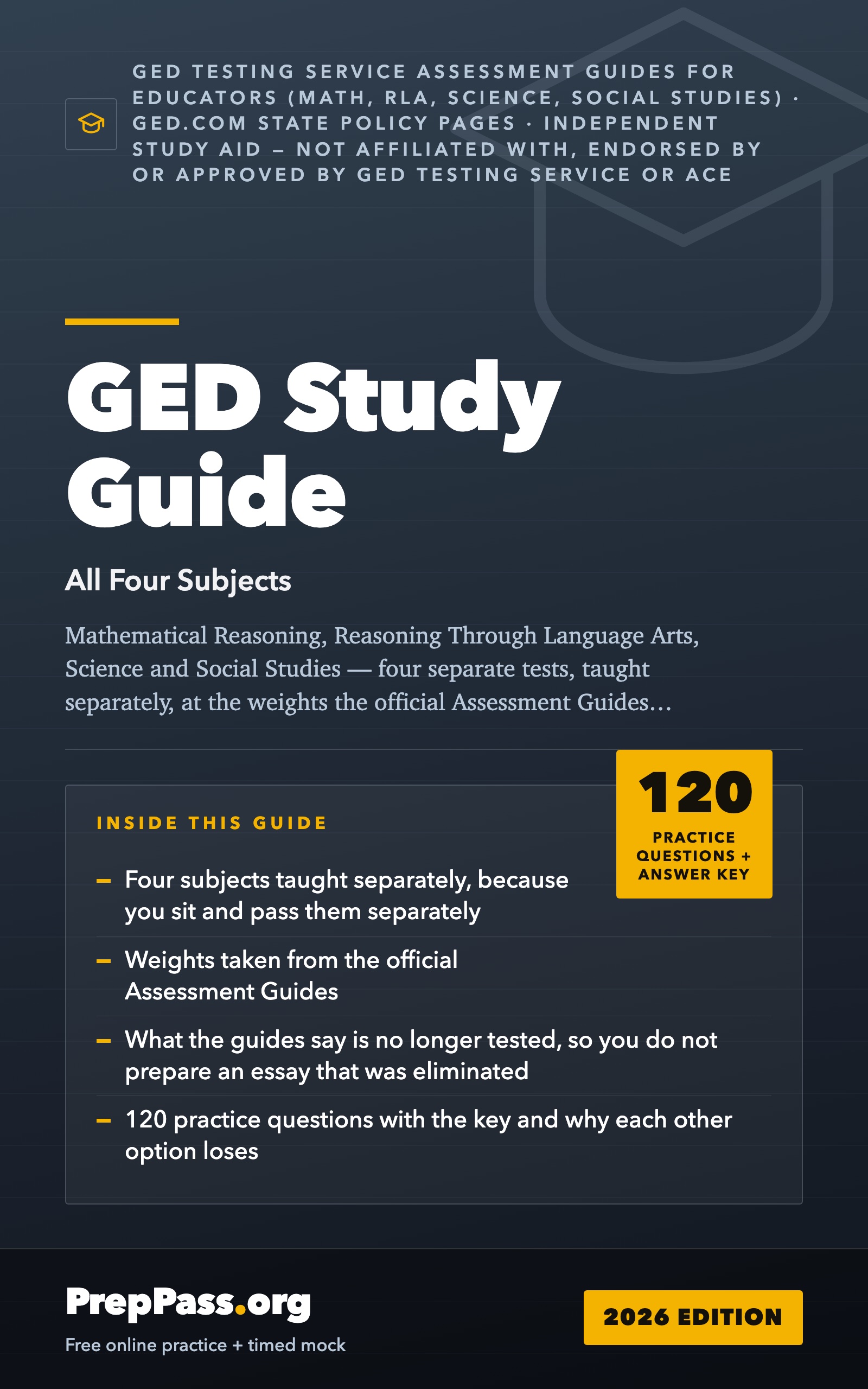
Luyện tập vẫn miễn phí. Trọn bộ hướng dẫn GED là chính phần kiến thức, dạy từ đầu đến cuối — tệp PDF + EPUB tải về, thuộc về bạn.