Học liệu
Nắm vững mọi nội dung của kỳ thi, bằng ngôn ngữ dễ hiểu.
The Casualty outline spends most of its Personal Lines weight here: the California financial responsibility law, the ISO Personal Auto Policy, California's auto statutes on good drivers, cancellation and uninsured motorists, ride-hailing and car sharing, the assigned risk and low-cost programs, and then watercraft and umbrella coverage. Section III.A of the Casualty outline — residential liability and liability endorsements — was taught with the homeowners form in Chapter 6; this chapter starts with the boat.
III.B Marine — Personal Watercraft
A homeowners policy is a poor fit for most boats. Property coverage for watercraft of all types, including trailers and motors, is capped at $1,500[1], and Section II liability applies only to small craft — sailboats under 26 feet and boats with outboard motors of 25 total horsepower or less, among a few other exceptions[1]. A watercraft endorsement to the homeowners policy broadens liability and medical payments for small sailboats and outboard boats[2]; larger boats need a boat owners or yacht policy. Those policies typically combine:
- Liability — operations liability, passenger liability and, for fleets, flotilla coverage.
- Medical payments for people aboard.
- Physical damage to the boat, motor, trailer and equipment.
- For yachts, hull coverage on the vessel itself and protection and indemnity (P&I) — the marine term for liability coverage.
III.C Personal Auto
1.a The California Financial Responsibility Law
"All drivers and all owners of a motor vehicle shall at all times be able to establish financial responsibility ... and shall at all times carry in the vehicle evidence of the form of financial responsibility in effect for the vehicle"[3]. Financial responsibility is established by being self-insured, being insured under a qualifying policy or bond, being a public entity, being a cash depositor under the Vehicle Code, or another method the DMV authorizes[4]. CDI's auto guide lists the three ways most drivers use: liability insurance from an authorized insurer, a $35,000 cash deposit with the DMV, or a $35,000 surety bond[5].
Minimum limits. For policies issued or renewed on or after January 1, 2025, the minimum liability limits are $30,000 for bodily injury to one person, $60,000 for bodily injury to two or more people in one accident, and $15,000 for property damage[6]. The prior minimums were $15,000/$30,000/$5,000[6], and the minimums rise again for policies issued or renewed on or after January 1, 2035[6]. An auto liability policy issued in California must carry at least these limits[7]. CDI states the minimums the same way for consumers[5].
Notice requirements. An insurer must notify the DMV when a policy is written or the insured stops paying; CDI's guide tells consumers that the insurer "tells the California Department of Motor Vehicles (DMV) if you buy auto insurance or if you stop paying your premium"[5].
1.b Company policies versus the ISO form
The exam uses ISO's Personal Auto Policy (PP 00 01) as the standard[8], but a company's own policy may differ in wording, limits and endorsements, and California amendatory endorsements change the ISO form to meet California statutes (cancellation notice periods, uninsured motorist rules and so on). Always read the actual policy.
1.c The Personal Auto Policy: who and what is covered
- "You" and "your" — the named insured and a resident spouse. If the spouse moves out, the spouse remains "you" only until the earliest of 90 days after the move, the effective date of another policy naming the spouse, or the end of the policy period[9].
- "Family member" — a person related to you by blood, marriage or adoption who is a resident of your household, including a ward or foster child[9].
- "Your covered auto" — any vehicle shown in the declarations, a newly acquired auto, any trailer you own, and a temporary substitute for a covered auto out of use because of breakdown, repair, servicing, loss or destruction[9].
- Who is insured under Part A — you or any family member for any auto or trailer, and "Any person using 'your covered auto'"[9]. California law requires the policy to cover the named insured and anyone using the vehicle with permission[7].
- Territory — the United States, its territories or possessions, Puerto Rico, and Canada, plus transport between their ports[9].
- Share-the-expense versus for-hire. Part A excludes a vehicle used as a public or livery conveyance, including any time the insured is logged into a transportation network platform as a driver, but the exclusion "does not apply to: a. A share-the-expense car pool"[9].
Newly acquired autos
A newly acquired private passenger auto, pickup or van gets the broadest coverage provided for any vehicle shown in the declarations, for everything except damage to your auto, if you ask the insurer to insure it within 14 days after you become the owner[9]. For physical damage:
- Collision begins on the date you become the owner. If at least one listed auto has collision coverage, you must ask within 14 days; if none does, you must ask within four days, and a $500 collision deductible applies to a loss that happens before you ask[9].
- Other than collision follows the same 14-day / four-day pattern[9].
CDI's objectives state the same rule: if the insured has collision coverage on at least one listed auto, all coverage on the newly acquired auto begins on the date of ownership[10].
Rental cars and non-owned autos
A non-owned private passenger auto rented for a vacation is covered under Part A because "You or any 'family member'" are insured "for the ownership, maintenance or use of any auto"[9]. Under Part D, a non-owned auto gets the broadest coverage applicable to any covered auto[9], and the policy pays up to $30 a day for loss-of-use charges you owe on a non-owned auto[9]. Liability insurance on a vehicle you do not own is excess over other collectible insurance[9].
1.d Primary and excess coverage
The PAP's liability coverage on a vehicle you do not own is excess over other collectible insurance, while coverage for your covered auto is shared pro rata with other applicable insurance[9]. Part D's "other sources of recovery" clause makes coverage on a non-owned auto "excess over any other collectible source of recovery," including the owner's coverage[9].
1.e The Good Driver Discount
Proposition 103 requires auto rates to be based, in decreasing order of importance, on the insured's driving safety record, annual miles driven, and years of driving experience, then other factors the Commissioner adopts[11]. A person who qualifies may buy a Good Driver Discount policy from the insurer of his or her choice, and its rate must be "at least 20 percent below the rate the insured would otherwise have been charged for the same coverage"[11]. To qualify, a driver must have been licensed for the previous three years and, in those three years, not had more than one violation point, and not been principally at fault in an accident causing injury or death[12]. The absence of prior insurance cannot, by itself, be used to set rates or eligibility[11].
Credit. CDI's objectives state that a consumer credit report cannot be used in California as the basis for declining to insure or as a premium factor for auto insurance[10]. The rating statute explains why: auto rates must follow the approved factors, and "the use of any criterion without approval shall constitute unfair discrimination"[11].
1.f Cancellation and nonrenewal
California limits the reasons an insurer may cancel or nonrenew an auto policy. Proposition 103 allows a notice of cancellation or nonrenewal "only if it is based on one or more of the following reasons: (A) nonpayment of premium; (B) fraud or material misrepresentation affecting the policy or insured; (C) a substantial increase in the hazard insured against"[13]. Section 661 lists the cancellation grounds in more detail, including suspension or revocation of the license of the named insured or a regular driver[14].
Notice periods:
- Cancellation: at least 20 days, or at least 10 days after nonpayment for a nonpayment cancellation; the cancellation takes effect only if the nonpayment is not cured within the 10 days[15].
- Renewal offer: at least 20 days before expiration; nonrenewal notice: at least 30 days before expiration[16]. If the insurer fails to give either, the policy continues for 30 days after the notice is given[16].
CDI's guide puts the grounds plainly — fraud or material misrepresentation, nonpayment, or substantial increase in the hazard — and notes the 10-day notice for nonpayment[5].
1.h Ride-hailing (TNC) and personal vehicle sharing
- Personal auto policies rarely cover TNC driving. The ISO form excludes use as a public or livery conveyance, including whenever the driver is logged into a transportation network platform[9]. Insurers offer products that fill the gap; CDI's guide notes you can buy coverage for business use, "including when driving for a Transportation Network Company"[5].
- What the TNC must carry. From the moment a driver accepts a ride request until the ride ends, TNC insurance must be primary and at least $1,000,000 for death, personal injury and property damage, and the TNC must provide uninsured and underinsured motorist coverage of $60,000 per person and $300,000 per incident while a passenger is in the vehicle[17].
- Personal vehicle sharing. A privately insured car is not reclassified as commercial or for-hire just because it is shared through a personal vehicle sharing program, as long as the owner's sharing revenue does not exceed the annual cost of owning and operating the vehicle and the owner does not knowingly allow commercial use[18]. The PAP excludes liability while the car is enrolled in and being used through such a program by someone other than you or a family member[9] — so the program's own insurance must respond.
2. Liability, medical payments and uninsured motorists
Part A — Liability. "We will pay damages for 'bodily injury' or 'property damage' for which any 'insured' becomes legally responsible because of an auto accident," and "In addition to our limit of liability, we will pay all defense costs we incur"[9].
- Supplementary payments (in addition to the limit): up to $250 for bail bonds, premiums on appeal bonds, post-judgment interest, up to $250 a day for lost earnings to attend hearings at the insurer's request, and other reasonable expenses; these payments do not reduce the limit[9].
- Split limits versus single limit. A split limit states a per-person bodily injury limit, a per-accident bodily injury limit and a property damage limit; CDI's example: with $50,000/$100,000, the policy will not pay more than $50,000 for one person or $100,000 for one accident[5]. A combined single limit is one sum for bodily injury and property damage per accident[19].
- Out-of-state coverage. If an accident happens in a state with higher financial responsibility limits, the policy provides the higher limits; if a state requires nonresidents to carry compulsory coverage, the policy provides at least the required minimum[9].
- Other insurance. For a non-owned vehicle, the PAP liability coverage is excess[9].
- Key exclusions. Intentional injury; property damage to property owned or transported by the insured, or rented to or in the insured's care (except a residence or private garage); vehicles with fewer than four wheels or designed mainly for off-road use; vehicles furnished for your regular use[9].
Part B — Medical Payments. Pays reasonable medical and funeral expenses "because of 'bodily injury'" caused by an accident and sustained by an insured, incurred within three years of the accident[9], for you and family members while occupying a motor vehicle or as pedestrians struck by one, and for anyone occupying your covered auto[9]. CDI notes the minimum medical payments limit you can buy is $1,000 per person[5], and it pays "no matter who is at fault"[5].
Part C — Uninsured Motorists. Pays compensatory damages an insured is legally entitled to recover from the owner or operator of an uninsured motor vehicle because of bodily injury[9]. An "uninsured motor vehicle" includes one with no bodily injury liability policy, one whose limits are below the financial responsibility minimum, a hit-and-run vehicle whose owner and operator cannot be identified, and one whose insurer denies coverage or becomes insolvent[9].
California's uninsured motorist law:
- Every auto bodily injury liability policy issued in California must include uninsured motorist coverage unless the named insured and insurer agree in writing to delete it or reduce it — but not below the financial responsibility limits[20]. CDI: "If you choose not to buy it, you must sign a form, called a waiver"[5].
- Underinsured motorist coverage pays when the at-fault driver's limits are too low[5].
- Uninsured motorist property damage (UMPD) pays damage to your car caused by an identified at-fault uninsured driver, up to $3,500, if you do not have collision coverage[5].
- Collision deductible waiver pays your collision deductible when an uninsured at-fault driver damages your car[5].
- Umbrella and excess policies are not required to include uninsured motorist coverage: "A policy shall be excluded from the application of this section if the automobile liability coverage is provided only on an excess or umbrella basis"[20].
Credit reports and MVRs. Insurers order a Motor Vehicle Report from the DMV — "the state's official record of your accidents, traffic violations, and suspended licenses"[5] — and the federal Fair Credit Reporting Act governs the use of consumer reports; in California, as noted above, credit may not be used to decline or price auto insurance[10, 11].
3. Physical damage and endorsements
Part D — Coverage for Damage to Your Auto pays "for direct and accidental loss to 'your covered auto' or any 'non-owned auto', including its equipment, minus any applicable deductible"[9].
- Collision means "the upset of 'your covered auto' or a 'non-owned auto' or its impact with another vehicle or object"[9].
- Other than collision (OTC) — what many insurers still call comprehensive — includes missiles or falling objects, fire, theft, explosion or earthquake, windstorm, hail, water or flood, vandalism, riot, contact with bird or animal, and breakage of glass; glass broken in a collision may be treated as collision at the insured's option[9]. CDI's guide: comprehensive covers damage "caused by something other than a collision"[5]. OTC is a property coverage — it pays for damage to the insured's own car.
- Valuation. The insurer pays the lesser of actual cash value or the cost to repair or replace with like kind and quality; depreciation and physical condition are considered for a total loss; betterment is not paid[9]. CDI notes collision and comprehensive "provide compensation based on the market value of your car"[5].
- The insurer's options. It may pay in money or repair or replace the property, and may return stolen property[9].
- Transportation expenses. Without a deductible, up to $30 a day and $900 total for temporary transportation after a covered loss to your auto; for total theft, beginning 48 hours after the theft[9].
- Personal effects and equipment. Part D covers the auto "including its equipment"; it excludes loss to non-permanently installed electronic equipment and limits custom equipment to $1,500 unless endorsed[9].
- Exclusions include wear and tear, freezing, mechanical or electrical breakdown, road damage to tires, and livery use[9].
- Duties after a loss. Promptly notify the insurer of how, when and where the accident happened; cooperate; submit to physical exams and examinations under oath as required[9]; for uninsured motorist claims, promptly notify police of a hit-and-run[9]; and for damage to your auto, protect it from further loss and notify police of a theft[9].
Common endorsements the objectives list: miscellaneous type vehicle (motor homes, motorcycles, golf carts), limited Mexico coverage, towing and labor, trust, joint ownership, auto loan/lease (GAP) coverage, named non-owner coverage, extended non-owned liability for a vehicle furnished for regular use, optional transportation expense limits, and customizing equipment coverage[10]. CDI's guide describes GAP as paying the difference between the car's fair market value and what is owed on the loan or lease[5].
4. CAARP and the Low-Cost Automobile program
California Automobile Assigned Risk Plan (CAARP). The Commissioner approves a plan for the equitable apportionment among admitted liability insurers of applicants "who are in good faith entitled to but are unable to procure that insurance through ordinary methods," and all such insurers must participate[21]. CDI's guide: CAARP assigns a driver to an insurer, all participating insurers charge the same premiums, installments are allowed, and "There is no broker's fee if you buy a CAARP policy"[5]. Eligibility standards may consider the applicant's driving record, license suspensions, accidents, and the condition or use of the car[22].
California Low-Cost Automobile Insurance (CLCA). A program within CAARP[23]:
- Limits: $10,000 per person and $20,000 per accident for bodily injury, $3,000 for property damage — lower than the standard minimums but satisfying financial responsibility for program participants[5, 24].
- Eligibility: household income at or below 250% of the federal poverty level; at least 16 and continuously licensed for three years (or pay a surcharge); no more than one at-fault property damage accident or one moving-violation point in three years; no at-fault injury accident; no Vehicle Code felony or misdemeanor on the record[25]. CDI adds that the car must be worth $25,000 or less[5].
- Terms: a one-year term, renewable annually[24]; an installment plan with no more than 20% down[26]; uninsured motorist and medical payments available as options[27].
Sources cited in this excerpt
- Homeowners 3 - Special Form, HO 00 03 05 11 (specimen filed with and published by the Nevada Division of Insurance). Insurance Services Office, Inc., 2010-05-01. https://doi.nv.gov/uploadedFiles/doinvgov/_public-documents/Consumers/Home/American_Family/Homesite_HO_00_03_05_11.pdf
- Home Insurance Forms (consumer information page). Alabama Department of Insurance, 2026-09-24. https://aldoi.gov/Consumers/HomeInsForms.aspx
- California Vehicle Code section 16020, text as retrieved 2026-09-24 (Amended by Stats. 2022, Ch. 295, Sec. 13. (AB 2956) Effective January 1, 2023.). California Legislature (California Legislative Information, leginfo.legislature.ca.gov), 2023-01-01. https://leginfo.legislature.ca.gov/faces/codes_displaySection.xhtml?lawCode=VEH§ionNum=16020
- California Vehicle Code section 16021, text as retrieved 2026-09-24 (Amended by Stats. 2003, Ch. 594, Sec. 41. Effective January 1, 2004.). California Legislature (California Legislative Information, leginfo.legislature.ca.gov), 2004-01-01. https://leginfo.legislature.ca.gov/faces/codes_displaySection.xhtml?lawCode=VEH§ionNum=16021
- Automobile Insurance information guide (Form 901, February 2025). California Department of Insurance, 2025-02-01. https://www.insurance.ca.gov/01-consumers/105-type/95-guides/01-auto/upload/IG-Auto-Insurance-Updated-020525.pdf
- California Vehicle Code section 16056, text as retrieved 2026-09-24 (Amended (as added by Stats. 2022, Ch. 717, Sec. 3) by Stats. 2023, Ch. 204, Sec. 19. (AB 1140) Effective January 1, 2024. Operative January 1, 2025, by its own provisions.). California Legislature (California Legislative Information, leginfo.legislature.ca.gov), 2025-01-01. https://leginfo.legislature.ca.gov/faces/codes_displaySection.xhtml?lawCode=VEH§ionNum=16056
- California Insurance Code section 11580.1, text as retrieved 2026-09-24 (Amended by Stats. 2016, Ch. 31, Sec. 176. (SB 836) Effective June 27, 2016.). California Legislature (California Legislative Information, leginfo.legislature.ca.gov), 2016-06-27. https://leginfo.legislature.ca.gov/faces/codes_displaySection.xhtml?lawCode=INS§ionNum=11580.1
- Property License Examination Objectives (effective January 1, 2026). California Department of Insurance, 2026-01-01. https://www.insurance.ca.gov/0200-industry/0030-seek-pre-lic/upload/2025-Property-License-Examination-Objectives.docx
- Personal Auto Policy, PP 00 01 09 18 (specimen published by the Virginia State Corporation Commission, Bureau of Insurance). Insurance Services Office, Inc., 2018-09-01. https://www.scc.virginia.gov/media/sccvirginiagov-home/regulated-industries/insurance/insurance-companies/property-casualty-companies/personal-commercial-auto-forms/PP-00-01-09-18.pdf
- Casualty License Examination Objectives (effective January 1, 2026). California Department of Insurance, 2026-01-01. https://www.insurance.ca.gov/0200-industry/0030-seek-pre-lic/upload/2025-Casualty-License-Examination-Objectives.docx
- California Insurance Code section 1861.02, text as retrieved 2026-09-24 (Amended by Stats. 2015, Ch. 348, Sec. 14. (AB 1515) Effective January 1, 2016. Note: This section was added on Nov. 8, 1988, by initiative Prop. 103.). California Legislature (California Legislative Information, leginfo.legislature.ca.gov), 2016-01-01. https://leginfo.legislature.ca.gov/faces/codes_displaySection.xhtml?lawCode=INS§ionNum=1861.02
- California Insurance Code section 1861.025, text as retrieved 2026-09-24 (Amended by Stats. 2015, Ch. 348, Sec. 15. (AB 1515) Effective January 1, 2016.). California Legislature (California Legislative Information, leginfo.legislature.ca.gov), 2016-01-01. https://leginfo.legislature.ca.gov/faces/codes_displaySection.xhtml?lawCode=INS§ionNum=1861.025
- California Insurance Code section 1861.03, text as retrieved 2026-09-24 (Amended by Stats. 2018, Ch. 776, Sec. 13. (AB 3250) Effective January 1, 2019. Note: This section was added on Nov. 8, 1988, by initiative Prop. 103.). California Legislature (California Legislative Information, leginfo.legislature.ca.gov), 2019-01-01. https://leginfo.legislature.ca.gov/faces/codes_displaySection.xhtml?lawCode=INS§ionNum=1861.03
- California Insurance Code section 661, text as retrieved 2026-09-24 (Amended by Stats. 2012, Ch. 786, Sec. 5. (AB 2303) Effective January 1, 2013.). California Legislature (California Legislative Information, leginfo.legislature.ca.gov), 2013-01-01. https://leginfo.legislature.ca.gov/faces/codes_displaySection.xhtml?lawCode=INS§ionNum=661
- California Insurance Code section 662, text as retrieved 2026-09-24 (Amended by Stats. 2024, Ch. 793, Sec. 1. (SB 1295) Effective January 1, 2025.). California Legislature (California Legislative Information, leginfo.legislature.ca.gov), 2025-01-01. https://leginfo.legislature.ca.gov/faces/codes_displaySection.xhtml?lawCode=INS§ionNum=662
- California Insurance Code section 663, text as retrieved 2026-09-24 (Repealed (in Sec. 6) and added by Stats. 2013, Ch. 369, Sec. 7. (SB 251) Effective January 1, 2014. Section operative January 1, 2019, by its own provisions.). California Legislature (California Legislative Information, leginfo.legislature.ca.gov), 2014-01-01. https://leginfo.legislature.ca.gov/faces/codes_displaySection.xhtml?lawCode=INS§ionNum=663
- California Public Utilities Code section 5433, text as retrieved 2026-09-24 (Amended by Stats. 2025, Ch. 314, Sec. 3. (SB 371) Effective January 1, 2026.). California Legislature (California Legislative Information, leginfo.legislature.ca.gov), 2026-01-01. https://leginfo.legislature.ca.gov/faces/codes_displaySection.xhtml?lawCode=PUC§ionNum=5433
- California Insurance Code section 11580.24, text as retrieved 2026-09-24 (Amended by Stats. 2024, Ch. 244, Sec. 1. (AB 2743) Effective January 1, 2025.). California Legislature (California Legislative Information, leginfo.legislature.ca.gov), 2025-01-01. https://leginfo.legislature.ca.gov/faces/codes_displaySection.xhtml?lawCode=INS§ionNum=11580.24
- Commercial Insurance information guide (Form 700, June 2024). California Department of Insurance, 2024-06-01. https://www.insurance.ca.gov/01-consumers/105-type/95-guides/09-comm/upload/IG-Commercial-Insurance-Updated-061524.pdf
- California Insurance Code section 11580.2, text as retrieved 2026-09-24 (Amended by Stats. 2005, Ch. 294, Sec. 23. Effective January 1, 2006.). California Legislature (California Legislative Information, leginfo.legislature.ca.gov), 2006-01-01. https://leginfo.legislature.ca.gov/faces/codes_displaySection.xhtml?lawCode=INS§ionNum=11580.2
- California Insurance Code section 11620, text as retrieved 2026-09-24 (Amended by Stats. 2017, Ch. 534, Sec. 69. (AB 1699) Effective January 1, 2018.). California Legislature (California Legislative Information, leginfo.legislature.ca.gov), 2018-01-01. https://leginfo.legislature.ca.gov/faces/codes_displaySection.xhtml?lawCode=INS§ionNum=11620
- California Insurance Code section 11624, text as retrieved 2026-09-24 (Amended by Stats. 1993, Ch. 1133, Sec. 1. Effective January 1, 1994.). California Legislature (California Legislative Information, leginfo.legislature.ca.gov), 1994-01-01. https://leginfo.legislature.ca.gov/faces/codes_displaySection.xhtml?lawCode=INS§ionNum=11624
- California Insurance Code section 11629.7, text as retrieved 2026-09-24 (Amended by Stats. 2014, Ch. 487, Sec. 1. (SB 1273) Effective January 1, 2015.). California Legislature (California Legislative Information, leginfo.legislature.ca.gov), 2015-01-01. https://leginfo.legislature.ca.gov/faces/codes_displaySection.xhtml?lawCode=INS§ionNum=11629.7
- California Insurance Code section 11629.71, text as retrieved 2026-09-24 (Amended by Stats. 2014, Ch. 487, Sec. 2. (SB 1273) Effective January 1, 2015.). California Legislature (California Legislative Information, leginfo.legislature.ca.gov), 2015-01-01. https://leginfo.legislature.ca.gov/faces/codes_displaySection.xhtml?lawCode=INS§ionNum=11629.71
- California Insurance Code section 11629.73, text as retrieved 2026-09-24 (Amended by Stats. 2019, Ch. 274, Sec. 2. (SB 570) Effective January 1, 2020.). California Legislature (California Legislative Information, leginfo.legislature.ca.gov), 2020-01-01. https://leginfo.legislature.ca.gov/faces/codes_displaySection.xhtml?lawCode=INS§ionNum=11629.73
- California Insurance Code section 11629.72, text as retrieved 2026-09-24 (Amended by Stats. 2019, Ch. 274, Sec. 1. (SB 570) Effective January 1, 2020.). California Legislature (California Legislative Information, leginfo.legislature.ca.gov), 2020-01-01. https://leginfo.legislature.ca.gov/faces/codes_displaySection.xhtml?lawCode=INS§ionNum=11629.72
- California Insurance Code section 11629.75, text as retrieved 2026-09-24 (Repealed and added by Stats. 2019, Ch. 274, Sec. 5. (SB 570) Effective January 1, 2020.). California Legislature (California Legislative Information, leginfo.legislature.ca.gov), 2020-01-01. https://leginfo.legislature.ca.gov/faces/codes_displaySection.xhtml?lawCode=INS§ionNum=11629.75
Nguyên tắc Chung của Bảo hiểm (Góc nhìn Bảo hiểm Tài sản & Trách nhiệm)
Bảo hiểm tài sản và trách nhiệm dân sự dựa trên một nhóm nhỏ các tư tưởng pháp lý và kinh tế giải thích vì sao công ty bảo hiểm sẵn sàng trả hàng nghìn đô la cho một yêu cầu bồi thường để đổi lấy vài trăm đô la phí bảo hiểm. Chương này đi qua những gì làm cho một rủi ro có thể bảo hiểm được, các đặc điểm đặc biệt của hợp đồng bảo hiểm, quy tắc thời điểm áp dụng lợi ích bảo hiểm trong tài sản (rất khác với bảo hiểm nhân thọ), cách nguyên tắc bồi thường kiểm soát các khoản chi trả, và các điều khoản (thế quyền, bảo hiểm khác, đồng bảo hiểm, khấu trừ) mà giám định viên thực sự áp dụng tại hiện trường tổn thất. Nắm vững tám phần này là bạn đã bao quát khoảng năm phần trăm bài thi cộng với nền tảng mà mọi chương P&C sau này đều giả định.
Bộ luật Bảo hiểm California và Đạo đức nghề nghiệp cho P&C
Đây là chủ đề lớn nhất trong kỳ thi môi giới-đại lý P&C của California. Các câu hỏi kiểm tra hiểu biết của bạn về những quy tắc mà Sở Bảo hiểm California (CDI) thi hành đối với người bán bảo hiểm và công ty bảo hiểm: cách định nghĩa các thực hành không công bằng, cách xử lý yêu cầu bồi thường, cách giành được, duy trì và mất giấy phép hành nghề, cách bảo vệ phí bảo hiểm như quỹ tín thác, cách bảo vệ quyền riêng tư của người được bảo hiểm, và cách phòng chống và trừng phạt gian lận. Mười hai phần dưới đây trình bày các đạo luật và quy định cung cấp phần lớn câu trả lời, kèm theo các thời hạn và số điều khoản chính xác hay được kiểm tra nhất. Nắm vững những nội dung này thì khoảng một trong năm câu hỏi của kỳ thi đã nằm trong tầm tay.
Nền tảng Bảo hiểm Tài sản
Chương này bao gồm các cơ chế cốt lõi được chia sẻ bởi hầu hết mọi hợp đồng bảo hiểm tài sản mà bạn sẽ thấy trong kỳ thi California: cách các hiểm họa được bảo hiểm được liệt kê, biểu mẫu tiêu chuẩn từ chối chi trả những tổn thất nào, tài sản được phân loại như thế nào, và số tiền được tính toán ra sao khi xảy ra tổn thất. Khoảng một trên mười câu hỏi thi đến từ tài liệu này, và các khái niệm tương tự lại xuất hiện trong các chương về bảo hiểm chủ nhà, nhà ở và tài sản thương mại. Hãy nắm vững sự phân biệt giữa hiểm họa định danh và hiểm họa mở, các hiểm họa cơ bản và mở rộng, các điều khoản loại trừ tiêu chuẩn, sự khác biệt giữa giá trị thực tế và giá trị thay thế, phép tính phạt đồng bảo hiểm, và các điều kiện bảo vệ người thế chấp, kiểm soát việc bỏ trống, điều chỉnh thế quyền và bảo hiểm khác, bạn sẽ nhận ra hình dạng của câu trả lời đúng ngay cả với những câu hỏi được diễn đạt theo cách không quen thuộc.
Bảo hiểm Nhà ở (Dwelling Policy - DP)
Chương trình Bảo hiểm Tài sản Nhà ở được thiết lập để bảo hiểm các tòa nhà ở không phù hợp với chương trình homeowners: nhà cho thuê, nhà nghỉ theo mùa, nhà cũ không đáp ứng tiêu chuẩn thẩm định homeowners, và các bất động sản nhỏ 1-4 hộ gia đình mà chủ sở hữu chỉ muốn bảo hiểm tài sản. Chương này trình bày ba mẫu Dwelling ISO (DP-1, DP-2, DP-3), đối tượng đủ điều kiện, các bảo hiểm theo chữ cái, các hiểm họa được bảo hiểm, các điều kiện chi phối khiếu nại (bao gồm đồng bảo hiểm và quy tắc trống nhà 60 ngày), các phụ lục thường gặp, và sự thật cốt lõi rằng Bảo hiểm Nhà ở KHÔNG có bảo hiểm trách nhiệm trong mẫu cơ bản. Nắm vững tám phần này, bạn đã bao quát khoảng 7% của kỳ thi.
Bảo hiểm chủ nhà (Các mẫu HO)
Hợp đồng bảo hiểm chủ nhà (HO) là hợp đồng tài sản cá nhân được bán rộng rãi nhất ở California, và nó tạo ra khoảng mười lăm trong số một trăm câu hỏi của kỳ thi Property & Casualty Broker-Agent. Gói này kết hợp bảo hiểm bất động sản, bảo hiểm tài sản cá nhân, bảo hiểm tổn thất sử dụng, trách nhiệm cá nhân và chi trả y tế cho người khác thành một hợp đồng duy nhất với các trang khai báo, loại trừ và điều kiện chung. Chương này hướng dẫn qua sáu loại mẫu phổ biến (HO-2, HO-3, HO-4, HO-5, HO-6 và HO-8), bốn bảo hiểm tài sản Phần I (A đến D), hai bảo hiểm trách nhiệm Phần II (E và F), các loại trừ tiêu chuẩn, quy tắc thẩm định lại bảo hiểm, các giới hạn nội bộ đặc biệt, các điều kiện quan trọng như điều khoản thế chấp và điều khoản tự do hóa, và lớp phủ đặc thù California bao gồm đề nghị động đất bắt buộc, lệnh hoãn không gia hạn vì cháy rừng §675.1, FAIR Plan là thị trường cuối cùng, và các quy định Fair Claims Settlement Practices. Nắm vững mười hai phần này và bạn sẽ làm chủ khối lớn nhất duy nhất của kỳ thi.
Bảo hiểm Tài sản Thương mại
Bảo hiểm tài sản thương mại bảo vệ các tòa nhà, đồ dùng doanh nghiệp, nguồn thu nhập và tài sản di động được sử dụng bởi các doanh nghiệp ở mọi quy mô. Khác với hợp đồng bảo hiểm chủ nhà, được bán dưới dạng một hợp đồng đóng gói, bảo hiểm tài sản thương mại có cấu trúc theo mô-đun: đại lý lắp ráp hợp đồng từ các biểu mẫu riêng biệt (khai báo, điều kiện, biểu mẫu bảo hiểm và biểu mẫu nguyên nhân tổn thất) rồi thêm các bổ sung và bảo hiểm tùy chọn được điều chỉnh phù hợp với người được bảo hiểm. Chương này sẽ trình bày cấu trúc mô-đun đó kết hợp như thế nào, ba biểu mẫu nguyên nhân tổn thất, biểu mẫu chủ lực — Biểu mẫu Bảo hiểm Tòa nhà và Tài sản Cá nhân (BPP / CP 00 10), các bảo hiểm thu nhập doanh nghiệp và chi phí phụ trội, Gói Chủ Doanh nghiệp (BOP) trọn gói, các tuyến chuyên biệt (bảo hiểm nhà thầu xây dựng, hỏng thiết bị, tội phạm thương mại, bảo hiểm hải vận nội địa, bảo hiểm hàng hải đại dương), và các cơ chế hợp đồng mà mỗi môi giới-đại lý phải nắm vững: đồng bảo hiểm, giá trị thỏa thuận và điều kiện bỏ trống. Nắm vững mười phần này sẽ bao quát khoảng 10% kỳ thi P&C của California.
Bảo hiểm xe — Cá nhân và Thương mại
Bảo hiểm xe là dòng kinh doanh tài sản và thương vong lớn nhất ở California và là chủ đề được kiểm tra nhiều trên kỳ thi môi giới-đại lý. Chương này giải thích cách thức hoạt động của luật trách nhiệm tài chính bắt buộc của California, đi qua từng phần trong sáu phần của Personal Auto Policy (PAP) tiêu chuẩn, vạch ra ranh giới rõ ràng giữa Va chạm và Khác Va Chạm (Comprehensive), cho thấy bảo hiểm Người lái Không Bảo hiểm và Thiếu Bảo hiểm bảo vệ người được bảo hiểm như thế nào khi người lái khác có quá ít hoặc không có bảo hiểm, và giải thích các quy tắc định mức phí đặc biệt của California do Prop 103 tạo ra và chương trình bảo hiểm xe giá rẻ cho người lái đủ điều kiện về thu nhập. Sau đó chương chuyển sang xe thương mại: hệ thống ký hiệu của Business Auto Coverage Form, biểu mẫu Auto Dealers (Garage), biểu mẫu Motor Carrier, và các rủi ro xe thuê và xe không sở hữu mà mọi doanh nghiệp cần xử lý. Nắm vững mười hai mục này và bạn đã bao quát khoảng mười lăm trong mỗi một trăm câu hỏi thi.
Bảo hiểm Tai nạn và Trách nhiệm
Bảo hiểm tai nạn (casualty) là nửa kia của bảo hiểm tài sản và tai nạn, chi trả khi người được bảo hiểm bị quy trách nhiệm pháp lý vì làm tổn thương một người khác hoặc làm hỏng tài sản của bên khác. Trong khi bảo hiểm tài sản trả lời 'tôi đã mất gì?', bảo hiểm tai nạn trả lời 'tôi nợ bao nhiêu?'. Chương này phát triển nền tảng pháp lý của sơ suất và các sản phẩm trách nhiệm thương mại chủ yếu được xây dựng trên đó: hợp đồng Bảo hiểm Trách nhiệm chung Doanh nghiệp (CGL), trách nhiệm nghề nghiệp, bảo hiểm giám đốc và cán bộ, trách nhiệm thực tiễn việc làm, bảo hiểm mạng, bảo hiểm dù, và các đạo luật trách nhiệm đặc thù của California. Khoảng một trong mười câu hỏi thi đến từ phần tài liệu này, và các khái niệm ở đây cũng được áp dụng trong các chương Xe hơi, Chủ nhà, và Bồi thường Người lao động.
Bảo hiểm Bồi thường Tai nạn Lao động
Bồi thường tai nạn lao động là loại bảo hiểm thương mại bắt buộc lâu đời nhất ở California và là loại có khả năng cao nhất khiến chủ sử dụng lao động phải chịu cả hậu quả hình sự lẫn dân sự nếu thiếu nó. Chương này sẽ dẫn bạn qua thỏa thuận luật định không lỗi nằm ở trung tâm của hệ thống, ai phải được bảo hiểm theo Cal. Labor Code §3700, cách hợp đồng tiêu chuẩn được xây dựng xung quanh Part One và Part Two, người lao động bị thương thực tế nhận được những phúc lợi nào, và cách các yêu cầu bồi thường WC, phân loại và phí bảo hiểm được xử lý tại California. Khoảng 7% bài thi hỏi về tài liệu này, vì vậy hiểu được cấu trúc ở đây sẽ giúp bạn lấy lại nhiều câu hỏi.
Quy định P&C đặc thù của California
California chồng thêm một lớp dày các quy định chỉ áp dụng trong tiểu bang lên trên bảo hiểm tài sản và thương vong tiêu chuẩn. Những quy định này hình thành từ các trận động đất thảm khốc, các mùa cháy rừng tái diễn, các sáng kiến của cử tri và sứ mệnh bảo vệ người tiêu dùng lâu đời của Sở Bảo hiểm. Khoảng ba phần trăm kỳ thi môi giới - đại lý kiểm tra phần này, nhưng các quy định lại xuất hiện ở khắp mọi nơi trong thực tiễn hàng ngày: mọi báo giá tài sản nhà ở, mọi hợp đồng ô tô cấp trong mã ZIP thuộc khu cháy rừng, mọi yêu cầu bồi thường kéo dài quá 40 ngày. Chương này lần lượt trình bày tám đặc thù California mà chuyên viên phải nắm vững — từ định giá phê duyệt trước theo Đề xuất 103 đến Kế hoạch FAIR, Cơ quan Bảo hiểm Động đất California, lệnh hoãn không gia hạn vì cháy rừng, Quy định Thực tiễn Bồi thường Công bằng, từ chối UM bằng văn bản, Tuyên bố Quyền của Chuyên gia Sửa chữa Xe và Chương trình Bảo hiểm Xe Giá rẻ.
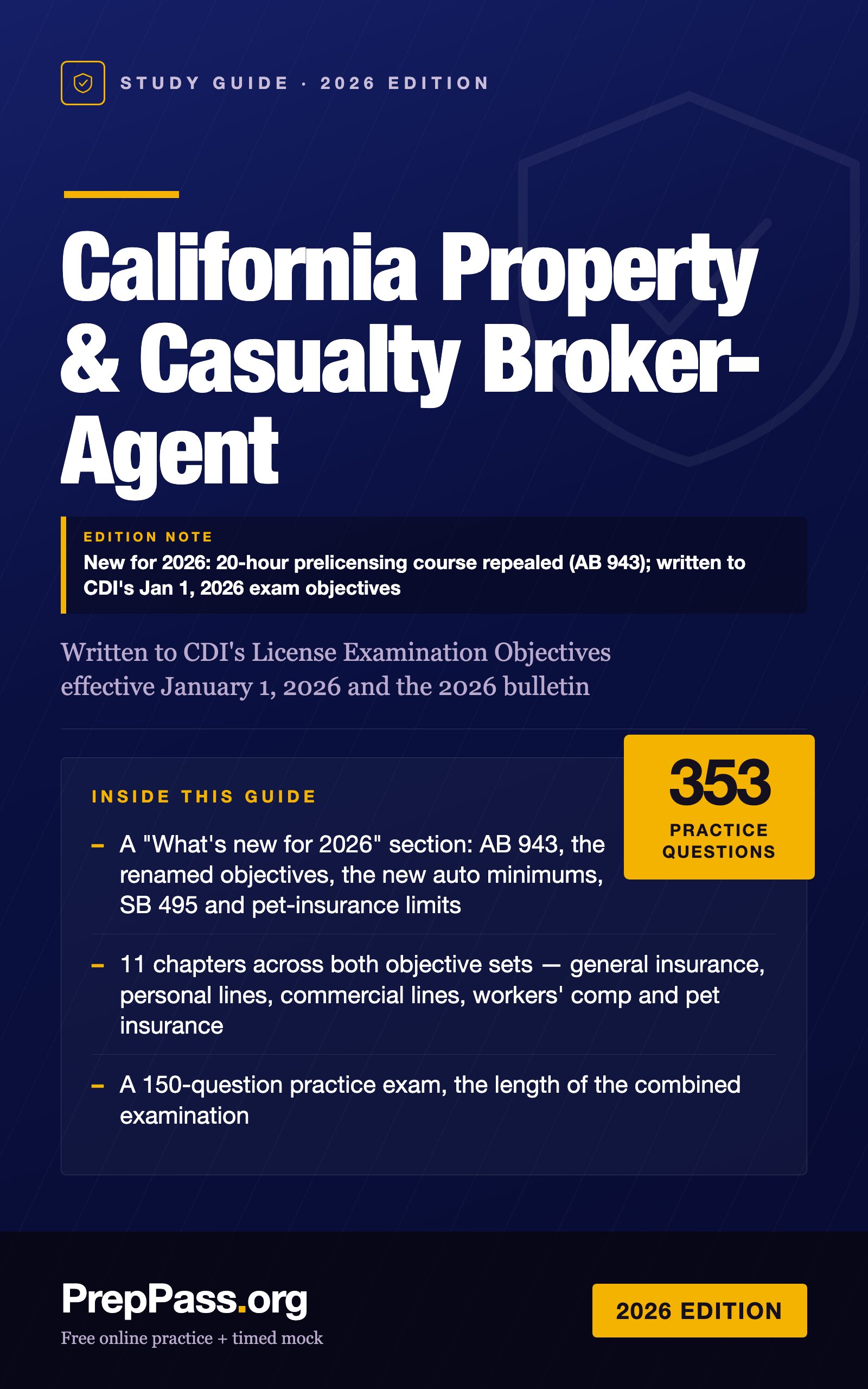
Luyện tập vẫn miễn phí. Trọn bộ hướng dẫn California Property & Casualty Broker-Agent là chính phần kiến thức, dạy từ đầu đến cuối — tệp PDF + EPUB tải về, thuộc về bạn.