NREMT EMT Practice Test
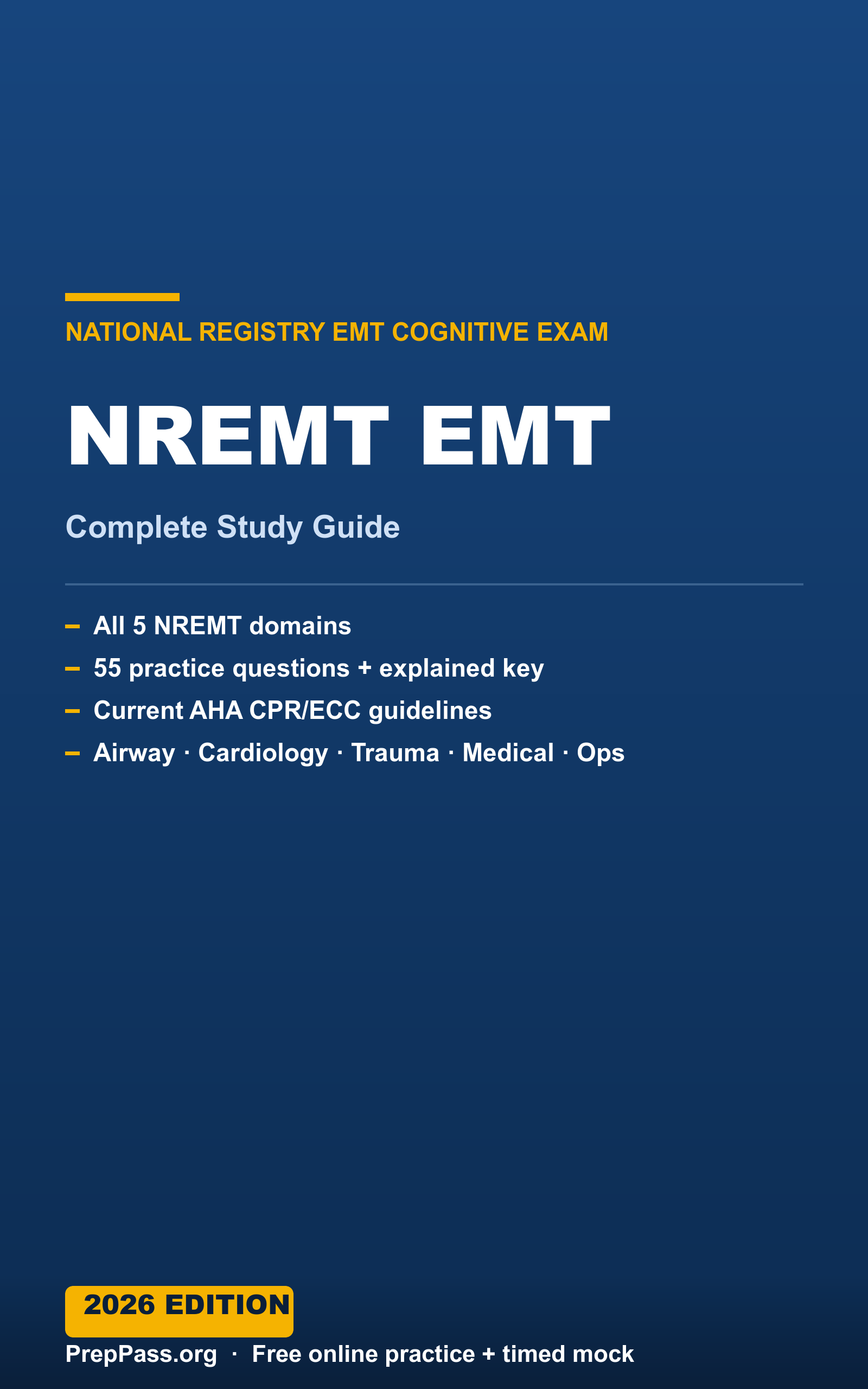
Luyện tập vẫn miễn phí. Trọn bộ hướng dẫn NREMT (EMT) là chính phần kiến thức, dạy từ đầu đến cuối — tệp PDF + EPUB tải về, thuộc về bạn.
Câu hỏi thường gặp
How many NREMT EMT practice questions are here?+
A full bank of original EMT practice questions across all five domains of the current (April 7, 2025) National Registry blueprint, weighted like the real exam, with explanations. Free, no signup.
How many questions is the real NREMT EMT exam, and how long is it?+
The NREMT EMT cognitive exam is computer-adaptive: you'll answer 70–120 items (about 10 unscored) within a 2-hour limit, and the number of questions is not a sign of pass or fail.
What passing score do I need on the NREMT EMT exam?+
There is no fixed passing percentage — the computer-adaptive exam passes or fails you against the National Registry standard, not a set percent correct.
Are these the real NREMT exam questions?+
No. Every question is 100% original, written from public EMS education standards and the National Registry content outline. We never copy real exam questions.
Câu hỏi luyện tập mẫu
Một vài câu hỏi thực tế từ ngân hàng miễn phí này, kèm giải thích đầy đủ. Dùng công cụ luyện tập ở trên cho toàn bộ.
- 1. Airway & Ventilation
What is the normal resting respiratory rate for a healthy adult?
- a.20 to 30 breaths per minute
- b.6 to 10 breaths per minute
- c.12 to 20 breaths per minute
- d.30 to 40 breaths per minute
Đáp án: c
Giải thích: A healthy adult at rest breathes about 12 to 20 times per minute. Rates persistently above or below this range suggest respiratory distress and warrant closer assessment and possible ventilatory support.
- 2. Cardiology & Resuscitation
If a patient in cardiac arrest has a transdermal medication patch on the chest where an AED pad must go, you should:
- a.Place the pad directly over the patch and press firmly
- b.Withhold defibrillation until a paramedic arrives
- c.Remove the patch and wipe the area before applying the pad
- d.Leave the patch in place and lower the shock energy
Đáp án: c
Giải thích: A medication patch under an AED pad can block energy delivery or cause a skin burn, so the patch is removed and the skin wiped before the pad goes on. Defibrillation should not be delayed waiting for a paramedic, and an automated external defibrillator selects its own energy, so there is no setting for the operator to turn down.
- 3. Medical, OB/GYN
Where the EMT's scope permits, for a patient having a severe allergic reaction (anaphylaxis) with prescribed medication available, the EMT may assist with:
- a.A tube of oral glucose
- b.Activated charcoal by mouth
- c.Chewable aspirin tablets
- d.An epinephrine auto-injector
Đáp án: d
Giải thích: Anaphylaxis is treated with epinephrine, and an EMT may assist a patient with their own prescribed auto-injector where protocol allows. Epinephrine reverses the airway swelling and low blood pressure caused by the reaction. Oral glucose treats low blood sugar, activated charcoal is used for some ingested poisons, and aspirin is used for suspected cardiac chest pain.
- 4. EMS Operations
A competent adult refuses care after being informed of the risks. The EMT should:
- a.Respect the refusal, document it thoroughly, and encourage the patient to call back if needed
- b.Treat and transport the patient anyway, because the risk of harm is too high
- c.Leave the scene without documenting the contact or the refusal at all
- d.Have a family member sign the refusal form in place of the patient
Đáp án: a
Giải thích: A competent, informed adult has the right to refuse care, and the refusal must be clearly documented after the risks have been explained. Encourage the patient to call back if symptoms worsen and involve medical direction as local policy requires. Treating a competent adult over their refusal is battery, leaving no record destroys the evidence that the risks were explained, and a relative's signature does not substitute for the decision of the patient who holds it.
- 5. Medical, OB/GYN
A woman in active labor says the baby is coming. Which single finding most reliably tells the EMT to prepare to deliver on scene rather than transport?
- a.Contractions about five minutes apart in a first pregnancy
- b.The membranes rupturing as the crew arrived on scene
- c.Crowning of the baby's head at the vaginal opening
- d.A bloody show of mucus passed about an hour ago
Đáp án: c
Giải thích: Crowning, meaning the presenting part is visible and bulging at the perineum with each contraction, means delivery is happening now, and preparing to deliver where the crew stands is safer than transporting through the birth. Contraction timing is the closest competitor and is worth recording, but contractions five minutes apart in a first labor commonly leave hours to go. Ruptured membranes and bloody show mark the progress of labor without predicting how soon the baby will arrive.
- 6. Airway & Ventilation
Why does a small child's airway obstruct more easily than an adult's?
- a.The child's cricoid cartilage is absent until adolescence, leaving the trachea unsupported
- b.The child's epiglottis is rigid and cannot fold over the glottic opening during swallowing
- c.Breathing depends mainly on the child's intercostal muscles, which tire quickly
- d.The tongue is proportionally larger and the trachea is narrower and more easily compressed
Đáp án: d
Giải thích: A child's tongue takes up proportionally more of the oral cavity, and the trachea is narrower and made of softer cartilage, so a small amount of swelling, a little secretion, or a neck flexed or hyperextended by careless positioning will close it. The epiglottis of a young child is floppier and more omega-shaped than an adult's, not rigid. Infants and small children are largely diaphragmatic breathers — the intercostal muscles are poorly developed, which is why retractions appear so early, but they are not what the child depends on. The cricoid ring is present from birth and is in fact the narrowest point of the airway in a young child, rather than being absent.
- 7. Trauma
An EMT is preparing to splint a forearm that is obviously deformed. Which step must be performed both before and after the splint is applied?
- a.Straightening the angulation so the limb lies in normal anatomical position
- b.Checking pulse, motor function, and sensation distal to the injury
- c.Padding the voids between the limb and the splint before securing the straps
- d.Covering any open wound with a sterile dressing to reduce contamination
Đáp án: b
Giải thích: Distal pulse, motor function and sensation are documented before the splint goes on and rechecked immediately afterward, because a splint applied too tightly can compromise circulation that was intact a minute earlier. Padding the voids and covering an open wound are both real and necessary steps, which is what makes them tempting, but each is done once, before the splint, and neither is repeated as a circulation check. Realigning an angulated limb is done only when the distal pulse is absent and local protocol permits, so it is not a routine step at all.
- 8. EMS Operations
A family presents a valid do-not-resuscitate order for a patient in cardiac arrest. What does a DNR order generally direct an EMT to do?
- a.Withhold resuscitation but continue oxygen, suctioning and comfort care
- b.Withhold all care, including oxygen, suctioning and any comfort measures
- c.Begin full resuscitation and leave the hospital to honor the order later
- d.Begin chest compressions but withhold ventilations and airway suctioning
Đáp án: a
Giải thích: A DNR order directs that resuscitation not be started. It is not an order to withhold care, so oxygen, suctioning, positioning, warmth and any pain relief inside the EMT's scope continue as comfort measures, and reading a DNR as 'do nothing' is the most common and most harmful misreading of it. No DNR form asks a crew to compress the chest while withholding ventilation; that combination is not a level any form offers. Deferring the decision to the hospital defeats the point of a prehospital order, which exists precisely so that resuscitation is not begun in the field. Which document a state recognizes out of hospital, and what a crew does when the form cannot be produced or the family objects at the bedside, is set by state law and local protocol, so the service's own policy governs.
- 9. Cardiology & Resuscitation
Where the EMT's scope permits placing a supraglottic airway, how does adult CPR change once that airway is in place?
- a.Compressions still pause every 30 compressions for two breaths, since pausing keeps the ventilations effective.
- b.Ventilation stops once the airway is in place.
- c.Continuous compressions with a breath every 2 seconds.
- d.Compressions become continuous, with one breath every 6 seconds.
Đáp án: d
Giải thích: Once an advanced airway seals the airway, breaths no longer have to be synchronized with compressions, so the compressor works continuously while the other rescuer delivers about 10 breaths per minute, one every 6 seconds. Continuing to pause after every 30 compressions is the tempting habit carried over from bag-mask CPR, but those pauses drop coronary perfusion pressure that then takes several compressions to rebuild. A breath every 2 seconds is 30 per minute, which raises pressure inside the chest, impedes venous return and reduces the output the compressions generate.
- 10. Medical, OB/GYN
A teenager swallowed a large number of acetaminophen (paracetamol) tablets about two hours ago. She is alert, her vital signs are normal, and she says she feels fine and does not want to go to hospital. What is the most important point for the EMT to make?
- a.Severe liver injury can develop over the days that follow even though she feels well now
- b.She is out of danger, because acetaminophen becomes toxic only when it is taken with alcohol or another drug
- c.Feeling well two hours after the overdose shows the amount taken was below the toxic dose for her weight
- d.She should be made to vomit at home and then watched by her family for the next several hours
Đáp án: a
Giải thích: Acetaminophen poisoning is dangerous precisely because the first hours are quiet — nausea at most, then an apparently well patient — while a toxic metabolite injures the liver over the days that follow. The antidote works best when it is started early, so assessment, blood testing and the transport decision cannot wait for symptoms to appear. Alcohol and poor nutrition increase the risk but are not required for toxicity, and inducing vomiting at home is not recommended, since it delays definitive care and risks aspiration.