New York Real Estate Salesperson Practice Test
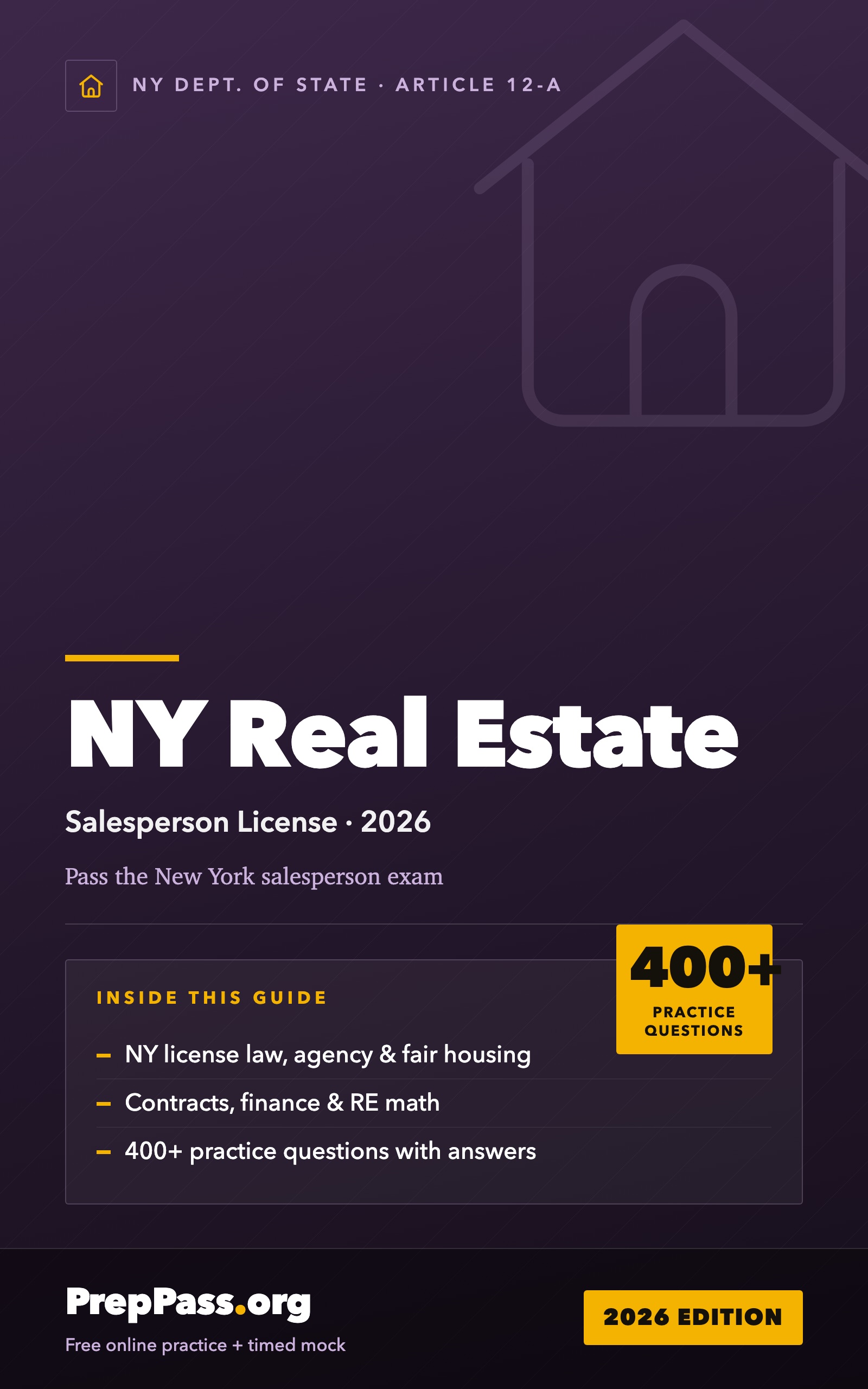
Luyện tập vẫn miễn phí. Trọn bộ hướng dẫn New York Real Estate Salesperson Exam là chính phần kiến thức, dạy từ đầu đến cuối — tệp PDF + EPUB tải về, thuộc về bạn.
Câu hỏi thường gặp
Có bao nhiêu câu hỏi luyện tập New York Real Estate Salesperson ở đây?+
Một ngân hàng đầy đủ câu hỏi New York Real Estate Salesperson nguyên gốc theo các lĩnh vực chính thức, có trọng số như bài thi thật, kèm giải thích. Miễn phí, không cần đăng ký.
Kỳ thi New York Real Estate Salesperson như thế nào?+
Khoảng 100 câu. Luyện theo chủ đề ở đây, rồi làm bài thi thử tính giờ để đánh giá mức sẵn sàng.
Đây có phải câu hỏi thi thật không?+
Không. Mọi câu hỏi đều 100% nguyên gốc, viết từ nguồn công khai kèm giải thích. Chúng tôi không sao chép câu hỏi thi thật hay tài liệu ôn thi trả phí.
Tôi có thể học bằng tiếng Trung hoặc tiếng Tây Ban Nha không?+
Phần luyện tập của PrepPass có tiếng Anh, 中文 và Español. Kỳ thi chính thức bằng tiếng Anh — chuyển ngôn ngữ câu hỏi sang tiếng Anh bất cứ lúc nào để làm quen thuật ngữ ngày thi.
Câu hỏi luyện tập mẫu
Một vài câu hỏi thực tế từ ngân hàng miễn phí này, kèm giải thích đầy đủ. Dùng công cụ luyện tập ở trên cho toàn bộ.
- 1. Principles of Real Estate
Which of the following is considered real property rather than personal property?
- a.Loose furniture staged for a showing
- b.A tenant's freestanding refrigerator brought into an apartment
- c.A car parked in the driveway
- d.A built-in central heating system permanently attached to the building
Đáp án: d
Giải thích: Real property includes land and anything permanently affixed to it, such as a built-in heating system. Items that are movable and not attached, like a refrigerator brought in by a tenant, are personal property (chattel). The test of a fixture looks at attachment, adaptation, and intent.
- 2. License Law & Agency
A material defect that a seller's agent knows about the property must be:
- a.Revealed only if the buyer asks directly
- b.Reported only to the Department of State
- c.Concealed to protect the seller
- d.Disclosed to prospective buyers
Đáp án: d
Giải thích: Even while representing the seller, an agent must honestly disclose known material defects to buyers and cannot participate in active concealment or fraud. The duty of honesty to third parties coexists with loyalty to the principal. Failing to disclose can expose the agent to liability.
- 3. Finance
Using an annual property tax rate of $2.50 per $100 of assessed value, the annual tax on a home assessed at $180,000 is:
- a.$4,500
- b.$450
- c.$45,000
- d.$5,400
Đáp án: a
Giải thích: Divide the assessed value by 100: $180,000 / 100 = 1,800 units. Multiply by the rate: 1,800 x $2.50 = $4,500. Property taxes are calculated from the assessed value, which may differ from market value.
- 4. Principles of Real Estate
The illegal practice of rezoning a single small parcel in a way inconsistent with the surrounding area is called:
- a.Buffer zoning, which places transitional uses between incompatible zoning districts
- b.Inverse condemnation, in which an owner sues because regulation has taken their property
- c.Downzoning, which reduces the permitted density or intensity of an entire district
- d.Spot zoning
Đáp án: d
Giải thích: Spot zoning is the improper singling out of one parcel for treatment different from the surrounding area, benefiting that owner without regard to the comprehensive plan. Courts often strike it down as arbitrary and inconsistent with sound planning.
- 5. License Law & Agency
An agent who secretly buys the principal's listed property through a relative, without disclosure, most directly violates the duty of:
- a.Obedience, the obligation to follow the principal's lawful instructions promptly and faithfully
- b.Reasonable care, the obligation to use competence and diligence in performing agency tasks
- c.Loyalty
- d.Accounting, the obligation to report and safeguard money and documents entrusted to the agent
Đáp án: c
Giải thích: Buying the principal's property through an undisclosed relative is self-dealing that puts the agent's interest ahead of the principal's, violating the duty of loyalty (and disclosure). An agent must place the principal's interests above their own and reveal any personal interest.
- 6. License Law & Agency
Net listings are discouraged and considered risky in New York because they:
- a.Guarantee the seller will receive the highest possible price in every market condition
- b.Eliminate the seller's need to receive and sign any agency disclosure form in the deal
- c.Create a conflict of interest and the potential to overcharge the seller
- d.Are legally required for all commercial real estate transactions completed within the state
Đáp án: c
Giải thích: In a net listing, the broker keeps everything above a net amount the seller sets, which creates a conflict of interest and the temptation to conceal the property's true value. Because of the potential for abuse, net listings are strongly discouraged or restricted.
- 7. Practice & Math
A seller's agent asked by the buyer about a known leaking roof should:
- a.Truthfully disclose the known material defect
- b.Deny that any problem exists at all in order to protect the interests of the seller-client
- c.Tell the buyer to waive all inspection contingencies so the roof issue is never examined
- d.Change the subject and steer the conversation toward the property's more attractive features
Đáp án: a
Giải thích: Even while representing the seller, an agent must deal honestly with the buyer and disclose known material defects such as a leaking roof. An agent may not actively conceal defects or make false statements.
- 8. Contracts
Under the Statute of Frauds, which lease generally must be in writing to be enforceable?
- a.Any oral rental arrangement lasting fewer than ninety total days
- b.A lease with a term longer than one year
- c.A tenancy at will that either party may end at any time on notice
- d.A month-to-month residential tenancy with a handshake understanding
Đáp án: b
Giải thích: The Statute of Frauds requires leases for a term longer than one year to be in writing to be enforceable. Short-term leases of a year or less may be oral. This parallels the writing requirement for contracts to sell real property.
- 9. Contracts
Under New York's Human Rights Law, a real estate agent asked to help a seller refuse offers from a protected class must:
- a.Follow the seller's instruction under the fiduciary duty of obedience
- b.Refer the seller to another agent willing to carry out the request
- c.Refuse the instruction, because obeying it would be illegal discrimination
- d.Quietly comply while documenting the seller's request in the file
Đáp án: c
Giải thích: The duty of obedience extends only to lawful instructions. Helping a seller discriminate against a protected class violates federal and New York fair housing law, so the agent must refuse and may need to withdraw. An agent who complies shares liability for the violation.
- 10. Finance
The TRID rule requires the borrower to receive the Closing Disclosure at least:
- a.Three business days before consummation of the loan
- b.Ten business days after the borrower moves into the property
- c.Thirty days before the borrower submits the loan application
- d.One full year after the closing has already been completed
Đáp án: a
Giải thích: Borrowers must receive the Closing Disclosure at least three business days before consummation (closing), giving them time to review final terms against the Loan Estimate. Certain significant changes restart the three-day period. This waiting rule protects borrowers from last-minute surprises.
Sở hữu trọn bộ hướng dẫn New York Real Estate Salesperson Exam — PDF + EPUB, $14.99 →