ASVAB · 2026 版
ASVAB — Complete Study Guide (2026)
All ten ASVAB tests in nine chapters — the four AFQT tests that decide enlistment eligibility taught first, and Assembling Objects included.
- 9 个分测验章节,每章都有关键数字表、例题详解、点名的陷阱与自测
- 书末附一整套完整模拟卷,每道题都写清答案背后的推理
- 8 个附录速查:公式总表、综合分公式、词根词缀、高频词汇、学习计划、考试当天策略、问征兵官的问题、术语表
$19.99一次买断 · 永久下载 · 无订阅
PDF + EPUB · 英文 · 328 页 · $19.99 一次买断
本书为英文版,下载的 PDF 与 EPUB 均为英文。
付款后立即下载 —— 无需注册账号,无订阅。
14 天退款保证:任何原因不满意?购买后 14 天内发邮件至 support@preppass.org 即可全额退款。 这是电子下载,无需寄回任何东西。 退款政策
考试事实最近一次对照官方资料核对:2026年9月。
先做 10 题,看看讲解 —— 免费
先答完这 10 题,交卷后每题都有解析 —— 还会指出本指南里讲这一点的那一节。约 5 分钟,无需注册。
开始 10 道免费题翻开这本书看看
三页真实内页,直接从你将下载的 PDF 渲染而来 —— 依次是一页速查、一页讲解、一道带解析的例题。没有任何一页是为了好看而重画的。
- 速查页Chapter 3 — Word Knowledge (WK) · PDF 第 71 页
一页可以随时翻回来的内容:把数字、期限或术语集中在一处。
- 怎么讲Chapter 1 — Scores, Line Scores, and the Job You Actually Want · PDF 第 26 页
讲解页:用文字把知识讲清楚,顺序与考试考查的顺序一致。
- 一道题的完整解析Chapter 1 — Scores, Line Scores, and the Job You Actually Want · PDF 第 21 页
一道练习题,连同答案和背后的推理 —— 不只是一个答案键。
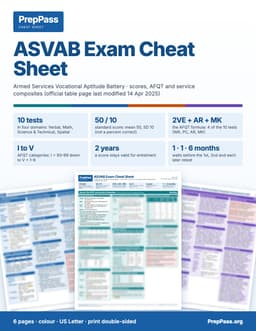
两周内就要考试?
这本指南是系统讲解,要花几周读。如果两周内就考,可打印的彩色速查表是另一款产品:考试涉及的关键数字,按章节排好。
6 页 · US Letter · 可打印 PDF · 永久保存
关于这场考试本身
| 主管机构 | U.S. Department of Defense |
|---|---|
| 题目数量 | 135 道题 来源: Official ASVAB — ASVAB Fact Sheet, Enlistment Testing Program (PDF, revised April 2025) |
| 考试时限 | 197 分钟 来源: Official ASVAB — ASVAB Fact Sheet, Enlistment Testing Program (PDF, revised April 2025) |
| 及格标准 | 没有及格线。能否入伍取决于 AFQT 分数:它由其中四个分测验(算术推理、数学知识、段落理解、词汇知识)计算得出,以 1-99 的百分位数报告 —— 表示相对于 1997 年全国 18 至 23 岁青年样本的排名,而不是答对题目的百分比。国防部的 ASVAB 页面未载明入伍所需的最低 AFQT 分数。 我们查阅但未找到该数据的来源: Official ASVAB — Understanding ASVAB Scores |
| 费用 | U.S. Department of Defense 未公布 我们查阅但未找到该数据的来源: Official ASVAB — What to Expect When You Take the ASVAB |
| 考试语言 | 英语 来源: Official ASVAB — Frequently Asked Questions (applicants) |
包含什么,不包含什么
包含
- Key numbers & facts boxed in every test chapter, plus a self-check to close it
- Worked examples with the arithmetic shown, and the common traps named — not just the answer
- All 10 tests in 9 chapters, with the AFQT four (AR, WK, PC, MK) taught first — Assembling Objects included
- Math and algebra/geometry worked step by step with checked arithmetic
- General science, electronics, mechanical, and auto & shop review
- Word Knowledge roots and Paragraph Comprehension strategy
- 120 original practice questions with answer explanations
- PDF (print & tab it) + EPUB (phone / e-reader)
不包含
- 不寄送纸质书 —— 这是一份你下载后可自行打印的文件
- 购书不含视频课程、讲师或一对一辅导 —— 站上的免费视频是另一回事
- 不含考试报名费与考点费用,这些仍需向官方机构缴纳
目录
查看 26 个部分及各部分起始页
- Part I — What the ASVAB actually decides第 6 页
- Chapter 1 — Scores, Line Scores, and the Job You Actually Want第 6 页
- Part II — The nine tests, taught第 6 页
- Answer Key with Explanations.第 8 页
- Chapter 2 — Arithmetic Reasoning (AR)第 41 页
- Chapter 3 — Word Knowledge (WK)第 70 页
- Chapter 4 — Paragraph Comprehension (PC)第 102 页
- Chapter 5 — Mathematics Knowledge (MK)第 122 页
- Part I — The coordinate plane Quantity Formula第 145 页
- Chapter 6 — General Science (GS)第 150 页
- Part I — Astronomy第 168 页
- Chapter 7 — Electronics Information (EI)第 174 页
- Part I — Magnetism and machines第 191 页
- Chapter 8 — Mechanical Comprehension (MC)第 196 页
- Chapter 9 — Auto & Shop Information (AS)第 220 页
- Part I — Shop: cutting, striking, driving, gripping第 236 页
- Chapter 10 — Assembling Objects (AO)第 246 页
- Answer Key with Explanations第 283 页
- Appendix A — Master formula & fact sheet第 295 页
- Appendix B — The composite formulas, on one page第 306 页
- Appendix C — Word parts for Word Knowledge第 309 页
- Appendix D — High-frequency vocabulary第 315 页
- Appendix E — Study plans第 320 页
- Appendix F — Exam-day strategy第 322 页
- Appendix G — What to ask your recruiter第 324 页
- Appendix H — Glossary of key terms第 326 页
取自你将下载的那份 PDF,并标明各章起始页 —— 不是在此手工录入的。
免费读完整一章
完整的一章,与电子书正文一字不差。直接在此窗口滚动阅读;无需下载,无需邮箱。
在本页直接阅读第 5 章
我们没有拿轻松的绪论充数 —— 免费章节直接翻到书里最见功力的部分,让你在考试真正难的地方检验这本书讲得好不好。
AFQT test. Appears in 11 of the 19 published service composites — and is doubled in the Navy's Basic Electricity and Electronics composite.
Introduction
Arithmetic Reasoning hides the math inside a story. Mathematics Knowledge hands it to you directly: solve this equation, simplify this expression, find this area, evaluate this exponent. There is no translation step, which means there is nowhere to hide either. You either know the rule or you do not.
That makes MK the most memorizable of the four AFQT tests, and therefore the fastest one to improve. Every formula this test uses fits on one sheet of paper — Appendix A of this book is that sheet. A candidate with three weeks and a weak MK score is in a far better position than a candidate with three weeks and a weak WK score, because a formula can be learned on Tuesday and used on Wednesday.
MK also does double duty. The same algebra that MK tests directly is the algebra you need for Ohm's law in Chapter 7 and for mechanical advantage in Chapter 8. Learning to rearrange a formula here pays off in two more chapters.
This chapter works thirty-three examples across every topic the test uses. Work them with a pencil.
Learning objectives
After working this chapter you should be able to:
- Apply the order of operations correctly, including to nested and signed expressions.
- Use the laws of exponents and simplify square roots.
- Identify factors, multiples, primes, the greatest common factor and the least common multiple.
- Add, subtract, multiply and divide fractions, including mixed numbers.
- Combine like terms, distribute, multiply two binomials, and factor simple quadratics.
- Solve one-step, two-step and variables-on-both-sides linear equations, and check by substitution.
- Rearrange a formula to isolate any variable in it.
- Solve linear inequalities, including the sign flip.
- Solve a system of two linear equations by substitution or elimination.
- Apply the angle rules for lines, triangles and parallel lines cut by a transversal.
- Use the Pythagorean theorem and recognise the common triples and special right triangles.
- Compute perimeter, area, circumference, volume and surface area for the standard figures.
- Find slope, midpoint and distance on the coordinate plane.
Key formulas & facts
| Topic | Formula / rule |
|---|---|
| Order of operations | Parentheses → Exponents → Multiply/Divide (left to right) → Add/Subtract (left to right) |
| Exponent: product | aᵐ × aⁿ = aᵐ⁺ⁿ |
| Exponent: quotient | aᵐ ÷ aⁿ = aᵐ⁻ⁿ |
| Exponent: power of a power | (aᵐ)ⁿ = aᵐⁿ |
| Exponent: zero | a⁰ = 1 (for a ≠ 0) |
| Exponent: negative | a⁻ⁿ = 1 ÷ aⁿ |
| Square root | √a × √b = √(ab); √144 = 12 |
| Signed numbers | Subtracting a negative adds; a negative times a negative is positive |
| Distribution | a(b + c) = ab + ac |
| FOIL | (a + b)(c + d) = ac + ad + bc + bd |
| Difference of squares | a² − b² = (a + b)(a − b) |
| Perfect square | (a + b)² = a² + 2ab + b² |
| Solving equations | Do the same inverse operation to both sides |
| Inequalities | Multiplying or dividing by a negative reverses the inequality sign |
| Straight angle | 180 degrees; a full turn is 360 degrees |
| Complementary / supplementary | Sum to 90 / sum to 180 degrees |
| Triangle angle sum | 180 degrees |
| Pythagorean theorem | a² + b² = c², c the hypotenuse |
| Common triples | 3-4-5, 5-12-13, 8-15-17, and any multiple |
| 45-45-90 triangle | legs x, x; hypotenuse x√2 |
| 30-60-90 triangle | short leg x, long leg x√3, hypotenuse 2x |
| Area of a triangle | ½ × base × height |
| Rectangle | area = lw; perimeter = 2l + 2w |
| Parallelogram / trapezoid | bh / ½(b₁ + b₂)h |
| Circle | circumference = 2πr = πd; area = πr² (π ≈ 3.14) |
| Rectangular solid | volume = lwh; surface area = 2(lw + lh + wh) |
| Cube | volume = s³; surface area = 6s² |
| Cylinder | volume = πr²h |
| Slope | (y₂ − y₁) ÷ (x₂ − x₁) |
| Midpoint | ((x₁ + x₂)/2 , (y₁ + y₂)/2) |
| Distance | √((x₂ − x₁)² + (y₂ − y₁)²) |
Part A — Number properties and operations
Order of operations
Evaluate in this order, and never out of it:
- Parentheses (and anything inside a radical or above/below a fraction bar, which act as invisible parentheses)
- Exponents
- Multiplication and division, left to right — they have equal priority
- Addition and subtraction, left to right — equal priority
The two places people go wrong are both about "equal priority." Multiplication does not outrank division, and addition does not outrank subtraction. When operations of equal priority sit side by side, work left to right.
Worked example 1 — order of operations, written out
Evaluate 4² + 3³.
Exponents first. 4² = 4 × 4 = 16. 3³ = 3 × 3 × 3 = 27. Then add. 16 + 27 = 43. The trap. Adding first: 4 + 3 = 7, then something with the exponents. Exponents outrank addition, always.
Worked example 2 — equal priority, left to right
Evaluate 24 ÷ 6 × 2.
Division and multiplication have equal priority, so work left to right. 24 ÷ 6 = 4. Then 4 × 2 = 8. The trap. Doing the multiplication first because "multiplication comes before division in the mnemonic": 6 × 2 = 12, then 24 ÷ 12 = 2. That gives 2, which is wrong, and 2 will be among the choices. The rule to fix in your mind. The mnemonic lists multiplication and division together on one line, and addition and subtraction together on another. Within a line, left to right.
Worked example 3 — nested parentheses and a negative
Evaluate 3 × (8 − (5 − 9)) ÷ 2.
Innermost parentheses first. 5 − 9 = −4. Next parentheses. 8 − (−4). Subtracting a negative adds: 8 + 4 = 12. Now left to right through the multiplication and division. 3 × 12 = 36. Then 36 ÷ 2 = 18. The two traps in one problem. Doing 8 − 5 first (ignoring the inner parentheses) and mishandling the double negative. Write each stage on its own line; that is what stops both.
Exponents
An exponent counts repeated multiplication: 3³ = 3 × 3 × 3 = 27. The laws you need:
- Same base, multiplying — add the exponents. 2³ × 2⁴ = 2⁷ = 128.
- Same base, dividing — subtract the exponents. 5⁶ ÷ 5² = 5⁴ = 625.
- A power raised to a power — multiply the exponents. (3²)³ = 3⁶ = 729.
- Anything to the zero power is 1 (except zero itself). 7⁰ = 1.
- A negative exponent means the reciprocal. 2⁻³ = 1 ÷ 2³ = 1/8.
Worked example 4 — the exponent laws, applied
Simplify (2³ × 2²) ÷ 2⁴.
Numerator — same base, multiplying, so add exponents. 2³ × 2² = 2⁵. Now divide — same base, so subtract exponents. 2⁵ ÷ 2⁴ = 2¹ = 2. Check the long way. 8 × 4 = 32; 32 ÷ 16 = 2. ✓ The trap. Multiplying the exponents in the numerator: 3 × 2 = 6, giving 2⁶ ÷ 2⁴ = 4. Exponents multiply only when a power is raised to a power, not when two powers are multiplied.
Square roots
The square root of a number is the value that, multiplied by itself, gives it: √144 = 12 because 12 × 12 = 144.
Memorize the perfect squares to 15 — they appear constantly, in geometry as well as here:
| n | 1 | 2 | 3 | 4 | 5 | 6 | 7 | 8 | 9 | 10 | 11 | 12 | 13 | 14 | 15 |
|---|---|---|---|---|---|---|---|---|---|---|---|---|---|---|---|
| n² | 1 | 4 | 9 | 16 | 25 | 36 | 49 | 64 | 81 | 100 | 121 | 144 | 169 | 196 | 225 |
Simplifying a root: pull out the largest perfect-square factor. √50 = √(25 × 2) = √25 × √2 = 5√2.
Worked example 5 — simplifying a radical
Simplify √72.
Find the largest perfect square that divides 72. The perfect squares are 4, 9, 16, 25, 36… and 36 divides 72. 72 = 36 × 2. √72 = √36 × √2 = 6√2. Check it numerically. 6 × 1.414 ≈ 8.49, and 8.49² ≈ 72.1. ✓ A slower but safe route if you do not spot 36: 72 = 4 × 18, so √72 = 2√18; then 18 = 9 × 2, so 2√18 = 2 × 3√2 = 6√2. Same answer. Pulling out squares in stages always works.
Factors, multiples, primes
- A factor divides a number evenly. The factors of 12 are 1, 2, 3, 4, 6, 12.
- A multiple is that number times a whole number. The multiples of 12 are 12, 24, 36, 48…
- A prime has exactly two factors, 1 and itself: 2, 3, 5, 7, 11, 13, 17, 19, 23, 29. Two is the only even prime, and 1 is not prime.
- The greatest common factor (GCF) is the largest number dividing both.
- The least common multiple (LCM) is the smallest number both divide into.
Worked example 6 — GCF and LCM
Find the GCF and the LCM of 12 and 18.
Prime-factorize both. 12 = 2 × 2 × 3 = 2² × 3 18 = 2 × 3 × 3 = 2 × 3² GCF — take the lowest power of each shared prime. Shared primes are 2 and 3. Lowest power of 2 is 2¹; lowest power of 3 is 3¹. GCF = 2 × 3 = 6. LCM — take the highest power of every prime that appears. Highest power of 2 is 2²; of 3 is 3². LCM = 4 × 9 = 36. Check both. 6 divides 12 and 18. ✓ 36 is divisible by 12 (three times) and by 18 (twice). ✓ A useful cross-check. GCF × LCM = the product of the two numbers: 6 × 36 = 216, and 12 × 18 = 216. ✓ That identity holds for any pair and is a free way to catch an error.
Signed numbers
Three rules cover almost everything:
- Subtracting a negative is adding. 5 − (−3) = 5 + 3 = 8.
- A negative times a negative is positive; a negative times a positive is negative.
- A negative raised to an even power is positive; to an odd power, negative. (−2)² = 4, but (−2)³ = −8.
And one notational trap: −2² and (−2)² are different. Without parentheses, the exponent attaches to the 2 alone and the minus sign is applied afterwards: −2² = −(2²) = −4. With parentheses, the whole −2 is squared: (−2)² = +4.
Part B — Fractions
The four operations
- Multiply: multiply straight across, then reduce. (2/3) × (3/4) = 6/12 = 1/2.
- Divide: invert the second fraction and multiply. (2/3) ÷ (3/4) = (2/3) × (4/3) = 8/9.
- Add or subtract: get a common denominator first, then combine the numerators only.
- Mixed numbers: convert to improper fractions before doing anything else.
Worked example 7 — adding fractions with unlike denominators
Compute 3/4 + 5/6.
Find the LCM of the denominators. 4 = 2², 6 = 2 × 3, so the LCM is 2² × 3 = 12. Convert both. 3/4 = 9/12 (multiply top and bottom by 3). 5/6 = 10/12 (multiply top and bottom by 2). Add the numerators only. 9/12 + 10/12 = 19/12. Convert to a mixed number. 19 ÷ 12 = 1 remainder 7, so 1 7/12. The trap, named. Adding denominators: 3/4 + 5/6 = 8/10. This is the most common fraction error there is. Denominators tell you what size the pieces are; you do not add the sizes, you make them the same and then add how many you have.
Worked example 8 — dividing mixed numbers
Compute 2½ ÷ 1¼.
Convert to improper fractions first. 2½ = (2 × 2 + 1)/2 = 5/2. 1¼ = (1 × 4 + 1)/4 = 5/4. Divide by inverting the second and multiplying. (5/2) ÷ (5/4) = (5/2) × (4/5). Cancel before multiplying — it keeps the numbers small. The 5s cancel; 4 ÷ 2 = 2. Result: 2. Check. 1¼ × 2 = 2½. ✓ The trap. Trying to divide the whole parts and the fractions separately. Convert to improper fractions and the problem becomes mechanical.
Worked example 9 — comparing fractions without decimals
Which is larger, 5/8 or 7/11?
Cross-multiply, comparing the products in the right positions. 5 × 11 = 55 (this belongs to 5/8) 7 × 8 = 56 (this belongs to 7/11) 56 > 55, so 7/11 is larger. Check with decimals. 5/8 = 0.625; 7/11 = 0.636… ✓ Why cross-multiplication works. You are multiplying both fractions by the same positive quantity (8 × 11), which cannot change which is bigger. It is faster than long division and it does not round.
购买前
- 怎么拿到?
- 付款后下载入口立即出现在本页,链接同时发到你的邮箱。无需注册账号。
- 不合适怎么办?
- 14 天内发邮件即可全额退款,无需理由。
- 免费练习会取消吗?
- 不会。站上的每一道练习题、计时模考和免费章节都继续免费。这本书是「学」的那一半,不是把免费部分围起来的门。
- 能在手机上看吗?
- 可以 —— EPUB 适合手机和电子书阅读器,PDF 适合打印和贴标签,两种都给你。
详细信息
All ten ASVAB tests in nine chapters — the four AFQT tests that decide enlistment eligibility taught first, and Assembling Objects included.
- Format: PDF + EPUB download · 328 pages
- 120 practice questions in the book, with a full answer key
- 800 free practice questions for this exam on PrepPass, included at no cost
- $19.99 one-time — no subscription
- 14-day money-back guarantee · refund policy
- Cross-referenced against: ASVAB subtest outline / officialasvab.com
- Last updated: September 2026
- 官方来源核验(ASVAB subtest outline / officialasvab.com)
- 800 道免费练习题
- 即时下载,永久拥有
ASVAB prep course 要 $88–$118。这本书讲的是同一门考试 —— 同样的规则、核对到最新标准 —— 只需一次性 $19.99,永久归你。
练习免费,为什么还要买书?
我们的练习题和计时模考一直免费 —— 网站上的东西不会因为这本书而收起来。这本 $19.99 的书是「学」的那一半:知识本身,按顺序讲清楚,存成一份属于你的文件。
- 系统讲解 —— 每个考试部分按章节从头讲到尾,不只是题目
- 可打印可贴标签 —— 一份适合打印的 PDF,能划重点、做批注、带到书桌前
- 随处离线学 —— EPUB 放手机或电子书阅读器;不用 wifi,不用一堆浏览器标签
- 全在一处 —— 章节和练习题都在同一份文件里
- 永久归你 —— 一次 $19.99,即时下载,无订阅
而且零风险:14 天退款保证 —— 不满意?发邮件即可全额退款,无需理由。 详见退款政策。
14 天退款保证 · 全额退款,无需理由。
一次购买,永久下载访问。此电子书是完整的 ASVAB 学习指南,含 PDF 与 EPUB。仅为教育性摘要,非专业或法律意见 —— 请始终以官方来源核实当前规定。最后更新:September 2026。