ASWB Masters Social Work Licensing Exam · 2026 版
ASWB Masters Study Guide — 2026 Edition
版本说明New for 2026: written to ASWB's August 2026 Masters exam — 122 questions, 3 content areas, two timed sections
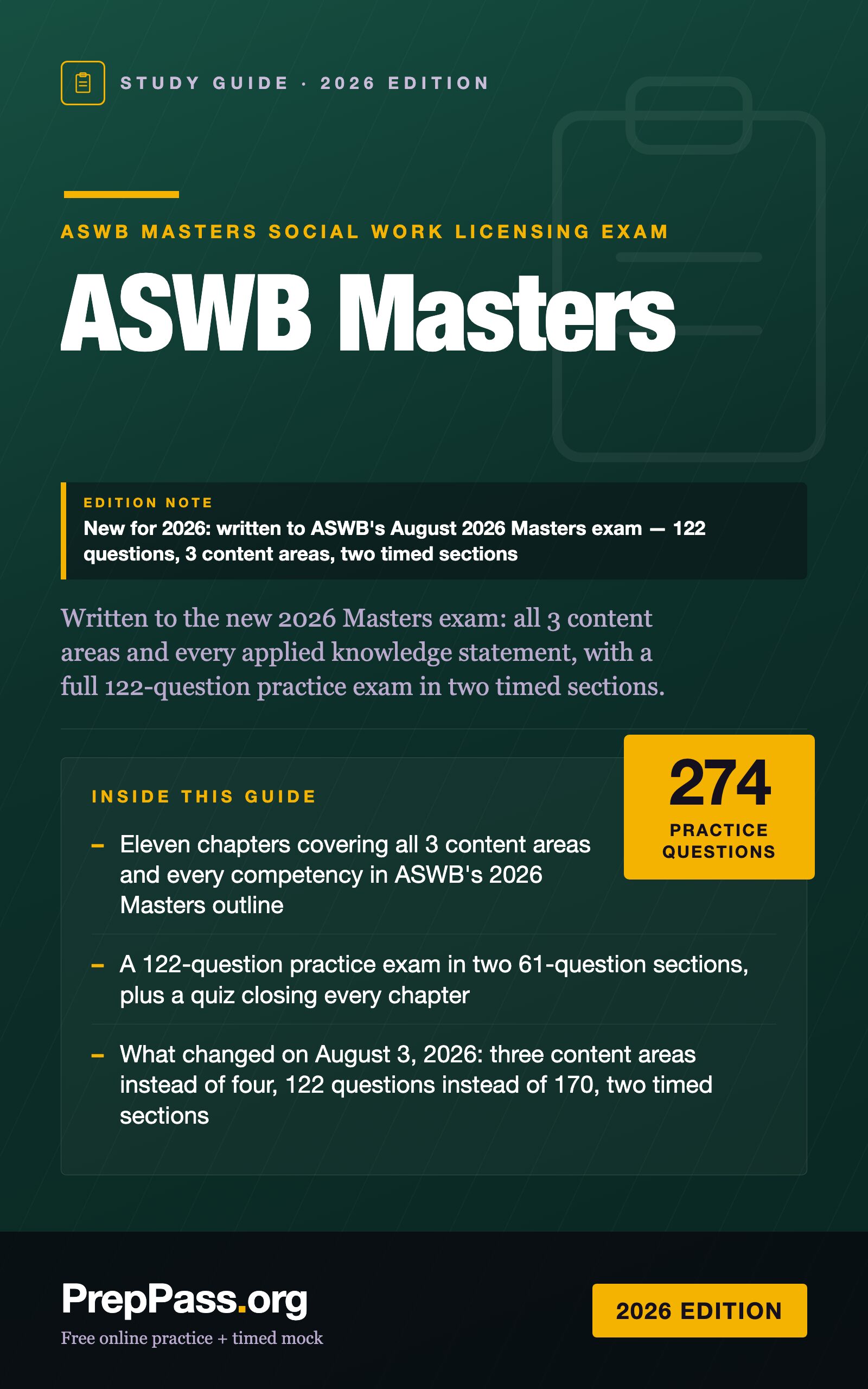
Written to the new 2026 Masters exam: all 3 content areas and every applied knowledge statement, with a full 122-question practice exam in two timed sections.
- 274 道原创 ASWB Masters 社工执照考试练习题,每题附解析,合成一本 PDF + EPUB 永久保存
PDF + EPUB · 英文 · 247 页 · $24.99 一次买断
本书为英文版,下载的 PDF 与 EPUB 均为英文。
付款后立即下载 —— 无需注册账号,无订阅。
14 天退款保证:任何原因不满意?购买后 14 天内发邮件至 support@preppass.org 即可全额退款。 退款政策
先做 10 题,看看讲解 —— 免费
先答完这 10 题,交卷后每题都有解析 —— 还会指出本指南里讲这一点的那一节。约 5 分钟,无需注册。
开始 10 道免费题翻开这本书看看
三页真实内页,直接从你将下载的 PDF 渲染而来 —— 依次是一页速查、一页讲解、一道带解析的例题。没有任何一页是为了好看而重画的。
- 速查页Chapter 1 — Ethical Principles and Responsibilities (Competency IA) · PDF 第 22 页
一页可以随时翻回来的内容:把数字、期限或术语集中在一处。
- 怎么讲Section 1 — answer key & explanations · PDF 第 202 页
讲解页:用文字把知识讲清楚,顺序与考试考查的顺序一致。
- 一道题的完整解析Chapter 2 — Ethical Service Delivery (Competency IB) · PDF 第 40 页
一道练习题,连同答案和背后的推理 —— 不只是一个答案键。
关于这场考试本身
| 主管机构 | Association of Social Work Boards (ASWB) —— 考试由 Pearson 承办 来源: ASWB — Examination Guidebook, Social Work Licensing Exams (08/2026 edition, PDF) |
|---|---|
| 题目数量 | 122 道题 (110 道计分,12 道不计分预试题) 来源: ASWB — Examination Guidebook, Social Work Licensing Exams (08/2026 edition, PDF) |
| 考试时限 | 240 分钟 来源: ASWB — Examination Guidebook, Social Work Licensing Exams (08/2026 edition, PDF) |
| 及格标准 | ASWB 未公布 我们查阅但未找到该数据的来源: ASWB — Examination Guidebook, Social Work Licensing Exams (08/2026 edition, PDF) |
| 费用 |
来源: ASWB — Examination Guidebook, Social Work Licensing Exams (08/2026 edition, PDF) |
| 考试语言 | ASWB 未公布 我们查阅但未找到该数据的来源: ASWB — Examination Guidebook, Social Work Licensing Exams (08/2026 edition, PDF) |
包含什么,不包含什么
包含
- Eleven chapters covering all 3 content areas and every competency in ASWB's 2026 Masters outline
- A 122-question practice exam in two 61-question sections, plus a quiz closing every chapter
- What changed on August 3, 2026: three content areas instead of four, 122 questions instead of 170, two timed sections
- Ethics taught from the NASW Code of Ethics, cited by section
- Key numbers and named traps at the end of every chapter, and a one-page decision guide
- 274 original questions, each with a worked explanation citing its source
- PDF + EPUB you keep
不包含
- 不寄送纸质书 —— 这是一份你下载后可自行打印的文件
- 购书不含视频课程、讲师或一对一辅导 —— 站上的免费视频是另一回事
- 不含考试报名费与考点费用,这些仍需向官方机构缴纳
目录
查看 19 个部分及各部分起始页
- Chapter 1 — Ethical Principles and Responsibilities (Competency IA)第 11 页
- Chapter 2 — Ethical Service Delivery (Competency IB)第 30 页
- Chapter 3 — Diversity and Social Justice (Competency IC)第 48 页
- Chapter 4 — Assessment Concepts I: Human Development, Behavior and Relationships (Competency IIA)第 62 页
- Chapter 5 — Assessment Concepts II: Trauma, Abuse, Mental Health, Substance Use and Environment (Competency IIA)第 79 页
- Chapter 6 — Assessment Methods and Techniques (Competency IIB)第 96 页
- Chapter 7 — Assessment Practices and Planning (Competency IIC)第 110 页
- Chapter 8 — Practice Concepts (Competency IIIA)第 125 页
- Chapter 9 — Intervention Methods and Techniques (Competency IIIB)第 137 页
- Chapter 10 — Practice Evaluation and Research (Competency IIIC)第 154 页
- Chapter 11 — Supervision and Administration (Competency IIID)第 167 页
- Section 1 Section 2 Total第 180 页
- Section 1 — 61 questions (2 hours)第 181 页
- Section 1 — answer key & explanations第 195 页
- Section 2 — 61 questions (2 hours)第 205 页
- Section 2 — answer key & explanations第 220 页
- Appendix A — The exam at a glance第 230 页
- Appendix B — Terms the exam expects you to use precisely第 233 页
- Appendix C — One-page decision guide第 236 页
取自你将下载的那份 PDF,并标明各章起始页 —— 不是在此手工录入的。
免费读完整一章
完整的一章,与电子书正文一字不差。直接在此窗口滚动阅读;无需下载,无需邮箱。
在本页直接阅读第 2 章
我们没有拿轻松的绪论充数 —— 免费章节直接翻到书里最见功力的部分,让你在考试真正难的地方检验这本书讲得好不好。
Competency IB moves from principles to the daily decisions that put them into practice: where the professional boundary sits, how far self-determination reaches, when the law requires a report, what goes in the record, how policy shapes service, how to act ethically around death and dying, what supervisors and managers owe, how to bill honestly, how technology changes each of these, and how to end a professional relationship well. On the 2026 Masters outline these topics sit inside content area I, Values and Ethics (35%).[1]
Professional boundaries in the social worker–client relationship
A boundary is the line between the professional relationship and every other kind of relationship. The ASWB outline lists the pressures on it: power differences, influence, privilege, conflicts of interest, self-disclosure and dual relationships.[1]
Dual and multiple relationships. The NASW Code does not forbid every overlapping relationship; it forbids those "in which there is a risk of exploitation or potential harm to the client." When a dual relationship is unavoidable — a rural social worker whose client is also the town's only pharmacist, for instance — the social worker "should take steps to protect clients" and is responsible for "setting clear, appropriate, and culturally sensitive boundaries."[2] The burden always sits with the social worker, never the client.
Conflicts of interest. Social workers inform clients when a real or potential conflict arises and resolve it in a way "that makes the clients' interests primary."[2] When services go to people who have a relationship with each other — a couple, a family — the social worker clarifies "which individuals will be considered clients" and what obligations are owed to each.[2]
Sexual relationships. With current clients the prohibition is absolute — "under no circumstances," whether the contact is "consensual or forced," and including "inappropriate sexual communications through the use of technology."[2] With former clients the Code says social workers "should not engage in sexual activities or sexual contact … because of the potential for harm," and places the full burden of showing no exploitation on the social worker who claims an exception.[2] Social workers also do not provide clinical services to former sexual partners.[2] Terminating services in order to pursue a relationship is expressly prohibited.[2]
Physical contact. Not banned outright, but social workers avoid contact "when there is a possibility of psychological harm to the client as a result of the contact (such as cradling or caressing clients)."[2]
Gifts, bartering and fees. Fees should be "fair, reasonable, and commensurate with the services performed," considering the client's ability to pay.[2] Bartering is permitted "only in very limited circumstances" — an accepted local practice, essential for services, negotiated without coercion, at the client's initiative and with informed consent.[2] A social worker may not charge a private fee to a client who is entitled to the same service through the social worker's agency.[2] Referral fees are prohibited when the referring social worker provided no service.[2]
Self-disclosure. Self-disclosure is a tool, not a relationship. The test is whether it serves the client's goals. A social worker who shares personal struggles because it feels good to be understood has crossed the line; a brief, purposeful disclosure that models hope may not. On the exam, answers that shift the focus to the social worker are almost always wrong.
Technology and boundaries. Social workers "avoid communication with clients using technology … for personal or non-work-related purposes"[2] and avoid "accepting requests from or engaging in personal relationships with clients on social networking sites."[2] A friend request from a client is declined, and the reason is discussed in the next session as a boundary conversation, not ignored.
Protecting and enhancing client self-determination
"Social workers respect and promote the right of clients to self-determination and assist clients in their efforts to identify and clarify their goals."[2] The outline's examples — medication, medical treatment, counseling, placement, the right to refuse services — show where the exam tests it: clients who want to leave the hospital against advice, older adults who refuse a nursing-home move, adults who return to an abusive partner.
The limit is narrow and specific: self-determination may be limited when "clients' actions or potential actions pose a serious, foreseeable, and imminent risk to themselves or others."[2] A choice that the social worker thinks is unwise is not, by itself, that kind of risk.
When a client lacks capacity, the social worker acts "to safeguard the interests and rights of those clients"[2] and seeks permission from an appropriate third party while still informing the client at their level of understanding.[2]
Exam pattern: If a competent adult makes a lawful but risky choice, the best answer supports the client's decision and reduces risk (education, safety planning, keeping the door open). If the choice creates imminent danger, protection comes first.
Mandatory reporting: abuse, threats of harm, impaired professionals, duty to warn
Child abuse and neglect
The federal Child Abuse Prevention and Treatment Act (CAPTA) requires every state to have provisions requiring certain individuals to report known or suspected child abuse and neglect.[3] Social workers are named as mandated reporters in most states.[3] The reporting standard is not proof: "Typically, a report must be made when the reporter, in their official capacity, suspects or has reason to believe that a child has been abused or neglected."[3]
What this means on the exam:
- Report, don't investigate. The social worker's job is to report reasonable suspicion to child protective services or law enforcement as state law directs — not to interview the alleged perpetrator, gather evidence, or wait for certainty.
- Report even if the client objects. The Code tells clients at the outset that legal obligations can supersede loyalty — its own example is a legal duty to report child abuse.[2]
- Tell the client when feasible that a report is being made, unless doing so would endanger the child.[2]
- Make sure the report is made. Informing a supervisor is good practice, but the exam expects the mandated reporter to ensure the report itself reaches the authority state law names.
- States vary. Who reports, how fast, and to whom are set by state law; the exam tests the principle, not a single state's statute.
Older and dependent adults
An "older adult" in CDC's elder abuse definition is someone aged 60 or older, and the abuse "occurs at the hands of a caregiver or other trusted person."[4] Forms include physical, sexual, emotional or psychological abuse, neglect ("the failure to meet an older adult's basic needs"),[4] and financial abuse ("the illegal, unauthorized, or improper use of money, benefits, property, or assets").[4] The National Institute on Aging advises reporting suspected abuse to an authority and notes that the person reporting "do[es] not personally need to prove that abuse is occurring; professionals will investigate."[5] Adult protective services is the usual recipient. As with child abuse, which professionals are mandated reporters is set by state law.
Threats of harm to others: duty to warn and protect
The foundational case is Tarasoff v. Regents of the University of California (1976). The California Supreme Court held that when a therapist determines, or should determine, "that his patient presents a serious danger of violence to another, he incurs an obligation to use reasonable care to protect the intended victim."[6] The court said discharging that duty may call for warning the intended victim or others likely to tell the victim, notifying the police, "or to take whatever other steps are reasonably necessary."[6] Its most quoted line: "The protective privilege ends where the public peril begins."[6]
Today, states differ. NCSL reports that "most states have laws that either require or permit mental health professionals to disclose information about patients who may become violent," and the triggering threat is defined differently from state to state — learn your own state's rule.[7] HIPAA permits disclosure, consistent with law and ethics, to prevent a serious and imminent threat, including to "the target of the threat."[8] The Code's own exception covers disclosure "necessary to prevent serious, foreseeable, and imminent harm to a client or others."[2]
The sequence the exam rewards: assess the threat (specific person? plan? means? history? intent?), consult if time allows, take protective action proportionate to the risk, disclose only what is necessary, tell the client when feasible, and document.
Impaired and unethical professionals
The Code asks social workers to discuss concerns directly with an impaired, incompetent or unethical colleague when feasible and productive, and to use formal channels — employer, licensing board, NASW, other professional bodies — if the colleague does not act.[9] State practice acts may add their own reporting rules for misconduct; the exam will not expect you to know any one state's version.
Legal and ethical issues regarding documentation
Records serve the client first. The Code's documentation standards:
- Documentation must be "accurate and reflects the services provided."[10]
- Records must be "sufficient and timely … to facilitate the delivery of services and to ensure continuity of services provided to clients in the future."[10]
- Documentation "should protect clients' privacy to the extent that is possible and appropriate and should include only information that is directly relevant to the delivery of services."[10]
- Records are kept after termination "for the number of years required by relevant laws, agency policies, and contracts."[10]
Two exam traps: (1) altering a record after the fact — errors are corrected by a dated, signed addendum, never by rewriting or deleting; (2) writing for the wrong audience — speculative or judgmental language that is not relevant to service delivery does not belong in the record, and derogatory language about clients is prohibited in any communication.[2]
Impact of governmental policies on service delivery
Law and policy define who is eligible, what is funded and how long services last. The Code asks social workers to "be aware of the impact of the political arena on practice" and to "advocate for changes in policy and legislation to improve social conditions."[11] Administrators advocate "within and outside their agencies for adequate resources to meet clients' needs,"[10] and when resources are scarce, allocation should be "nondiscriminatory and based on appropriate and consistently applied principles."[10] On the exam, a policy that harms clients calls for advocacy through legitimate channels, not quiet noncompliance.
Legal and ethical issues related to death and dying
Advance directives. Under the federal Patient Self-Determination Act rules, Medicare- and Medicaid-participating providers must give adult patients written information about their rights under state law to accept or refuse treatment "and the right to formulate, at the individual's option, advance directives."[12] The two most common directives are the living will, which tells doctors how a person wants to be treated if they cannot make their own decisions,[13] and the durable power of attorney for health care, which names a health care proxy to make decisions if the person cannot communicate.[13]
Palliative care versus hospice. Palliative care focuses on "improving quality of life for people with serious illnesses and their care partners," is available at any age, and "can be provided along with curative treatment."[14] Hospice is for a person with a terminal illness whose doctor believes they have "six months or less to live if the illness runs its natural course," and in hospice "attempts to cure the person's illness are stopped."[14] The Medicare hospice regulation uses the same prognosis: "a life expectancy of 6 months or less if the terminal illness runs its normal course."[15]
The social worker's role. Social workers help clients understand options, document their wishes, communicate with family and the team, and have their decisions respected. Laws on medical aid in dying exist in some jurisdictions and not others; the social worker's ethical task is to know the law where they practice, respect the client's self-determination within it, avoid imposing personal beliefs, and seek consultation when their own values conflict.[16]
Sources cited in this excerpt
- ASWB Examination Guidebook (08/2026 edition, for exams administered beginning August 3, 2026). Association of Social Work Boards, 2026-08. https://www.aswb.org/wp-content/uploads/2026/05/2026-Social-Work-Licensing-Exam-Guidebook-5.4.2026.pdf
- NASW Code of Ethics, Standard 1: Social Workers' Ethical Responsibilities to Clients. National Association of Social Workers, 2021 revision; read 2026-09-25. https://www.socialworkers.org/About/Ethics/Code-of-Ethics/Code-of-Ethics-English/Social-Workers-Ethical-Responsibilities-to-Clients
- Mandatory Reporting of Child Abuse and Neglect (State Statutes series). Child Welfare Information Gateway (U.S. Children's Bureau), read 2026-09-25. https://artifacts.childwelfare.gov/public/documents/mandatory-reporting-abuse-neglect.pdf?VersionId=hBmqKpTL4fH1g96myykMFNR046sQNdbu
- About Abuse of Older Persons. Centers for Disease Control and Prevention, read 2026-09-25. https://www.cdc.gov/elder-abuse/about/index.html
- Elder Abuse. National Institute on Aging, read 2026-09-25. https://www.nia.nih.gov/health/elder-abuse/elder-abuse
- Tarasoff v. Regents of University of California, 17 Cal.3d 425 (1976) - SCOCAL, Stanford Law School. Supreme Court of California (via Stanford Law School SCOCAL), 1976-07-01; read 2026-09-25. https://scocal.stanford.edu/opinion/tarasoff-v-regents-university-california-30278
- Mental Health Professionals' Duty to Warn (updated March 16, 2022). National Conference of State Legislatures, 2022-03-16; read 2026-09-25. https://www.ncsl.org/health/mental-health-professionals-duty-to-warn
- 45 CFR § 164.512 Uses and disclosures for which an authorization or opportunity to agree or object is not required. (eCFR, current text). Electronic Code of Federal Regulations (U.S. Government Publishing Office / Office of the Federal Register), current as of 2026-09-25. https://www.ecfr.gov/api/renderer/v1/content/enhanced/current/title-45?part=164§ion=164.512
- NASW Code of Ethics, Standard 2: Ethical Responsibilities to Colleagues. National Association of Social Workers, 2021 revision; read 2026-09-25. https://www.socialworkers.org/About/Ethics/Code-of-Ethics/Code-of-Ethics-English/Social-Workers-Ethical-Responsibilities-to-Colleagues
- NASW Code of Ethics, Standard 3: Ethical Responsibilities in Practice Settings. National Association of Social Workers, 2021 revision; read 2026-09-25. https://www.socialworkers.org/About/Ethics/Code-of-Ethics/Code-of-Ethics-English/Social-Workers-Ethical-Responsibilities-in-Practice-Settings
- NASW Code of Ethics, Standard 6: Ethical Responsibilities to the Broader Society. National Association of Social Workers, 2021 revision; read 2026-09-25. https://www.socialworkers.org/About/Ethics/Code-of-Ethics/Code-of-Ethics-English/Social-Workers-Ethical-Responsibilities-to-the-Broader-Society
- 42 CFR § 489.102 Requirements for providers. (eCFR, current text). Electronic Code of Federal Regulations (U.S. Government Publishing Office / Office of the Federal Register), current as of 2026-09-25. https://www.ecfr.gov/api/renderer/v1/content/enhanced/current/title-42?part=489§ion=489.102
- Advance Care Planning: Advance Directives for Health Care. National Institute on Aging, read 2026-09-25. https://www.nia.nih.gov/health/advance-care-planning/advance-care-planning-advance-directives-health-care
- What Are Palliative Care and Hospice Care? National Institute on Aging, read 2026-09-25. https://www.nia.nih.gov/health/hospice-and-palliative-care/what-are-palliative-care-and-hospice-care
- 42 CFR § 418.22 Certification of terminal illness. (eCFR, current text). Electronic Code of Federal Regulations (U.S. Government Publishing Office / Office of the Federal Register), current as of 2026-09-25. https://www.ecfr.gov/api/renderer/v1/content/enhanced/current/title-42?part=418§ion=418.22
- NASW Code of Ethics: Preamble, Purpose, Ethical Principles. National Association of Social Workers, 2021 revision; read 2026-09-25. https://www.socialworkers.org/About/Ethics/Code-of-Ethics/Code-of-Ethics-English
购买前
- 怎么拿到?
- 付款后下载入口立即出现在本页,链接同时发到你的邮箱。无需注册账号。
- 不合适怎么办?
- 14 天内发邮件即可全额退款,无需理由。
- 免费练习会取消吗?
- 不会。站上的每一道练习题、计时模考和免费章节都继续免费。这本书是「学」的那一半,不是把免费部分围起来的门。
- 能在手机上看吗?
- 可以 —— EPUB 适合手机和电子书阅读器,PDF 适合打印和贴标签,两种都给你。
详细信息
Written to the new 2026 Masters exam: all 3 content areas and every applied knowledge statement, with a full 122-question practice exam in two timed sections.
- Format: PDF + EPUB download · 247 pages
- 274 practice questions in the book, with a full answer key
- 100 free practice questions for this exam on PrepPass, included at no cost
- $24.99 one-time — no subscription
- 14-day money-back guarantee · refund policy
- Cross-referenced against: ASWB Examination Guidebook (08/2026 edition) Masters content outline and ASWB's exam pages, the NASW Code of Ethics and federal regulations (eCFR), read September 2026
- 官方来源核验(ASWB Examination Guidebook (08/2026 edition) Masters content outline and ASWB's exam pages, the NASW Code of Ethics and federal regulations (eCFR), read September 2026)
- 100 道免费练习题
- 即时下载,永久拥有
练习免费,为什么还要买书?
我们的练习题和计时模考一直免费 —— 网站上的东西不会因为这本书而收起来。这本 $24.99 的书是「学」的那一半:知识本身,按顺序讲清楚,存成一份属于你的文件。
- 系统讲解 —— 每个考试部分按章节从头讲到尾,不只是题目
- 可打印可贴标签 —— 一份适合打印的 PDF,能划重点、做批注、带到书桌前
- 随处离线学 —— EPUB 放手机或电子书阅读器;不用 wifi,不用一堆浏览器标签
- 全在一处 —— 章节和练习题都在同一份文件里
- 永久归你 —— 一次 $24.99,即时下载,无订阅
而且零风险:14 天退款保证 —— 不满意?发邮件即可全额退款,无需理由。 详见退款政策。
14 天退款保证 · 全额退款,无需理由。
一次购买,永久下载访问。此电子书是完整的 ASWB Masters Social Work Licensing Exam 学习指南,含 PDF 与 EPUB。仅为教育性摘要,非专业或法律意见 —— 请始终以官方来源核实当前规定。