CCRN (Adult) — Acute/Critical Care Nursing Certification Exam · 2026 版
CCRN (Adult) Study Guide — 2026 Edition
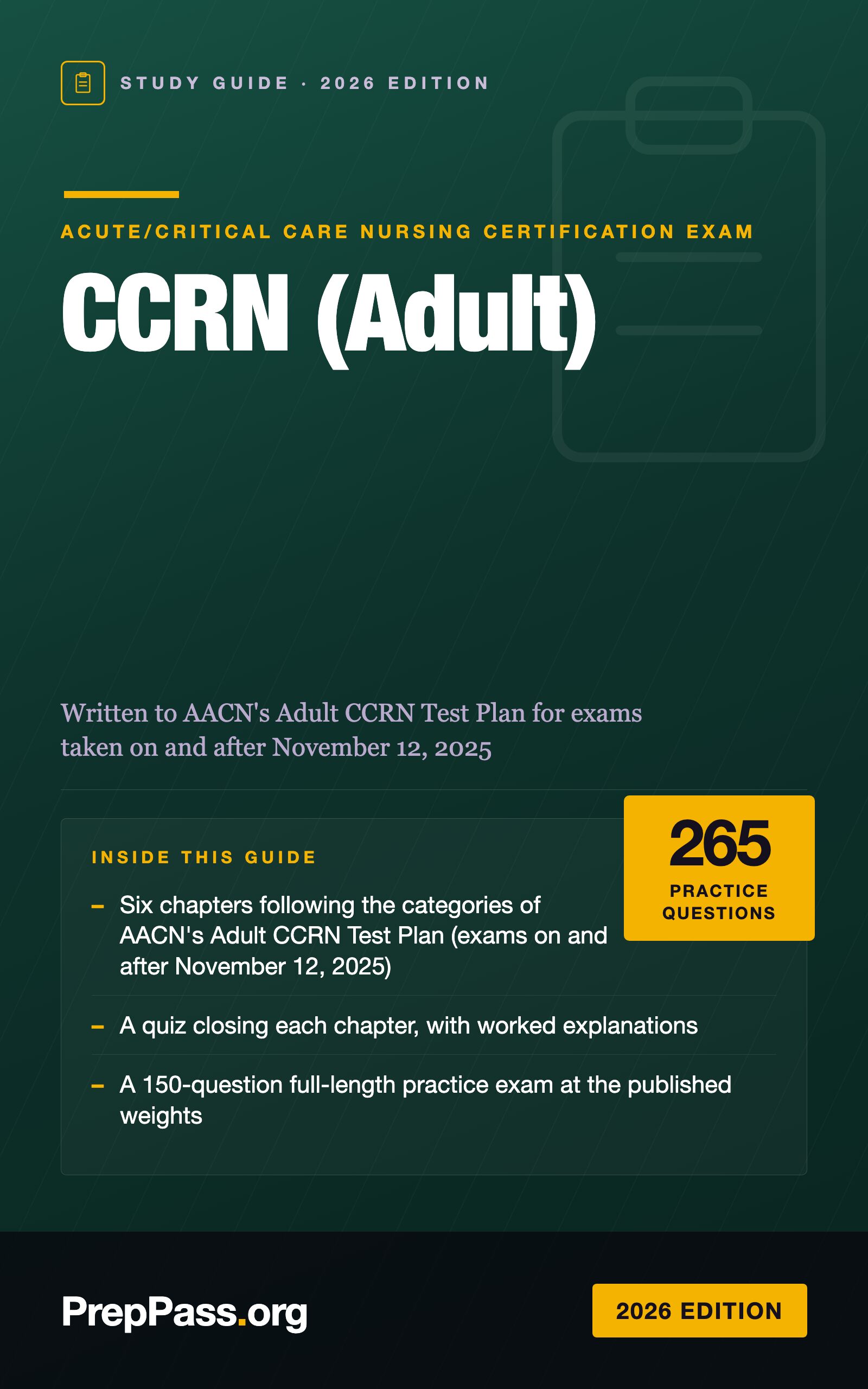
Written to AACN's Adult CCRN Test Plan for exams taken on and after November 12, 2025: six chapters, 265 original questions with worked explanations, and a 150-question full-length practice exam.
- 265 道原创 CCRN 练习题,每题附解析,合成一本 PDF + EPUB 永久保存
PDF + EPUB · 英文 · 136 页 · $24.99 一次买断
本书为英文版,下载的 PDF 与 EPUB 均为英文。
付款后立即下载 —— 无需注册账号,无订阅。
14 天退款保证:任何原因不满意?购买后 14 天内发邮件至 support@preppass.org 即可全额退款。 退款政策
先做 10 题,看看讲解 —— 免费
先答完这 10 题,交卷后每题都有解析 —— 还会指出本指南里讲这一点的那一节。约 5 分钟,无需注册。
开始 10 道免费题翻开这本书看看
三页真实内页,直接从你将下载的 PDF 渲染而来 —— 依次是一页速查、一页讲解、一道带解析的例题。没有任何一页是为了好看而重画的。
- 速查页Chapter 6 — Professional Caring & Ethical Practice · PDF 第 64 页
一页可以随时翻回来的内容:把数字、期限或术语集中在一处。
- 怎么讲Section 6 — Professional Caring & Ethical Practice (questions 121–150) · PDF 第 111 页
讲解页:用文字把知识讲清楚,顺序与考试考查的顺序一致。
- 一道题的完整解析Chapter 2 — Respiratory · PDF 第 23 页
一道练习题,连同答案和背后的推理 —— 不只是一个答案键。
关于这场考试本身
| 主管机构 | AACN Certification Corporation —— 考试由 PSI 承办 来源: AACN Certification Corporation — CCRN Exam Handbook - Direct Care (July 2026, PDF) |
|---|---|
| 题目数量 | 150 道题 (125 道计分,25 道不计分预试题) 来源: AACN Certification Corporation — CCRN Exam Handbook - Direct Care (July 2026, PDF) |
| 考试时限 | 180 分钟 来源: AACN Certification Corporation — CCRN Exam Handbook - Direct Care (July 2026, PDF) |
| 及格标准 | 125 题中答对 83 题 |
| 费用 |
来源: AACN Certification Corporation — CCRN Exam Handbook - Direct Care (July 2026, PDF) |
| 考试语言 | AACN Certification Corporation 未公布 我们查阅但未找到该数据的来源: AACN Certification Corporation — CCRN Exam Handbook - Direct Care (July 2026, PDF) |
免费的 CCRN (Adult) — Acute/Critical Care Nursing Certification Exam 练习题与学习章节 →
包含什么,不包含什么
包含
- Six chapters following the categories of AACN's Adult CCRN Test Plan (exams on and after November 12, 2025)
- A quiz closing each chapter, with worked explanations
- A 150-question full-length practice exam at the published weights
- 265 original questions, each explained and cited to its source
- Key-numbers and quick-reference tables for fast review
- PDF + EPUB you keep
不包含
- 不寄送纸质书 —— 这是一份你下载后可自行打印的文件
- 购书不含视频课程、讲师或一对一辅导 —— 站上的免费视频是另一回事
- 不含考试报名费与考点费用,这些仍需向官方机构缴纳
目录
查看 14 个部分及各部分起始页
- Chapter 1 — Cardiovascular第 7 页
- Chapter 2 — Respiratory第 17 页
- Chapter 3 — Endocrine, Hematology/Immunology, Gastrointestinal, Renal/Genitourinary, Integumentary第 27 页
- Chapter 4 — Musculoskeletal, Neurological, Behavioral/Psychosocial第 40 页
- Chapter 5 — Multisystem第 51 页
- Chapter 6 — Professional Caring & Ethical Practice第 61 页
- Appendix A — Critical-care terminology第 73 页
- Appendix B — Quick-reference tables第 74 页
- Section 1 — Cardiovascular (questions 1–20)第 76 页
- Section 2 — Respiratory (questions 21–38)第 80 页
- Section 3 — Endocrine, Hematology/Immunology, GI, Renal/GU, Integumentary (questions 39–69)第 84 页
- Section 4 — Musculoskeletal, Neurological, Behavioral/Psychosocial (questions 70–96)第 90 页
- Section 5 — Multisystem (questions 97–120)第 96 页
- Section 6 — Professional Caring & Ethical Practice (questions 121–150)第 101 页
取自你将下载的那份 PDF,并标明各章起始页 —— 不是在此手工录入的。
免费读完整一章
完整的一章,与电子书正文一字不差。直接在此窗口滚动阅读;无需下载,无需邮箱。
在本页直接阅读第 1 章
Cardiovascular questions ask you to recognise a failing circulation from the bedside picture, name the mechanism, and choose the first intervention — and they reward knowing why the tempting intervention would make things worse. The test plan lists sixteen cardiovascular topics, from acute coronary syndrome to vascular interventions; this chapter teaches the ones that most often decide a patient's next hour.
Acute coronary syndrome
Most heart attacks are caused by a blood clot that blocks a coronary artery, starving the heart muscle of oxygen[1]. Unstable angina sits on the same continuum: chest pain that is new, worsening or no longer relieved the way it used to be. Nitroglycerin relaxes the blood vessels, but it may not fully relieve the pain of a heart attack[1], because it does nothing to the clot itself. For ST-elevation MI, time is muscle: when angioplasty is the chosen treatment, it should be done within 90 minutes of arrival at the hospital[1]. Heparin is part of acute treatment, and its principal hazard is bleeding — the FDA label records fatal haemorrhage[2].
How it is tested: the exam gives you a time or a drug and asks what matters about it. The trap is treating symptom relief (nitroglycerin, a falling pain score) as if it were reperfusion.
Heart failure and cardiogenic shock
When the heart cannot pump efficiently, blood backs up into the vessels that carry blood through the lungs, producing pulmonary oedema, crackles and breathlessness[3]. When the right side fails, blood backs up in the systemic veins instead[4]; distended neck veins signal high pressure on the right side of the heart[4], and dependent oedema follows.
Cardiogenic shock is the end of this road: the heart cannot supply enough blood and oxygen to the organs[5], most often during or after a heart attack[5]. Skin that is cool to the touch and decreased urination are its perfusion signs[5]. Treatment uses medicines to increase blood pressure and improve heart function[5] while the cause is fixed; a large fluid bolus is the classic wrong answer, because a failing left ventricle cannot handle the volume.
Haemodynamic ranges. This book uses the MedlinePlus normal values for right-heart catheterisation: cardiac index 2.8 to 4.2 L/min/m²[6] and pulmonary capillary wedge pressure 4 to 12 mm Hg[6]. Other references quote slightly different ranges; the exam tests the direction of change (low index with high wedge = pump failure), not the last decimal.
Two drug facts belong here. Spironolactone is a mineralocorticoid receptor antagonist and a listed cause of high potassium[7]. IV verapamil is contraindicated in severe congestive heart failure unless the failure is caused by a supraventricular tachycardia it can treat[8].
Obstructive shock: cardiac tamponade
In tamponade, fluid in the pericardial sac prevents the ventricles from expanding fully[9]. The examination shows neck veins that bulge while the blood pressure is low[9], faint heart sounds[9], and blood pressure that falls on deep inspiration — pulsus paradoxus[9]. Echocardiography, done at the bedside in an emergency, is the test of choice[9]. The fluid must be drained as quickly as possible[9]; IV fluids only hold the blood pressure until drainage happens[9]. Obstructive shock in general is caused by something outside the heart that prevents it from pumping enough blood[10].
Pericarditis and Dressler syndrome
Pericarditis pain is often relieved by sitting up and leaning forward[11], and the stethoscope may pick up a pericardial rub[11]. Late pericarditis after a heart attack — Dressler syndrome — usually develops several weeks or months later[12]. The trap is reading every post-MI chest pain as reinfarction.
Aortic dissection
In a dissection, a tear lets blood flow between the layers of the aortic wall, and the tear extends along it[13]. The pain is sudden and severe and described as sharp, stabbing, tearing or ripping[13]. Blood pressure is lowered with IV drugs, and beta-blockers are the medicines of first choice[13]; ascending dissections are treated with surgery[13]. Anticoagulants and thrombolytics are the dangerous distractors — the problem is a torn wall, not a clot.
Dysrhythmias: atrial fibrillation and flutter
In atrial fibrillation the atria contract chaotically — they quiver[14]; in atrial flutter they beat very rapidly but regularly[14]. The irregular rhythm of AF makes blood clots more likely to form[14], which is why anticoagulation is central to long-term care; warfarin is monitored with the INR[15]. Cardioversion can restore a normal rhythm right away and can be done as an emergency[14] — the answer for rapid AF with hypotension or chest pain. For planned cardioversion, some patients start blood thinners beforehand[16].
Hypertensive emergency
What turns severe hypertension into an emergency is organ damage — the brain, eyes, blood vessels, heart and kidneys may be damaged[17] — and the patient receives IV medicines to reduce the pressure[17], with diuretics if there is fluid in the lungs[17]. Nitroprusside is a common IV choice; its label warns that it can cause precipitous falls in blood pressure[18] and, at prolonged or high infusion rates, cyanide toxicity[18].
Structural heart disease: mechanical valves
Mechanical heart valves rarely fail, but clots can form on them and cause a stroke[19] — the reason for lifelong anticoagulation.
Key numbers & deadlines
| Figure | Value | Source |
|---|---|---|
| STEMI — angioplasty target when it is the chosen treatment | Within 90 minutes of arrival | [1] |
| Cardiac index (normal, MedlinePlus) | 2.8–4.2 L/min/m² | [6] |
| Pulmonary capillary wedge pressure (normal, MedlinePlus) | 4–12 mm Hg | [6] |
| Nitroprusside — cyanide risk | Except briefly or at < 2 mcg/kg/min | [18] |
Key takeaways
- Cardiogenic shock is pump failure: cool skin, low urine output, low index with high wedge. Support the pump; do not flood it.
- Tamponade: distended neck veins with low pressure, faint heart sounds, pulsus paradoxus. Drain it; fluids only buy time.
- Dissection: tearing pain; lower heart rate and pressure with IV beta-blockers first; ascending dissections go to surgery.
- AF with instability gets cardioversion; long-term, the clot risk drives anticoagulation.
- A hypertensive emergency is defined by organ damage, not by the number alone.
Chapter 1 quiz — 16 questions
Answer each question, then check the key that follows.
1. A patient develops hypotension, jugular venous distension, and muffled heart sounds a few hours after cardiac surgery. Which condition do these findings most suggest?
- A. Cardiogenic shock from pump failure
- B. Hypovolaemic shock from surgical bleeding
- C. Tamponade from pericardial fluid
- D. Septic shock from a wound infection
2. A patient with an acute aortic dissection is started on an IV beta-blocker. What is the main purpose of this drug?
- A. Dissolve thrombus in the false lumen
- B. Lower heart rate and wall stress
- C. Raise cardiac output to the kidneys
- D. Prevent ventricular dysrhythmias on transport
3. Why is anticoagulation a central part of long-term management of atrial fibrillation?
- A. The fast rate thickens the blood
- B. The irregular rhythm damages coronary arteries
- C. Chaotic atria let clots form
- D. Loss of atrial kick causes hypertension
4. A patient in cardiogenic shock after a large anterior MI has a blood pressure of 78/52 mm Hg, cool clammy skin, and urine output of 15 mL/hr. Which intervention does the nurse anticipate as the priority?
- A. A 2-litre crystalloid bolus
- B. Therapeutic hypothermia protocol
- C. Vasopressor or inotrope infusion
- D. High-dose loop diuretic
5. A patient's systolic blood pressure falls markedly each time they breathe in deeply. This finding (pulsus paradoxus) is most associated with which condition?
- A. Tension pneumothorax
- B. Abdominal compartment syndrome
- C. Massive pulmonary embolism
- D. Cardiac tamponade
6. A patient describes abrupt, severe, tearing chest pain that moves to the back. Blood pressure is 196/110 mm Hg in the right arm and 148/92 mm Hg in the left arm. Which condition does the nurse suspect first?
- A. Acute pericarditis
- B. Oesophageal spasm
- C. Aortic dissection
- D. Costochondritis
7. A patient's blood pressure is 232/134 mm Hg. Which additional finding makes this a hypertensive emergency needing IV treatment?
- A. Systolic pressure above 220 mm Hg
- B. New confusion and falling urine output
- C. A history of missed medication doses
- D. Diastolic pressure above 120 mm Hg
8. In left-sided heart failure, what causes the pulmonary congestion?
- A. Pressure backing up from the failing left ventricle
- B. The right ventricle pumping too much volume into the lungs
- C. Aortic valve stenosis blocking forward flow
- D. Pericardial constriction compressing the left atrium
9. A patient with new-onset atrial fibrillation has a heart rate of 168, blood pressure of 82/54 mm Hg, and chest pain. Which action does the nurse anticipate first?
- A. Oral rate-control drug and observation
- B. Synchronised cardioversion
- C. Vagal manoeuvres and carotid massage
- D. Outpatient anticoagulation teaching
10. After pericardiocentesis for cardiac tamponade, the patient's blood pressure rises and the jugular venous distension resolves. Why did the patient improve?
- A. The compressing pericardial fluid was removed
- B. The procedure strengthened the heart muscle
- C. The needle dilated the coronary arteries
- D. Drainage stimulated the vagus nerve
11. Which assessment finding points to right-sided rather than left-sided heart failure?
- A. Pulmonary crackles and dyspnoea
- B. Neck vein distension, ankle oedema
- C. Pink frothy sputum and hypoxaemia
- D. Paroxysmal nocturnal dyspnoea
12. A patient receiving nitroprusside for a hypertensive emergency must be continuously monitored. Which complication is the nurse chiefly guarding against?
- A. Ischaemia from abrupt hypotension
- B. Coronary vasospasm from nitrate withdrawal
- C. Pulmonary oedema from rising afterload
- D. Metabolic alkalosis from sodium loading
13. In cardiogenic shock, cool clammy skin and oliguria reflect which underlying problem?
- A. Vasodilation from inflammatory mediators
- B. Absolute volume loss from haemorrhage
- C. Obstruction of the great vessels
- D. Poor perfusion from pump failure
14. A patient with atrial fibrillation is started on warfarin. Which teaching point is most important?
- A. It dissolves existing atrial clots within hours
- B. It can stop once the heart rate is controlled
- C. It converts the rhythm back to sinus rhythm
- D. Regular INR blood tests guide the dose
15. A patient with an ST-elevation MI arrives at a hospital that performs angioplasty. Within what time of arrival should the angioplasty ideally be done?
- A. Within 90 minutes
- B. Within 24 hours
- C. After troponin peaks
- D. After 12 hours of observation
16. A patient with a Type A (ascending) aortic dissection is awaiting surgery. What is the nurse's priority goal until then?
- A. Heart rate and blood pressure control
- B. Aggressive fluids to maximise aortic flow
- C. Anticoagulation to prevent false-lumen clot
- D. Vasopressors to keep systolic pressure above 180
Answer key & explanations
1. C. Distended neck veins with a low blood pressure[9] and faint heart sounds[9] are the bedside picture of cardiac tamponade: fluid in the pericardial sac stops the ventricles expanding fully[9]. Bleeding after surgery is the tempting alternative, but hypovolaemia empties the veins, so the neck veins would be flat, not distended.
2. B. As a dissection extends, blood tracks between the layers of the aortic wall[13], so treatment lowers the pressure driving it; MedlinePlus lists IV blood-pressure-lowering drugs with beta-blockers as the first choice[13]. Slowing the heart and lowering pressure reduces the force on the torn wall. The drug does not dissolve clot, and raising cardiac output would increase that force rather than reduce it.
3. C. In AF the atria contract chaotically, or quiver[14], and this irregular rhythm makes blood clots more likely to form[14]; a clot that travels to the brain causes stroke. The rhythm does not injure the coronary arteries directly, and loss of atrial contraction lowers rather than raises output and pressure.
4. C. Cardiogenic shock means the heart cannot supply enough blood and oxygen to the organs[5], and treatment includes medicines to increase blood pressure and improve heart function[5]. A large fluid bolus is the tempting reflex for hypotension, but a failing left ventricle cannot handle the volume and pulmonary congestion worsens; a diuretic would drop an already low pressure further.
5. D. MedlinePlus lists blood pressure that falls when breathing deeply among the examination findings of cardiac tamponade[9]. Fluid in the fixed pericardial sac stops the ventricles expanding fully[9], so filling of the left heart on inspiration is squeezed further. Tension pneumothorax and massive PE also cause obstructive shock, but pulsus paradoxus is the classic tamponade sign.
6. C. Dissection pain is sudden and severe and is described as sharp, stabbing, tearing or ripping[13]; a tear that extends along the aortic wall[13] can reduce flow into one arm, which is why a pressure difference between arms raises the suspicion. Pericarditis is the tempting alternative, but its pain is typically eased by sitting up and leaning forward[11] and does not cause an arm-to-arm pressure difference.
7. B. What makes severe hypertension an emergency is organ damage — MedlinePlus notes that the brain, eyes, blood vessels, heart and kidneys may be damaged[17] — and patients are treated with IV medicines[17]. New confusion and reduced urine output are signs that the brain and kidneys are being injured. A very high number on its own, however alarming, does not show organ injury.
8. A. When the heart cannot pump efficiently, blood backs up into the vessels that carry blood through the lungs[3]: in left-sided failure, the left ventricle cannot move its volume forward, so pressure rises in the pulmonary veins and fluid enters the lungs. The right ventricle is not over-pumping; right-sided failure backs blood up into the systemic veins instead[4].
9. B. Rapid AF with hypotension and chest pain is unstable, and cardioversion can be used as an emergency method to restore a normal rhythm right away[14]. Oral rate control is the tempting choice, but it acts too slowly for a patient whose perfusion is already failing; vagal manoeuvres do not convert AF.
10. A. In tamponade the excess pressure from pericardial fluid stops the ventricles expanding fully[9]; pericardiocentesis drains that fluid[9], so the ventricles fill again and stroke volume and blood pressure recover. The heart muscle itself was never the problem, so the procedure does not strengthen it.
11. B. When the right heart fails, blood backs up in the systemic veins[4]; swollen neck veins are a sign of high pressure in the right side of the heart[4], and ankle swelling follows. Crackles, frothy sputum and nocturnal dyspnoea come from blood backing up into the lung vessels, the left-sided pattern[3].
12. A. The FDA label warns that nitroprusside can cause precipitous decreases in blood pressure that, without proper monitoring, can lead to irreversible ischaemic injury or death[18]. The drug lowers afterload rather than raising it, so pulmonary oedema from afterload is the wrong way round.
13. D. Cardiogenic shock is the heart failing to supply enough blood and oxygen to the organs[5]; skin that is cool to the touch[5] and decreased urination[5] are the signs of that poor perfusion. Distributive shock from inflammatory vasodilation is the tempting alternative, but it typically starts with warm, vasodilated skin.
14. D. Warfarin is monitored with a regular prothrombin time blood test reported as the INR[15]. It is given because the irregular AF rhythm makes clots more likely to form[14]; it prevents new clots rather than dissolving existing ones, and the clot risk persists even when the rate is controlled.
15. A. MedlinePlus states that angioplasty is often the first-choice treatment and should be done within 90 minutes after arrival at the hospital, and usually no later than 12 hours after the heart attack[1]. Waiting for the troponin to peak or for a period of observation wastes heart muscle; the 12-hour figure is an outer limit, not a target.
16. A. Ascending dissections are treated with surgery[13], and until then blood pressure is lowered with IV drugs, beta-blockers first[13], because pressure drives blood further along the torn wall[13]. Fluids and vasopressors raise that pressure, and anticoagulation adds bleeding risk to a torn aorta.
Sources cited in this excerpt
- Heart attack: MedlinePlus Medical Encyclopedia. U.S. National Library of Medicine (MedlinePlus). https://medlineplus.gov/ency/article/000195.htm
- DailyMed - HEPARIN SODIUM injection, solution. U.S. National Library of Medicine DailyMed (FDA-approved labeling). https://dailymed.nlm.nih.gov/dailymed/drugInfo.cfm?setid=c8c4edd2-ee9e-4558-6b8c-b83adc242a0a
- Pulmonary edema: MedlinePlus Medical Encyclopedia. U.S. National Library of Medicine (MedlinePlus). https://medlineplus.gov/ency/article/000140.htm
- Cor pulmonale: MedlinePlus Medical Encyclopedia. U.S. National Library of Medicine (MedlinePlus). https://medlineplus.gov/ency/article/000129.htm
- Cardiogenic shock: MedlinePlus Medical Encyclopedia. U.S. National Library of Medicine (MedlinePlus). https://medlineplus.gov/ency/article/000185.htm
- Swan-Ganz - right heart catheterization: MedlinePlus Medical Encyclopedia. U.S. National Library of Medicine (MedlinePlus). https://medlineplus.gov/ency/article/003870.htm
- High potassium level: MedlinePlus Medical Encyclopedia. U.S. National Library of Medicine (MedlinePlus). https://medlineplus.gov/ency/article/001179.htm
- DailyMed - VERAPAMIL HYDROCHLORIDE injection, solution. U.S. National Library of Medicine DailyMed (FDA-approved labeling). https://dailymed.nlm.nih.gov/dailymed/drugInfo.cfm?setid=d7a749d0-4ab3-4fbb-8d7b-e09d68413c41
- Cardiac tamponade: MedlinePlus Medical Encyclopedia. U.S. National Library of Medicine (MedlinePlus). https://medlineplus.gov/ency/article/000194.htm
- Shock: MedlinePlus Medical Encyclopedia. U.S. National Library of Medicine (MedlinePlus). https://medlineplus.gov/ency/article/000039.htm
- Pericarditis: MedlinePlus Medical Encyclopedia. U.S. National Library of Medicine (MedlinePlus). https://medlineplus.gov/ency/article/000182.htm
- Pericarditis - after heart attack: MedlinePlus Medical Encyclopedia. U.S. National Library of Medicine (MedlinePlus). https://medlineplus.gov/ency/article/000166.htm
- Aortic dissection: MedlinePlus Medical Encyclopedia. U.S. National Library of Medicine (MedlinePlus). https://medlineplus.gov/ency/article/000181.htm
- Atrial fibrillation and atrial flutter: MedlinePlus Medical Encyclopedia. U.S. National Library of Medicine (MedlinePlus). https://medlineplus.gov/ency/article/000184.htm
- Warfarin: MedlinePlus Drug Information. U.S. National Library of Medicine (MedlinePlus). https://medlineplus.gov/druginfo/meds/a682277.html
- Cardioversion: MedlinePlus Medical Encyclopedia. U.S. National Library of Medicine (MedlinePlus). https://medlineplus.gov/ency/article/007110.htm
- Malignant hypertension: MedlinePlus Medical Encyclopedia. U.S. National Library of Medicine (MedlinePlus). https://medlineplus.gov/ency/article/000491.htm
- DailyMed - SODIUM NITROPRUSSIDE injection, solution, concentrate. U.S. National Library of Medicine DailyMed (FDA-approved labeling). https://dailymed.nlm.nih.gov/dailymed/drugInfo.cfm?setid=6fbfb86c-da8d-4741-b1e0-7000e2bbad5f
- Heart valve surgery: MedlinePlus Medical Encyclopedia. U.S. National Library of Medicine (MedlinePlus). https://medlineplus.gov/ency/article/002954.htm
购买前
- 怎么拿到?
- 付款后下载入口立即出现在本页,链接同时发到你的邮箱。无需注册账号。
- 不合适怎么办?
- 14 天内发邮件即可全额退款,无需理由。
- 免费练习会取消吗?
- 不会。站上的每一道练习题、计时模考和免费章节都继续免费。这本书是「学」的那一半,不是把免费部分围起来的门。
- 能在手机上看吗?
- 可以 —— EPUB 适合手机和电子书阅读器,PDF 适合打印和贴标签,两种都给你。
详细信息
Written to AACN's Adult CCRN Test Plan for exams taken on and after November 12, 2025: six chapters, 265 original questions with worked explanations, and a 150-question full-length practice exam.
- Format: PDF + EPUB download · 136 pages
- 265 practice questions in the book, with a full answer key
- 118 free practice questions for this exam on PrepPass, included at no cost
- $24.99 one-time — no subscription
- 14-day money-back guarantee · refund policy
- Cross-referenced against: AACN's CCRN Exam Handbook — Direct Care (July 2026) and its Adult CCRN Test Plan
- Last updated: September 2026
- 官方来源核验(AACN's CCRN Exam Handbook — Direct Care (July 2026) and its Adult CCRN Test Plan)
- 118 道免费练习题
- 即时下载,永久拥有
练习免费,为什么还要买书?
我们的练习题和计时模考一直免费 —— 网站上的东西不会因为这本书而收起来。这本 $24.99 的书是「学」的那一半:知识本身,按顺序讲清楚,存成一份属于你的文件。
- 系统讲解 —— 每个考试部分按章节从头讲到尾,不只是题目
- 可打印可贴标签 —— 一份适合打印的 PDF,能划重点、做批注、带到书桌前
- 随处离线学 —— EPUB 放手机或电子书阅读器;不用 wifi,不用一堆浏览器标签
- 全在一处 —— 章节和练习题都在同一份文件里
- 永久归你 —— 一次 $24.99,即时下载,无订阅
而且零风险:14 天退款保证 —— 不满意?发邮件即可全额退款,无需理由。 详见退款政策。
14 天退款保证 · 全额退款,无需理由。
一次购买,永久下载访问。此电子书是完整的 CCRN (Adult) — Acute/Critical Care Nursing Certification Exam 学习指南,含 PDF 与 EPUB。仅为教育性摘要,非专业或法律意见 —— 请始终以官方来源核实当前规定。最后更新:September 2026。