CRC — Certified Rehabilitation Counselor Examination · 2026 版
CRC Study Guide — 2026 Edition
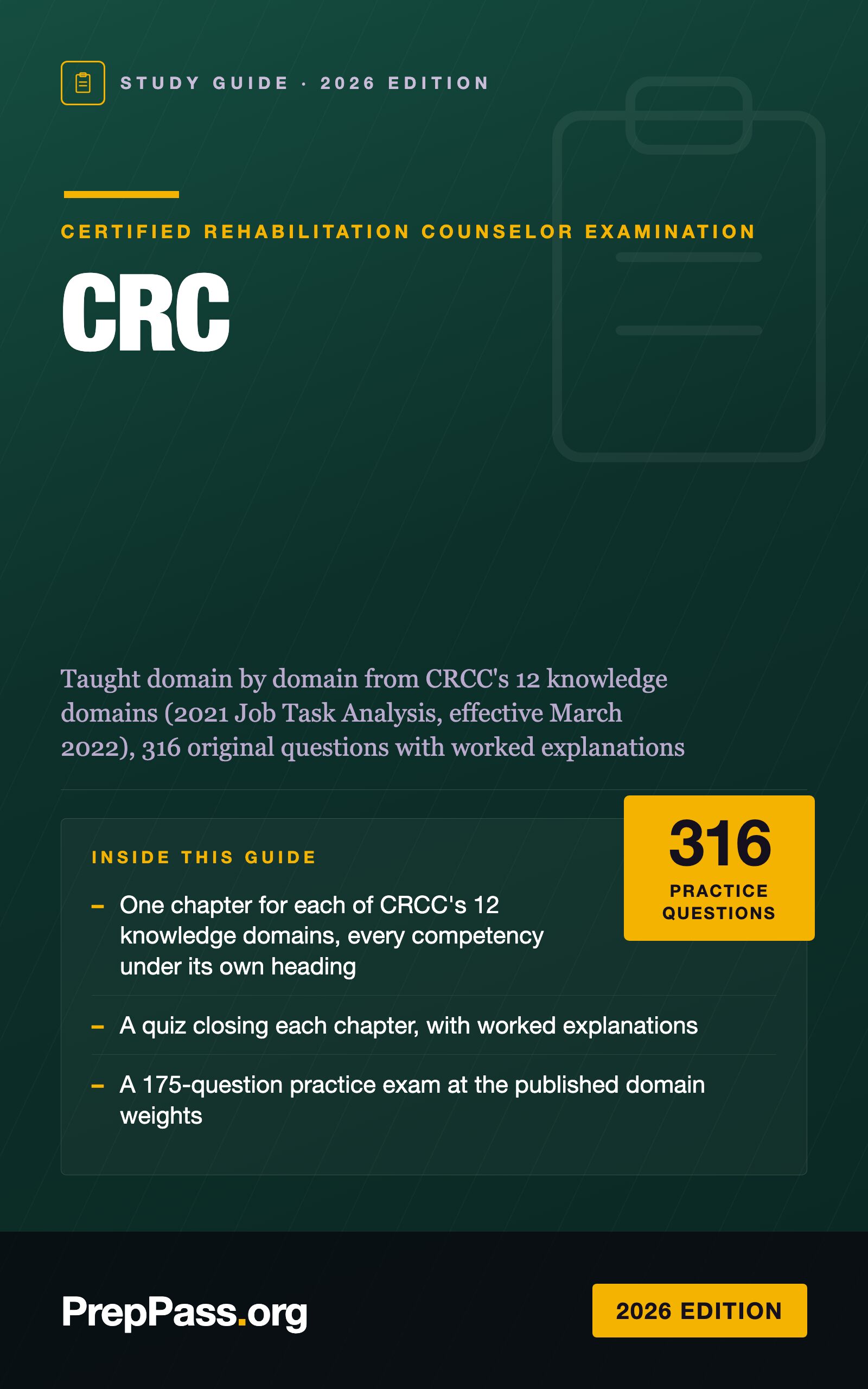
Taught domain by domain from CRCC's 12 knowledge domains (2021 Job Task Analysis, effective March 2022), 316 original questions with worked explanations, and a 175-question full-length practice exam.
- 316 道原创 CRC 练习题,每题附解析,合成一本 PDF + EPUB 永久保存
PDF + EPUB · 英文 · 192 页 · $24.99 一次买断
本书为英文版,下载的 PDF 与 EPUB 均为英文。
付款后立即下载 —— 无需注册账号,无订阅。
14 天退款保证:任何原因不满意?购买后 14 天内发邮件至 support@preppass.org 即可全额退款。 退款政策
先做 10 题,看看讲解 —— 免费
先答完这 10 题,交卷后每题都有解析 —— 还会指出本指南里讲这一点的那一节。约 5 分钟,无需注册。
开始 10 道免费题翻开这本书看看
三页真实内页,直接从你将下载的 PDF 渲染而来 —— 依次是一页速查、一页讲解、一道带解析的例题。没有任何一页是为了好看而重画的。
- 速查页Chapter 2 — Counseling Theories, Techniques, and Evidence-Based Practices · PDF 第 29 页
一页可以随时翻回来的内容:把数字、期限或术语集中在一处。
- 怎么讲Chapter 12 — Research, Methodology, and Performance Management · PDF 第 130 页
讲解页:用文字把知识讲清楚,顺序与考试考查的顺序一致。
- 一道题的完整解析Chapter 7 — Career Development and Job Placement · PDF 第 78 页
一道练习题,连同答案和背后的推理 —— 不只是一个答案键。
关于这场考试本身
| 主管机构 | Commission on Rehabilitation Counselor Certification (CRCC) —— 考试由 Pearson VUE 承办 |
|---|---|
| 题目数量 | 175 道题 (150 道计分,25 道不计分预试题) |
| 考试时限 | 210 分钟 |
| 及格标准 | CRCC 未公布 我们查阅但未找到该数据的来源: CRCC — CRC Exam Overview |
| 费用 |
来源: CRCC — Get Certified (CRC eligibility, fees and exam dates) |
| 考试语言 | CRCC 未公布 我们查阅但未找到该数据的来源: CRCC — CRC Exam Overview |
免费的 CRC — Certified Rehabilitation Counselor Examination 练习题与学习章节 →
包含什么,不包含什么
包含
- One chapter for each of CRCC's 12 knowledge domains, every competency under its own heading
- A quiz closing each chapter, with worked explanations
- A 175-question practice exam at the published domain weights
- 316 original questions, each explained and cited to its source
- VR regulations (34 CFR 361), ADA Title I and 2026 SSA work-incentive figures
- PDF + EPUB you keep
不包含
- 不寄送纸质书 —— 这是一份你下载后可自行打印的文件
- 购书不含视频课程、讲师或一对一辅导 —— 站上的免费视频是另一回事
- 不含考试报名费与考点费用,这些仍需向官方机构缴纳
目录
查看 14 个部分及各部分起始页
- Chapter 1 — Professional Orientation and Ethical Practice第 9 页
- Chapter 2 — Counseling Theories, Techniques, and Evidence-Based Practices第 22 页
- Chapter 3 — Group and Family Counseling第 35 页
- Chapter 4 — Crisis and Trauma Counseling第 43 页
- Chapter 5 — Medical and Psychosocial Aspects of Chronic Illness and Disabilities第 50 页
- Answer key & explanations第 57 页
- Chapter 6 — Assessment/Evaluation, Occupational Analysis, and Service Implementation第 59 页
- Chapter 7 — Career Development and Job Placement第 71 页
- Chapter 8 — Business Engagement第 81 页
- Chapter 9 — Community Resources and Partnerships第 89 页
- Chapter 10 — Case Management第 99 页
- Chapter 11 — Health Care and Disability Management第 108 页
- Chapter 12 — Research, Methodology, and Performance Management第 116 页
- Appendix B — Decision tables第 187 页
取自你将下载的那份 PDF,并标明各章起始页 —— 不是在此手工录入的。
免费读完整一章
完整的一章,与电子书正文一字不差。直接在此窗口滚动阅读;无需下载,无需邮箱。
在本页直接阅读第 10 章
我们没有拿轻松的绪论充数 —— 免费章节直接翻到书里最见功力的部分,让你在考试真正难的地方检验这本书讲得好不好。
Case management is the operating system of rehabilitation counseling: the process that turns assessment into outcomes, the documentation that proves it, and the coordination that holds it together. The exam tests this domain through process questions — what comes next, what was skipped, what the record must show.
A. Understand and apply the case management process
The process follows a disciplined sequence: referral and intake, assessment, planning, implementation and coordination, monitoring, and closure or follow-up. Each step feeds the next; skipping steps creates the exam's favorite failure scenarios. A plan written before assessment is complete will miss needs; implementation without monitoring will miss problems. Interdisciplinary teamwork is part of the process: counselors on teams must keep the focus on how to serve clients best[1], and clients must be afforded full participation in decisions about their services[1]. The outcome standard for VR case management is competitive integrated employment or supported employment and economic self-sufficiency[2].
B. Complete case recording and documentation
The record must show what was done, why, and with whose consent: assessments administered, the client's choices, services authorized, provider contacts, and the rationale for significant decisions. Documentation standards the exam tests: timeliness (record promptly), accuracy (record what happened, not what should have happened), completeness (the next counselor can pick up the case), and confidentiality (access limited to those with a need to know). When disclosure of confidential information is required, clarify what is requested and share only what is required[1]. The trap is the thorough-but-late record or the prompt-but-vague one — the standard requires both.
C. Understand and apply negotiation, mediation, and conflict resolution strategies
Counselors negotiate with employers, mediate between clients and providers, and resolve conflicts among team members or stakeholders. The exam tests principled negotiation: separate the people from the problem, focus on interests rather than positions, and generate options before deciding. In team conflicts, the Code's procedure applies — attempt resolution within the team first; if that fails, recuse rather than implement a decision that breaches the Code. The trap is the counselor who avoids the conflict (hoping it resolves itself) or who escalates prematurely.
D. Understand and apply the principles of caseload management
Caseload management is triage under scarcity: prioritizing by urgency and need, allocating time across cases, and managing the order of selection when a VR agency cannot serve everyone (priority goes to individuals with the most significant disabilities[2]). The exam tests the counselor who systematizes — tickler systems, scheduled reviews, proactive outreach to stalled cases — versus the counselor who works whoever shouts loudest. Time management is an ethical issue: neglected cases are underserved clients.
E. Understand and address institutional and social barriers that impede access, equity, and success
Barriers live in systems, not just in clients: inaccessible facilities, discriminatory policies, transportation gaps, employer bias, and fragmented services. The counselor's job is to identify these barriers and address them — through advocacy, accommodation, referral, or systems change — rather than treating them as the client's personal deficit. The exam tests barrier analysis: when a capable client repeatedly fails, look at the system before blaming the client.
F. Apply techniques for working with individuals with limited English proficiency or varied communication methods
Effective service requires effective communication: qualified interpreters (never minor children, never the client's employer), translated materials, and alternative formats for sensory disabilities. The exam tests the details: the interpreter translates, not advises; the counselor speaks to the client, not the interpreter; confidentiality extends to the interpreted session. The trap is the convenient-but-inappropriate interpreter — a family member with a stake in the outcome, or a bilingual staff member pulled from unrelated duties without qualification.
G. Understand and apply principles, models, and documentation formats for biopsychosocial case conceptualization
The biopsychosocial model organizes the case: biological factors (medical conditions, medications, functional capacities), psychological factors (cognition, emotion, motivation, adjustment), and social factors (family, culture, community, systems). Treatment planning translates the conceptualization into goals, interventions, responsibilities, and timelines — with the client's informed choice at the center. The exam tests integration: the plan that addresses only the medical dimension while ignoring the psychological and social ones is incomplete by definition.
Going deeper — VR timelines and documentation
The VR regulations set the clock for case management. An eligibility determination is due within 60 days of application unless exceptional circumstances apply or the parties agree to extend it[3]. Applicants who are eligible for SSDI or SSI are presumed eligible and treated as individuals with significant disabilities[4]. The individualized plan for employment is due as soon as possible and no later than 90 days after eligibility, unless the agency and the individual agree to a specific later date[5]. Before providing most services, the agency checks for comparable services and benefits[6], but if they are not available when needed, VR provides the service until they are[6]. A case closes with an employment outcome only after the job has lasted at least 90 days[7], and a closure for other reasons must be justified in the record[8]. Throughout, clients receive the information and support to exercise informed choice[9].
Key numbers & deadlines
| Figure | Value | Source |
|---|---|---|
| Team member duty | Keep the focus on how to serve clients best | Code of Professional Ethics (2023)[1] |
| Client participation | Full participation in decisions about their services | Code of Professional Ethics (2023)[1] |
| VR outcome standard | Competitive integrated/supported employment; economic self-sufficiency | RSA[2] |
| Order of selection | Priority to individuals with the most significant disabilities | RSA[2] |
| Disclosure standard | Clarify what is requested; disclose only what is required | Code of Professional Ethics (2023)[1] |
Key takeaways
- Follow the process in order: intake, assessment, planning, implementation, monitoring, closure — each step feeds the next.
- Document promptly, accurately, completely, and confidentially; the record must show the client's choices and your rationale.
- On teams, keep the client's best interests central and protect full client participation in decisions.
- Manage the caseload systematically; when resources are scarce, priority goes to the most significant disabilities.
- Analyze barriers in the system before attributing failure to the client.
- Biopsychosocial planning integrates medical, psychological, and social dimensions with the client's informed choice.
Chapter 10 quiz — 13 questions
Answer each question, then check the key that follows.
1. A counselor opens a case management relationship. What must informed consent include?
- A. Only fees and office hours
- B. Only the counselor's credentials
- C. Purposes, methods, risks, benefits
- D. A signature on the intake form alone
2. A client applied for VR services on March 1. Absent exceptional circumstances or an agreed extension, by when must the eligibility decision be made?
- A. Within 60 days
- B. Within 30 days
- C. Within 90 days
- D. Within 120 days
3. A counselor serves on an interdisciplinary team for a client. What does the Code require of the counselor's team role?
- A. Serve the client best, with full participation
- B. Defer to team consensus without representing the client
- C. Share all client information with every team member
- D. Let the team's scheduling override the client's goals
4. A counselor writes a VR case plan. What outcome should it target?
- A. Integrated employment by choice
- B. Keeping the case open indefinitely
- C. Sheltered placement by default
- D. Whatever service costs least
5. A case requires expertise the counselor does not have. What does the Code require?
- A. Keep the case and learn as you go
- B. Close the case without a referral
- C. Ask the client to find another provider
- D. Refer the client, putting the client's welfare first
6. A counselor discontinues case management services. What procedure does the Code require?
- A. Close the file without a referral
- B. Orderly transfer with notice and referrals
- C. Close the case without notifying the client
- D. Transfer only the most recent notes
7. A counselor coordinates care within a treatment team. How much information should be shared?
- A. Only the information the team's work requires
- B. The entire file, to be thorough
- C. Nothing without a court order
- D. Whatever each member requests
8. A counselor coordinates services across agencies. What client right must be preserved?
- A. The team may decide without the client
- B. The right to refuse services
- C. Consent given once covers all agencies
- D. Only the lead agency needs consent
9. A counselor evaluates case management outcomes for a state VR client. What outcome defines success?
- A. Rapid case closure
- B. Integrated employment and self-sufficiency
- C. Continuous enrollment
- D. Appointment counts
10. A client was found eligible for VR on May 1. Unless both parties agree to an extension, when must the individualized plan for employment be developed?
- A. Within 30 days of eligibility
- B. Within 60 days of application
- C. Only after all assessments finish
- D. Within 90 days of eligibility
11. A VR client started a competitive integrated job 45 days ago and is doing well. May the counselor close the case as successfully employed now?
- A. No; it takes a year
- B. Yes, after 30 days on the job
- C. No; it must last 90 days
- D. Yes, once hired
12. A client's hearing aids could be paid for by her health insurance, but the insurer will not approve them for four months and her job starts next week. What should the VR agency do?
- A. Deny the hearing aids permanently
- B. Require the client to pay and seek reimbursement
- C. Wait for the insurer, since it is the comparable benefit
- D. Provide it now; the benefit is late
13. A client who receives SSDI applies for VR services. How is her eligibility treated?
- A. She is presumed eligible for VR services
- B. She is eligible only for supported employment
- C. She must prove eligibility like any applicant
- D. She is ineligible because she receives benefits
Answer key & explanations
1. C. The Code requires counselors to obtain informed consent that includes the purposes, goals, techniques, procedures, limitations, potential risks, and benefits of services. A case management plan starts from that consent.[1]
2. A. Under 34 CFR 361.41, once an individual applies, the eligibility determination must be made within 60 days unless exceptional and unforeseen circumstances intervene or the parties agree to an extension. Ninety days is the separate deadline for the IPE after eligibility.[3, 5]
3. A. The Code requires counselors who join interdisciplinary teams to keep the focus on how to serve clients best and to make reasonable efforts to ensure clients participate fully in decisions about their services. The counselor therefore advocates the client's interests inside the team and protects the client's participatory role. The most tempting distractor is deferring to team consensus, because the Code does expect counselors to implement team decisions they did not personally favor — but not decisions that breach the Code, and ethical concerns are raised within the team first. Unlimited sharing violates confidentiality, and letting convenience override goals abandons the client's interests.[1, 10]
4. A. State VR services are provided consistent with the client's strengths, priorities, and informed choice toward competitive integrated or supported employment. The case plan serves that goal.[2]
5. D. The Code requires referral when the counselor lacks competence, with the primary obligation being the client's welfare. A referral outside competence is the ethical move.[1]
6. B. The Code requires transferring or closing files in an orderly, professional manner, sensitive to the client's needs, when discontinuing services, with prior notification and appropriate referrals. That procedure governs case closure.[1]
7. A. The Code's minimal-disclosure rule applies: when circumstances require disclosing confidential information, the counselor clarifies what is being requested and ensures only required information is disclosed, and clients are told during professional disclosure that team members will share their information. Sending the whole file is the tempting "thorough" answer, but it discloses more than the work requires; refusing all sharing without a court order blocks legitimate coordination.[1]
8. B. The Code recognizes clients' freedom to choose whether to remain in a professional relationship and to refuse services or changes, and requires reasonable efforts so they can participate fully in decisions. Multi-agency coordination does not let a team decide without the client or treat one consent as covering every agency.[1]
9. B. State VR programs provide services so that individuals with disabilities may prepare for and engage in competitive integrated employment or supported employment and achieve economic self-sufficiency. Outcomes are therefore judged against employment and self-sufficiency, not against service volume or speed. The most tempting distractor is appointment counts: activity is easy to track and often appears in administrative reports, but it measures effort rather than results. Continuous enrollment without a goal contradicts the employment purpose, and rapid closure without an outcome abandons it.[2]
10. D. 34 CFR 361.45 requires the IPE to be developed as soon as possible, but not later than 90 days after the eligibility determination, unless the agency and the individual agree to extend it to a specific date.[5]
11. C. A case may be closed with an employment outcome only after the individual has maintained it for an appropriate period of not less than 90 days and no longer needs services. Forty-five days is too soon; a year is not the rule.[7]
12. D. If comparable services or benefits exist but are not available when needed for progress toward the IPE outcome, the VR agency must provide the service until the comparable benefit becomes available. Making her wait four months would jeopardize the job.[6]
13. A. Under 34 CFR 361.42, an applicant determined eligible for Social Security benefits under title II or XVI is presumed eligible for VR services and is considered an individual with a significant disability. Benefit receipt is not a bar to VR.[4]
Sources cited in this excerpt
- Code of Professional Ethics for Certified Rehabilitation Counselors (2023). Commission on Rehabilitation Counselor Certification. https://crccertification.com/wp-content/uploads/2023/04/2023-Code-of-Ethics.pdf
- State Vocational Rehabilitation Services Program. Rehabilitation Services Administration, U.S. Department of Education. https://rsa.ed.gov/about/programs/vocational-rehabilitation-state-grants
- 34 CFR 361.41 — Processing referrals and applications. Electronic Code of Federal Regulations (eCFR). https://www.ecfr.gov/current/title-34/section-361.41
- 34 CFR 361.42 — Assessment for determining eligibility and priority for services. Electronic Code of Federal Regulations (eCFR). https://www.ecfr.gov/current/title-34/section-361.42
- 34 CFR 361.45 — Development of the individualized plan for employment. Electronic Code of Federal Regulations (eCFR). https://www.ecfr.gov/current/title-34/section-361.45
- 34 CFR 361.53 — Comparable services and benefits. Electronic Code of Federal Regulations (eCFR). https://www.ecfr.gov/current/title-34/section-361.53
- 34 CFR 361.56 — Requirements for closing the record of services of an individual who has achieved an employment outcome. Electronic Code of Federal Regulations (eCFR). https://www.ecfr.gov/current/title-34/section-361.56
- 34 CFR 361.47 — Record of services. Electronic Code of Federal Regulations (eCFR). https://www.ecfr.gov/current/title-34/section-361.47
- 34 CFR 361.52 — Informed choice. Electronic Code of Federal Regulations (eCFR). https://www.ecfr.gov/current/title-34/section-361.52
- Code of Professional Ethics for Certified Rehabilitation Counselors (2023). https://crccertification.com/wp-content/uploads/2023/04/2023-Code-of-Ethics.pdf
购买前
- 怎么拿到?
- 付款后下载入口立即出现在本页,链接同时发到你的邮箱。无需注册账号。
- 不合适怎么办?
- 14 天内发邮件即可全额退款,无需理由。
- 免费练习会取消吗?
- 不会。站上的每一道练习题、计时模考和免费章节都继续免费。这本书是「学」的那一半,不是把免费部分围起来的门。
- 能在手机上看吗?
- 可以 —— EPUB 适合手机和电子书阅读器,PDF 适合打印和贴标签,两种都给你。
详细信息
Taught domain by domain from CRCC's 12 knowledge domains (2021 Job Task Analysis, effective March 2022), 316 original questions with worked explanations, and a 175-question full-length practice exam.
- Format: PDF + EPUB download · 192 pages
- 316 practice questions in the book, with a full answer key
- 107 free practice questions for this exam on PrepPass, included at no cost
- $24.99 one-time — no subscription
- 14-day money-back guarantee · refund policy
- Cross-referenced against: CRCC's published exam overview, 2021 Job Task Analysis blueprint and CRC Certification Guide
- Last updated: September 2026
- 官方来源核验(CRCC's published exam overview, 2021 Job Task Analysis blueprint and CRC Certification Guide)
- 107 道免费练习题
- 即时下载,永久拥有
练习免费,为什么还要买书?
我们的练习题和计时模考一直免费 —— 网站上的东西不会因为这本书而收起来。这本 $24.99 的书是「学」的那一半:知识本身,按顺序讲清楚,存成一份属于你的文件。
- 系统讲解 —— 每个考试部分按章节从头讲到尾,不只是题目
- 可打印可贴标签 —— 一份适合打印的 PDF,能划重点、做批注、带到书桌前
- 随处离线学 —— EPUB 放手机或电子书阅读器;不用 wifi,不用一堆浏览器标签
- 全在一处 —— 章节和练习题都在同一份文件里
- 永久归你 —— 一次 $24.99,即时下载,无订阅
而且零风险:14 天退款保证 —— 不满意?发邮件即可全额退款,无需理由。 详见退款政策。
14 天退款保证 · 全额退款,无需理由。
一次购买,永久下载访问。此电子书是完整的 CRC — Certified Rehabilitation Counselor Examination 学习指南,含 PDF 与 EPUB。仅为教育性摘要,非专业或法律意见 —— 请始终以官方来源核实当前规定。最后更新:September 2026。