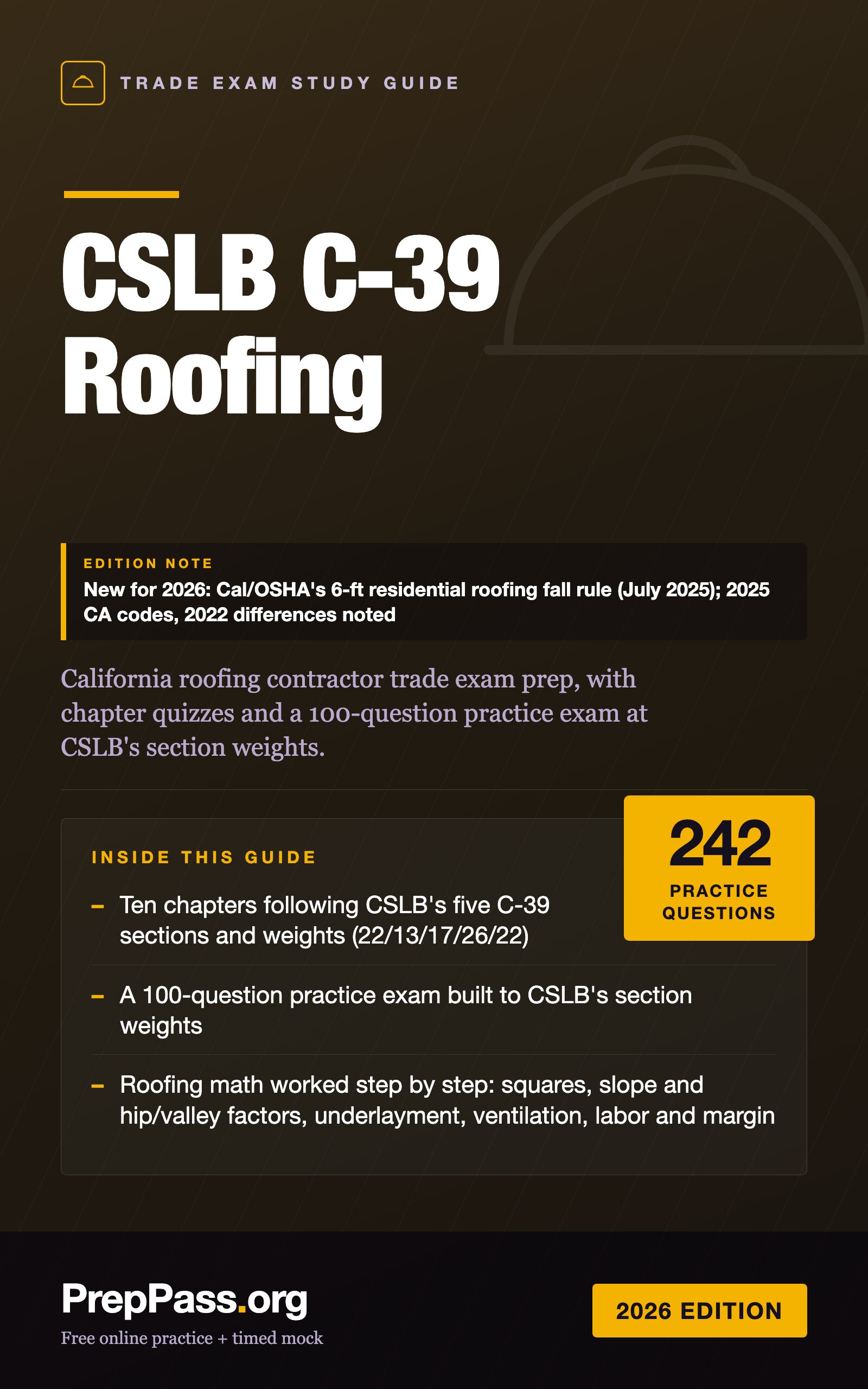
CSLB C-39 Roofing · 2026 版
CSLB C-39 Roofing Trade Exam Study Guide (2026)
版本说明New for 2026: Cal/OSHA's 6-ft residential roofing fall rule (July 2025); 2025 CA codes, 2022 differences noted
California roofing contractor trade exam prep, with chapter quizzes and a 100-question practice exam at CSLB's section weights.
- 242 道原创CSLB 屋面技术科目练习题,每题附解析,合成一本 PDF + EPUB 永久保存
PDF + EPUB · 英文 · 226 页 · $24.99 一次买断
本书为英文版,下载的 PDF 与 EPUB 均为英文。
付款后立即下载 —— 无需注册账号,无订阅。
14 天退款保证:任何原因不满意?购买后 14 天内发邮件至 support@preppass.org 即可全额退款。 退款政策
不止考一门?有套装价
- CSLB Law & Business — Complete Study Guide (2026)$24.99
- CSLB C-39 Roofing Trade Exam Study Guide (2026)$24.99
- CSLB Law & Business — Cram Sheet (2026)$9.99
3 件一起买:$30.99 —— 比分开买省 $28.98
分开买 $59.97 · 立减 48% · 一次结账,共 3 件。
已经买过《CSLB Law & Business》了?那就别买套装——套装里含这本,你会重复付费。单独购买《CSLB C-39 Roofing》只要 $24.99。 CSLB C-39 Roofing · 套装内容 →
先做 10 题,看看讲解 —— 免费
先答完这 10 题,交卷后每题都有解析 —— 还会指出本指南里讲这一点的那一节。约 5 分钟,无需注册。
开始 10 道免费题翻开这本书看看
三页真实内页,直接从你将下载的 PDF 渲染而来 —— 依次是一页速查、一页讲解、一道带解析的例题。没有任何一页是为了好看而重画的。
- 速查页Chapter 3; Section 3 (Low-Slope Roof Projects) is Chapters 4 and 5; Section 4 · PDF 第 6 页
一页可以随时翻回来的内容:把数字、期限或术语集中在一处。
- 怎么讲Chapter 4 — Low-Slope Roofs: Flashing, Ventilation, Underlayment and Drainage · PDF 第 70 页
讲解页:用文字把知识讲清楚,顺序与考试考查的顺序一致。
- 一道题的完整解析Part 6, the Energy Code, sets cool-roof and insulation requirements · PDF 第 19 页
一道练习题,连同答案和背后的推理 —— 不只是一个答案键。
关于这场考试本身
| 主管机构 | Contractors State License Board (CSLB), California Department of Consumer Affairs —— 考试由 PSI Services LLC 承办 |
|---|---|
| 题目数量 | CSLB 未公布 我们查阅但未找到该数据的来源: CSLB — Step 7: Studying for the Examination |
| 考试时限 | 210 分钟 |
| 及格标准 | CSLB 未公布 我们查阅但未找到该数据的来源: CSLB — Step 7: Studying for the Examination |
| 费用 |
|
| 考试语言 | 英语 · 西班牙语 |
包含什么,不包含什么
包含
- Ten chapters following CSLB's five C-39 sections and weights (22/13/17/26/22)
- A 100-question practice exam built to CSLB's section weights
- Roofing math worked step by step: squares, slope and hip/valley factors, underlayment, ventilation, labor and margin
- Cal/OSHA fall protection as amended July 1, 2025, beside the commercial roofing rules
- Key-numbers appendix, math reference, glossary and a table of the pairs the exam confuses
- 242 original questions, each with a worked explanation citing its source
- PDF + EPUB you keep
不包含
- 不寄送纸质书 —— 这是一份你下载后可自行打印的文件
- 购书不含视频课程、讲师或一对一辅导 —— 站上的免费视频是另一回事
- 不含考试报名费与考点费用,这些仍需向官方机构缴纳
目录
查看 22 个部分及各部分起始页
- Chapter 3; Section 3 (Low-Slope Roof Projects) is Chapters 4 and 5; Section 4第 5 页
- Chapter 1 — Planning Roof Projects第 10 页
- Part 6, the Energy Code, sets cool-roof and insulation requirements第 12 页
- Chapter 2 — Estimating Roof Projects第 30 页
- Chapter 3 — Job Site Preparation for Roof Projects第 47 页
- Chapter 4 — Low-Slope Roofs: Flashing, Ventilation, Underlayment and Drainage第 67 页
- Chapter 5 — Low-Slope Roof Systems and Repairs第 82 页
- Chapter 6 — Steep-Slope Roofs: Flashing, Ventilation and Underlayment第 99 页
- Chapter 7 — Steep-Slope Systems I: Asphalt Shingles, Metal and Roll Roofing第 114 页
- Chapter 8 — Steep-Slope Systems II: Tile, Slate and Wood; Steep-Slope Repairs第 128 页
- Chapter 9 — Safety I: Personnel and Job Site Safety第 143 页
- Chapter 10 — Safety II: Fall Protection第 158 页
- Practice Exam — 100 Questions第 177 页
- Section 1 — Planning and Estimating (22 questions)第 177 页
- Section 2 — Job Site Preparation for Roof Projects (13 questions)第 184 页
- Section 3 — Low-Slope Roof Projects (17 questions)第 188 页
- Section 4 — Steep-Slope Roof Projects (26 questions)第 194 页
- Section 5 — Safety (22 questions)第 202 页
- Appendix A — Key Numbers第 209 页
- Appendix B — Roofing Math Quick Reference Area and squares第 213 页
- Appendix C — Glossary第 215 页
- Appendix D — Pairs the Examination Likes to Confuse第 219 页
取自你将下载的那份 PDF,并标明各章起始页 —— 不是在此手工录入的。
免费读完整一章
完整的一章,与电子书正文一字不差。直接在此窗口滚动阅读;无需下载,无需邮箱。
在本页直接阅读第 10 章
我们没有拿轻松的绪论充数 —— 免费章节直接翻到书里最见功力的部分,让你在考试真正难的地方检验这本书讲得好不好。
Falls are the defining hazard of the roofing trade, and California's fall protection rules for roofing are more detailed — and changed more recently — than any other part of this examination. The first question in every fall-protection problem is which rule applies: residential-type roofing (Section 1731) or other roofing (Section 1730). The second is the slope, and the third is the height. Get those three right and the answer follows.
10.1 Which rule applies
Section 1731 — residential-type roofing activities. Roofing work under 1731 "consists of roofing and re-roofing work, including roof removal performed on single-family homes, townhouses, duplexes and other structures covered by Section 1716.2"[1]. It also includes loading and installing roofing materials, related insulation, sheet metal integral to the roofing system and vapor barrier work — but not construction of the roof deck[1].
Section 1730 — roof hazards (other roofing). Section 1730 governs roofing operations generally and says expressly: "This section does not apply to residential-type roofing activities as defined in Section 1731."[2]
Both sit on top of the general program rules: roofing employers comply with the IIPP section and train employees per Section 1510[2].
10.2 Residential-type roofing (Section 1731) — the 2025 rule
Section 1731 was amended effective July 1, 2025[1, 3]. Its current text:
- Roof slopes 0:12 up to and including 7:12: employees must be protected from falling "when on a roof surface where the employee fall distance is 6 feet or more above the grade or level below"[1].
- Roof slopes greater than 7:12: employees must be protected "regardless of height"[1].
Methods (for both slope ranges): personal fall protection systems, scaffolding, safety nets or guardrails — or, only if the employer demonstrates that conventional methods are infeasible, a fall protection plan with safety monitors and controlled access zones under Sections 1671.1 and 1671.2[1].
Measuring height: the fall height is "the vertical distance from the employee's walking/working surface to the ground or level below," and "the height of parapets shall not be included"[1].
Training: in addition to the IIPP, each affected employee is trained in the specific fall hazards of roofing work, including work on or near gable ends, slipping hazards, roof holes and openings, skylights, ladders and scaffolds, roof access, placement of materials, impalement hazards, and the care and use of fall protection systems[1], with training documented per Section 3203[1].
What changed
The Standards Board's rulemaking notice describes the old rule: protection keyed to work at elevations above 15 feet[4], with an express exclusion for "custom-built homes, re-roofing operations, roofing replacements or additions on existing dwelling units"[4]. The amendment reduced the trigger to a fall distance of six feet or more[4] and brought re-roofing inside the rule.
Trap: using "15 feet" for residential roofing. That was the old rule. Since July 1, 2025, it is 6 feet for slopes through 7:12, and any height above 7:12.
Worked example — Residential decisions
| Situation | Rule | Protection required? |
|---|---|---|
| Reroof, single-story house, 5:12, fall distance 10 ft | 1731(c)(1) | Yes — 6 ft or more |
| Tear-off, townhouse, 3:12, fall distance 5 ft | 1731(c)(1) | Not by the 6-ft trigger |
| New roof, duplex, 8:12, fall distance 7 ft | 1731(c)(2) | Yes — regardless of height |
| House, 10:12 dormer roof, fall distance 4 ft | 1731(c)(2) | Yes — regardless of height |
| Parapet 30 in high, flat residential roof, fall distance 12 ft to ground | 1731(c)(1); parapet not counted in height | Yes |
10.3 Other roofing (Section 1730)
Section 1730 is organised by roof covering type and slope. "Single-unit (monolithic)" coverings are membranes such as built-up and single-ply; "multiple-unit" coverings are shingles, tile and the like.
Low-slope monolithic roofs, 0:12 to 4:12
Employees must be protected from falls from roofs more than 20 feet high by one or a combination of the section's methods[2] — and where felt-laying machines or other equipment pulled by an operator walking backwards are in use, regardless of height[2].
The section's default method is the warning line system:
- Rope, wire or similar lines flagged with highly visible material at about 6-foot intervals, 34 to 45 inches above the roof[2], with a minimum tensile strength of 500 pounds[2].
- Headers — sheets of roofing laid parallel to the edge — also, unless conditions prohibit[2].
- Warning lines and headers no closer than 5 feet from the roof edge[2].
- Where backwards-pulled equipment or ride-on equipment is used, headers no closer than 10 feet and warning lines no closer than 5 feet from edges perpendicular to the direction of travel[2].
- Access points, material handling areas and storage areas connected to the work area by a clear path formed by two warning lines[2].
- Employees instructed to stay inside the warning lines except for edge work[2]; application outside the lines closely supervised by a qualified person[2].
- A backwards-walking operator stays no closer than 3 feet to edges parallel to the direction of travel, and ride-on equipment is never used or stored between the warning line and the edge[2].
The warning-line rules do not apply when employees are protected instead by personal fall protection, catch platforms, scaffold platforms, eave barriers, standard railings and toeboards, or parapets at least 24 inches high (36 inches at edges facing moving equipment)[2].
Steep monolithic roofs, greater than 4:12
Roofs more than 20 feet high need parapets of 24 inches or more, personal fall protection, catch platforms, scaffold platforms, eave barriers, or standard railings and toeboards[2]. And equipment pulled by an operator walking backwards may not be used on roofs steeper than 4:12[2].
Multiple-unit coverings (shingles, tile)
- 0:12 through 5:12, more than 20 feet high: a roof jack system per Section 1724(a), a parapet at least 24 inches high, or equivalent protection[2].
- Greater than 5:12, more than 20 feet high: a 24-inch parapet, personal fall protection, catch platforms or scaffold platforms[2].
Trap: applying Section 1730's 20-foot trigger to a house. Section 1730 does not apply to residential-type roofing. On a single-family reroof, the 1731 rules (6 feet, or any height above 7:12) govern.
10.4 The roofing protection systems (Section 1724)
Section 1724 specifies the equipment that Sections 1730 and 1731 refer to:
- Roof jacks: spans between jacks not over 10 feet[5]; planks of at least 2 × 6 selected lumber[5]; rope supports of at least ¾-inch first-grade Manila[5].
- Crawling boards: at least 10 inches wide and 1 inch thick, with 1 × 1½-inch cleats spaced not more than 24 inches[5]; running ridge to eave where the building permits[5]; with a ¾-inch Manila handhold line beside each board[5]; secured by ridge hooks or other effective means[5].
- Catch platforms: close below the eaves, extending at least 2 feet horizontally beyond the eave projection, with standard railings and toeboards[5], fully planked[5].
- Eave barriers: anchored at eave level or tied back to substantial anchorages on the roof[5].
- Personal fall protection: installed per Article 24, with safety lines attached "in a secure manner to substantial anchorages on the roof"[5].
10.5 Personal fall arrest, restraint and positioning (Section 1670)
When personal fall protection is worn generally
Outside the roofing-specific sections, Section 1670 requires approved personal fall arrest, restraint or positioning systems for employees exposed to falling more than 7½ feet from the perimeter of a structure and from sloped roof surfaces steeper than 7:12 not otherwise protected[6].
Personal fall arrest system (PFAS) rules
- No body belts as part of a personal fall arrest system[6]; the harness attachment point is in the center of the back near shoulder level or above the head[6].
- Lanyards and vertical lifelines: minimum breaking strength 5,000 pounds[6]; one employee per vertical lifeline[6].
- Self-retracting lifelines that limit free fall to 2 feet or less: at least 3,000 pounds tensile[6].
- Horizontal lifelines: designed, installed and used under a qualified person, with a safety factor of at least two[6].
- Anchorages: capable of supporting 5,000 pounds per employee attached, or designed by a qualified person with a safety factor of two[6].
- Performance when a fall is arrested: maximum arresting force 1,800 pounds with a harness[6]; free fall not more than 6 feet, with no contact with a lower level[6]; deceleration distance not more than 3.5 feet[6].
- Rescue: the employer provides for prompt rescue, or ensures employees can rescue themselves[6].
- Inspection: before each use[6], and at least twice a year by a competent person, documented[6].
- Not to guardrails or hoists[6]; harnesses and lanyards are never used to hoist materials[6].
- After a fall: any component subjected to in-service loading is removed from service permanently[6].
Restraint and positioning
- Fall restraint keeps the worker from reaching the edge: rigged so the employee can move only as far as the sides of the working area[6], on anchorages capable of 4 times the intended load[6].
- Positioning devices limit free fall to 2 feet[6].
Worked example — Clearance under a lanyard
A roofer ties off with a 6-foot shock-absorbing lanyard to an anchor at foot level. Why is that a problem?
The rule is a free fall of not more than 6 feet with no contact with any lower level[6], and "where practicable, the anchor end of the lanyard shall be secured at a level not lower than the employee's waist"[6]. An anchor at foot level adds the distance from the harness D-ring down to the anchor to the free fall, pushing it past 6 feet, and then the deceleration distance (up to 3.5 feet) and the worker's own height are added below that. On a one-story roof, the worker can hit the ground before the system stops the fall. Use a higher anchor, a shorter lanyard, a self-retracting lifeline or fall restraint.
10.6 Nets, fall protection plans and controlled access zones
Safety nets
Where the elevation is 25 feet or more and personal fall arrest and more conventional protection are clearly impractical, safety nets are required at the perimeter[7].
Fall protection plan (Section 1671.1)
A fall protection plan is the last resort, not a choice:
- "There is a presumption that conventional fall protection is feasible and will not create a greater hazard."[8]
- The plan is prepared by a qualified person, specific to the site, and kept up to date[8]; a copy is kept at the job site[8]; implementation is supervised by a competent person[8].
- It documents why conventional systems — guardrails, personal fall arrest or safety nets — are infeasible or more hazardous[8].
- After a fall or a near miss, the employer investigates and changes the plan as needed[8].
Controlled access zones and safety monitors (Section 1671.2)
- Control lines are erected 6 to 25 feet from the unprotected edge[9], flagged at not more than 6-foot intervals[9], rigged so the lowest point is at least 39 inches and the highest not more than 45 inches above the working surface[9], with a minimum breaking strength of 200 pounds[9].
- The safety monitor is a competent person, within visual sighting distance of and in communication with the employees monitored[9], with no other responsibilities that could distract from monitoring[9].
Trap: the working foreman as safety monitor. A monitor who is also running the crew or laying shingles has other responsibilities; the rule forbids it.
Trap: warning lines versus control lines. Section 1730 warning lines: 34–45 inches high, 500-pound strength, at least 5 feet from the edge. Section 1671.2 control lines: 39–45 inches, 200-pound strength, 6 to 25 feet from the edge. The examination tests whether you keep them apart.
Sources cited in this excerpt
- Cal. Code Regs., tit. 8, sec. 1731: Residential-type Roofing Activities. California Department of Industrial Relations (Cal/OSHA), accessed 2026-09-24. https://www.dir.ca.gov/title8/1731.html
- Cal. Code Regs., tit. 8, sec. 1730: Roof Hazards. California Department of Industrial Relations (Cal/OSHA), accessed 2026-09-24. https://www.dir.ca.gov/title8/1730.html
- Fall Protection in Residential Construction — rulemaking status (Sections 1671.1, 1716.2, 1730 and 1731). Occupational Safety and Health Standards Board (DIR), accessed 2026-09-24. https://www.dir.ca.gov/OSHSB/Fall-Protection-in-Residential-Construction.html
- Notice of Proposed Rulemaking and Informative Digest: Fall Protection in Residential Construction. Occupational Safety and Health Standards Board (DIR), 2024-01-18 hearing. https://www.dir.ca.gov/oshsb/documents/noticeJan2024-Fall-Protection-in-Residential-Construction.pdf
- Cal. Code Regs., tit. 8, sec. 1724: Roofing--General. California Department of Industrial Relations (Cal/OSHA), accessed 2026-09-24. https://www.dir.ca.gov/title8/1724.html
- Cal. Code Regs., tit. 8, sec. 1670: Personal Fall Arrest Systems, Personal Fall Restraint Systems and Positioning Devices. California Department of Industrial Relations (Cal/OSHA), accessed 2026-09-24. https://www.dir.ca.gov/title8/1670.html
- Cal. Code Regs., tit. 8, sec. 1671: Safety Nets. California Department of Industrial Relations (Cal/OSHA), accessed 2026-09-24. https://www.dir.ca.gov/title8/1671.html
- Cal. Code Regs., tit. 8, sec. 1671.1: Fall Protection Plan. California Department of Industrial Relations (Cal/OSHA), accessed 2026-09-24. https://www.dir.ca.gov/title8/1671_1.html
- Cal. Code Regs., tit. 8, sec. 1671.2: Controlled Access Zones and Safety Monitoring Systems. California Department of Industrial Relations (Cal/OSHA), accessed 2026-09-24. https://www.dir.ca.gov/title8/1671_2.html
购买前
- 怎么拿到?
- 付款后下载入口立即出现在本页,链接同时发到你的邮箱。无需注册账号。
- 不合适怎么办?
- 14 天内发邮件即可全额退款,无需理由。
- 免费练习会取消吗?
- 不会。站上的每一道练习题、计时模考和免费章节都继续免费。这本书是「学」的那一半,不是把免费部分围起来的门。
- 能在手机上看吗?
- 可以 —— EPUB 适合手机和电子书阅读器,PDF 适合打印和贴标签,两种都给你。
详细信息
California roofing contractor trade exam prep, with chapter quizzes and a 100-question practice exam at CSLB's section weights.
- Format: PDF + EPUB download · 226 pages
- 242 practice questions in the book, with a full answer key
- 100 free practice questions for this exam on PrepPass, included at no cost
- $24.99 one-time — no subscription
- 14-day money-back guarantee · refund policy
- Cross-referenced against: CSLB Roofing (C-39) study guide 13E-39 (03-2026), the 2025 California Residential and Building Codes and Cal. Code Regs. tit. 8, read September 2026
- 官方来源核验(CSLB Roofing (C-39) study guide 13E-39 (03-2026), the 2025 California Residential and Building Codes and Cal. Code Regs. tit. 8, read September 2026)
- 100 道免费练习题
- 即时下载,永久拥有
CSLB exam prep course 要 $200–$800。这本书讲的是同一门考试 —— 同样的规则、核对到最新标准 —— 只需一次性 $24.99,永久归你。
练习免费,为什么还要买书?
我们的练习题和计时模考一直免费 —— 网站上的东西不会因为这本书而收起来。这本 $24.99 的书是「学」的那一半:知识本身,按顺序讲清楚,存成一份属于你的文件。
- 系统讲解 —— 每个考试部分按章节从头讲到尾,不只是题目
- 可打印可贴标签 —— 一份适合打印的 PDF,能划重点、做批注、带到书桌前
- 随处离线学 —— EPUB 放手机或电子书阅读器;不用 wifi,不用一堆浏览器标签
- 全在一处 —— 章节和练习题都在同一份文件里
- 永久归你 —— 一次 $24.99,即时下载,无订阅
而且零风险:14 天退款保证 —— 不满意?发邮件即可全额退款,无需理由。 详见退款政策。
14 天退款保证 · 全额退款,无需理由。
一次购买,永久下载访问。此电子书是完整的 CSLB C-39 Roofing 学习指南,含 PDF 与 EPUB。仅为教育性摘要,非专业或法律意见 —— 请始终以官方来源核实当前规定。