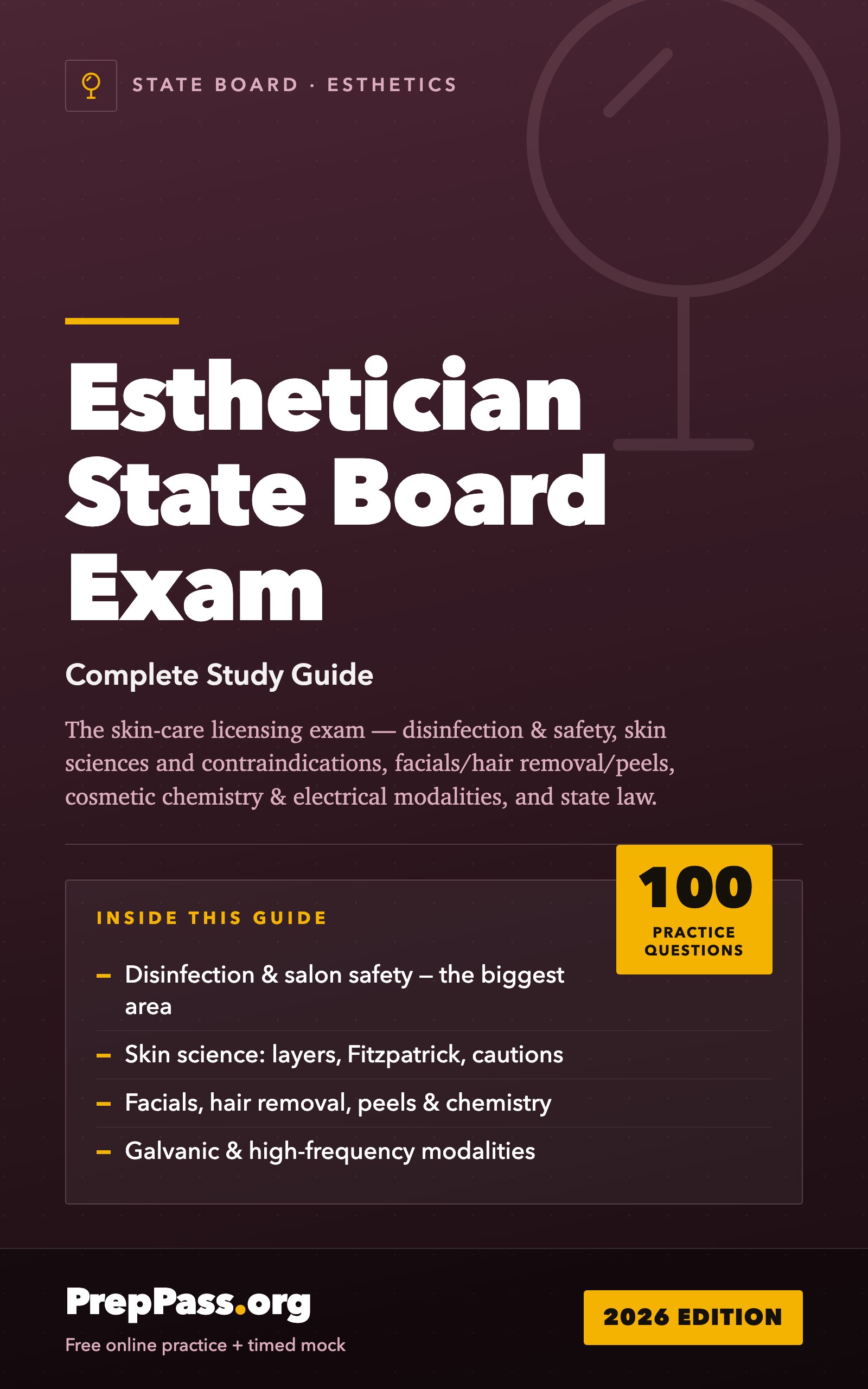
Esthetician (State Board) · 2026 版
Esthetician State Board Exam — Complete Study Guide (2026)
The skin-care licensing exam — disinfection & safety, skin sciences and contraindications, facials/hair removal/peels, cosmetic chemistry & electrical modalities, and state law.
- 书内 55 道练习题,配完整答案解析
- 47 页逐章讲解 —— 不是一堆题目的堆砌
- 已与standard esthetics/skin-science references / EPA disinfection / OSHA BBP & HazCom / NIC & state esthetics board outlines逐条核对
翻开这本书看看
三页真实内页,直接从你将下载的 PDF 渲染而来 —— 一页讲解、一道带解析的例题、一页速查。没有任何一页是为了好看而重画的。
- 一道题的完整解析Practice Exam (55 Questions) · PDF 第 26 页
一道练习题,连同答案和背后的推理 —— 不只是一个答案键。
- 速查页Practice Exam (55 Questions) · PDF 第 38 页
一页可以随时翻回来的内容:把数字、期限或术语集中在一处。
- 怎么讲Practice Exam (55 Questions) · PDF 第 39 页
讲解页:用文字把知识讲清楚,顺序与考试考查的顺序一致。
包含什么,不包含什么
包含
- Disinfection, infection control & salon safety (the biggest exam area)
- Skin sciences: layers, conditions, Fitzpatrick, and key contraindications
- Facials, hair removal, chemical peels, and cosmetic chemistry
- Electrical modalities (galvanic, high-frequency) and their contraindications
- 55 original practice questions with answer explanations
- PDF (print & tab it) + EPUB (phone / e-reader)
不包含
- 不寄送纸质书 —— 这是一份你下载后可自行打印的文件
- 购书不含视频课程、讲师或一对一辅导 —— 站上的免费视频是另一回事
- 不含考试报名费与考点费用,这些仍需向官方机构缴纳
目录
查看 6 章及各章起始页
- Chapter 1 — Disinfection, Infection Control & Safety第 5 页
- Chapter 2 — Skin Sciences: Structure, Conditions & Contraindications第 10 页
- Chapter 3 — Facial Treatments, Hair Removal & Client Services第 15 页
- Chapter 4 — Cosmetic Chemistry & Electrical Modalities第 19 页
- Chapter 5 — Law, Scope of Practice & Establishment Rules第 22 页
- Practice Exam (55 Questions)第 26 页
取自你将下载的那份 PDF,并标明各章起始页 —— 不是在此手工录入的。
免费读完整一章
完整的一章,与电子书正文一字不差。直接在此窗口滚动阅读;无需下载,无需邮箱。
在本页直接阅读第 2 章
我们没有拿轻松的绪论充数 —— 免费章节直接翻到书里最见功力的部分,让你在考试真正难的地方检验这本书讲得好不好。
About a quarter of the exam tests whether you understand the skin you are working on — how it is built, what it does, how it ages, how hair grows, and, above all, when a condition belongs to a physician rather than to you. Many of these questions describe skin and ask whether you treat, modify, or refer. Learning the anatomy and the lesion vocabulary is what lets you describe skin accurately without ever crossing into diagnosis.
The Layers of the Skin
Skin has three main layers.
The epidermis is the outermost layer and is where every esthetic service takes place. From deepest to most superficial, its layers are the stratum basale, spinosum, granulosum, lucidum, and corneum. An easy anchor: the basale sits against the dermis (it builds), and the corneum faces the world (it sheds). Cell division and melanin production happen in the stratum basale; the stratum corneum is dead, keratinized tissue that you cleanse and exfoliate; the stratum lucidum is a clear layer found only on the palms and soles. [verify — the lucidum is classically described as present only in thick, glabrous skin.]
The dermis lies below and is divided into the papillary and reticular layers. It holds collagen and elastin, blood vessels, nerve endings, sebaceous and sudoriferous glands, and hair follicles. This is where skin's structure and firmness live.
The subcutaneous (subcutis) layer beneath the dermis is adipose tissue that insulates, cushions, and gives the face its contour; its loss with age drives hollowing and sagging.
Because superficial services affect only the epidermis, they improve texture and tone but cannot rebuild dermal structure — which is precisely why a deep wrinkle is not something a superficial peel can "remove," and why over-promising that result is both a marketing problem and a scope problem.
What the Skin Does, and How It Renews
The skin protects, provides sensation, regulates temperature through blood flow and perspiration, excretes waste through sweat, secretes sebum, and absorbs a limited amount of what is applied to it. Sebum and perspiration form the acid mantle, a thin film with a pH around 4.5–5.5 that discourages microbial growth and slows water loss. Highly alkaline (high-pH) cleansers strip that mantle and leave skin tight and reactive, which is why choosing a cleanser near the skin's own pH matters.
Epidermal cells are produced in the basal layer and take roughly a month in a young adult to migrate to the surface and shed — a cycle that slows with age. That slowdown is the main reason mature skin looks duller: dead cells linger and light no longer reflects evenly, which is also why appropriate exfoliation helps mature skin and why over-exfoliation backfires.
Keep two ideas separate: skin type reflects genetically determined oil production, while a skin condition such as dehydration (a lack of water), sensitivity, or congestion can occur in any type and changes over time. Oily and dehydrated skin is common and normal.
Fitzpatrick Types, Pigmentation, and Photodamage
The Fitzpatrick scale classifies skin by its response to ultraviolet light, from Type I (always burns, never tans) to Type VI (deeply pigmented, rarely burns). It predicts more than sunburn: higher Fitzpatrick types have melanocytes that respond vigorously to inflammation, so aggressive exfoliation, heat, or trauma can trigger post-inflammatory hyperpigmentation (PIH) that is worse than the original concern. Protocols for higher types start conservatively, progress slowly, and always pair with daily broad-spectrum sun protection.
Melasma is a hormonally influenced hyperpigmentation appearing as symmetrical patches on the cheeks, forehead, and upper lip; it is aggravated by both UV and heat, so sun protection is the foundation of any protocol and steam and hot towels are limited. UVA (longer wavelength) reaches the dermis and drives aging and pigment change; UVB (shorter) primarily causes burning; both raise skin-cancer risk, which is what "broad spectrum" on a label means. Intrinsic aging is genetically programmed; extrinsic aging comes from sun, smoking, and pollution — and it is the part a client can actually control.
Lesions, Disorders, and Knowing When to Refer
Primary lesions are present when a condition first appears — macules, papules, pustules, vesicles, wheals, tubercles. Secondary lesions develop as it progresses or heals — crusts, scales, fissures, excoriations, ulcers, scars. You describe these; you never diagnose them.
Common findings within scope: open comedones (blackheads) are follicular contents oxidized dark by air; closed comedones (whiteheads) are trapped below the surface; milia are keratin-filled cysts with no follicular opening; telangiectasia are dilated capillaries seen as red lines; sebaceous hyperplasia is enlarged sebaceous glands.
The referral line is critical for the exam. Mild acne is within scope, but deep painful nodules and cysts (grade IV) must never be extracted — they are medical. Rosacea, eczema with broken or weeping skin, active herpes simplex, and anything crusted, spreading, or suspiciously changing all call for referral. A mole showing asymmetry, irregular borders, color variation, larger diameter, or recent change is avoided entirely; you encourage the client to see a physician without naming a diagnosis. And you obtain physician clearance for high-risk histories: uncontrolled diabetes, recent facial surgery or procedures, active cancer treatment, and photosensitizing medications.
Hair Growth and Its Cycle
Hair grows from a follicle nourished by the dermal papilla and cycles through three phases: anagen (active growth, hair fully attached), catagen (short transition, follicle shrinks), and telogen (resting, then shedding). Waxing gives its longest-lasting result during anagen, because the hair is removed with the fullest structure attached. Because follicles cycle independently, regrowth is staggered — clients see stubble sooner than expected and benefit from a regular rebooking schedule.
Two commonly confused terms: hirsutism is excessive terminal hair in a male pattern on a woman (often hormonal); hypertrichosis is excessive growth in areas not normally hair-bearing. All esthetic hair removal (waxing, tweezing, threading) is temporary; permanent removal by electrolysis or laser falls under different licensing.
### Key Facts — Chapter 2 - Three layers: epidermis (services happen here), dermis (collagen/elastin, glands, vessels), subcutis (fat/contour). - Epidermis deep→surface: basale, spinosum, granulosum, lucidum, corneum. Basale builds, corneum sheds; lucidum only on palms/soles. [verify] - Superficial services reach only the epidermis — they cannot rebuild the dermis. - Acid mantle pH ≈ 4.5–5.5; cell turnover ≈ one month in youth and slows with age. - Type = oil (genetic); condition = e.g., dehydration (water), can occur in any type. - Fitzpatrick I→VI; higher types → higher PIH risk → start gentle + daily SPF. Melasma = symmetrical, worsened by UV and heat. - UVA ages (deep), UVB burns (surface); "broad spectrum" covers both. - Primary vs. secondary lesions; never extract cysts/nodules; refer rosacea, eczema flares, herpes, changing moles. - Hair cycle anagen (best for waxing) / catagen / telogen; esthetic removal is temporary.
Worked scenario. A Fitzpatrick V client wants "the strongest possible peel" to erase acne marks fast. The instinct to go strong is exactly backward: her melanocytes react to inflammation, so an aggressive treatment risks darkening the very marks she wants gone. The professional answer is to start conservatively, progress gradually, and anchor the plan to daily broad-spectrum SPF, while setting the expectation that safe fading takes a series, not one session. You do not refuse her outright (darker skin can absolutely be treated) — you treat it correctly for her type.
Named exam traps.
- Reversed layer order. The basale is deep (builds); the corneum is on top (sheds). If a sequence starts with "corneum" going down, it's the wrong direction unless it explicitly says superficial-to-deep.
- "Type vs. condition." Oily skin can also be dehydrated. Skin type doesn't flip day to day; conditions do.
- "UVB is the deep, aging ray." No — UVA is deep/aging; UVB burns the surface.
- "Higher Fitzpatrick tolerates any strength." The opposite — higher types need more caution.
- Extracting a cyst / nodule or abrading a changing mole — both are referral situations, never a service.
购买前
- 怎么拿到?
- 付款后下载入口立即出现在本页,链接同时发到你的邮箱。无需注册账号。
- 不合适怎么办?
- 14 天内发邮件即可全额退款,无需理由。
- 免费练习会取消吗?
- 不会。站上的每一道练习题、计时模考和免费章节都继续免费。这本书是「学」的那一半,不是把免费部分围起来的门。
- 能在手机上看吗?
- 可以 —— EPUB 适合手机和电子书阅读器,PDF 适合打印和贴标签,两种都给你。
详细信息
The skin-care licensing exam — disinfection & safety, skin sciences and contraindications, facials/hair removal/peels, cosmetic chemistry & electrical modalities, and state law.
- Format: PDF + EPUB download · 47 pages
- 55 practice questions in the book, with a full answer key
- 100 free practice questions for this exam on PrepPass, included at no cost
- $14.99 one-time — no subscription
- 14-day money-back guarantee · refund policy
- Cross-referenced against: standard esthetics/skin-science references / EPA disinfection / OSHA BBP & HazCom / NIC & state esthetics board outlines
- Last updated: August 2026
- 官方来源核验(standard esthetics/skin-science references / EPA disinfection / OSHA BBP & HazCom / NIC & state esthetics board outlines)
- 即时下载,永久拥有
练习免费,为什么还要买书?
我们的练习题和计时模考一直免费 —— 网站上的东西不会因为这本书而收起来。这本 $14.99 的书是「学」的那一半:知识本身,按顺序讲清楚,存成一份属于你的文件。
- 系统讲解 —— 每个考试部分按章节从头讲到尾,不只是题目
- 可打印可贴标签 —— 一份适合打印的 PDF,能划重点、做批注、带到书桌前
- 随处离线学 —— EPUB 放手机或电子书阅读器;不用 wifi,不用一堆浏览器标签
- 全在一处 —— 章节、每章速记卡、练习题都在同一份文件里
- 永久归你 —— 一次 $14.99,即时下载,无订阅
而且零风险:14 天退款保证 —— 不满意?发邮件即可全额退款,无需理由。 详见退款政策。
14 天退款保证 · 全额退款,无需理由。
一次购买,永久下载访问。此电子书是完整的 Esthetician (State Board) 学习指南,含 PDF 与 EPUB。仅为教育性摘要,非专业或法律意见 —— 请始终以官方来源核实当前规定。最后更新:August 2026。