学习指南 · 2026 版
GED Study Guide 2026 — All Four Subjects, with 4 Full-Length Practice Tests
Math, Reasoning Through Language Arts, Science and Social Studies.
- 篇幅
- 304 页
- 书内练习题
- 278
- PrepPass 在线计时模考
- 100 题 · 120 分钟
- 考试事实核对于
- 2026年9月
- 文件最后更新
- 2026年10月
- 交付
- PDF + EPUB · 英文 · 即时下载
购买前请阅读: Independent study aid, not affiliated with or endorsed by GED Testing Service or ACE.
阅读本声明的其余部分
Practice-test scores are not converted to the 100–200 scale; use GED Ready to judge readiness.
关于本书
Math, Reasoning Through Language Arts, Science and Social Studies — taught separately at the official weights, with one full-length practice test per subject timed to GED Testing Service's published testing times.
考试事实、适合谁与变化
关于这场考试本身
| 主管机构 | GED Testing Service LLC |
|---|---|
| 题目数量 | GED Testing Service 未公布 我们查阅但未找到该数据的来源: GED Testing Service — Test Subjects |
| 考试时限 | 没有统一时限 —— GED 由四门独立考试组成,各自计时:社会研究 70 分钟、科学 90 分钟、数学推理 115 分钟(含两部分之间 3 分钟休息)、语言艺术推理 150 分钟(含第 2 与第 3 部分之间 10 分钟休息及 45 分钟写作)。每科时间均含 2 或 3 分钟的说明与最后检查。GEDTS 未公布合计总时长,各科可在不同日期参加。 我们查阅但未找到该数据的来源: GED Testing Service — Test Subjects |
| 及格标准 | 标准分 145(量表范围 100–200) 来源: GED Testing Service — GED® test score scale history (fifth test series, 2014–present) |
| 费用 | GED Testing Service 未公布 我们查阅但未找到该数据的来源: GED Testing Service — Test Subjects |
| 考试语言 | 英语 · 西班牙语 来源: GED Testing Service — How to take the GED® in Spanish (GED.com blog, March 18, 2026) |
翻开这本书看看
三页真实内页,直接从你将下载的 PDF 渲染而来 —— 依次是一页速查、一页讲解、一道带解析的例题。没有任何一页是为了好看而重画的。
- 速查页Part 4 — Social Studies What this test asks of you · PDF 第 205 页
一页可以随时翻回来的内容:把数字、期限或术语集中在一处。
- 怎么讲Part 3 — Science What this test asks of you · PDF 第 159 页
讲解页:用文字把知识讲清楚,顺序与考试考查的顺序一致。
- 一道题的完整解析Part 1 — Reasoning Through Language Arts What this test asks of you · PDF 第 62 页
一道练习题,连同答案和背后的推理 —— 不只是一个答案键。
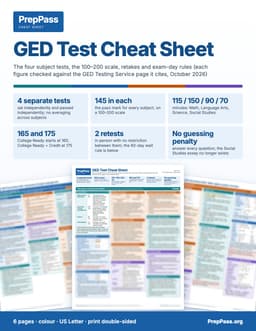
两周内就要考试?
这本指南是系统讲解,要花几周读。如果两周内就考,可打印的彩色速查表是另一款产品:考试涉及的关键数字,按章节排好。
6 页 · US Letter · 可打印 PDF · 永久保存
How this book compares
GED Testing Service offers free test previews and sells GED Ready, its official practice test. This book teaches all four subjects with full-length practice tests; Mometrix sells a GED study guide with practice tests and videos.
| Resource | Price | What you get | Choose it if |
|---|---|---|---|
| This bookGED Study Guide 2026 — All Four Subjects, with 4 Full-Length Practice TestsPrepPass | $14.99 | Independent downloadable study guide for all four subjects
| Choose this book if you want the four subjects taught separately, each with full-length practice tests timed like the real ones. |
| From the exam bodyGED Ready — the official GED practice test (opens the publisher's page in a new tab)GED Testing Service | $7.99 per subject; $25.99 for all subjects | The official practice test, one per subject
| Choose GED Ready if you want the official measure of whether you are ready to book a subject. |
| AlternativeGED Secrets (opens the publisher's page in a new tab)Mometrix Test Preparation | $19.99 ebook; $24.99 printed book | Study guide with practice tests and videos
| Choose Mometrix if you want video tutorials or a printed copy. |
This book
GED Study Guide 2026 — All Four Subjects, with 4 Full-Length Practice Tests
PrepPass
- Price
- $14.99
- What you get
Independent downloadable study guide for all four subjects
- 278 practice questions with explanations
- 304 pages, PDF + EPUB
- Choose it if
- Choose this book if you want the four subjects taught separately, each with full-length practice tests timed like the real ones.
From the exam body
GED Ready — the official GED practice test (opens the publisher's page in a new tab)
GED Testing Service
- Price
- $7.99 per subject; $25.99 for all subjects
- What you get
The official practice test, one per subject
- Free GED test previews are also available on GED.com
- Choose it if
- Choose GED Ready if you want the official measure of whether you are ready to book a subject.
Alternative
GED Secrets (opens the publisher's page in a new tab)
Mometrix Test Preparation
- Price
- $19.99 ebook; $24.99 printed book
- What you get
Study guide with practice tests and videos
- Three full-length practice tests and 300+ online video tutorials (per the product title)
- Choose it if
- Choose Mometrix if you want video tutorials or a printed copy.
Other resources' prices and contents are as listed on each publisher's or seller's own page, checked September 24, 2026. Prices change; confirm on the linked page before you buy. This book's price and contents come from our own catalog.
Sources (3)
- https://www.ged.com/study/ged-ready.html — read September 24, 2026
- https://www.ged.com/study/free-online-ged-test.html — read September 24, 2026
- https://www.mometrix.com/studyguides/ged/ — read September 24, 2026
包含什么,不包含什么
包含
- Four subjects taught separately, because you sit and pass them separately
- Weights taken from the official Assessment Guides — including the Social Studies erratum most material still repeats wrong
不包含
- 不寄送纸质书 —— 这是一份你下载后可自行打印的文件
- 购书不含视频课程、讲师或一对一辅导 —— 站上的免费视频是另一回事
完整的包含项与不包含项
包含
- What the guides say is no longer tested, so you do not prepare an essay that was eliminated
- 4 full-length practice tests — 46 math, 46 RLA + an Extended Response, 36 science, 30 social studies — timed to the published testing times, with score grids by reporting category
- 120 warm-up questions, the same items as the free bank, printed beside the chapters they test
- Worked examples throughout, with every calculation checked
- PDF (print & tab it) + EPUB (phone / e-reader)
不包含
- 不含考试报名费与考点费用,这些仍需向官方机构缴纳
目录
查看 17 个部分及各部分起始页
- Part 1 — Reasoning Through Language Arts What this test asks of you第 13 页
- Part 2 — Mathematical Reasoning What this test asks of you第 72 页
- Part 3 — Science What this test asks of you第 121 页
- Part 4 — Social Studies What this test asks of you第 163 页
- Part 5 — Four Full-Length Practice Tests第 208 页
- Practice Test 1 — Mathematical Reasoning第 210 页
- Part 1 — no calculator (questions 1–5)第 210 页
- Part 2 — calculator allowed (questions 6–46)第 211 页
- Practice Test 2 — Reasoning Through Language Arts第 221 页
- Section 1 (questions 1–25)第 221 页
- Section 2 — Extended Response (45 minutes)第 231 页
- Section 3 (questions 26–46)第 232 页
- Practice Test 3 — Science第 241 页
- Practice Test 4 — Social Studies第 253 页
- Part 5 — Answer Keys and Explanations第 263 页
- Appendix B — Glossary第 299 页
- Appendix C — Exam-day strategy Before the day第 302 页
取自你将下载的那份 PDF,并标明各章起始页 —— 不是在此手工录入的。
免费读完整一章
完整的一章,与电子书正文一字不差。直接在此窗口滚动阅读;无需下载,无需邮箱。
在本页直接阅读第 2.4 章
我们没有拿轻松的绪论充数 —— 免费章节直接翻到书里最见功力的部分,让你在考试真正难的地方检验这本书讲得好不好。
Introduction
This is the largest single category on the test, about 30% of it, and for many adult candidates the least familiar. If school algebra ended for you around "solve for x" and never explained what x was doing there, slow down here.
Start with what algebra is for. Arithmetic answers a question about particular numbers: this many hours at this rate. Algebra answers a question about a relationship holding for any numbers: what happens to the total when the hours change, or what the hours must be to reach a target. A variable is a placeholder for a quantity that varies, and an equation is a claim that two expressions have the same value.
The skill the test rewards is translation: turn a paragraph about a rental agreement into symbols, operate on them, and translate the result back into a sentence about the rental agreement. The middle step can be learned mechanically; the two ends are where the thinking is, and where DOK level 2 items live.
Expressions: building them and simplifying them
An expression combines numbers, variables and operations with no equals sign: 3x + 7, 2(l + w). An equation sets two expressions equal. The distinction is not pedantic: you evaluate an expression and you solve an equation, and a question asking you to "write an expression for the total cost" is not asking you to solve anything.
Translating English into symbols
Most of the work is a small vocabulary, and the entries worth care are the ones people reverse.
| English | Symbols |
|---|---|
| the sum of x and 7; 7 more than x | x + 7 |
| 7 less than x | x − 7 |
| x less than 7 | 7 − x |
| the product of 5 and x | 5x |
| the quotient of x and 5 | x/5 |
| twice a number, increased by 9 | 2x + 9 |
| twice the sum of a number and 9 | 2(x + 9) |
"Seven less than x" reverses the order you read it in, and the last two rows differ only in where the parentheses sit — which changes the answer for every value of x. Name the quantity with its units — "let h = hours worked in week one" — so you do not solve for a number and then wonder what it counts.
Combining like terms and distributing
Like terms have the same variable to the same power. 4x and 7x combine to 11x; 4x and 4x² do not, and neither do 4x and 4y — four boxes plus seven crates is just four boxes and seven crates.
The distributive property says a(b + c) = ab + ac — the multiplier reaches every term inside. Two failures are common and both are expensive: distributing to only the first term, so that 3(2x − 5) becomes 6x − 5, and mishandling a negative multiplier, since −2(x − 4) is −2x + 8, not −2x − 8. Subtracting a parenthesized expression is distribution by −1, so (5x + 3) − (2x − 7) is 3x + 10. Every sign inside flips.
Exponent rules
Four rules cover this level, and each is just counting factors: xᵃ · xᵇ = xᵃ⁺ᵇ; xᵃ / xᵇ = xᵃ⁻ᵇ, because factors cancel in pairs; (xᵃ)ᵇ = xᵃᵇ; and x⁰ = 1 for nonzero x. A negative exponent means a reciprocal: x⁻² = 1/x². It does not mean a negative number, and that misreading is a standard distractor.
Solving linear equations
An equation is a balance: whatever you do to one side you must do to the other. Solving means peeling operations off the variable in reverse order of operations — undo addition and subtraction first, then multiplication and division, like unwrapping a parcel.
The procedure, in order: clear parentheses by distributing; clear fractions by multiplying every term on both sides by the common denominator; combine like terms on each side; move variable terms to one side and constants to the other; divide by the coefficient; and substitute your answer back into the original equation.
That last step is why algebra is safer than arithmetic — your answer is checkable, exactly. On a multiple-choice item you can also work backward, substituting each choice until one balances; on a fill-in-the-blank item you must solve forward and then check. When variables appear on both sides, move them to whichever side keeps the coefficient positive, which eliminates a class of sign errors for free.
Sometimes the variables cancel entirely. A true statement left over, like 7 = 7, means every number is a solution — the two sides were the same expression in disguise. A false one, like 7 = 3, means no number works. Neither means you made a mistake, and items are written to see whether you know that.
Rearranging formulas: the skill the formula sheet demands
Here the sheet stops helping. It gives you A = ½h(b₁ + b₂); suppose you have the area, the height and one base and need the other base. Nobody hands you a rearranged version.
Rearranging uses the same moves as solving — the other letters just come along for the ride. Treat the letter you want as "the variable" and every other letter as "a number whose value you happen not to know." If the target is multiplied by something, divide both sides by it: I = Prt solved for r is r = I/(Pt). If the target is added to something, subtract it: y = mx + b solved for b is b = y − mx.
There is a second route, easier for many candidates: substitute the numbers first, then solve the resulting simple equation. Use the general rearrangement when the item asks for a formula, and substitute-then-solve when it asks for a number.
Inequalities
An inequality says one side is larger, or at least as large, rather than equal. They are the language of constraints — budgets, capacities, weight limits — which is why they appear in workforce contexts constantly. "At most" and "no more than" are ≤; "at least" and "no less than" are ≥; "more than" and "exceeds" are strict >.
You solve one exactly like an equation, with one rule that has no equivalent in equation solving: multiplying or dividing both sides by a negative reverses the direction of the sign. The reason is visible on a number line — 3 is less than 5, but −3 is greater than −5. Note the precise condition: the flip comes from multiplying or dividing by a negative, not from a negative merely appearing. Solving x + 7 < 2 gives x < −5 with no flip.
The answer is a range, and in context it usually needs one more translation. If a mileage constraint solves to m ≤ 428.7, the practical answer is 428. Read the context to decide whether the boundary itself is allowed and whether fractional values make sense.
Quadratics
A quadratic equation has a squared variable and no higher power: y = ax² + bx + c in standard form. Squared relationships describe real things — areas, projectile heights, some revenue models. Before anything else, get the equation into the form ax² + bx + c = 0. Every method assumes it, and the most common error is applying a method to an equation that still has terms on both sides.
Factoring works when the numbers are friendly. For a leading coefficient of 1, find two numbers that multiply to c and add to b, then use the fact that makes factoring worth anything: if a product is zero, one of the factors must be zero.
The quadratic formula works always, and it is on your sheet: x = (−b ± √(b² − 4ac))/(2a). Identify a, b and c with their signs and compute the part under the root first. Errors cluster around signs: b² is positive even when b is negative, −4ac becomes a plus when a and c have opposite signs, and −b becomes positive when b is negative — in 2x² − 7x + 3 = 0, b is −7, so −b is +7.
Applied quadratics almost always produce two solutions of which only one makes sense. A width of −8 feet is arithmetically valid and physically meaningless — discard it explicitly and say why, since that discarding is part of what a reasoning-focused item is grading.
Worked examples
Example 1 — variables on both sides. Solve 3(2x − 5) + 4 = 5x + 1.
- Distribute:
6x − 15 + 4 = 5x + 1. - Combine on the left:
6x − 11 = 5x + 1. - Subtract
5x:x − 11 = 1, sox = 12.
Check: Substitute into the original. Left: 3(24 − 5) + 4 = 61. Right: 5(12) + 1 = 61. Balanced.
Example 2 — rearranging a formula from the sheet. A trapezoidal bed has area 162 sq ft, height 9 ft, and one parallel side of 22 ft. Find the other parallel side.
- Setup:
A = ½h(b₁ + b₂)with A = 162, h = 9, b₂ = 22. - Rearrange: multiply by 2 →
2A = h(b₁ + b₂); divide by h →2A/h = b₁ + b₂; subtract b₂ →b₁ = 2A/h − b₂. - Substitute:
b₁ = 324/9 − 22 = 36 − 22 =14 ft.
Check: Run the formula forward with b₁ = 14: ½ × 9 × (14 + 22) = 162. The substitute-first route lands in the same place: 162 = 4.5(b₁ + 22) → 36 = b₁ + 22 → b₁ = 14.
Example 3 — an inequality with a negative coefficient. Solve 5 − 3x ≥ 17.
- Subtract 5:
−3x ≥ 12. - Divide by −3 and reverse the sign:
x ≤ −4.
Check: Test three values. At x = −4: 5 + 12 = 17, and 17 ≥ 17 is true, so the boundary belongs. At x = −5: 20 ≥ 17, inside. At x = −3: 14 is not ≥ 17, outside. The direction is right.
Example 4 — a budget constraint. A van rents for $49.95 per day plus $0.35 per mile. With $200 for a one-day rental, what is the greatest whole number of miles?
- Setup: let m = miles.
49.95 + 0.35m ≤ 200. - Subtract 49.95:
0.35m ≤ 150.05, som ≤ 428.71…and the answer is 428 miles.
Check: Price both ends. At 428 miles: 149.80 + 49.95 = $199.75, within budget. At 429: 150.15 + 49.95 = $200.10, over. Rounding 428.71 up is the trap — the round-up rule from chapter 2.3 is for things you must buy enough of, not for a ceiling you must stay under.
Example 5 — factoring. Solve x² + 3x − 40 = 0.
- Already in standard form, so find two numbers multiplying to −40 and adding to +3.
- The factor pairs of 40 are 1 and 40, 2 and 20, 4 and 10, 5 and 8. The pair 5 and 8 differs by 3, so take +8 and −5.
(x + 8)(x − 5) = 0, sox = −8orx = 5.
Check: For x = 5: 25 + 15 − 40 = 0. For x = −8: 64 − 24 − 40 = 0. Both satisfy it.
Example 6 — a quadratic in context. A rectangular garden is 3 feet longer than twice its width and has an area of 65 square feet. Find its dimensions.
- Setup: let w = width. Length =
2w + 3, sow(2w + 3) = 65. - Set to zero:
2w² + 3w − 65 = 0. - Formula with a = 2, b = 3, c = −65: discriminant 9 + 520 = 529, and √529 = 23.
w = (−3 ± 23)/4, givingw = 5orw = −6.5. A width cannot be negative, so width 5 ft, length 13 ft.
Check: 5 × 13 = 65 square feet, and 13 is 3 more than twice 5. Both conditions hold.
购买者常问的问题
怎么拿到?
付款后下载入口立即出现在本页,链接同时发到你的邮箱。无需注册账号。
不合适怎么办?
14 天内发邮件即可全额退款,无需理由。
免费练习会取消吗?
不会。站上的每一道练习题、计时模考和免费章节都继续免费。这本书是「学」的那一半,不是把免费部分围起来的门。
更多问题 (1)
能在手机上看吗?
可以 —— EPUB 适合手机和电子书阅读器,PDF 适合打印和贴标签,两种都给你。
练习免费,为什么还要买书?
我们的练习题和计时模考一直免费 —— 网站上的东西不会因为这本书而收起来。这本 $14.99 的书是「学」的那一半:知识本身,按顺序讲清楚,存成一份属于你的文件。
- 系统讲解 —— 每个考试部分按章节从头讲到尾,不只是题目
- 可打印可贴标签 —— 一份适合打印的 PDF,能划重点、做批注、带到书桌前
- 随处离线学 —— EPUB 放手机或电子书阅读器;不用 wifi,不用一堆浏览器标签
- 全在一处 —— 章节和练习题都在同一份文件里
- 永久归你 —— 一次 $14.99,即时下载,无订阅
详细信息
- 官方来源核验(GED Testing Service Assessment Guides for Educators (Math, RLA, Science, Social Studies) · ged.com state policy pages · Independent study aid — not affiliated with, endorsed by or approved by GED Testing Service or ACE)
- 401 道免费练习题
一次购买,永久下载访问。此电子书是完整的 GED 学习指南,含 PDF 与 EPUB。仅为教育性摘要,非专业或法律意见 —— 请始终以官方来源核实当前规定。最后更新:October 2026。