学习指南 · 2026 版
NHA CPT Phlebotomy Study Guide — 2026 Edition
Written to NHA's current CPT test plan, with a full-length 120-item practice exam at the real exam's length
版本: Rewritten Sept 2026 for NHA's new CPT exam (Jan 7, 2026): Special Collections now 12 of 100 scored items.
- 篇幅
- 222 页
- 书内练习题
- 236
- PrepPass 在线计时模考
- 100 题 · 130 分钟
- 考试事实核对于
- 2026年9月
- 文件最后更新
- 2026年10月
- 交付
- PDF + EPUB · 英文 · 即时下载
关于本书
考试申请费:每次 $134,缴给 National Healthcareer Association。补考要再交一次。本指南:$14.99,一次买断。
考试事实、适合谁与变化
关于这场考试本身
| 主管机构 | National Healthcareer Association (NHA) —— 考试由 a PSI testing center, a live remote proctoring provider, or the candidate's own school or employer 承办 |
|---|---|
| 题目数量 | 120 道题 (100 道计分,20 道不计分预试题) 来源: NHA — Test Plan for the Certified Phlebotomy Technician (CPT) Exam (2024 job analysis, PDF) |
| 考试时限 | 120 分钟 来源: NHA — Test Plan for the Certified Phlebotomy Technician (CPT) Exam (2024 job analysis, PDF) |
| 及格标准 | 标准分 390(量表范围 200–500) |
| 费用 |
来源: NHA store — Certified Phlebotomy Technician (CPT) Exam Application |
| 考试语言 | 英语 |
翻开这本书看看
三页真实内页,直接从你将下载的 PDF 渲染而来 —— 依次是一页速查、一页讲解、一道带解析的例题。没有任何一页是为了好看而重画的。
- 速查页Section 1 (items 1–31) → Chapters 2 and 3. Section 2 (items 32–55) → · PDF 第 194 页
一页可以随时翻回来的内容:把数字、期限或术语集中在一处。
- 怎么讲Chapter 5. Routine Blood Collections I: Equipment, Tubes and the Order of Draw · PDF 第 102 页
讲解页:用文字把知识讲清楚,顺序与考试考查的顺序一致。
- 一道题的完整解析Chapter 8. Processing · PDF 第 22 页
一道练习题,连同答案和背后的推理 —— 不只是一个答案键。
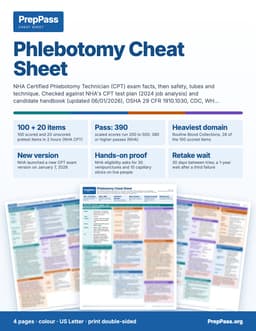
两周内就要考试?
这本指南是系统讲解,要花几周读。如果两周内就考,可打印的彩色速查表是另一款产品:考试涉及的关键数字,按章节排好。
4 页 · US Letter · 可打印 PDF · 永久保存
How this book compares
NHA publishes the CPT test plan for free and sells its own online study guide and practice tests, and states that buying its preparation materials is not required to sit the exam. This book is an independent written review with a practice exam.
| Resource | Price | What you get | Choose it if |
|---|---|---|---|
| This bookNHA CPT Phlebotomy Study Guide — 2026 EditionPrepPass | $14.99 | Downloadable review for phlebotomy technician certification exams
| Choose this book if you want the order of draw, tube additives, specimen handling and safety rules taught in writing, alongside your training and the free practice questions. |
| From the exam bodyCPT test plan (opens the publisher's page in a new tab)National Healthcareer Association (NHA) | Free (PDF) | The official list of what the CPT exam covers | Read it in any case to check every topic the exam covers. |
| From the exam bodyCPT Online Study Guide and Practice Tests (opens the publisher's page in a new tab)National Healthcareer Association (NHA) | Price not listed on the page we checked | The exam body's own interactive study materials
| Choose NHA's materials if you want practice tests from the organization that writes the CPT exam. |
| AlternativeNHA Phlebotomy Study Guide 2026-2027 (opens the publisher's page in a new tab)Mometrix Test Preparation | $23.99 ebook; $28.99 printed book | Study guide with practice questions | Choose Mometrix if you want a printed copy. |
This book
NHA CPT Phlebotomy Study Guide — 2026 Edition
PrepPass
- Price
- $14.99
- What you get
Downloadable review for phlebotomy technician certification exams
- 236 practice questions with explanations
- 222 pages, PDF + EPUB
- Choose it if
- Choose this book if you want the order of draw, tube additives, specimen handling and safety rules taught in writing, alongside your training and the free practice questions.
From the exam body
CPT test plan (opens the publisher's page in a new tab)
National Healthcareer Association (NHA)
- Price
- Free (PDF)
- What you get
The official list of what the CPT exam covers
- Choose it if
- Read it in any case to check every topic the exam covers.
From the exam body
CPT Online Study Guide and Practice Tests (opens the publisher's page in a new tab)
National Healthcareer Association (NHA)
- Price
- Price not listed on the page we checked
- What you get
The exam body's own interactive study materials
- An online study guide with interactive games, quizzes and flashcards, and a phlebotomy practice test with up to six attempts
- Choose it if
- Choose NHA's materials if you want practice tests from the organization that writes the CPT exam.
Alternative
NHA Phlebotomy Study Guide 2026-2027 (opens the publisher's page in a new tab)
Mometrix Test Preparation
- Price
- $23.99 ebook; $28.99 printed book
- What you get
Study guide with practice questions
- Choose it if
- Choose Mometrix if you want a printed copy.
Other resources' prices and contents are as listed on each publisher's or seller's own page, checked September 24, 2026. Prices change; confirm on the linked page before you buy. This book's price and contents come from our own catalog.
Sources (2)
- https://www.nhanow.com/certification/nha-certifications/certified-phlebotomy-technician-(cpt) — read September 24, 2026
- https://www.mometrix.com/studyguides/phlebotomy/ — read September 24, 2026
包含什么,不包含什么
包含
- 236 original questions with explanations, including a 120-item practice exam built to NHA's domain weights
- The order of draw, additives and inversions from the tube manufacturer's own documents
不包含
- 不寄送纸质书 —— 这是一份你下载后可自行打印的文件
- 购书不含视频课程、讲师或一对一辅导 —— 站上的免费视频是另一回事
完整的包含项与不包含项
包含
- A full chapter on Special Collections — blood cultures, newborn screening, tolerance tests, blood alcohol and drug screens
- Processing: clotting times, centrifuge settings, ice/warm/light handling and Category B shipping
- Sixteen worked case studies and an item-by-item test plan crosswalk
- What changed in the 2026 exam and in CLSI's renumbered standards (PRE02, PRE04, PRE01)
不包含
- 不含考试报名费与考点费用,这些仍需向官方机构缴纳
目录
查看 17 个部分及各部分起始页
- Chapter 8. Processing第 9 页
- Chapter 1. Core Knowledge: The Phlebotomist, the Circulatory System and Blood第 11 页
- Chapter 2. Safety and Compliance I: Infection Control, Exposure and Emergencies第 28 页
- Chapter 3. Safety and Compliance II: Regulations, Privacy, Ethics and Quality Control第 46 页
- Chapter 4. Patient Preparation第 63 页
- Chapter 5. Routine Blood Collections I: Equipment, Tubes and the Order of Draw第 85 页
- Chapter 6. Routine Blood Collections II: Venipuncture, Capillary Collection and Complications第 104 页
- Chapter 7. Special Collections第 125 页
- Section 1. Safety and Compliance (31 items)第 164 页
- Section 2. Patient Preparation (24 items)第 170 页
- Section 3. Routine Blood Collections (34 items)第 176 页
- Section 4. Special Collections (14 items)第 182 页
- Section 5. Processing (17 items)第 185 页
- Section 1 (items 1–31) → Chapters 2 and 3. Section 2 (items 32–55) →第 189 页
- Appendix A. Test Plan Crosswalk第 207 页
- Appendix B. Terms to Use Precisely第 212 页
- Appendix C. Quick Reference第 214 页
取自你将下载的那份 PDF,并标明各章起始页 —— 不是在此手工录入的。
免费读完整一章
完整的一章,与电子书正文一字不差。直接在此窗口滚动阅读;无需下载,无需邮箱。
在本页直接阅读第 5 章
我们没有拿轻松的绪论充数 —— 免费章节直接翻到书里最见功力的部分,让你在考试真正难的地方检验这本书讲得好不好。
Test plan coverage: Domain 3, Routine Blood Collections — 28 of 100 scored items, the largest domain[1]. This chapter covers tasks 3A, 3B, 3D, 3J and 3N and knowledge k47, k54–k59 and k66: selecting and checking equipment, needles, evacuated tubes and their additives, the order of draw, fill levels and inversions. Chapter 6 covers the draw itself, capillary collection and complications.
A reminder from the edition notes at the front of this book: the order of draw below is the CLSI order as published in the dated, freely readable sources named here. CLSI's current venous standard is PRE02 (8th edition, February 13, 2025), which replaced GP41[2]. BD's own chart, dated June 2023, is headed "CLSI-recommended order of draw (GP41-A7)"[3]. Always follow your facility's order where it is written down; BD's chart itself says "Always follow your facility's protocol for order of draw."[3]
5.1 The three collection systems (task 3A; k54)
| System | Parts | When it is used |
|---|---|---|
| Evacuated tube system | double-ended needle, tube holder, vacuum tubes | Routine venipuncture; multiple tubes from one puncture |
| Winged (butterfly) set | short needle with plastic wings, flexible tubing, holder or syringe | Small, fragile or hand veins; children; older adults |
| Needle and syringe | hypodermic needle, syringe, then a transfer device into tubes | Very fragile veins where vacuum would collapse the vein |
WHO explains why closed systems are preferred: "Closed systems for blood sampling are preferable because they have proven to be safer than open systems."[4] Vacuum tube systems reduce "the risk of direct exposure to blood and has made it easier to take multiple samples from a single venepuncture"[4]. In the evacuated system the tube "is under vacuum. Once the needle is in the vein, the tube is pressed on to the needle and the blood is drawn automatically into the sample tube by vacuum until the required amount is collected"[4].
Do not push the tube on early. WHO: "Do not push the laboratory tube onto the needle inside the barrel until the needle is in the blood vessel, or the vacuum will be lost."[4]
Syringe transfers. When a syringe is used, fill tubes with a transfer device, not by pushing a needle through the stopper by hand. WHO warns not to "press the syringe plunger because additional pressure increases the risk of haemolysis"[4], and a hospital procedure says to transfer "as soon as possible using a Blood Transfer Device, as a delay could cause improper coagulation"[5].
5.2 Needles: gauge, length and safety features (k55, k56, k66)
Gauge runs backward. The larger the gauge number, the smaller the needle's bore. A 21-gauge needle is larger than a 23-gauge.
WHO's Table 3.1 gives recommended gauges by use[4]:
| Gauge | Use in WHO's table |
|---|---|
| 16–18 | Blood donation |
| 21 (1–1.5 inch) | Adults |
| 22 (1 inch) | Adults; children, older adults and small veins |
| 23 | Adults; winged set for children, older adults, small veins and neonates |
Why not smaller? WHO lists "use of a needle of too small a gauge (23 or under), or too large a gauge for the vessel" among causes of hemolysis[4]. "If the needle is too large for the vein for which it is intended, it will tear the vein and cause bleeding (haematoma); if the needle is too small, it will damage the blood cells during sampling"[4].
Choosing the device (k55). The test plan lists the factors: "current health status, stated history, vein size, requisition requirements"[1]. WHO: "Choose the gauge of hypodermic needle that fits comfortably into the most prominent vein with little discomfort"[4].
Safety features (k66). Needles must have engineered sharps-injury protection where available — OSHA defines these as devices "with a built-in safety feature or mechanism that effectively reduces the risk of an exposure incident"[6]. They come as hinged shields, sliding sheaths and retractable needles. WHO notes that some systems have "a mechanism that can be activated once the needle has been used; the mechanism retracts the used needle into the barrel and snaps it shut"[4]. Activate the feature immediately as the needle leaves the skin (Chapter 6).
5.3 Checking equipment before you use it (task 3B; k58)
Task 3B is to "Verify quality of equipment (e.g., sterility, expiration date, and manufacturer's defects)"[1]; k58 adds "inspection of needles, check for cracks in tubes, and check expiration dates"[1]. BD's package insert gives the manufacturer's rules:
- "Do not use tubes after their expiration date. Tubes expire on the last day of the month and year indicated."[7] An expired tube may have lost vacuum or have a degraded additive.
- "Do not use tubes or needles if foreign matter is present."[7]
- "Do not use needle if label has been torn before venipuncture."[7] The paper seal shows the needle is still sterile.
- "Tube interiors are sterile."[7]
- Cracked or chipped tubes can break in the centrifuge and release "sample, droplets, and an aerosol into the centrifuge bowl"[7].
Also tap tubes gently before use: BD instructs collectors to "Gently tap tubes containing additives to dislodge any material that may be adhering to the stopper"[7].
5.4 Tubes and additives (k57; k47)
The stopper color tells you the additive. Colors are standardized by the manufacturer, not by law, so always read the label as well. The table combines BD's tube guide and WHO's order-of-draw table.
| Stopper | Additive | What it does | Specimen | Typical use |
|---|---|---|---|---|
| Yellow (SPS) or blood culture bottles | Sodium polyanethol sulfonate (SPS) / broth | Preserves microorganisms | Whole blood | "SPS for blood culture specimen collections in microbiology"[8] |
| Light blue | Buffered sodium citrate, 0.109 M (3.2%) in plastic[8] | "Forms calcium salts to remove calcium"[4] | Plasma | "For coagulation determinations"[8] |
| Red | None (glass) or clot activator (plastic)[8] | Blood clots | Serum | Chemistry, serology |
| Gold / red-gray (SST) | Clot activator and gel[8] | Gel forms a barrier between serum and cells | Serum | "For serum determinations in chemistry"[8] |
| Orange (RST) | Thrombin-based clot activator | Fast clotting — "Blood clotting time: 5 minutes"[8] | Serum | STAT chemistry |
| Green | Sodium or lithium heparin | "Inactivates thrombin and thromboplastin"[4] | Plasma | "For plasma determinations in chemistry"[8] |
| Light green (PST) | Lithium heparin and gel[8] | Anticoagulates; gel separates plasma | Plasma | Chemistry |
| Lavender | K2EDTA or K3EDTA[8] | Removes calcium | Whole blood | "for whole blood hematology determinations"[8] |
| Pink | K2EDTA | Removes calcium | Whole blood | Blood bank; crossmatch label "required by the AABB"[8] |
| Gray | Potassium oxalate/sodium fluoride[8] | "Sodium fluoride is the antiglycolytic agent"[8] | Plasma | "For glucose determinations"[8] |
| Royal blue | Clot activator or K2EDTA; low trace elements[8] | Stopper formulated for "low levels of trace elements" | Serum or whole blood | "For trace-element, toxicology, and nutritional-chemistry determinations"[8] |
| Tan | K2EDTA | Certified low lead | Whole blood | "For lead determinations"[8] |
| Yellow (ACD) | Acid citrate dextrose | Preserves cells | Whole blood | "ACD for use in blood bank studies, HLA phenotyping, and DNA and paternity testing"[8] |
| White (PPT) | K2EDTA and gel | Separates plasma | Plasma | "molecular diagnostic test methods"[8] |
Three additive facts that turn into exam questions
- Lithium heparin and lithium levels. BD: "Do not use BD Vacutainer® Tubes containing lithium heparin for lithium measurement."[7] WHO's table says "For lithium level use sodium heparin"[4].
- Why EDTA wrecks a potassium or calcium result. K2EDTA and K3EDTA are potassium salts of EDTA, and EDTA works by removing calcium[4]. Carry a little of it into a chemistry tube and the potassium reads falsely high while the calcium reads falsely low. That is the main reason EDTA comes near the end of the order of draw.
- Fluoride stops glycolysis. Red cells keep consuming glucose in the tube; sodium fluoride, "the antiglycolytic agent"[8], stops them, and WHO notes it "preserves glucose up to five days"[4].
Matching the test to the tube (k47)
The test plan's example for k47 is "blue stopper for coagulation"[1]. Exam items usually give a test and ask for the tube, or give a tube and ask what it cannot be used for. Work from the department the test belongs to:
| Department or test type | Tube | What the sources say |
|---|---|---|
| Coagulation (PT/INR, PTT) | Light blue citrate | "For coagulation determinations"[8]; full draw required[4] |
| Routine chemistry (metabolic panels, lipids, liver tests) | Gold SST, red, or light green PST | SST "For serum determinations in chemistry"[8]; PST for "plasma determinations in chemistry"[8] |
| STAT chemistry | Orange RST | "For stat serum determinations in chemistry"[8] |
| Serology and immunology | Red or gold | WHO lists "immunology and serology" among clot-tube uses[4] |
| Hematology (CBC, hemoglobin, hematocrit) | Lavender EDTA | "For whole blood hematology determinations"[8]; WHO: "Haematology"[4] |
| Blood bank (type and crossmatch) | Pink EDTA (or lavender per facility) | Crossmatch label "required by the AABB"[8]; K2EDTA "may be used for routine immunohematology testing"[8] |
| Glucose, lactate (per lab) | Gray fluoride/oxalate | "For glucose determinations"[8] |
| Lithium level | Not lithium heparin | [7] |
| Ammonia | Heparin per WHO's table ("for ammonia level use either" heparin salt) or EDTA per some reference labs | [4] |
| Lead | Tan K2EDTA | "For lead determinations"[8] |
| Trace elements, toxicology | Royal blue | [8] |
| HLA typing, paternity, DNA | Yellow ACD | WHO: "HLA tissue typing ... paternity testing ... DNA studies"[4] |
| Molecular (PCR) | White PPT | [8] |
| Blood cultures | Culture bottles or yellow SPS | [8] |
Your laboratory's test directory has the final word: the same test can be validated on different tubes in different laboratories — ammonia is the classic example, drawn on heparin in some laboratories and EDTA in others[4, 9].
5.5 The order of draw (task 3J; k59)
Why it exists
WHO: "Draw blood collection tubes in the correct order, to avoid cross-contamination of additives between tubes."[4] The additive on the outside of the needle that punctures one stopper can be carried into the next tube.
The order
The CLSI order, as BD's 2023 chart and the CLSI 7th-edition summary give it[3, 10]:
- Blood cultures — blood culture bottles or the yellow SPS tube (sterile specimens first)
- Sodium citrate — light blue (coagulation)
- Serum tubes — red, gold/SST, orange/RST (with or without clot activator or gel)
- Heparin — green or light green (with or without gel)
- EDTA — lavender, pink, white (with or without gel)
- Sodium fluoride/potassium oxalate — gray (glucose)
A university hospital procedure gives the same six and adds the yellow ACD tube after gray[5]. BD's package insert states the principle in four groups: "1. Tubes for sterile samples. 2. Tubes for coagulation studies (e.g., citrate). 3. BD SST™ and Serum Tubes. 4. Tubes with other additives (e.g., heparin, EDTA, fluoride)."[7]
One way to remember it: say what each tube is for, in order — germs, clotting, serum, then the three anticoagulant families (heparin, EDTA, fluoride). If a mnemonic helps you, make one from the stopper colors; the order is what matters.
Rules that go with the order
- Same order for every method. "The order of draw is the same whether the specimens are collected by evacuated tube method or by syringe and is also the same for plastic or glass tubes."[10]
- What may come before the light-blue tube. "Only blood cultures, glass non additive tubes or plastic tubes without clot activator may be collected before the coagulation tube (light blue)."[10]
- The discard tube with a winged set. "When a winged blood collection set is used for venipuncture and a citrate tube is the first tube needed, a discard tube must first be collected. The discard tube is used to remove air from the tubing of the collection set, to ensure the proper volume of blood is drawn into the tube." It "should be a nonadditive or coagulation tube."[3] It "does not need to be filled completely"[7]. BD warns that its plastic serum tubes contain clot activator and "are not to be used as discard tubes before drawing citrate tubes"[7].
- Coagulation tube alone with a straight needle. WHO: "If a routine coagulation assay is the only test ordered, then a single light blue top tube may be drawn."[4]
- Blood cultures with a winged set. "When a winged blood collection set is used, the aerobic blood culture bottle is filled first, followed by the anaerobic bottle."[3]
- Trace elements. "Syringes must not be used for trace element collections that include testing for cobalt and chromium because the plunger tip contributes such elements to the specimen."[10]
- Capillary collections use a different order (Chapter 6).
Sources cited in this excerpt
- NHA Certified Phlebotomy Technician (CPT) Test Plan for the CPT Exam (based on a job analysis completed in 2024). National Healthcareer Association, 2024-06-24. https://info.nhanow.com/hubfs/Test%20Plans/nha-2025-cpt-test-plan.pdf
- CLSI PRE02, Collection of Diagnostic Venous Blood Specimens, 8th ed. (product page). Clinical and Laboratory Standards Institute, 2025-02-13. https://clsi.org/shop/standards/pre02/
- The BD Vacutainer Blood Collection System: Order of draw for multiple tube collections (BD-47766, June 2023), copy hosted by a hospital laboratory test directory. Becton, Dickinson and Company, 2023-06. https://www.testmenu.com/lifespan/TestDirectory/SiteFile?fileName=sidebar\BD+Blood+Collection+Tubes+Order+of+Draw++2025.pdf
- WHO guidelines on drawing blood: best practices in phlebotomy. World Health Organization, 2010. https://iris.who.int/server/api/core/bitstreams/10682984-b7a0-4e4b-bd32-0cbc7d22136b/content
- Routine Venipuncture Guidelines (UF Health Pathology Laboratories procedure). University of Florida Health Pathology Laboratories, 2019-10. https://pathlabs.ufl.edu/wordpress/files/2019/10/uf-health-pathology-laboratories-venipuncture-procedure.pdf
- 29 CFR 1910.1030, Bloodborne pathogens (eCFR, current). Office of the Federal Register / eCFR, 2026-09-24. https://www.ecfr.gov/current/title-29/subtitle-B/chapter-XVII/part-1910/subpart-Z/section-1910.1030
- Vacutainer Evacuated Blood Collection System For In Vitro Diagnostic Use (BD package insert, document VDP40436, valid from 12-Aug-2021), as posted by FDA. Becton, Dickinson and Company / U.S. Food and Drug Administration, 2021-08-12. https://www.fda.gov/media/151687/download
- BD Vacutainer Venous Blood Collection Tube Guide (VS5229-13, 07/10), copy hosted by a health-system laboratory. Becton, Dickinson and Company, 2010-07. https://www.chihealth.com/content/dam/chihealthcom/documents/services/laboratory/bd-tube-guide.pdf
- NH3V - Overview: Ammonia, Plasma (Mayo Clinic Laboratories test catalog). 2026-09-24. https://www.mayocliniclabs.com/test-catalog/overview/35130
- New CLSI Venipuncture Guidelines (ACAreer newsletter, vol. 22 issue 2), summarizing CLSI GP41 7th ed. American Certification Agency for Healthcare Professionals, 2017. https://acacert.com/files/newsletter/ACAreerSummer_Fall2017.pdf
购买者常问的问题
怎么拿到?
付款后下载入口立即出现在本页,链接同时发到你的邮箱。无需注册账号。
不合适怎么办?
14 天内发邮件即可全额退款,无需理由。
免费练习会取消吗?
不会。站上的每一道练习题、计时模考和免费章节都继续免费。这本书是「学」的那一半,不是把免费部分围起来的门。
更多问题 (1)
能在手机上看吗?
可以 —— EPUB 适合手机和电子书阅读器,PDF 适合打印和贴标签,两种都给你。
练习免费,为什么还要买书?
我们的练习题和计时模考一直免费 —— 网站上的东西不会因为这本书而收起来。这本 $14.99 的书是「学」的那一半:知识本身,按顺序讲清楚,存成一份属于你的文件。
- 系统讲解 —— 每个考试部分按章节从头讲到尾,不只是题目
- 可打印可贴标签 —— 一份适合打印的 PDF,能划重点、做批注、带到书桌前
- 随处离线学 —— EPUB 放手机或电子书阅读器;不用 wifi,不用一堆浏览器标签
- 全在一处 —— 章节和练习题都在同一份文件里
- 永久归你 —— 一次 $14.99,即时下载,无订阅
详细信息
- 官方来源核验(NHA CPT Test Plan (2024 job analysis) and NHA Candidate Handbook (updated 06/01/2026), read 2026-09-24)
- 300 道免费练习题
phlebotomy training program 要 $1,599–$2,295。这本书讲的是同一门考试 —— 同样的规则、核对到最新标准 —— 只需一次性 $14.99,永久归你。
一次购买,永久下载访问。此电子书是完整的 NHA Certified Phlebotomy Technician (CPT) 学习指南,含 PDF 与 EPUB。仅为教育性摘要,非专业或法律意见 —— 请始终以官方来源核实当前规定。最后更新:October 2026。