学习指南 · 2026 版
PTCB Pharmacy Technician (PTCE) — Complete Study Guide (2026)
Medications, Patient Safety, Order Entry, and Federal Requirements — with pharmacy-math worked examples and DEA/USP references.
版本: New for 2026: weighted to the PTCE Content Outline effective January 6, 2026.
- 篇幅
- 461 页
- 书内练习题
- 522
- PrepPass 在线计时模考
- 90 题 · 110 分钟
- 考试事实核对于
- 2026年9月
- 文件最后更新
- 2026年10月
- 交付
- PDF + EPUB · 英文 · 即时下载
关于本书
CPhT 申请及 PTCE 考试费:每次 $129,缴给 PTCB。补考要再交一次。本指南:$19.99,一次买断。
考试事实、适合谁与变化
关于这场考试本身
| 主管机构 | Pharmacy Technician Certification Board (PTCB) —— 考试由 Pearson VUE 承办 |
|---|---|
| 题目数量 | 90 道题 (80 道计分,10 道不计分预试题) |
| 考试时限 | 110 分钟 |
| 及格标准 | 标准分 1,400(量表范围 1,000–1,600) |
| 费用 |
|
| 考试语言 | PTCB 未公布 我们查阅但未找到该数据的来源: PTCB — Become a Certified Pharmacy Technician (CPhT) |
翻开这本书看看
三页真实内页,直接从你将下载的 PDF 渲染而来 —— 依次是一页速查、一页讲解、一道带解析的例题。没有任何一页是为了好看而重画的。
- 速查页Glossary · PDF 第 452 页
一页可以随时翻回来的内容:把数字、期限或术语集中在一处。
- 怎么讲Part III — Domain Practice Sets · PDF 第 358 页
讲解页:用文字把知识讲清楚,顺序与考试考查的顺序一致。
- 一道题的完整解析Part III — Domain Practice Sets · PDF 第 345 页
一道练习题,连同答案和背后的推理 —— 不只是一个答案键。
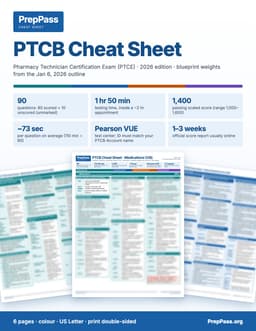
两周内就要考试?
这本指南是系统讲解,要花几周读。如果两周内就考,可打印的彩色速查表是另一款产品:考试涉及的关键数字,按章节排好。
6 页 · US Letter · 可打印 PDF · 永久保存
包含什么,不包含什么
包含
- All 4 knowledge domains, weighted like the outline effective January 2026 (Medications 35%, Federal Requirements 18.75%)
- Pharmacy math worked step by step (days supply, IV rate, alligation, ratio strength)
不包含
- 不寄送纸质书 —— 这是一份你下载后可自行打印的文件
- 购书不含视频课程、讲师或一对一辅导 —— 站上的免费视频是另一回事
完整的包含项与不包含项
包含
- DEA schedules, refill rules, and required forms (222/224/106/41)
- USP <795>/<797>/<800> storage, garbing, and compounding rules
- 522 original practice questions in all: three 90-question practice exams weighted to the outline plus domain practice sets, every answer explained
- Exam review, not an introduction: it assumes pharmacy training or work experience and basic arithmetic; it also summarises PTCB's eligibility, fee and retake rules
- PDF (print & tab it) + EPUB (phone / e-reader)
不包含
- 不含考试报名费与考点费用,这些仍需向官方机构缴纳
目录
查看 6 个部分及各部分起始页
- Part II — Full-Length Practice Exams第 222 页
- Practice Exam 1 — Answer Key and Explanations第 223 页
- Practice Exam 2 — Answer Key and Explanations第 262 页
- Practice Exam 3 — Answer Key and Explanations第 302 页
- Part III — Domain Practice Sets第 340 页
- Glossary第 452 页
取自你将下载的那份 PDF,并标明各章起始页 —— 不是在此手工录入的。
免费读完整一章
完整的一章,与电子书正文一字不差。直接在此窗口滚动阅读;无需下载,无需邮箱。
在本页直接阅读第 4 章
The free chapter is Chapter 4, Order Entry and Processing: the pharmacy math, worked step by step, and a fair sample of the book's pace. Chapter 1 (drug names and classes) is denser reference.
Introduction — the most improvable domain on the exam
This is the chapter where the arithmetic lives, and arithmetic is the one part of the PTCE you can reliably move from weak to strong in a fortnight. The reason is structural: the exam changes the numbers, not the methods. There are perhaps twenty genuinely different calculation skills in pharmacy practice. Once you can do each one without looking anything up, a new question is a new set of digits in a shape you already recognise.
Three rules before any of it.
Write the units down and carry them through. Most wrong answers in pharmacy maths are not arithmetic failures — they are unit failures. Milligrams got divided by millilitres and nobody noticed. If your units cancel to the unit the question asked for, you are probably right; if they do not, you are certainly wrong.
Convert before you calculate. Pounds to kilograms, teaspoonfuls to millilitres, grams to milligrams — do all of it first, in a separate line, before any division happens.
Sanity-check the size of the answer. A child's dose that came out larger than an adult's, an infusion that will finish in four minutes, a days supply of 900 — these are not close calls. Ask whether the number could be true before you write it down.
And one rule that is about safety rather than arithmetic: a calculation that produces a surprising number is escalated, not trusted. If you work a dose and it looks wrong, you do not adjust it to look right. You take it to the pharmacist.
4.1a Sig codes and prescription abbreviations
Reading a sig
A prescriber compresses directions into abbreviations, most of them from Latin. The technician's job is to expand them into plain patient language stating how much, by what route, how often, and for what, written at a reading level the patient can actually use.
| Category | Code | Meaning |
|---|---|---|
| Frequency | QD / q.d. | once daily — banned abbreviation, spell out "daily" |
BID | twice daily | |
TID | three times daily | |
QID | four times daily | |
QAM | every morning | |
QPM | every evening | |
QHS | at bedtime | |
q4h, q6h, q8h, q12h | every 4, 6, 8, 12 hours | |
QOD | every other day — banned, spell out | |
TIW | three times a week — banned, write "3 times weekly" | |
PRN | as needed | |
STAT | immediately | |
| Route | PO | by mouth |
SL | sublingual | |
PR | per rectum | |
IV / IM / SUBQ | intravenous / intramuscular / subcutaneous | |
OD / OS / OU | right eye / left eye / each eye — banned, spell out | |
AD / AS / AU | right ear / left ear / each ear — banned, spell out | |
NGT | nasogastric tube | |
| Quantity and form | tab / cap | tablet / capsule |
gtt | drop | |
tsp / tbsp | teaspoonful (5 mL) / tablespoonful (15 mL) | |
ss | one half | |
ut dict / UD | as directed | |
aa | of each | |
q.s. | a sufficient quantity | |
q.s. ad | add a sufficient quantity to make | |
| Timing and condition | AC | before meals |
PC | after meals | |
HS | at bedtime | |
NPO | nothing by mouth | |
disp | dispense | |
sig | write on the label |
Worked expansion
The sig i tab PO BID PRN pain, disp #20 expands to:
i tab— one tabletPO— by mouthBID— twice dailyPRN pain— as needed for paindisp #20— dispense 20 tablets
The patient label reads: "Take one tablet by mouth twice daily as needed for pain." Not "1 tab PO BID PRN," and not "take as directed" — the patient has to be able to follow it.
Roman numerals
Quantities and doses still appear in Roman numerals, and misreading one is a quantity error.
| Symbol | Value |
|---|---|
ss | ½ |
i / I | 1 |
v / V | 5 |
x / X | 10 |
l / L | 50 |
c / C | 100 |
d / D | 500 |
m / M | 1,000 |
The rule: a smaller numeral after a larger one is added; a smaller numeral before a larger one is subtracted. So XXX is 30, XL is 40, LX is 60, XC is 90, CX is 110, and iss is 1½.
The wrong turn: reading XL as 60 instead of 40, or XC as 110 instead of 90. Whenever a smaller symbol sits to the left, subtract.
Medical terminology and symbols
A handful of terms and symbols recur in orders and profiles:
| Term or symbol | Meaning |
|---|---|
Rx | prescription, "recipe" |
℞ only | prescription-only (legend) product |
c̄ | with |
s̄ | without |
> / < | greater than / less than |
↑ / ↓ | increase / decrease |
Δ | change |
@ | at — avoid in orders; mistaken for "2" |
HTN | hypertension |
DM | diabetes mellitus |
CHF | congestive heart failure |
COPD | chronic obstructive pulmonary disease |
GERD | gastro-oesophageal reflux disease |
UTI | urinary tract infection |
URI | upper respiratory infection |
RA | rheumatoid arthritis |
CKD | chronic kidney disease |
NKDA | no known drug allergies |
hypo- / hyper- | below normal / above normal |
-itis | inflammation |
-emia | in the blood |
-algia | pain |
brady- / tachy- | slow / fast |
### Key numbers & deadlines — reading orders 5 mL per teaspoonful. 15 mL per tablespoonful. These two conversions appear in more days-supply questions than any others. Banned in orders:
U,IU,QD,QOD,cc,µg,MS,D/C,TIW,SC/SQ, and the eye/ear abbreviations. Roman numerals: smaller before larger subtracts.XL= 40, not 60.iss= 1½. The patient label is written in plain language, never in the prescriber's shorthand.
4.1b The conversions everything else rests on
The metric ladder
Every metric conversion in pharmacy is a factor of 1,000, and every error is a decimal point that moved the wrong number of places.
| From | To | Multiply by |
|---|---|---|
| kilogram (kg) | gram (g) | 1,000 |
| gram (g) | milligram (mg) | 1,000 |
| milligram (mg) | microgram (mcg) | 1,000 |
| litre (L) | millilitre (mL) | 1,000 |
Worked example — grams to milligrams.
An order calls for 0.25 g of a drug. The stock is labelled in milligrams. - Step 1. Identify the factor: g → mg is × 1,000. - Step 2. 0.25 g × 1,000 = 250 mg. Answer: 250 mg.
The wrong turn: moving the decimal point two places instead of three, which produces 25 mg — one tenth of the dose. This is the single most common metric error in pharmacy, and it produces exactly the tenfold discrepancy that the leading-zero and trailing-zero rules in Chapter 3 exist to prevent. If a conversion produces an answer that is off by a factor of ten, count the places again.
Household and apothecary conversions
These are conventional equivalences. A well-written exam question states the factor it wants you to use, and you should use the stated factor rather than a more precise one.
| Measure | Conventional metric equivalent |
|---|---|
| 1 teaspoonful (tsp) | 5 mL |
| 1 tablespoonful (tbsp) | 15 mL |
| 1 fluid ounce (fl oz) | 30 mL |
| 1 cup | 240 mL |
| 1 pint | 480 mL |
| 1 quart | 960 mL |
| 1 gallon | 3,840 mL |
| 1 pound (lb) | 454 g |
| 1 kilogram (kg) | 2.2 lb |
| 1 inch | 2.54 cm |
Worked example — fluid ounces to millilitres.
A prescription directs the patient to take 8 fluid ounces of a solution. - Step 1. Conventional factor: 1 fl oz = 30 mL. - Step 2. 8 × 30 = 240 mL. Answer: 240 mL.
The wrong turn: using the weight ounce (about 28.35 g) instead of the fluid ounce. That produces 226.8, and more importantly it produces grams where the question asked for millilitres. The unit check catches it: you were asked for a volume and you produced a mass.
Temperature conversion
°C = (°F − 32) × 5/9 · °F = (°C × 9/5) + 32
Worked example — Fahrenheit to Celsius.
A refrigerator log reads 41 °F. Is the unit within the 2–8 °C vaccine range? - Step 1. Subtract 32: 41 − 32 = 9. - Step 2. Multiply by 5/9: 9 × 5 ÷ 9 = 5. - Step 3. Compare: 5 °C is inside 2–8 °C. In range. Answer: 5 °C, in range.
Worked example — Celsius to Fahrenheit.
A label says store at 25 °C. What is that in Fahrenheit? - Step 1. Multiply by 9/5: 25 × 9 ÷ 5 = 45. - Step 2. Add 32: 45 + 32 = 77. Answer: 77 °F — which is the upper end of controlled room temperature, 20–25 °C / 68–77 °F.
The wrong turn: doing the operations in the wrong order — multiplying before subtracting when converting °F to °C, or adding 32 before multiplying when going the other way. Converting 41 °F by multiplying first gives 41 × 5/9 = 22.8, then − 32 = −9.2, which is nonsense but not obviously nonsense on a stressful exam. Subtract first going down; add last coming up.
Ratio and proportion — the workhorse
Most pharmacy calculations reduce to one setup: a known relationship on one side, the unknown on the other, in the same units, cross-multiplied.
Worked example — how much liquid contains the dose.
Stock is 250 mg per 5 mL. The dose ordered is 400 mg. How many mL? - Step 1. Write the known: 250 mg / 5 mL. - Step 2. Write the unknown in the same orientation: 400 mg / x mL. - Step 3. Cross-multiply: 250 × x = 400 × 5 → 250x = 2,000. - Step 4. Divide: x = 2,000 ÷ 250 = 8. Answer: 8 mL.
The wrong turn: setting the proportion up inverted — 250/400 = 5/x worked the wrong way round gives 3.125 mL, which is less than the volume that holds the smaller 250 mg dose. That is the sanity check: a bigger dose needs a bigger volume. If your answer moved the wrong direction, you inverted the ratio.
4.1c Days supply — six different products, six different setups
Days supply = total quantity dispensed ÷ amount used per day. The formula never changes. What changes is what counts as "amount used per day," and that is where the errors are.
Solid oral dosage forms
Worked example.
90 tablets, sig one tablet three times daily. - Step 1. Amount per day = 1 × 3 = 3 tablets. - Step 2. 90 ÷ 3 = 30. Answer: a 30-day supply.
The wrong turn: dividing by the number of tablets per dose rather than per day, or ignoring the frequency entirely and answering 90 days. A quantity divided by a dose is not a days supply.
Split and uneven daily doses
Worked example.
90 tablets, sig one tablet in the morning and two at bedtime. - Step 1. Add the day's doses: 1 + 2 = 3 tablets per day. - Step 2. 90 ÷ 3 = 30. Answer: a 30-day supply.
The wrong turn: treating "twice daily" as the daily total and dividing by 2, which gives 45 days. Count tablets per day, not administrations per day. These are only the same number when every dose is one unit.
Liquids
Worked example.
A 300 mL bottle of suspension, sig one teaspoonful three times daily. - Step 1. Convert the dose: 1 tsp = 5 mL. - Step 2. Amount per day = 5 mL × 3 = 15 mL. - Step 3. 300 ÷ 15 = 20. Answer: a 20-day supply.
The wrong turn: dividing the bottle by the number of doses per day instead of the millilitres per day — 300 ÷ 3 = 100 days, which would be five times the true figure and a guaranteed insurance rejection. For liquids the denominator is always mL per day.
Insulin
Worked example.
One 10 mL vial of U-100 insulin, patient uses 40 units per day. - Step 1. Units in the vial: 100 units/mL × 10 mL = 1,000 units. - Step 2. 1,000 ÷ 40 = 25. Answer: a 25-day supply.
The wrong turn: dividing the millilitres by the units — 10 ÷ 40 = 0.25 — which produces a quarter of a day. The unit check kills it instantly: mL ÷ units does not give days. Convert the vial to units first, every time.
The second wrong turn: assuming 100 units/mL when the product is concentrated. A U-300 pen holds three times the units of a U-100 pen of the same volume, and a days-supply calculation that assumes U-100 will be a third of the true figure. Read the strength.
Eye drops
Drop counts depend on the dropper, so the question must give you the drops-per-millilitre figure. Use the figure you are given.
Worked example.
A 5 mL bottle, sig one drop in each eye twice daily. The question states 20 drops per mL. - Step 1. Drops in the bottle: 5 mL × 20 = 100 drops. - Step 2. Drops per day: 1 drop × 2 eyes × 2 times daily = 4 drops. - Step 3. 100 ÷ 4 = 25. Answer: a 25-day supply.
The wrong turn: forgetting that "each eye" doubles the drops. Counting 2 drops per day instead of 4 gives 50 days — exactly double, and exactly the sort of error that lets a glaucoma patient run out two weeks early.
Inhalers and metered devices
Worked example.
An inhaler labelled 200 actuations, sig two puffs four times daily. - Step 1. Actuations per day: 2 × 4 = 8. - Step 2. 200 ÷ 8 = 25. Answer: a 25-day supply.
The wrong turn: dividing by the number of administrations (4) rather than actuations (8), giving 50 days. Two puffs is two actuations.
Topicals
Worked example.
A 30 g tube, sig apply 1 gram to the affected area twice daily. - Step 1. Grams per day: 1 × 2 = 2 g. - Step 2. 30 ÷ 2 = 15. Answer: a 15-day supply.
The wrong turn: treating the tube size as a volume in millilitres. A cream is dispensed by weight; 30 g is not 30 mL, and the two are only equal when the specific gravity is exactly 1.
### Key numbers & deadlines — days supply Days supply = total quantity ÷ amount used per day. The denominator is in the same unit as the quantity. Liquids: convert to mL per day first. 1 tsp = 5 mL; 1 tbsp = 15 mL. U-100 insulin: 100 units/mL, so a 10 mL vial is 1,000 units. Check for U-200, U-300 and U-500 products. "Each eye" doubles the drops. So does "each ear" and "each nostril." Two puffs four times daily is eight actuations a day, not four. Creams and ointments are dispensed by weight, not volume. A days-supply error is both a billing problem and a safety problem. Too long and the patient runs out early with no refill; too short and a controlled substance accumulates.
购买者常问的问题
怎么拿到?
付款后下载入口立即出现在本页,链接同时发到你的邮箱。无需注册账号。
不合适怎么办?
14 天内发邮件即可全额退款,无需理由。
免费练习会取消吗?
不会。站上的每一道练习题、计时模考和免费章节都继续免费。这本书是「学」的那一半,不是把免费部分围起来的门。
更多问题 (1)
能在手机上看吗?
可以 —— EPUB 适合手机和电子书阅读器,PDF 适合打印和贴标签,两种都给你。
练习免费,为什么还要买书?
我们的练习题和计时模考一直免费 —— 网站上的东西不会因为这本书而收起来。这本 $19.99 的书是「学」的那一半:知识本身,按顺序讲清楚,存成一份属于你的文件。
- 系统讲解 —— 每个考试部分按章节从头讲到尾,不只是题目
- 可打印可贴标签 —— 一份适合打印的 PDF,能划重点、做批注、带到书桌前
- 随处离线学 —— EPUB 放手机或电子书阅读器;不用 wifi,不用一堆浏览器标签
- 全在一处 —— 章节和练习题都在同一份文件里
- 永久归你 —— 一次 $19.99,即时下载,无订阅
详细信息
- 官方来源核验(PTCE Content Outline effective 2026-01-06 / 21 CFR / USP / ISMP)
- 400 道免费练习题
PTCE exam prep course 要 $80–$400。这本书讲的是同一门考试 —— 同样的规则、核对到最新标准 —— 只需一次性 $19.99,永久归你。
一次购买,永久下载访问。此电子书是完整的 PTCB Pharmacy Technician (PTCE) 学习指南,含 PDF 与 EPUB。仅为教育性摘要,非专业或法律意见 —— 请始终以官方来源核实当前规定。最后更新:October 2026。