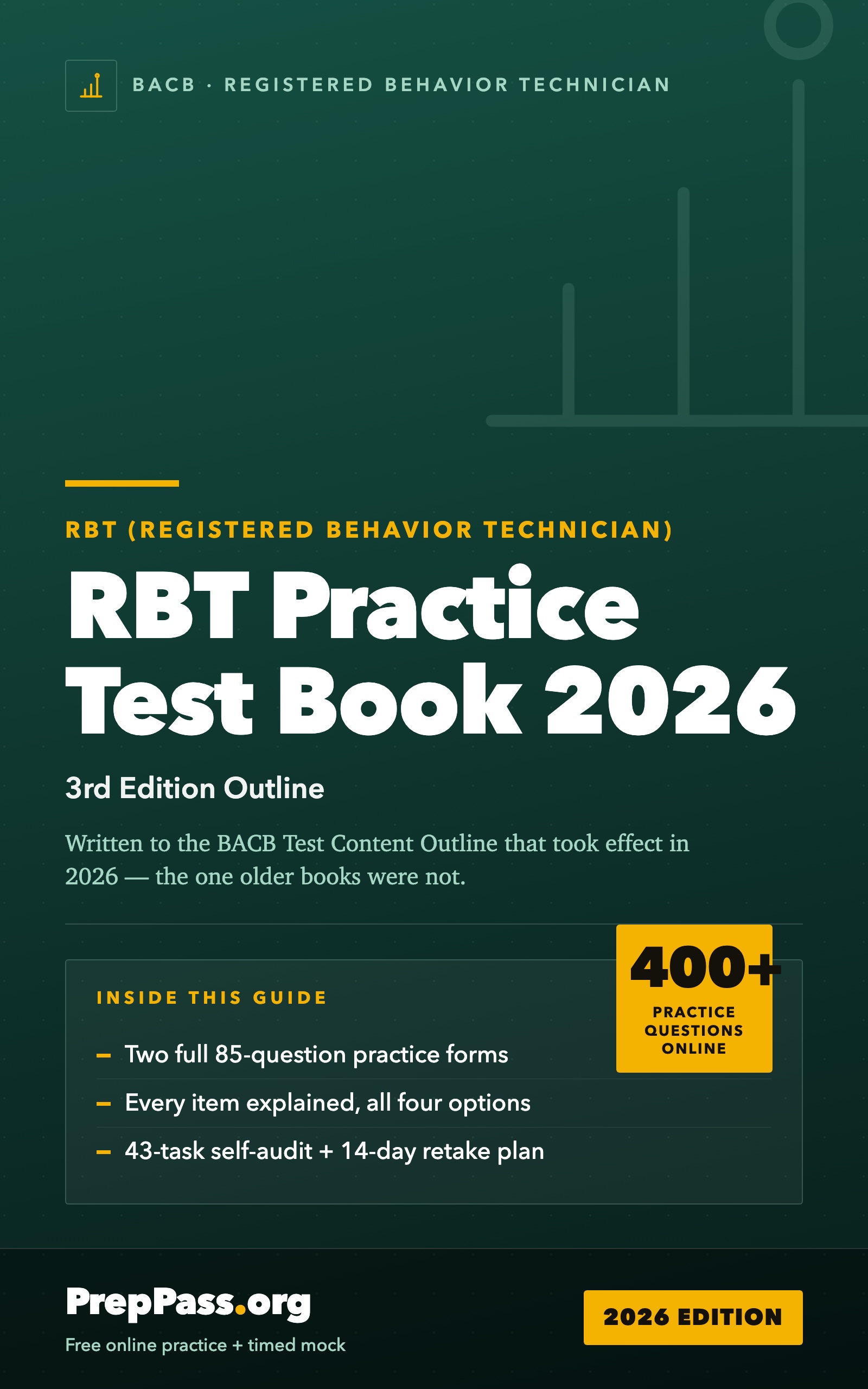
RBT (Registered Behavior Technician) · 2026 版
RBT Practice Test Book 2026 — 3rd Edition Outline
Written to the BACB Test Content Outline that took effect in 2026 — the one older books were not.
- 2 套完整模拟卷共 170 道题,四个选项逐一讲解
- 2 套卷各配答案与分领域评分表 —— 当天就能按领域给自己打分
- 43 项任务自查清单 —— 在考试发现之前先找出你的弱项
先做 10 题,看看讲解 —— 免费
先答完这 10 题,交卷后每题都有解析 —— 还会指出本指南里讲这一点的那一节。约 5 分钟,无需注册。
开始 10 道免费题翻开这本书看看
三页真实内页,直接从你将下载的 PDF 渲染而来 —— 一页讲解、一道带解析的例题、一页速查。没有任何一页是为了好看而重画的。
- 速查页Part II — The Retake Toolkit · PDF 第 132 页
一页可以随时翻回来的内容:把数字、期限或术语集中在一处。
- 怎么讲Part II — The Retake Toolkit · PDF 第 140 页
讲解页:用文字把知识讲清楚,顺序与考试考查的顺序一致。
- 怎么讲Part II — The Retake Toolkit · PDF 第 163 页
讲解页:用文字把知识讲清楚,顺序与考试考查的顺序一致。
包含什么,不包含什么
包含
- Written to the 2026 3rd-edition outline — including the tasks that are new in it
- Two full 85-question practice exams, weighted to the six official domains
- Every answer mapped to its domain and task, so you can score yourself by domain the same day
- The 43-task self-audit checklist — find your weak tasks before the exam finds them
- The best-answer method: worked scenarios showing why the “almost right” option loses
- A 14-day retake study plan keyed to your own diagnostic results
- Both forms come with every item explained — why the key is best AND why each of the other three loses
- PDF (print & tab it) + EPUB (phone / e-reader)
不包含
- 不寄送纸质书 —— 这是一份你下载后可自行打印的文件
- 购书不含视频课程、讲师或一对一辅导 —— 站上的免费视频是另一回事
- 不含考试报名费与考点费用,这些仍需向官方机构缴纳
目录
查看 22 章及各章起始页
- Part I — The Study Guide第 22 页
- Chapter 1 — Data Collection and Graphing第 23 页
- Part C — Permanent product recording (A.3.)第 27 页
- Part D — Observable and measurable description (A.5.)第 28 页
- Chapter 2 — Behavior Assessment第 40 页
- Part C — Functional assessment: three methods, one RBT role (B.3.)第 45 页
- Chapter 3 — Behavior Acquisition第 53 页
- Part C — Discrete-trial teaching (C.3.)第 57 页
- Part D — Naturalistic teaching (C.4.)第 59 页
- Part I — Shaping (C.10.)第 66 页
- Chapter 4 — Behavior Reduction第 74 页
- Part C — Differential reinforcement (D.3.)第 78 页
- Part D — Extinction (D.4.)第 80 页
- Chapter 5 — Documentation and Reporting第 94 页
- Part C — Variables that might affect progress (E.3.)第 98 页
- Part D — Objective session documentation (E.4.)第 99 页
- Chapter 6 — Ethics第 108 页
- Part C — Ongoing supervision requirements (F.3.)第 111 页
- Part D — Effective supervision practices (F.4.)第 114 页
- Part I — Interpersonal and professional skills (F.9.)第 121 页
- Part II — The Retake Toolkit第 131 页
- Part III — Two full-length practice forms第 174 页
取自你将下载的那份 PDF,并标明各章起始页 —— 不是在此手工录入的。
免费读完整一章
完整的一章,与电子书正文一字不差。直接在此窗口滚动阅读;无需下载,无需邮箱。
在本页直接阅读第 1 章
Introduction
Data is the part of this job that cannot be faked, and it is the part of the exam that cannot be bluffed. Every other domain depends on this one: an acquisition program is only working if the data say so, a behavior plan is only justified if the data say so, and your session note is only honest if it matches what you recorded.
Domain A is 13 scored questions, the third-largest domain behind Behavior Acquisition and Behavior Reduction, and it is the domain that changed most in the 3rd edition. The old Measurement domain asked you to collect data and plot it. The new Data Collection and Graphing domain also asks you to compute summary measures (A.6.), read a graph and describe its trend (A.7.), and explain what goes wrong when data or implementation are sloppy (A.8.). Those three tasks are new. If your last attempt included graph-reading items or a "responses per hour" arithmetic item and they felt like they came from nowhere, this is why.
The good news is that Domain A is the most learnable domain on the exam. The distinctions are crisp, the arithmetic is simple, and the traps are a short, fixed list. This chapter walks through the two families of measurement (continuous and discontinuous), permanent product, observable and measurable description, the three summary calculations you will actually be asked for, how to read a line graph, and what procedural fidelity means.
Learning objectives
After working through this chapter you should be able to:
- A.1. Implement continuous measurement procedures — frequency, duration, latency, and interresponse time — and choose the right one for a described behavior.
- A.2. Implement discontinuous measurement procedures — partial interval, whole interval, and momentary time sampling — and state which over-estimates and which under-estimates occurrence.
- A.3. Implement permanent product recording procedures, and recognize when a permanent product is and is not available.
- A.4. Enter data and update graphs accurately, on the correct axes, in the correct phase.
- A.5. Describe behavior and environment in observable and measurable terms, and rewrite a subjective description into an objective one.
- A.6. Calculate and summarize data in different ways — rate, mean duration, and percentage — from raw session data.
- A.7. Identify trends in graphed data, including level, trend direction, variability, and what a phase-change line means.
- A.8. Describe the risks associated with unreliable data collection and poor procedural fidelity, and explain why both threaten the client, not just the paperwork.
Part A — Continuous measurement: counting the behavior itself (A.1.)
Continuous measurement means you record every occurrence of the behavior during the observation period. Nothing is estimated. Four procedures, and the exam expects you to pick between them from a one-sentence description.
Frequency (count). A tally of how many times the behavior occurred. Use it when the behavior has a clear beginning and end and each instance takes roughly the same amount of time. "Ravi hit the table 7 times." Frequency alone is only interpretable if the observation periods are the same length — which is exactly why rate exists (see A.6.).
Duration. How long the behavior lasts, from onset to offset. Use it when how long is the clinically important part: tantrums, on-task engagement, crying, self-stimulation. You can record total duration across a session, or duration per occurrence, from which you compute mean duration.
Latency. The time from a stimulus or instruction to the start of the behavior. Use it when the concern is how long it takes the learner to get going after a demand. "The RBT says 'put on your shoes'; 42 seconds pass before Maya reaches for a shoe." Latency starts at the antecedent event and stops when the behavior begins.
Interresponse time (IRT). The time between the end of one occurrence of a behavior and the start of the next. Use it when the concern is spacing or pacing: how long between two requests, two bites, two vocalizations. IRT and rate move in opposite directions — shorter IRTs mean a higher rate.
The discrimination that matters most: latency versus IRT. Both are time-between measures, which is why the exam loves them together. Latency is measured from something the environment did (an instruction, a cue) to the behavior starting. IRT is measured from one behavior to the next occurrence of the same behavior. If the stem mentions an instruction or an SD, and the clock starts there, it is latency. If the clock starts at the end of a response, it is IRT.
| Procedure | Clock starts | Clock stops | Answers the question |
|---|---|---|---|
| Frequency | — (tally) | — | How many times? |
| Duration | Behavior begins | Behavior ends | How long does it last? |
| Latency | Antecedent/instruction | Behavior begins | How long until it starts? |
| IRT | One response ends | Next response begins | How much time between them? |
Part B — Discontinuous measurement: sampling the behavior (A.2.)
Discontinuous measurement divides the observation into intervals and records whether the behavior occurred, rather than recording every instance. It is an estimate, chosen because it lets one person watch a behavior while also teaching. Three procedures — and the exam tests them almost entirely through what each one over- or under-estimates.
Partial-interval recording. Mark the interval if the behavior occurred at any point during it, even for one second, even once. Because a single brief occurrence scores the whole interval, partial interval over-estimates how much the behavior actually occurred. It is usually chosen for behaviors you want to decrease, since over-estimating a problem behavior is the conservative error.
Whole-interval recording. Mark the interval only if the behavior occurred for the entire interval, start to finish. A behavior that stops for two seconds in the middle does not score. Because of that, whole interval under-estimates occurrence. It is usually chosen for behaviors you want to increase, such as on-task engagement or sustained play, since under-estimating a desired behavior is the conservative error there.
Momentary time sampling (MTS). Look at the one moment the interval ends and record whether the behavior is occurring right then. What happens in between is not recorded at all. MTS may over- or under-estimate depending on the behavior; because it requires attention only at fixed moments, it is the least intrusive of the three and the most practical for a teacher or an RBT running a group.
All three are reported as a percentage of intervals — number of intervals scored divided by total intervals, times 100. This is the single most-missed detail in the domain. Interval methods never yield a count of responses. If an option says "momentary time sampling; recorded as 4 occurrences," it is wrong on the reporting even if the procedure were right.
| Procedure | You score an interval when… | Bias | Typically used for |
|---|---|---|---|
| Partial interval | Behavior occurs at any point in the interval | Over-estimates | Behaviors to decrease |
| Whole interval | Behavior occurs throughout the entire interval | Under-estimates | Behaviors to increase |
| Momentary time sampling | Behavior is occurring at the moment the interval ends | Either direction | Group settings, long observations |
A memory hook that survives exam pressure: Partial is Plus (inflates), Whole is Weak (deflates), and Momentary is a Moment (a snapshot, nothing in between).
Part C — Permanent product recording (A.3.)
Permanent product recording measures the outcome the behavior leaves behind rather than the behavior as it happens: the completed worksheet, the number of shirts folded, the beads strung, the dishes in the rack, the photograph of a made bed.
Its advantage is that you do not have to be watching. Its requirements are strict:
- There must be a durable outcome that reliably results from the behavior. "Was polite to peers" leaves no product. "Put 12 blocks in the bin" does.
- The product must be attributable to the client. If a sibling helped, or a teacher finished the last three problems, the product no longer measures the client's behavior. The exam likes this one: a stem where someone else may have contributed is testing whether you notice that permanent product has become invalid.
- It tells you nothing about how the behavior occurred. Twenty completed math problems could be twenty independent responses or twenty fully prompted ones. If the program cares about independence, prompt level, or topography, permanent product is the wrong measure.
Permanent product versus direct observation is a scope question in disguise: use permanent product when the outcome is the target, and direct observation when the process is the target.
Part D — Observable and measurable description (A.5.)
Task A.5. asks you to describe behavior and environment in observable and measurable terms. This shows up in Domain A as "which description is best written," and again in Domain E as "which session note is objective." It is the same skill in two places, and it is one of the cheapest points on the exam to secure.
A description is observable if two people watching the same event would agree it happened, and measurable if you could count it, time it, or otherwise quantify it.
| Not observable/measurable | Observable and measurable |
|---|---|
| "Jonah was aggressive." | "Jonah struck the therapist's arm with a closed fist 4 times." |
| "Amara was frustrated and shut down." | "Amara placed her head on the desk and did not respond to 3 consecutive instructions." |
| "Ben had a meltdown for a while." | "Ben screamed and dropped to the floor for 6 minutes 40 seconds." |
| "Client was uncooperative today." | "Client completed 2 of 10 presented trials." |
| "Sara enjoyed the activity." | "Sara remained at the table and manipulated the materials for 9 of 10 intervals." |
The words the exam plants to signal a bad description are internal-state and evaluative words: angry, frustrated, upset, anxious, defiant, unmotivated, refused, enjoyed, attempted, manipulative, attention-seeking. Notice that "attention-seeking" is on that list. It states a function — a conclusion drawn from data — as though it were an observation. An RBT records what happened; the analysis of why belongs to the supervising BCBA.
Also describe the environment the same way: not "the room was chaotic," but "four peers were present and the fire alarm sounded at 10:14."
Part E — Entering data and updating graphs (A.4.)
Task A.4. is the mechanical one, and it is mostly about not corrupting the record.
The conventional line graph. Behavior data are plotted on a line graph with the behavior measure on the y-axis (vertical) and time or sessions on the x-axis (horizontal). Each session is one data point. Points within the same condition are connected; points are not connected across a phase-change line.
The phase-change line is a vertical line separating conditions — baseline from intervention, or one intervention from the next — usually labeled at the top ("Baseline," "DRA + extinction"). Its purpose is to let anyone reading the graph see what changed and when. Drawing a connecting line across it visually implies continuity that did not exist, which is why the convention is to break the line.
Practical rules the exam can turn into items:
- Enter data during or immediately after the session, not from memory hours later. Delay is a data-integrity problem, not a paperwork problem.
- Record what actually happened, including a session that went badly, a session cut short, or a session where you made an implementation error. Data that flatter you are worse than no data.
- If a session did not occur, that is not a zero. A zero means the behavior was measured and did not occur. A missed session is a gap.
- If you notice a data-entry error later, correct it through the documented process and tell your supervisor — do not quietly overwrite it.
- Graph on the schedule the program specifies, so that the person making decisions is looking at current data.
Part F — Calculating and summarizing data (A.6.)
New in the 3rd edition, and arithmetic-light. Three computations cover almost everything.
Rate = count ÷ time. Rate converts a raw count into something comparable across sessions of different lengths. Always state the unit.
Worked: An RBT records 15 instances of aggression during a 90-minute session. Rate per minute = 15 ÷ 90 = 0.17 per minute. Rate per hour = 15 ÷ 1.5 hours = 10 per hour.
That example is not arbitrary — it is the shape of the BACB's own published sample question in the current Handbook. Get comfortable converting minutes to hours: 90 minutes is 1.5 hours, 30 minutes is 0.5 hours, 45 minutes is 0.75 hours. The trap is dividing by 90 and then labeling the result "per hour."
Mean duration = total duration ÷ number of occurrences. Not divided by the session length, and not divided by the number of intervals.
Worked: Three tantrums lasting 4, 7, and 4 minutes. Total duration = 15 minutes. Mean duration = 15 ÷ 3 = 5 minutes per occurrence. Total duration (15 minutes) and mean duration (5 minutes) are different summaries of the same data, and an item will offer you both.
Percentage = (part ÷ whole) × 100. The judgment is entirely in choosing the denominator.
Worked: Maya responds independently on 12 of 20 trials: 12 ÷ 20 × 100 = 60% independent responding. Worked: Stereotypy is scored in 4 of 10 intervals: 4 ÷ 10 × 100 = 40% of intervals — note the units. It is 40% of intervals, not "40% of the session" and not "4 occurrences."
Choosing the summary that fits the measure is itself testable:
| Raw data | Correct summary |
|---|---|
| Count in sessions of unequal length | Rate (per minute or per hour) |
| Several timed episodes | Total duration and/or mean duration |
| Trials with a correct/incorrect outcome | Percentage of trials |
| Interval recording sheet | Percentage of intervals |
| Time from instruction to response, several trials | Mean latency |
购买前
- 怎么拿到?
- 付款后下载入口立即出现在本页,链接同时发到你的邮箱。无需注册账号。
- 不合适怎么办?
- 14 天内发邮件即可全额退款,无需理由。
- 免费练习会取消吗?
- 不会。站上的每一道练习题、计时模考和免费章节都继续免费。这本书是「学」的那一半,不是把免费部分围起来的门。
- 能在手机上看吗?
- 可以 —— EPUB 适合手机和电子书阅读器,PDF 适合打印和贴标签,两种都给你。
详细信息
Written to the BACB Test Content Outline that took effect in 2026 — the one older books were not.
- Format: PDF + EPUB download · 286 pages
- 190 practice questions in the book, with a full answer key
- 403 free practice questions for this exam on PrepPass, included at no cost
- $19.99 one-time — no subscription
- 14-day money-back guarantee · refund policy
- Cross-referenced against: BACB RBT Test Content Outline (3rd ed.) · RBT Ethics Code (2.0)
- Last updated: September 2026
- 官方来源核验(BACB RBT Test Content Outline (3rd ed.) · RBT Ethics Code (2.0))
- 403 道免费练习题
- 即时下载,永久拥有
关于这场考试本身
| 主管机构 | Behavior Analyst Certification Board, Inc. (BACB) —— 考试由 Pearson VUE 承办 来源: BACB — Registered Behavior Technician Handbook (PDF, updated 06/2026) |
|---|---|
| 题目数量 | 85 道题 (75 道计分,10 道不计分预试题) 来源: BACB — Registered Behavior Technician Handbook (PDF, updated 06/2026) |
| 考试时限 | 90 分钟 来源: BACB — Registered Behavior Technician Handbook (PDF, updated 06/2026) |
| 及格标准 | BACB 未公布 我们查阅但未找到该数据的来源: BACB — Registered Behavior Technician Handbook (PDF, updated 06/2026) |
| 费用 |
来源: BACB — Registered Behavior Technician Handbook (PDF, updated 06/2026) |
| 考试语言 | 英语 来源: BACB — Registered Behavior Technician Handbook (PDF, updated 06/2026) |
练习免费,为什么还要买书?
我们的练习题和计时模考一直免费 —— 网站上的东西不会因为这本书而收起来。这本 $19.99 的书是「学」的那一半:知识本身,按顺序讲清楚,存成一份属于你的文件。
- 系统讲解 —— 每个考试部分按章节从头讲到尾,不只是题目
- 可打印可贴标签 —— 一份适合打印的 PDF,能划重点、做批注、带到书桌前
- 随处离线学 —— EPUB 放手机或电子书阅读器;不用 wifi,不用一堆浏览器标签
- 全在一处 —— 章节、每章速记卡、练习题都在同一份文件里
- 永久归你 —— 一次 $19.99,即时下载,无订阅
而且零风险:14 天退款保证 —— 不满意?发邮件即可全额退款,无需理由。 详见退款政策。
14 天退款保证 · 全额退款,无需理由。
一次购买,永久下载访问。此电子书是完整的 RBT (Registered Behavior Technician) 学习指南,含 PDF 与 EPUB。仅为教育性摘要,非专业或法律意见 —— 请始终以官方来源核实当前规定。最后更新:September 2026。