Arkansas Real Estate Broker · 2026 版
Arkansas Real Estate Broker Exam Study Guide (2026)
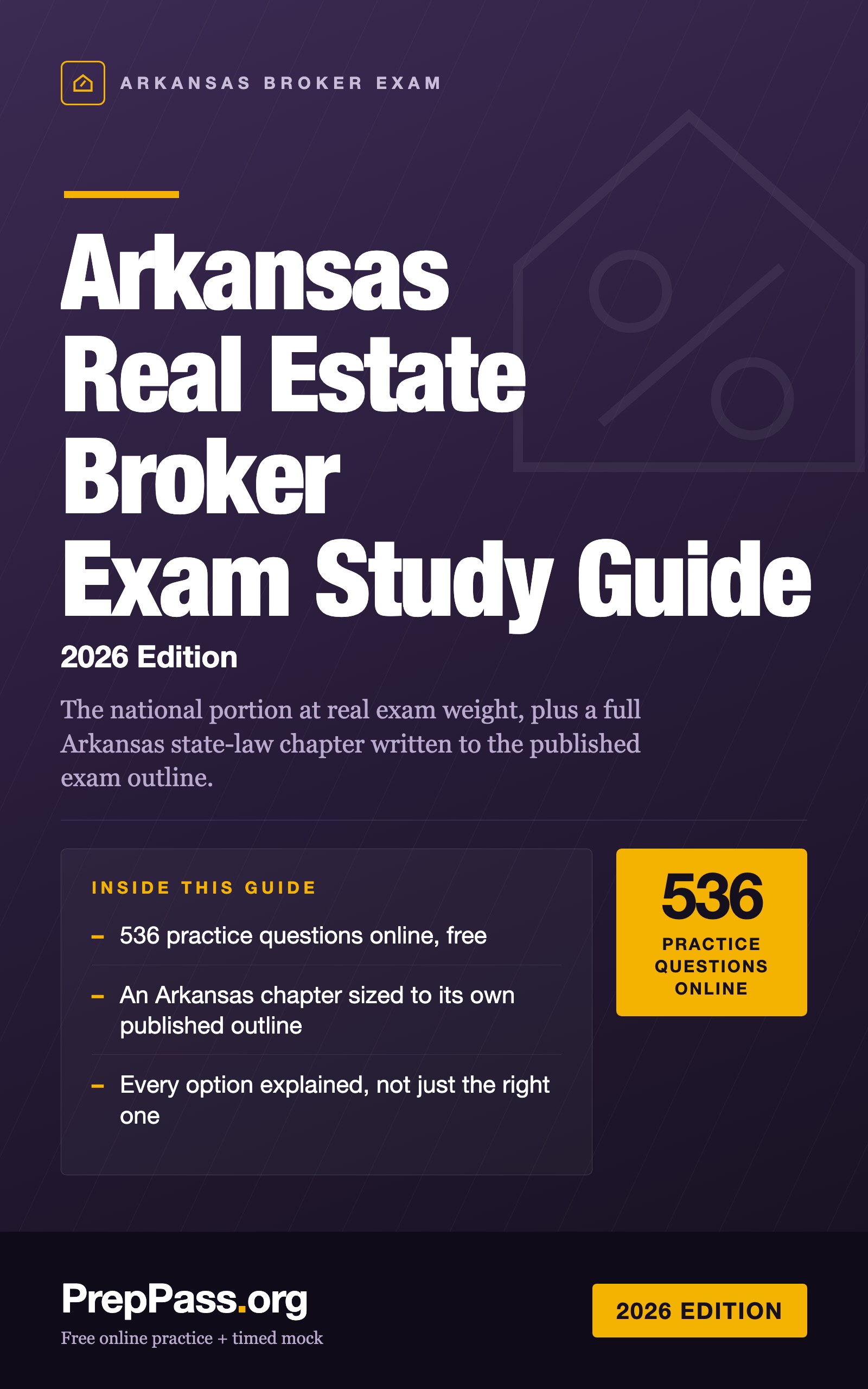
Arkansas runs a single integrated paper with no separate national portion, so the whole exam is Arkansas content. The Arkansas chapter is sized to the published outline — 10 areas, 120 scored items — area by area, not flattened.
- 全国通用部分 8 章,外加一整章阿肯色房地产法 —— PDF + EPUB 永久保存
- 一套 60 题的全国部分模拟考,答案键逐一解释四个选项,而不只是正确的那个
- 另有 20 道阿肯色房地产法题目,并附完整解析答案键
先做 10 题,看看讲解 —— 免费
先答完这 10 题,交卷后每题都有解析 —— 还会指出本指南里讲这一点的那一节。约 5 分钟,无需注册。
开始 10 道免费题翻开这本书看看
三页真实内页,直接从你将下载的 PDF 渲染而来 —— 一页讲解、一道带解析的例题、一页速查。没有任何一页是为了好看而重画的。
- 速查页Part C — Encumbrances a broker must read off a title report · PDF 第 102 页
一页可以随时翻回来的内容:把数字、期限或术语集中在一处。
- 一道题的完整解析Answer Key and Explanations · PDF 第 174 页
一道练习题,连同答案和背后的推理 —— 不只是一个答案键。
- 怎么讲Part II — Arkansas State Law & Practice · PDF 第 286 页
讲解页:用文字把知识讲清楚,顺序与考试考查的顺序一致。
包含什么,不包含什么
包含
- An Arkansas chapter written to the published exam outline, area by area
- Where Arkansas law departs from the national rule — both stated, so neither is guessed
- Supervision, trust accounts, brokerage operation and broker math
- An Arkansas practice set with every option explained, not just the right one
- 536 practice questions online, free, from the same bank
- PDF (print & tab it) + EPUB (phone / e-reader)
不包含
- 不寄送纸质书 —— 这是一份你下载后可自行打印的文件
- 购书不含视频课程、讲师或一对一辅导 —— 站上的免费视频是另一回事
- 不含考试报名费与考点费用,这些仍需向官方机构缴纳
目录
查看 29 章及各章起始页
- Part C — Advertising and recordkeeping compliance第 14 页
- Part D — Consumer contact and transaction integrity第 16 页
- 2. Trust Funds, Escrow, and the Client’s Money第 30 页
- Part C — Records that survive an audit第 33 页
- Part D — Disputed money第 34 页
- 3. Agency at the Broker Level第 40 页
- Part C — Fiduciary duties, at the level a broker is examined on第 44 页
- Part D — Dual agency, designated agency, and the alternatives第 46 页
- 4. Contracts and Brokerage Agreements第 55 页
- Part C — Options, rights of first refusal, and installment contracts第 60 页
- Part D — Between contract and closing第 61 页
- 5. Fair Housing, Accessibility, and Antitrust: The Exposure You Carry Personally第 72 页
- Part C — The exemptions, and why they rarely save anyone第 78 页
- Part D — Disability: the distinction the exam always tests第 79 页
- 6. Ownership, Land Use Controls, and Transfer of Title第 95 页
- Part C — Encumbrances a broker must read off a title report第 101 页
- Part D — Legal descriptions第 103 页
- 7. Valuation, Financing, and the Federal Lending Laws第 113 页
- Part C — The instruments第 121 页
- Part D — Loan programs, structures, and qualifying第 123 页
- 8. Disclosures, Environmental Risk, and Property Management第 136 页
- Part C — The management agreement and the manager’s authority第 142 页
- Part D — Leases and tenancies第 144 页
- Practice Exam — 60 Questions第 153 页
- Answer Key and Explanations第 170 页
- Appendix A — Broker Math Cheat Sheet第 221 页
- Appendix B — Glossary第 243 页
- Appendix C — Exam-Day Strategy第 262 页
- Part II — Arkansas State Law & Practice第 267 页
取自你将下载的那份 PDF,并标明各章起始页 —— 不是在此手工录入的。
免费读完整一章
完整的一章,与电子书正文一字不差。直接在此窗口滚动阅读;无需下载,无需邮箱。
在本页直接阅读第 9 章
我们没有拿轻松的绪论充数 —— 免费章节直接翻到书里最见功力的部分,让你在考试真正难的地方检验这本书讲得好不好。
What Arkansas's exam actually is
Every other state edition in this series pairs a shared national manuscript with a state chapter that adds the state-specific layer on top. Arkansas does not work that way, and saying so plainly, before anything else, is the most useful sentence in this book.
The Arkansas Real Estate Commission (AREC) does not give a national exam and a state exam. It gives one exam. Pearson VUE administers it under Candidate Handbook #090400, and the handbook's own description is unambiguous: "The Arkansas Unified Real Estate Broker examination covers both general knowledge concepts, as well as Arkansas-specific content. The examination consists of 120 scored items and ten pretest (unscored) items. The pretest items are not identified and will not affect a candidate's score in any way." One paper, 120 scored questions, mixing agency law and financing math with AREC regulation numbers in whatever order the exam form puts them. There is no point at which the "national part" ends and the "Arkansas part" begins, because no such division exists on the form you will sit.
That matters for how you should use this book. If you also own PrepPass's national real estate broker manuscript, do not treat this chapter as a supplement to it — a thin add-on covering only what the national book left out. Arkansas licensees do not get that luxury, and neither should your studying. This chapter is written to stand on its own as the complete content map of the Arkansas exam: general real estate principles (contracts, agency, appraisal, financing, property characteristics) and the Arkansas statutes and AREC regulations that govern them, together, in the proportions Pearson VUE's own content outline assigns them. Skipping the general-knowledge sections here because "the national book already covered that" would leave you unprepared for roughly half of a paper that does not separate the two.
Vendor and dates. The content outline in force is titled "Arkansas Unified Real Estate Broker Examination Content Outline," effective December 1, 2025. The handbook you would download today carries a June 2026 revision line. Both documents describe the same 120-scored/10-pretest structure.
Time. The handbook does not publish a minutes figure for this exam, and this chapter will not invent one. What it says, in the general exam-day instructions that apply across all five Arkansas real estate and property management exams Pearson VUE administers under this handbook, is: "You should report to the test center at least 30 minutes before your exam begins to complete registration. You will have two to four hours to complete your exam." That two-to-four-hour window is shared across the Broker, Salesperson, Property Management Associate, and Property Management Broker exams collectively — it is not a per-exam allotment, and nothing in the handbook narrows it further for the broker paper specifically. Anyone who tells you Arkansas gives you "X minutes" for the broker exam is quoting a number the vendor does not publish.
Passing score — and the trap inside the word "70." The handbook sets a passing scaled score of 70 for the Real Estate Broker exam (also 70 for Salesperson, Property Management Associate, and Property Management Broker). Read the handbook's own caution carefully, because it exists specifically to head off a wrong assumption: "With equating, scores are reported on a scale common to all forms of the examination (scaled score)... The scaled score that is reported to candidates who passed the exam is neither the number of questions answered correctly nor the percentage of questions answered correctly." A 70 does not mean you got 70% of the 120 items right. It means a statistical equating procedure — built to correct for the fact that different exam forms carry questions of slightly different difficulty — placed your raw performance at or above the cut line on a converted scale. Do not walk in trying to count toward 84 correct answers (70% of 120) as your target; that number is not how Arkansas measures whether you passed.
The ten content areas. Pearson VUE publishes these as percentages of the exam — never as item counts. The item counts in the right-hand column below are not the vendor's; they are this book's own derivation, using the standard largest-remainder method to allocate 120 scored items across ten percentages that must sum to 120. Independent rounding of each area on its own gives 118, two short of 120; the two areas whose exact fractional shares were closest to rounding up (Area I, at 4.8, and Area V, at 21.6) each absorb one of the two leftover items. Treat the percentage column as the vendor's fact and the item column as this book's arithmetic on top of it.
| Area (published order) | Percentage | Derived items |
|---|---|---|
| I. Duties and Authority of the Real Estate Commission | 4% | 5 |
| II. Arkansas Statutory Requirements Governing Licensure | 10% | 12 |
| III. Other Arkansas Statutory Requirements | 6% | 7 |
| IV. Federal Laws Governing Real Estate Activities | 10% | 12 |
| V. Broker Operations and Responsibilities | 18% | 22 |
| VI. Client and Customer Relationships and Agency Disclosures | 12% | 14 |
| VII. Real Property Characteristics, Legal Descriptions, Condition | 10% | 12 |
| VIII. Property Valuation and the Appraisal Process | 5% | 6 |
| IX. Contracts, Financing and Settlement | 15% | 18 |
| X. Property Management | 10% | 12 |
Two things jump out of that table and shape how this chapter is built. First, Areas V and IX together are 33% of the exam — a third of everything you will be asked. Broker Operations alone, at 18%, is the single largest area on the paper; nothing else comes close. Second, Area IV puts federal law — RESPA, TILA, TRID, the Fair Housing Act, the ADA, lead-based paint disclosure — inside the state exam itself, at a full 10%. In a two-part state like Texas or a Broker-Lawyer-Committee state, federal law of this kind is usually assumed to live in the national portion and gets no separate space in the state chapter. Arkansas has no national portion to assume it into. If this chapter skipped federal law on the theory that "the national book covers that," it would leave out 12 of your 120 scored items. It does not skip it — Area IV below is a full, separately cited section, because on the Arkansas paper federal law is state-exam content.
One more housekeeping note before the content: the handbook publishes no reference list at all for this outline. Every citation in this chapter — every Ark. Code Ann. section, every AREC Regulation number, every C.F.R. cite — was independently researched and verified against the current text of the Arkansas Real Estate License Law (Ark. Code Ann. tit. 17, ch. 42), the Arkansas Time-Share Law (tit. 18, ch. 14), the AREC Commission Regulations (04/2024 edition as revised April 9, 2025), and the relevant federal statutes and regulations current as of mid-2026. None of it is copied from a vendor bibliography, because none exists. Where a provision this chapter might otherwise have used had been repealed — Ark. Code Ann. § 17-42-410, and AREC Regulations 4.4, 5.3, 10.3, 10.17, 13.9, 13.14 and 13.15 among them — it was left out rather than cited as if still good law.
I. Duties and Authority of the Real Estate Commission — 5 of 120 items (4%)
The smallest area on the exam, and the one that establishes who is doing the regulating.
Composition. Ark. Code Ann. § 17-42-201 puts five members on the Commission, each appointed by the Governor to a three-year term: three who have been licensed brokers or salespersons for at least five years, and two who are not in the real estate business at all — one representing consumers generally, and one who must be sixty or older and represents the elderly specifically. That last seat is not decorative; it reflects a recurring concern in real estate regulation about elder financial exploitation, and it means two of the Commission's five votes belong to people the regulated industry does not select.
General powers and investigation. Section 17-42-203(a) lets the Commission "do all things necessary and convenient for carrying into effect the provisions of this chapter" and to promulgate rules, and § 17-42-205 gives it subpoena power for both investigations and hearings. Records access runs through Regulation 10.7(b)(3): a principal broker's three-year firm records are "open to inspection by and made available to the investigative staff of the Commission at the firm's office or other location designated by the Commission." Two details matter for the exam: the inspection right does not depend on a complaint having already been filed — § 17-42-312(a)(1) lets the Commission investigate on its own motion — and the inspection is not confined to the Commission's Little Rock office. Trap: a wrong answer will often try to condition Commission access on a court order or on the location being the Commission's own headquarters. Neither is correct.
The three-year clock. Section 17-42-314(b) is a limitations rule most candidates underweight: except where a license was obtained by false or fraudulent representation, AREC "may not investigate a licensee's conduct or hold a disciplinary hearing on it unless the complaint is filed or the investigation begins within three (3) years from the date of the actions complained of." Fraud in the original license application is the one stated exception, and it carries no time limit at all.
Disciplinary authority. Section 17-42-312(a)(4) gives the Commission a menu on finding a violation, not a single mandatory outcome: suspension, revocation, or denial of a license; a penalty of not more than $1,000 per violation; required education; required reexamination; conditions or restrictions on the license; or restitution and damages. A lighter track exists alongside it — § 17-42-312(d) lets the executive director issue citations without a full hearing: up to $100 for missed continuing or post-licensure education, up to $250 for practicing on an expired license or for an advertising violation, contestable within thirty days. A licensee whose license is revoked may reapply after two years under § 17-42-311(c).
The Recovery Fund. Section 17-42-406 sets Arkansas's mechanism apart from most states' — enough so that this chapter returns to it in the "what's unusual" section below with a direct comparison. In outline, the Commission in a disciplinary hearing first finds whether a violation occurred, then determines the aggrieved party's damages, then directs the licensee to pay; only if that amount stays unpaid thirty days after a final, unappealed order does the Commission pay from the fund, capped at $25,000 for any one violation or continuing series and $75,000 in total for the acts of any one licensee. Section 17-42-407 limits any award to actual, compensatory damages — no punitive damages, no interest to the claimant. And under § 17-42-409, once the fund pays, the licensee's license is "immediately suspended until he or she has completely reimbursed the commission for the payment, plus interest at a rate to be determined by the commission," a rate capped at 10% per annum. Practical bite: the fund's payment settles the injured consumer's claim, but it does not settle the licensee's debt — the license stays down until that debt is repaid, which is a materially different consequence than a fixed suspension period.
II. Arkansas Statutory Requirements Governing Licensure — 12 of 120 items (10%)
This area runs from "who needs a license at all" through the entire lifecycle of holding one: qualifying, activating and inactivating, transferring, renewing, and reporting changes.
Who needs a license, and the one-act rule. Section 17-42-103(10) and (12) define the acts that trigger the licensing requirement — selling, exchanging, leasing, collecting rent, auctioning, and simply advertising oneself as being in the real estate business. What trips up candidates is how little conduct it takes to cross the line: § 17-42-301(c) states flatly, "The commission of a single act by a person required to be licensed under this chapter and not so licensed shall constitute a violation of this chapter." Subsection (b) reaches anyone who even "offers, attempts, or agrees to perform" one of those acts, "whether as part of a transaction or as an entire transaction." Neither repetition nor a completed closing is required — one unlicensed act, once, is a violation on its own. The consequences are real: § 17-42-109(a) allows a civil penalty up to $5,000 plus disgorgement of any compensation received, and § 17-42-105(d) makes a violation of the chapter a Class D felony.
Exemptions. Section 17-42-104 lists who is carved out: owners acting for themselves; an attorney-in-fact under a recorded power of attorney who takes no fee; attorneys at law; receivers and executors acting under a will, trust, or court order; a resident manager who lives on the premises and leases units in connection with that employment; and — narrowly — salaried or hourly clerical leasing staff. That last exemption, § 17-42-104(a)(6), is worth reading carefully because the exam tests exactly where it ends: it covers a person paid only a salary or hourly wage who delivers lease applications, receives security deposits or rent made payable to the broker or owner, shows a unit under direct written instructions with terms the broker already set, and conveys information the broker prepared. The moment that person negotiates rent or lease terms, is paid a commission per lease, or exercises discretion over a deposit amount, the exemption is gone and a license is required. Trap: a leasing agent paid a commission per signed lease is doing licensed work regardless of the job title on the business card.
Broker eligibility. Regulation 4.1(a) sets the floor: the age of majority; not less than 60 classroom hours completed within the 36 months preceding application, at least 45 of them in a Commission-developed course; an affidavit of no unprofessional conduct; and disclosure of other licenses held and any disciplinary or fraud litigation. The experience requirement sits in Ark. Code Ann. § 17-42-303(b)(1): an active, bona fide apprenticeship under a valid salesperson license, or a salesperson or broker license held in another state, for not less than 24 months within the previous 48. A waiver exists under § 17-42-303(b)(2) for an applicant who has already held an active broker license for 18 months, or who has 24 months of acceptable real-estate-related experience. Regulation 4.1(c)(4) adds a separate deadline that has nothing to do with education: the state and federal criminal background check "shall be completed within six months immediately preceding the date the Application for Real Estate License Examination is received in the Commission's office," and an application arriving outside that window is returned. Practical bite: an applicant can request the background check and sit for the exam once the request has gone to the Identification Bureau of the Arkansas State Police (Regulation 4.1(h)), but Ark. Code Ann. § 17-42-306(a)(4)(B) bars actually issuing the license until the Commission receives and approves the results.
The 90-day payment clock. After passing the exam, Ark. Code Ann. § 17-42-306(b)(1)(A) requires the applicant to pay the license fee and the Real Estate Recovery Fund fee "within ninety (90) days from the date of the licensing examination." Miss that window and § 17-42-306(b)(2) invalidates the exam results outright — "the applicant shall be required to make new application and retake the licensing examination as an original applicant." Regulation 4.3(c) repeats the ninety days. The one built-in extension applies to an applicant still waiting on a federal criminal background check.
Active status, inactive status, and transfers. Section 17-42-308(a)(2) is categorical: the holder of an inactive license "shall not practice as a real estate broker, salesperson, property management associate, or property management broker in this state without first activating the license." There is no supervision workaround and no grace period. Regulation 6.2(d) prices reactivation at seven approved classroom hours for each year the license sat inactive, capped at thirty hours. On termination of an association with a firm, Regulation 7.5(a) gives the principal broker seven days to notify the Commission and return the departing licensee's license and pocket card — and "such notification shall automatically inactivate the license." Moving to a new firm requires the new principal broker's signature on the transfer application plus the transfer fee and, under Regulation 7.5(b), "a statement that the licensee is not taking any listings, management contracts, appraisals, lease agreements, or copies of any such documents, or any other pertinent information belonging to the former principal broker or firm." The old broker's consent is not part of it.
Renewal and continuing education. Every broker and salesperson license expires on December 31 under Regulation 6.1(a). Renewal applications with the fee are due, by Regulation 6.1(b), "no later than September 30" — filed late, the application is treated as one to renew an already-expired license, which carries a higher fee. Active status requires seven approved classroom hours of continuing education annually (Regulation 6.1(c); the statutory band in Ark. Code Ann. § 17-42-307(b)(1)(A) runs six to seven hours), and one of those hours must specifically address "how real estate professionals can limit risk to preserve personal safety for agents and consumers."
Required notifications. Regulation 7.6(a) requires prompt notice to the Commission — on a Commission-prescribed form, with the reissuance fee — of any change of name, address, or place of business; "at the next renewal" is not prompt enough. Regulation 10.16(a) requires a written report within thirty days of any conviction or plea of guilty or nolo contendere to a crime other than a traffic violation, running from the conviction or plea date, not from completion of a sentence.
购买前
- 怎么拿到?
- 付款后下载入口立即出现在本页,链接同时发到你的邮箱。无需注册账号。
- 不合适怎么办?
- 14 天内发邮件即可全额退款,无需理由。
- 免费练习会取消吗?
- 不会。站上的每一道练习题、计时模考和免费章节都继续免费。这本书是「学」的那一半,不是把免费部分围起来的门。
- 能在手机上看吗?
- 可以 —— EPUB 适合手机和电子书阅读器,PDF 适合打印和贴标签,两种都给你。
详细信息
Arkansas runs a single integrated paper with no separate national portion, so the whole exam is Arkansas content. The Arkansas chapter is sized to the published outline — 10 areas, 120 scored items — area by area, not flattened.
- Format: PDF + EPUB download · 305 pages
- 80 practice questions in the book, with a full answer key
- 536 free practice questions for this exam on PrepPass, included at no cost
- $14.99 one-time — no subscription
- 14-day money-back guarantee · refund policy
- Cross-referenced against: Pearson VUE #090400 (rev 2026-06 (outline eff. 2025-12-01))
- Last updated: September 2026
- 官方来源核验(Pearson VUE #090400 (rev 2026-06 (outline eff. 2025-12-01)))
- 536 道免费练习题
- 即时下载,永久拥有
real estate broker pre-license course 要 $200–$1,000。这本书讲的是同一门考试 —— 同样的规则、核对到最新标准 —— 只需一次性 $14.99,永久归你。
练习免费,为什么还要买书?
我们的练习题和计时模考一直免费 —— 网站上的东西不会因为这本书而收起来。这本 $14.99 的书是「学」的那一半:知识本身,按顺序讲清楚,存成一份属于你的文件。
- 系统讲解 —— 每个考试部分按章节从头讲到尾,不只是题目
- 可打印可贴标签 —— 一份适合打印的 PDF,能划重点、做批注、带到书桌前
- 随处离线学 —— EPUB 放手机或电子书阅读器;不用 wifi,不用一堆浏览器标签
- 全在一处 —— 章节、每章速记卡、练习题都在同一份文件里
- 永久归你 —— 一次 $14.99,即时下载,无订阅
而且零风险:14 天退款保证 —— 不满意?发邮件即可全额退款,无需理由。 详见退款政策。
14 天退款保证 · 全额退款,无需理由。
一次购买,永久下载访问。此电子书是完整的 Arkansas Real Estate Broker 学习指南,含 PDF 与 EPUB。仅为教育性摘要,非专业或法律意见 —— 请始终以官方来源核实当前规定。最后更新:September 2026。