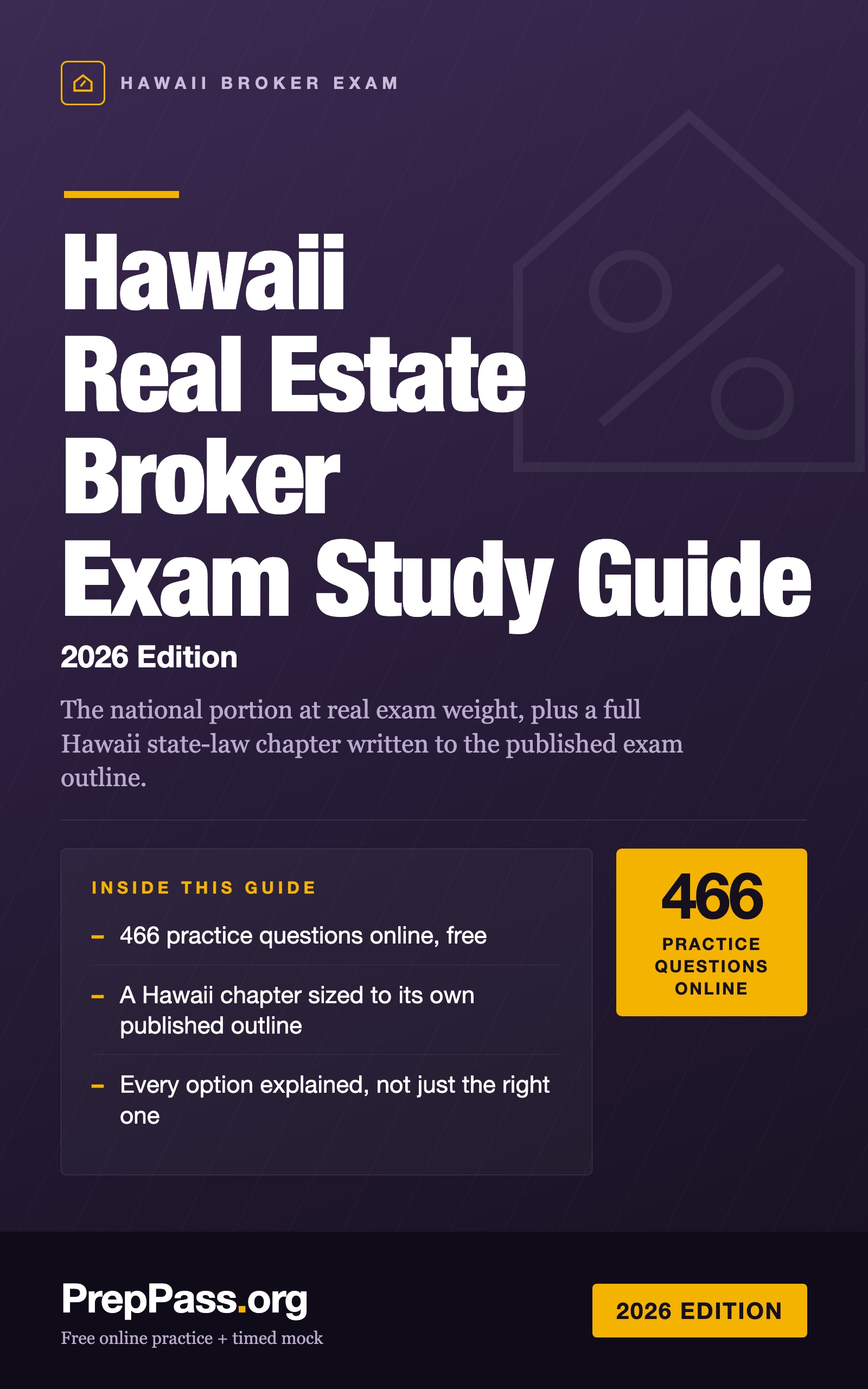
Hawaii Real Estate Broker · 2026 版
Hawaii Real Estate Broker Exam Study Guide (2026)
The national portion at real exam weight, plus a Hawaii chapter. The Hawaii chapter is sized to the published outline — 9 areas, 50 scored items — area by area, not flattened.
- 全国通用部分 8 章,外加一整章夏威夷房地产法 —— PDF + EPUB 永久保存
- 一套 60 题的全国部分模拟考,答案键逐一解释四个选项,而不只是正确的那个
- 另有 20 道夏威夷房地产法题目,并附完整解析答案键
先做 10 题,看看讲解 —— 免费
先答完这 10 题,交卷后每题都有解析 —— 还会指出本指南里讲这一点的那一节。约 5 分钟,无需注册。
开始 10 道免费题翻开这本书看看
三页真实内页,直接从你将下载的 PDF 渲染而来 —— 一页讲解、一道带解析的例题、一页速查。没有任何一页是为了好看而重画的。
- 速查页Part C — Encumbrances a broker must read off a title report · PDF 第 102 页
一页可以随时翻回来的内容:把数字、期限或术语集中在一处。
- 一道题的完整解析Answer Key and Explanations · PDF 第 174 页
一道练习题,连同答案和背后的推理 —— 不只是一个答案键。
- 怎么讲Part II — Hawaii State Law & Practice · PDF 第 282 页
讲解页:用文字把知识讲清楚,顺序与考试考查的顺序一致。
包含什么,不包含什么
包含
- A Hawaii chapter written to the published exam outline, area by area
- Where Hawaii law departs from the national rule — both stated, so neither is guessed
- Supervision, trust accounts, brokerage operation and broker math
- A Hawaii practice set with every option explained, not just the right one
- 466 practice questions online, free, from the same bank
- PDF (print & tab it) + EPUB (phone / e-reader)
不包含
- 不寄送纸质书 —— 这是一份你下载后可自行打印的文件
- 购书不含视频课程、讲师或一对一辅导 —— 站上的免费视频是另一回事
- 不含考试报名费与考点费用,这些仍需向官方机构缴纳
目录
查看 30 章及各章起始页
- Part C — Advertising and recordkeeping compliance第 14 页
- Part D — Consumer contact and transaction integrity第 16 页
- 2. Trust Funds, Escrow, and the Client’s Money第 30 页
- Part C — Records that survive an audit第 33 页
- Part D — Disputed money第 34 页
- 3. Agency at the Broker Level第 40 页
- Part C — Fiduciary duties, at the level a broker is examined on第 44 页
- Part D — Dual agency, designated agency, and the alternatives第 46 页
- 4. Contracts and Brokerage Agreements第 55 页
- Part C — Options, rights of first refusal, and installment contracts第 60 页
- Part D — Between contract and closing第 61 页
- 5. Fair Housing, Accessibility, and Antitrust: The Exposure You Carry Personally第 72 页
- Part C — The exemptions, and why they rarely save anyone第 78 页
- Part D — Disability: the distinction the exam always tests第 79 页
- 6. Ownership, Land Use Controls, and Transfer of Title第 95 页
- Part C — Encumbrances a broker must read off a title report第 101 页
- Part D — Legal descriptions第 103 页
- 7. Valuation, Financing, and the Federal Lending Laws第 113 页
- Part C — The instruments第 121 页
- Part D — Loan programs, structures, and qualifying第 123 页
- 8. Disclosures, Environmental Risk, and Property Management第 136 页
- Part C — The management agreement and the manager’s authority第 142 页
- Part D — Leases and tenancies第 144 页
- Practice Exam — 60 Questions第 153 页
- Answer Key and Explanations第 170 页
- Appendix A — Broker Math Cheat Sheet第 221 页
- Appendix B — Glossary第 243 页
- Appendix C — Exam-Day Strategy第 262 页
- Part II — Hawaii State Law & Practice第 267 页
- Section 16-99-4(h) states that the principal broker or broker-in-charge第 312 页
取自你将下载的那份 PDF,并标明各章起始页 —— 不是在此手工录入的。
免费读完整一章
完整的一章,与电子书正文一字不差。直接在此窗口滚动阅读;无需下载,无需邮箱。
在本页直接阅读第 9 章
我们没有拿轻松的绪论充数 —— 免费章节直接翻到书里最见功力的部分,让你在考试真正难的地方检验这本书讲得好不好。
This chapter covers Hawaii law only. Agency theory, fair housing at the federal level, RESPA and TILA, financing, valuation and the arithmetic are in the national portion you have just read. What follows is the 50 scored items that only a Hawaii candidate sits — in the order PSI prints them, and sized to what each area is actually worth.
1. What the Hawaii state portion actually is
Hawaii's examination is delivered by PSI under candidate information bulletin 1664, the edition effective January 16, 2026. The broker paper is not shaped the way most states' are, and the first thing to get right is the count:
| Portion | Items | Points | Time |
|---|---|---|---|
| Uniform (general) | 75 | 80 | 2 hours 30 minutes |
| Hawaii state | 50 | 50 | 1 hour 30 minutes |
| Total | 125 questions | 130 points | 4 hours |
Read that table twice. The broker paper is 125 questions but 130 points, because the uniform broker portion contains items scored at up to two points. The familiar "80 + 50 = 130 questions" figure that most secondary sources repeat for Hawaii brokers is actually the salesperson paper. If a book tells you the Hawaii broker exam has 130 questions, it has confused points with questions, or brokers with salespersons.
Passing is 75% for brokers — 70% for salespersons — and it is applied per section. A candidate who passes one section and fails the other retakes only the failed section, within two years of the section already passed.
Here is the state content outline, with the broker item counts:
| Area | Broker items | Share |
|---|---|---|
| Ascertaining and Disclosing Material Facts | 7 | 14% |
| Types of Ownership | 3 | 6% |
| Property Management | 5 | 10% |
| Land Utilization | 3 | 6% |
| Title and Conveyances | 6 | 12% |
| Contracts | 7 | 14% |
| Financing | 2 | 4% |
| Escrow Process and Closing Statements | 4 | 8% |
| Professional Practices and Conduct | 13 | 26% |
Hawaii's state portion is unusually substantive rather than license-law-heavy. Six of the nine areas — ownership, title, contracts, financing, escrow and material facts — are about the property and the transaction, not about the license. Only one area, Professional Practices and Conduct, is license law proper, and even that is a quarter of the paper. Compare a state whose entire state portion is licensing, advertising and trust accounts: Hawaii is not that exam. Two-thirds of your revision here belongs to Hawaii's substantive law — the Land Court, conveyance tax and HARPTA, chapter 508D disclosure, chapter 521 tenancies, chapter 514B condominiums, chapter 449 escrow.
Note also where the broker paper differs from the salesperson paper: Contracts rises from 5 items to 7 and Escrow from 3 to 4, while Ascertaining and Disclosing Material Facts falls from 8 to 7, Types of Ownership from 4 to 3 and Professional Practices and Conduct from 14 to 13. Property Management stays at 5, and the outline flags commercial real estate management inside it as broker only.
Two warnings about the source documents.
First, do not study from the copy of this outline hosted on files.hawaii.gov. That file dates from 2011. The total is still 50, which is exactly why the substitution is easy to miss, but the distribution was substantially rewritten in the years since: Financing 4 → 2, Contracts 8 → 7, Types of Ownership 5 → 3, Property Management 3 → 5, Title and Conveyances 4 → 6, Professional Practices and Conduct 12 → 13. The stale file is still a top web-search result. PSI's live bulletin is the authority.
Second, the bulletin publishes no statute or rule references at all. Its eighteen pages carry registration, fees, identification, security and scoring procedures, the two content outlines and five sample questions; the only law it cites anywhere is its own examination-security language. It names Hawaii statutes only inside subtopic labels — "Seller Disclosure Law," "Residential Landlord-Tenant Code," "Professional and Vocational Licensing Act," "HARPTA, GET" — with no section numbers and no currency dates. Every citation in this chapter is therefore drawn from primary sources: the Hawaii Revised Statutes and Hawaii Administrative Rules chapter 16-99 as posted by the Department of Commerce and Consumer Affairs. If you go to check a section yourself, note that www.capitol.hawaii.gov sits behind a filter that refuses automated requests; data.capitol.hawaii.gov serves the identical files.
2. Ascertaining and Disclosing Material Facts (7 items, 14%)
The bulletin's subtopics, verbatim: 1. Bureau of Conveyances/Land Court — a. Documents and indexes, b. Conveyance tax. 2. Tax Office — a. Tax maps, b. Real property taxes and assessments, c. Other state taxes (e.g., HARPTA, GET). 3. Statutory disclosures — a. Seller Disclosure Law, b. Leasehold disclosures, c. Planned Community Associations, d. Distressed Property and Short Sales. 4. Environmental conditions. 5. Hawaii land history and property rights.
Two record systems in one bureau
Hawaii runs a Regular System and a Land Court (Torrens) system side by side inside the Bureau of Conveyances, and they work differently. For Land Court property, HRS § 501-101 provides that no deed, mortgage or other voluntary instrument "shall take effect as a conveyance or bind the land, but shall operate only as a contract between the parties, and as evidence of authority to the registrar or assistant registrar to make registration," and that "the act of registration shall be the operative act to convey or affect the land." Ownership is evidenced by the transfer certificate of title, and HRS § 501-82 holds a purchaser for value in good faith free of everything except the encumbrances noted on that certificate. Delivery of a signed deed passes title in the Regular System; in Land Court it does not. Filing the same instrument in the Regular System instead files it in the wrong register altogether and leaves the certificate of title unchanged. Parcels are identified throughout by tax map key — zone, section, parcel.
Two state taxes that surface in every file
Conveyance tax, HRS chapter 247. § 247-2 runs two rate ladders. The general one runs from ten cents per $100 for property worth under $600,000 up to one dollar per $100 at $10,000,000 or more. The second, in § 247-2(2), applies "for the sale of a condominium or single family residence for which the purchaser is ineligible for a county homeowner's exemption on property tax," and runs from fifteen cents to one dollar twenty-five per $100 across the same value bands. It is a genuinely different table, not the same table doubled, and the difference at the top is 25%, not 100%. Note who pays: § 247-4 charges the tax to the grantor or seller — so a purchaser's exemption status sets the rate on a bill the seller settles. It is due no later than 90 days after the taxable transaction and in any event before the certificate seal is imprinted.
HARPTA, HRS § 235-68. Section 235-68(b) makes every transferee — the buyer — "deduct and withhold a tax equal to 7.25 per cent of the amount realized" on the disposition of Hawaii real property when the seller is a nonresident person, and makes the withholder personally liable for it. Section 235-68(c) requires the buyer to file a return of the amount withheld with the Department of Taxation within 20 days of the transfer date. Two features are tested: the base is the amount realized, not the seller's gain, and the obligation runs to the buyer even though escrow performs the mechanics. Fifteen per cent is the federal FIRPTA rate, which can apply on top for a foreign seller. Section 235-68(d) excuses withholding on an affidavit of resident status and § 235-68(e) lets the seller apply for a withholding certificate.
Chapter 508D: the seller disclosure regime and its clocks
HRS chapter 508D governs sales of residential real property — fee simple or leasehold, one to four dwelling units, or a residential condominium or cooperative apartment. The seller delivers the disclosure statement no later than ten calendar days from acceptance of the purchase contract (§ 508D-5(a)). The buyer then has fifteen calendar days to examine it and decide whether to rescind (§ 508D-5(b)); written notification must reach the seller inside those fifteen days, and failing to deliver it "shall be deemed an acceptance of the disclosure statement." Rescission under this subsection is without loss of deposits, which "shall be immediately returned to the buyer" — a Hawaii rule worth knowing, because a rule that forfeits the deposit gets it exactly backwards. The parties may agree in writing to shorten or extend either period (§ 508D-5(c)).
§ 508D-6 is the second clock. A buyer who receives a statement that "fails to disclose a material fact or contains an inaccurate assertion that directly, substantially, and adversely affects the value" of the property, and who did not know of it, may elect in writing to rescind within fifteen calendar days of the earlier of discovery or receipt of a corrected statement. The right has a hard end point: it "shall not apply if the sale … has been recorded," though other remedies survive. And the seller's agent has a parallel duty at § 508D-7(c) — on becoming aware of facts inconsistent with or contradictory to the statement, the agent must disclose them to the seller, the buyer and the buyer's agent.
§ 508D-3.5 adds the association package where the property is subject to a recorded declaration: the articles or other creating document, the bylaws, the declaration and organizational documents with exhibits, and any rules on use of common areas, architectural control, maintenance or assessments — plus, under subsection (b), restrictions imposed by deed covenants or another recorded document, including unrecorded rules issued by whoever enforces them. Timing: the seller need not produce them until ten calendar days after both parties have received a current title report, and the buyer then has fifteen calendar days to examine and rescind — a right that stacks on top of §§ 508D-5, 508D-6 and 508D-13. Subsection (d) allows delivery by internet address with the buyer's consent; subsection (e) provides that complying "shall fulfill the seller's duty of disclosure of material facts relating to a recorded declaration."
§ 508D-8 excludes two categories from the statement: that an occupant had AIDS or was tested for HIV, and events with no effect on the physical structure or environment of the property.
Environmental conditions: five mapped areas, not four
§ 508D-15(a) requires the seller to disclose that the property lies within any of five mapped areas: the special flood hazard area, airport noise exposure areas, military Air Installation Compatible Use Zones, tsunami inundation areas, and the sea level rise exposure area designated by the Hawaii climate change mitigation and adaptation commission. That fifth item was added by Act 179 in 2021 and amended in 2023 — any Hawaii disclosure list showing four mapped areas predates it and is out of date. The duty is conditional on "the availability of maps that designate the five areas by tax map key (zone, section, parcel)," and each county must supply legible copies. § 508D-15(b) adds a shoreline duty: permitted and unpermitted erosion control structures, permit expiration dates, notices of alleged violation and fines. Subsection (c) construes genuine map ambiguity in the seller's favor where a good faith effort was made; subsection (d) confirms the seller has no duty to examine any other public record.
Hawaii land history is a material-facts item, not decoration
HRS § 7-1, a survivor of the nineteenth-century land division, is titled "Building materials, water, etc.; landlords' titles subject to tenants' use." It preserves the right of the people on each land to take firewood, house-timber, aho cord, thatch, or ki leaf from the land on which they live for their own private use — though not to sell for profit — and provides that "the springs of water, running water, and roads shall be free to all, on all lands granted in fee simple," excepting wells and watercourses individuals have made for their own use. Article XII, section 7 of the state constitution protects traditional and customary rights on the same footing. A buyer can therefore acquire fee simple Hawaii land carrying access and gathering rights that no deed ever granted. That is a material fact to raise at the listing appointment, not at closing.
购买前
- 怎么拿到?
- 付款后下载入口立即出现在本页,链接同时发到你的邮箱。无需注册账号。
- 不合适怎么办?
- 14 天内发邮件即可全额退款,无需理由。
- 免费练习会取消吗?
- 不会。站上的每一道练习题、计时模考和免费章节都继续免费。这本书是「学」的那一半,不是把免费部分围起来的门。
- 能在手机上看吗?
- 可以 —— EPUB 适合手机和电子书阅读器,PDF 适合打印和贴标签,两种都给你。
详细信息
The national portion at real exam weight, plus a Hawaii chapter. The Hawaii chapter is sized to the published outline — 9 areas, 50 scored items — area by area, not flattened.
- Format: PDF + EPUB download · 314 pages
- 80 practice questions in the book, with a full answer key
- 466 free practice questions for this exam on PrepPass, included at no cost
- $14.99 one-time — no subscription
- 14-day money-back guarantee · refund policy
- Cross-referenced against: HRS 508 · HRS 467-1 · HRS 514 · PSI bulletin 1664 (rev 2026-01-16)
- Last updated: September 2026
- 官方来源核验(HRS 508 · HRS 467-1 · HRS 514 · PSI bulletin 1664 (rev 2026-01-16))
- 466 道免费练习题
- 即时下载,永久拥有
real estate broker pre-license course 要 $200–$1,000。这本书讲的是同一门考试 —— 同样的规则、核对到最新标准 —— 只需一次性 $14.99,永久归你。
练习免费,为什么还要买书?
我们的练习题和计时模考一直免费 —— 网站上的东西不会因为这本书而收起来。这本 $14.99 的书是「学」的那一半:知识本身,按顺序讲清楚,存成一份属于你的文件。
- 系统讲解 —— 每个考试部分按章节从头讲到尾,不只是题目
- 可打印可贴标签 —— 一份适合打印的 PDF,能划重点、做批注、带到书桌前
- 随处离线学 —— EPUB 放手机或电子书阅读器;不用 wifi,不用一堆浏览器标签
- 全在一处 —— 章节、每章速记卡、练习题都在同一份文件里
- 永久归你 —— 一次 $14.99,即时下载,无订阅
而且零风险:14 天退款保证 —— 不满意?发邮件即可全额退款,无需理由。 详见退款政策。
14 天退款保证 · 全额退款,无需理由。
一次购买,永久下载访问。此电子书是完整的 Hawaii Real Estate Broker 学习指南,含 PDF 与 EPUB。仅为教育性摘要,非专业或法律意见 —— 请始终以官方来源核实当前规定。最后更新:September 2026。