Massachusetts Real Estate Broker · 2026 版
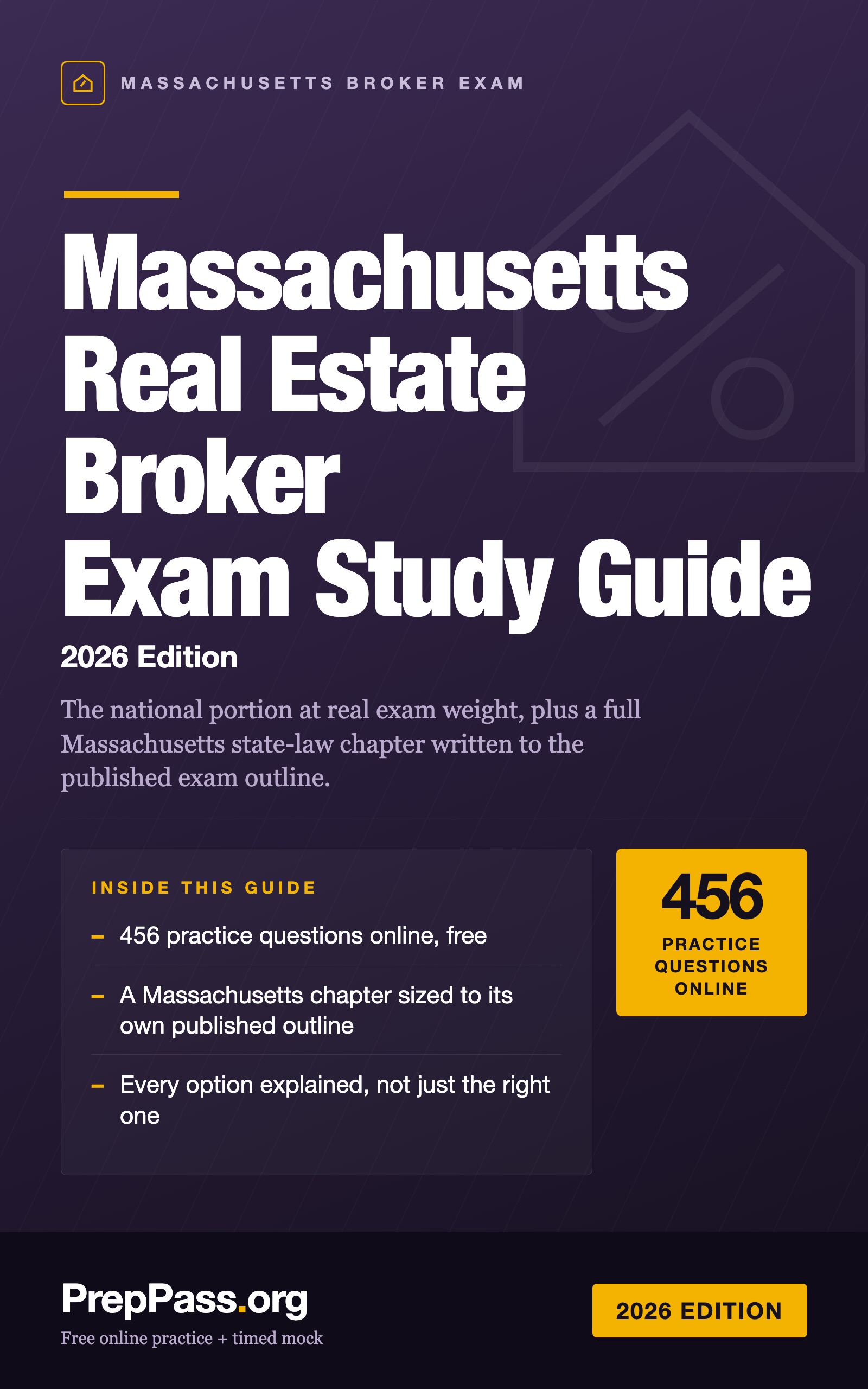
Massachusetts Real Estate Broker Exam Study Guide (2026)
The national portion at real exam weight, plus a Massachusetts chapter. The Massachusetts chapter is sized to the published outline — 9 areas, 40 scored items — area by area, not flattened.
- 全国通用部分 8 章,外加一整章马萨诸塞房地产法 —— PDF + EPUB 永久保存
- 一套 60 题的全国部分模拟考,答案键逐一解释四个选项,而不只是正确的那个
- 另有 20 道马萨诸塞房地产法题目,并附完整解析答案键
先做 10 题,看看讲解 —— 免费
先答完这 10 题,交卷后每题都有解析 —— 还会指出本指南里讲这一点的那一节。约 5 分钟,无需注册。
开始 10 道免费题翻开这本书看看
三页真实内页,直接从你将下载的 PDF 渲染而来 —— 一页讲解、一道带解析的例题、一页速查。没有任何一页是为了好看而重画的。
- 速查页Part C — Encumbrances a broker must read off a title report · PDF 第 102 页
一页可以随时翻回来的内容:把数字、期限或术语集中在一处。
- 一道题的完整解析Part II — Massachusetts State Law & Practice · PDF 第 292 页
一道练习题,连同答案和背后的推理 —— 不只是一个答案键。
- 怎么讲Part II — Massachusetts State Law & Practice · PDF 第 295 页
讲解页:用文字把知识讲清楚,顺序与考试考查的顺序一致。
包含什么,不包含什么
包含
- A Massachusetts chapter written to the published exam outline, area by area
- Where Massachusetts law departs from the national rule — both stated, so neither is guessed
- Supervision, trust accounts, brokerage operation and broker math
- A Massachusetts practice set with every option explained, not just the right one
- 456 practice questions online, free, from the same bank
- PDF (print & tab it) + EPUB (phone / e-reader)
不包含
- 不寄送纸质书 —— 这是一份你下载后可自行打印的文件
- 购书不含视频课程、讲师或一对一辅导 —— 站上的免费视频是另一回事
- 不含考试报名费与考点费用,这些仍需向官方机构缴纳
目录
查看 29 章及各章起始页
- Part C — Advertising and recordkeeping compliance第 14 页
- Part D — Consumer contact and transaction integrity第 16 页
- 2. Trust Funds, Escrow, and the Client’s Money第 30 页
- Part C — Records that survive an audit第 33 页
- Part D — Disputed money第 34 页
- 3. Agency at the Broker Level第 40 页
- Part C — Fiduciary duties, at the level a broker is examined on第 44 页
- Part D — Dual agency, designated agency, and the alternatives第 46 页
- 4. Contracts and Brokerage Agreements第 55 页
- Part C — Options, rights of first refusal, and installment contracts第 60 页
- Part D — Between contract and closing第 61 页
- 5. Fair Housing, Accessibility, and Antitrust: The Exposure You Carry Personally第 72 页
- Part C — The exemptions, and why they rarely save anyone第 78 页
- Part D — Disability: the distinction the exam always tests第 79 页
- 6. Ownership, Land Use Controls, and Transfer of Title第 95 页
- Part C — Encumbrances a broker must read off a title report第 101 页
- Part D — Legal descriptions第 103 页
- 7. Valuation, Financing, and the Federal Lending Laws第 113 页
- Part C — The instruments第 121 页
- Part D — Loan programs, structures, and qualifying第 123 页
- 8. Disclosures, Environmental Risk, and Property Management第 136 页
- Part C — The management agreement and the manager’s authority第 142 页
- Part D — Leases and tenancies第 144 页
- Practice Exam — 60 Questions第 153 页
- Answer Key and Explanations第 170 页
- Appendix A — Broker Math Cheat Sheet第 221 页
- Appendix B — Glossary第 243 页
- Appendix C — Exam-Day Strategy第 262 页
- Part II — Massachusetts State Law & Practice第 267 页
取自你将下载的那份 PDF,并标明各章起始页 —— 不是在此手工录入的。
免费读完整一章
完整的一章,与电子书正文一字不差。直接在此窗口滚动阅读;无需下载,无需邮箱。
在本页直接阅读第 9 章
我们没有拿轻松的绪论充数 —— 免费章节直接翻到书里最见功力的部分,让你在考试真正难的地方检验这本书讲得好不好。
Massachusetts is the state where a national study guide will most badly mislead you, and for a specific reason: the Commonwealth's own consumer, fair housing, lead, and tenancy statutes are far stricter than the federal law the national portion teaches, and four whole areas of the state exam exist because of them. Everything below is Massachusetts law — M.G.L. c.112 §§ 87PP–87DDD½ (the license law), 254 CMR (the Board's regulations), and the satellite chapters the outline reaches: c.93A, c.93I, c.111, c.131, c.143, c.148, c.151B, c.183A, c.185, c.186, and c.21A. Nothing here repeats the national portion; where Massachusetts departs from the national rule, both are named.
What the Massachusetts portion actually is
| Regulator | Board of Registration of Real Estate Brokers and Salespersons |
| Test vendor / document | PSI candidate information bulletin 4460, revision 2025-09-23 |
| National portion | 75 items |
| Massachusetts portion | 40 items, 40 points |
| Time for the Massachusetts portion | 90 minutes |
| Passing score | 70% — applied independently to each portion |
| Governing law | M.G.L. c.112 §§ 87PP–87DDD½; 254 CMR; c.93A; c.93I; c.111; c.131; c.143; c.148; c.151B; c.183A; c.185; c.186; c.21A |
Read the pass rule carefully, because it is the single most consequential fact on this page. The bulletin says you need a minimum of 70% to pass, and that 70% is applied independently per portion. A strong national score does not carry a weak Massachusetts score, and the reverse is equally true. Practically: 28 of 40 on the state side, on its own, every time. Candidates who allocate study time by "total questions" get this wrong and fail a paper they knew three-quarters of.
The published broker weighting
| # | Area (as published) | Broker items | Published band | Item share |
|---|---|---|---|---|
| I | Duties and Powers of the Board of Registration of Real Estate Brokers and Salespersons | 2 | 5% | 5.0% |
| II | Licensing Requirements | 4 | 10% | 10.0% |
| III | Requirements Governing Licensees | 14 | 33–35% | 35.0% |
| IV | Contracts | 2 | 5% | 5.0% |
| V | Consumer Protection Laws | 4 | 10–12% | 10.0% |
| VI | Environmental Issues and Hazardous Materials | 4 | 10% | 10.0% |
| VII | Massachusetts Fair Housing Law | 4 | 10% | 10.0% |
| VIII | Landlord Tenant Law | 4 | 10% | 10.0% |
| IX | Additional Topics | 2 | 5% | 5.0% |
| Total | 40 | 100% |
Two of those bands are ranges, and this book will not pretend otherwise. PSI publishes area III as 33–35% and area V as 10–12%. The broker item counts — 14 and 4 — imply exactly 35.0% and 10.0%. Those are the item-derived figures, not published percentages, and the chapter is sized to the item counts because the item counts are what you actually sit. Where a competing guide prints "33%" or "12%" as though PSI had fixed a single number, it has resolved a range the vendor left open.
⚠ The structural trap: Massachusetts has no "Agency" heading
Massachusetts folds agency into area III as sub-item E, "Agency and Non-Agency Relationships." There is no standalone Agency heading anywhere on the Massachusetts outline. This one lettered subtopic did survive in the outline record and can be cited as published — and it matters enormously, because a candidate, or a study product, that matches topic names against this outline will report zero agency coverage for Massachusetts. It is not zero. Agency sits inside the 14-item, 35% block that is the largest area on the paper, alongside advertising, broker-salesperson relations, conflicts, escrow and home inspection.
If your study material shows a Massachusetts "Agency" chapter weighted at 0%, it matched on headings and it is wrong. Dual agency, designated agency, subagency and the facilitator are all live Massachusetts exam content, and Massachusetts's rules for each differ from the national defaults in ways this chapter sets out.
The Massachusetts signature: environment is a full 10%
Most states test no state environmental law at all. Massachusetts gives area VI a full 10% — four items covering lead paint, Title 5 private sewage disposal, smoke and carbon monoxide detection, and wetlands. None of it is national content. Together with areas V, VII and VIII, 40% of the Massachusetts portion is statutes a national guide does not cover.
A note on the source: apart from sub-item E discussed above, the lettered sub-lists under each area heading are not reproduced here, because this book will not present a subtopic list it cannot point to in the published outline. Each section instead tells you what the exam actually asks about in that area. (Note also that mass.gov returns a 403 to automated requests; PSI's own endpoint serves the bulletin.)
1. I. Duties and Powers of the Board of Registration — 2 of 40 scored items (5%)
The full name is the Board of Registration of Real Estate Brokers and Salespersons. Only two items, and the bulletin gives the area only two subtopics: examination of records and sanctions. Both live in M.G.L. c.112.
Records. § 87BBB(A) empowers the Board to conduct investigations and hearings and to require by summons the attendance and testimony of witnesses and the production of books and papers. If a licensee refuses, the Board applies to the superior court for the county where the investigation is carried on, or where the witness resides or has his principal place of business, and that court can order him to appear and produce. The Board does not seize records itself — enforcement runs through a judge.
Hearings and appeals. No renewal may be refused and no license suspended or revoked except after a hearing, on at least ten days' written notice stating the grounds and enclosing the complaint. The licensee may appear personally and by counsel, cross-examine, and produce evidence. An aggrieved licensee appeals to the superior court sitting in equity within twenty days of receiving notice of the decision — and that appeal does not stay the suspension or revocation while it is pending.
Sanctions, including one that is mandatory. § 87AAA lists the grounds on which the Board may suspend, revoke or refuse to renew, and adds a sanction the Board has no discretion over: once the Commission Against Discrimination has made a final finding that a licensee committed an unlawful practice under c.151B in the course of his occupation, the Board shall suspend forthwith for sixty days, and for ninety days if the violation came within two years of a prior final violation. Racial solicitation under clause (k) also carries a fine of $1,000 to $2,500, up to six months, or both; unlicensed practice carries a fine of up to $500 under § 87CCC.
2. II. Licensing Requirements — 4 of 40 scored items (10%)
Who needs a license. § 87PP defines a broker as anyone who, for another and for consideration, sells, exchanges, purchases, rents, leases, lists or negotiates real estate, or assists in procuring prospects. A salesperson does everything in that definition except complete the negotiation. And § 87DDD½ adds a sentence with no national counterpart: no person may engage in the business of finding dwelling accommodations for prospective tenants for a fee unless licensed. That is why apartment-finding services sit inside the Massachusetts license law even though they never list or sell anything.
Becoming a broker. A candidate must be at least 18, hold a current Massachusetts salesperson license, and show three years affiliated with an active Massachusetts broker as an active salesperson at a minimum of 25 hours per calendar week (254 CMR 2.00(6)) — measured week by week, not as an average — with the experience no more than two years old at the examination. § 87SS requires 40 classroom hours of Board-approved broker courses, and exempts a Massachusetts attorney from the examination. § 87TT requires a $5,000 surety bond conditioned on the broker's faithful accounting for all funds entrusted to him; the Board may revoke if the bond lapses.
Active, inactive, expired. A license runs two years, renews biennially without examination, and expires on the licensee's birthday. Continuing education must be completed before renewing as active; bulletin 4460 states the current requirement as 12 hours. A licensee who cannot certify it is renewed on inactive status under § 87XX½ — the Board does not refuse the renewal and the license does not lapse, it comes back inactive. An inactive licensee may not practice, but the section preserves one carve-out: he may assist with or direct the procuring of prospects and may receive referral fees for that, and may reactivate on completing the education for the immediately preceding renewal period.
Telling the Board. A salesperson must promptly give written notice of any change of business address (§ 87VV); a broker, written notice of any change of business location (§ 87YY). Failure is a ground for revocation. A resident broker must maintain a usual place of business in the Commonwealth and display the license conspicuously there.
3. III. Requirements Governing Licensees — 14 of 40 scored items (35%)
The largest block on the paper, and — because of sub-item E — the home of Massachusetts agency law.
Advertising and solicitation
§ 87AAA(k) forbids soliciting the sale or listing of residential property on the ground of an alleged change of value due to the entry into the neighborhood of persons of another race, economic level, religion, or ethnic origin, and forbids distributing material designed to induce an owner to sell for that reason. Note that Massachusetts adds economic level to the usual list. The penalty is not merely license discipline: a fine of $1,000 to $2,500, imprisonment up to six months, or both. The offense is the racial or economic predicate, so documenting an accurate price trend is no defense, and the prohibition reaches distributed material generally — omitting names and streets saves nothing.
Broker and salesperson
Under § 87RR a salesperson may not run his own real estate business and acts only as the representative of a broker, who must approve the negotiation and completion of transactions and "shall be responsible with the salesman" for any § 87AAA violation the salesperson commits. Joint responsibility is the point, and the section makes no distinction by employment form: a salesperson may be an employee or an independent contractor, paid on commission only, and is under the broker's supervision either way. A salesperson may be affiliated with only one broker at a time, and may accept compensation for licensed acts from no one but his own broker — disclosure to the broker does not cure a payment taken from a cooperating firm, because the statute bars accepting it. And § 87RR closes with a recovery bar: no person shall recover in any suit for compensation for services as a broker performed within the Commonwealth unless he was a duly licensed broker at the time the services were performed. Licensing up later cannot reach back.
Where Massachusetts departs from the national rule: agency, and the facilitator
§ 87AAA¾ governs residential property of one to four dwellings, and it is where the national manuscript's agency chapter and Massachusetts practice diverge.
- Dual agency requires informed written consent from buyer and seller on the Board's prescribed form, signed and dated — three requirements: consent, in writing, on the Board's form. Silence is not consent, and counsel on both sides is no substitute. And there is a second, later step the national model has no analogue for: notice of the dual agency must also be given to the purchaser and the seller after the listed property is first shown. Consent given in the abstract at the start of a relationship is easy to forget by the time a real property and a real conflict appear.
- Designated agency also requires informed written consent. Once designated agents are appointed for both sides, the appointing broker is presumed a dual agent who exclusively represents neither party; information known to a designated agent is not imputed to the broker or other affiliated licensees; and the appointment does not limit the broker's own liability. Both the designated agent and the appointing broker must reveal known material defects. Consent is conclusively presumed if the disclosure form is signed no later than the offer or the purchase and sale agreement, whichever comes first — the earlier of the two, so a signature obtained later in the deal does not earn the presumption.
- Subagency requires that the seller be told about vicarious liability and consent in writing. The disclosure is specific: the seller is being told she may answer for the conduct of a firm she never hired.
- A facilitator represents neither party and acts in no agency capacity.
Contrast the national chapter, which treats dual-agency consent as a matter of general written disclosure and designated agency as a species of dual agency. In Massachusetts the form is prescribed by the Board, the timing is fixed by statute, and there is a post-showing notice obligation on top.
The facilitator is not a transaction broker by another name. § 87AAA¾(f) defines the facilitator as one who represents neither party and acts in no agency capacity — a service relationship rather than an agency one. Two consequences follow that catch candidates out. First, the facilitator is not a compensation arrangement: a broker does not become a facilitator by agreeing to be paid a flat fee, and cannot become one after the fact to escape a duty already owed. Second, the facilitator status does not switch off the disclosure obligations that run to everyone. The obligation to reveal known material defects in a listed property is imposed by § 87AAA¾(c) on the designated agent and the appointing broker, and § 87AAA(a)'s bar on knowing substantial misrepresentation applies to every licensed act, however the licensee has styled the relationship.
A note on scale. Read the four relationships as one system. Seller's agent and buyer's agent are the ordinary cases. Dual agency is what happens when one licensee stands on both sides. Designated agency is Massachusetts's attempt to keep one firm on both sides while keeping the individual agents apart — and the statute pays for that by presuming the appointing broker a dual agent and refusing to let the appointment shrink his liability. Subagency is the relationship that reaches outside the firm, which is exactly why the vicarious-liability warning attaches to it and to nothing else. Each of the four is defined by who is represented, not by who pays.
Where it bites
A Massachusetts firm lists a three-family in Somerville. The listing agent knows from a conversation with the seller that the second-floor bathroom leaks into the unit below; the seller asks her not to mention it. The firm's broker of record appoints her as the seller's designated agent and appoints a colleague as the buyer's designated agent. The buyer's designated agent asks the broker of record what he knows about the building; the broker, having heard nothing, says nothing. At the signing of the first written contract to purchase, nobody hands the buyer a brochure. The buyer's rent for the unit she is vacating included a fee the firm's rental desk charged her in September 2025, though the landlord had engaged the broker.
Count the Massachusetts violations. § 87AAA¾(c) obliges both the designated agent and the appointing broker to reveal known material defects — the listing agent's knowledge is not imputed upward, but her own duty to reveal is personal and the seller's instruction cannot waive it. The broker of record is presumed a dual agent under the same subsection and his liability is not limited by having made the appointments. § 87YY½ required the consumer-affairs brochure at the signing of the first written contract, and no one delivered it. And § 87DDD½ as amended by St.2025 c.9 § 43 made that September rental fee unlawful, because the landlord, not the tenant, engaged the broker. On top of the license exposure sits c.93A: a knowing failure to disclose a defect is an unfair or deceptive act, and § 9(3) opens the door to two to three times actual damages plus fees, which will exceed anything the Board does.
Conflicts, documents, and money
§ 87AAA makes it a ground for discipline to:
- (a) knowingly make a substantial misrepresentation in performing a licensed act;
- (b) act as broker and undisclosed principal in the same transaction — the vice being that the broker sits on both sides while the seller believes she has an agent working only for her;
- act for more than one party without the knowledge and consent of all;
- (f) take an undisclosed commission, rebate or profit on a principal's expenditures;
- (g) induce a party to break an existing contract or lease for the licensee's gain;
- (e) pay or split commissions with someone required to be licensed who is not;
- (i) fail to give both the buyer and the seller a copy of the purchase and sale agreement — a simple rule, easy to breach in a busy office, which is presumably why it earned its own clause;
- (d) fail within a reasonable time to account for or remit money belonging to others; and
- (h) commingle a principal's money with the broker's own.
The $5,000 bond under § 87TT points the same way, being conditioned on faithful accounting.
Rental fees — the 2025 change
As amended by St.2025 c.9 § 43, effective 1 August 2025, § 87DDD½ lets a licensee contract solely with a prospective tenant to find rental property, or solely with a landlord to find a tenant, and provides that "any fee shall only be paid by the party, lessor or tenant who originally engaged and entered into a contract with the licensed broker or salesperson." Read with the parallel amendment to c.186 § 15B, which now binds the lessor's agent as well as the lessor, the result is blunt: a tenant who did not engage the broker cannot be charged the broker's fee. The advertisement cannot decide it, and the fee cannot be split between both sides — the statute says solely.
Home inspectors
§ 87YY½ requires the licensee, at the signing of the first written contract to purchase, to hand the buyer the home inspection brochure published by the office of consumer affairs and business regulation, and forbids recommending a specific inspection company or inspector. A complete Board-prepared list of licensed inspectors may be given on request — the opposite of narrowing it to a favored few. The prohibition lifts only where a written contract or written agency disclosure shows the broker acts exclusively as the buyer's broker.
购买前
- 怎么拿到?
- 付款后下载入口立即出现在本页,链接同时发到你的邮箱。无需注册账号。
- 不合适怎么办?
- 14 天内发邮件即可全额退款,无需理由。
- 免费练习会取消吗?
- 不会。站上的每一道练习题、计时模考和免费章节都继续免费。这本书是「学」的那一半,不是把免费部分围起来的门。
- 能在手机上看吗?
- 可以 —— EPUB 适合手机和电子书阅读器,PDF 适合打印和贴标签,两种都给你。
详细信息
The national portion at real exam weight, plus a Massachusetts chapter. The Massachusetts chapter is sized to the published outline — 9 areas, 40 scored items — area by area, not flattened.
- Format: PDF + EPUB download · 299 pages
- 80 practice questions in the book, with a full answer key
- 456 free practice questions for this exam on PrepPass, included at no cost
- $14.99 one-time — no subscription
- 14-day money-back guarantee · refund policy
- Cross-referenced against: PSI bulletin 4460 (rev 2025-09-23)
- Last updated: September 2026
- 官方来源核验(PSI bulletin 4460 (rev 2025-09-23))
- 456 道免费练习题
- 即时下载,永久拥有
real estate broker pre-license course 要 $200–$1,000。这本书讲的是同一门考试 —— 同样的规则、核对到最新标准 —— 只需一次性 $14.99,永久归你。
练习免费,为什么还要买书?
我们的练习题和计时模考一直免费 —— 网站上的东西不会因为这本书而收起来。这本 $14.99 的书是「学」的那一半:知识本身,按顺序讲清楚,存成一份属于你的文件。
- 系统讲解 —— 每个考试部分按章节从头讲到尾,不只是题目
- 可打印可贴标签 —— 一份适合打印的 PDF,能划重点、做批注、带到书桌前
- 随处离线学 —— EPUB 放手机或电子书阅读器;不用 wifi,不用一堆浏览器标签
- 全在一处 —— 章节、每章速记卡、练习题都在同一份文件里
- 永久归你 —— 一次 $14.99,即时下载,无订阅
而且零风险:14 天退款保证 —— 不满意?发邮件即可全额退款,无需理由。 详见退款政策。
14 天退款保证 · 全额退款,无需理由。
一次购买,永久下载访问。此电子书是完整的 Massachusetts Real Estate Broker 学习指南,含 PDF 与 EPUB。仅为教育性摘要,非专业或法律意见 —— 请始终以官方来源核实当前规定。最后更新:September 2026。