Maryland Real Estate Broker · 2026 版
Maryland Real Estate Broker Exam Study Guide (2026)
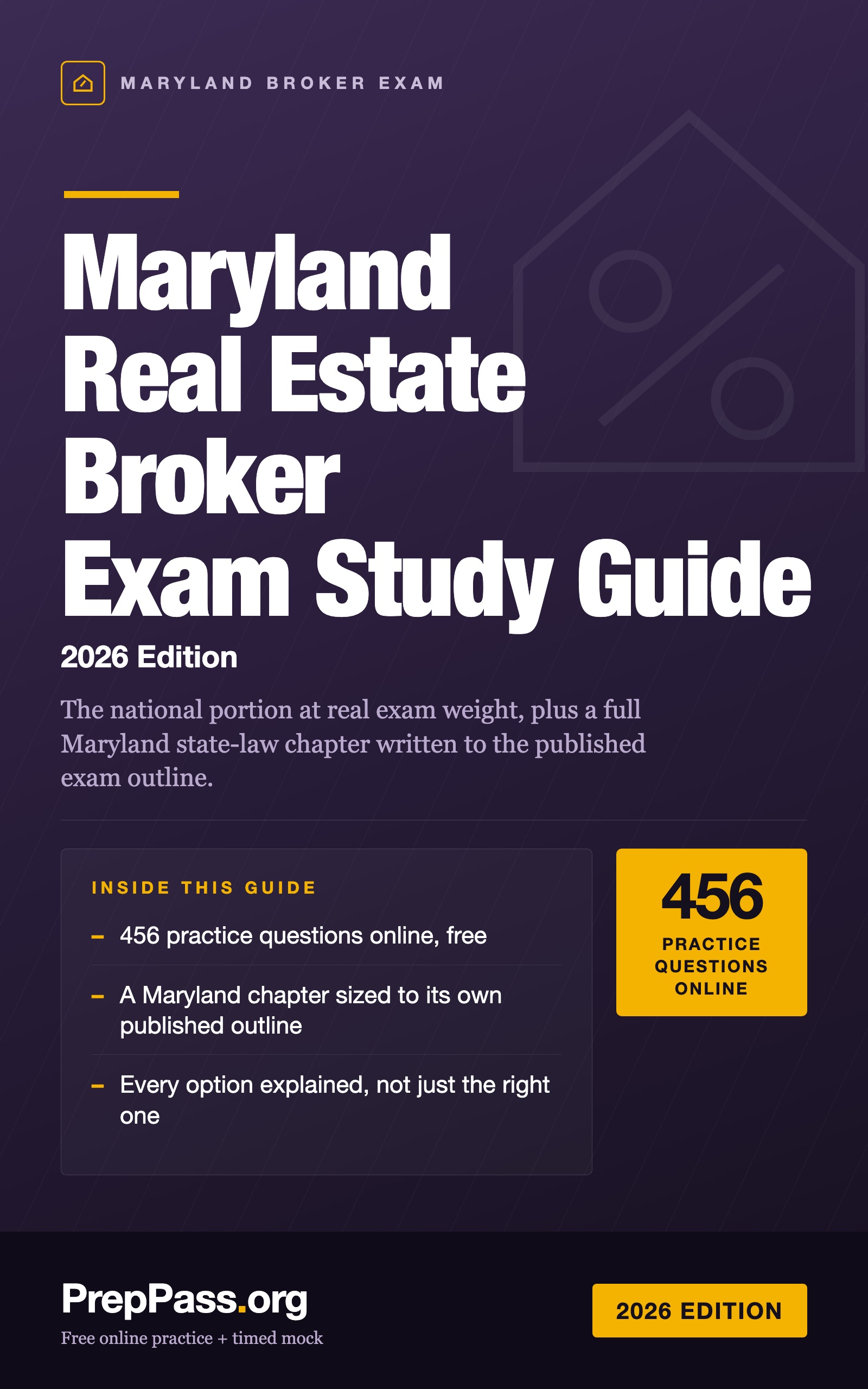
The national portion at real exam weight, plus a Maryland chapter. The Maryland chapter is sized to the published outline — 6 areas, 40 scored items — area by area, not flattened.
- 全国通用部分 8 章,外加一整章马里兰房地产法 —— PDF + EPUB 永久保存
- 一套 60 题的全国部分模拟考,答案键逐一解释四个选项,而不只是正确的那个
- 另有 20 道马里兰房地产法题目,并附完整解析答案键
先做 10 题,看看讲解 —— 免费
先答完这 10 题,交卷后每题都有解析 —— 还会指出本指南里讲这一点的那一节。约 5 分钟,无需注册。
开始 10 道免费题翻开这本书看看
三页真实内页,直接从你将下载的 PDF 渲染而来 —— 一页讲解、一道带解析的例题、一页速查。没有任何一页是为了好看而重画的。
- 速查页Part C — Encumbrances a broker must read off a title report · PDF 第 102 页
一页可以随时翻回来的内容:把数字、期限或术语集中在一处。
- 一道题的完整解析Part II — Maryland State Law & Practice · PDF 第 286 页
一道练习题,连同答案和背后的推理 —— 不只是一个答案键。
- 怎么讲Part II — Maryland State Law & Practice · PDF 第 291 页
讲解页:用文字把知识讲清楚,顺序与考试考查的顺序一致。
包含什么,不包含什么
包含
- A Maryland chapter written to the published exam outline, area by area
- Where Maryland law departs from the national rule — both stated, so neither is guessed
- Supervision, trust accounts, brokerage operation and broker math
- A Maryland practice set with every option explained, not just the right one
- 456 practice questions online, free, from the same bank
- PDF (print & tab it) + EPUB (phone / e-reader)
不包含
- 不寄送纸质书 —— 这是一份你下载后可自行打印的文件
- 购书不含视频课程、讲师或一对一辅导 —— 站上的免费视频是另一回事
- 不含考试报名费与考点费用,这些仍需向官方机构缴纳
目录
查看 29 章及各章起始页
- Part C — Advertising and recordkeeping compliance第 14 页
- Part D — Consumer contact and transaction integrity第 16 页
- 2. Trust Funds, Escrow, and the Client’s Money第 30 页
- Part C — Records that survive an audit第 33 页
- Part D — Disputed money第 34 页
- 3. Agency at the Broker Level第 40 页
- Part C — Fiduciary duties, at the level a broker is examined on第 44 页
- Part D — Dual agency, designated agency, and the alternatives第 46 页
- 4. Contracts and Brokerage Agreements第 55 页
- Part C — Options, rights of first refusal, and installment contracts第 60 页
- Part D — Between contract and closing第 61 页
- 5. Fair Housing, Accessibility, and Antitrust: The Exposure You Carry Personally第 72 页
- Part C — The exemptions, and why they rarely save anyone第 78 页
- Part D — Disability: the distinction the exam always tests第 79 页
- 6. Ownership, Land Use Controls, and Transfer of Title第 95 页
- Part C — Encumbrances a broker must read off a title report第 101 页
- Part D — Legal descriptions第 103 页
- 7. Valuation, Financing, and the Federal Lending Laws第 113 页
- Part C — The instruments第 121 页
- Part D — Loan programs, structures, and qualifying第 123 页
- 8. Disclosures, Environmental Risk, and Property Management第 136 页
- Part C — The management agreement and the manager’s authority第 142 页
- Part D — Leases and tenancies第 144 页
- Practice Exam — 60 Questions第 153 页
- Answer Key and Explanations第 170 页
- Appendix A — Broker Math Cheat Sheet第 221 页
- Appendix B — Glossary第 243 页
- Appendix C — Exam-Day Strategy第 262 页
- Part II — Maryland State Law & Practice第 267 页
取自你将下载的那份 PDF,并标明各章起始页 —— 不是在此手工录入的。
免费读完整一章
完整的一章,与电子书正文一字不差。直接在此窗口滚动阅读;无需下载,无需邮箱。
在本页直接阅读第 9 章
我们没有拿轻松的绪论充数 —— 免费章节直接翻到书里最见功力的部分,让你在考试真正难的地方检验这本书讲得好不好。
Maryland does not test broker candidates on a longer version of the salesperson paper. It tests a different paper, weighted differently, in half an hour. Everything below is Maryland law — Business Occupations and Professions Article Title 17, the Real Property Article where it reaches brokerage, and the Commission's regulations at COMAR 09.11. Nothing in this chapter repeats the national portion; where Maryland's rule and the national rule diverge, both are named so you can see the seam.
What the Maryland portion actually is
| Regulator | Maryland Real Estate Commission (MREC), within the Maryland Department of Labor |
| Test vendor / document | PSI, candidate information bulletin 529, revision 2024-08-15 |
| National portion | 75 items |
| Maryland portion | 40 items, 40 points |
| Time for the Maryland portion | 30 minutes |
| Passing score | 28 of 40 |
| Governing law | Md. Code, Bus. Occ. & Prof. Title 17; Md. Code, Real Property Art.; COMAR 09.11 |
Thirty minutes for forty items is forty-five seconds per question, and it is the shortest state portion of any state in this series. That single number should shape how you study. You will not have time to reason a Maryland answer out from first principles; you have time to recognize it. Deadlines, dollar caps and hour counts have to be automatic — the "7 business days," the "$50,000," the "15 clock hours," the "5 years" — because a candidate who has to reconstruct them will run out of clock before the last five items.
Maryland licenses four tiers, and the exam expects you to keep them straight: salesperson, associate broker (someone who has met every broker requirement but practices under another broker, § 17-304), broker, and branch office manager (§ 17-518(d)). Two of those tiers — broker and branch office manager — carry supervisory duties the salesperson paper barely touches, and that is where the broker column of the outline puts its extra items.
The published broker weighting — and a caveat you should read before you trust any other study guide
| # | Area (as published) | Broker items | Share | Salesperson items |
|---|---|---|---|---|
| 1 | Duties and Powers of the Real Estate Commission | 5 | 12.5% | 4 |
| 2 | Licensing Requirements | 8 | 20.0% | 4 |
| 3 | Brokerage Relationships | 7 | 17.5% | 7 |
| 4 | Supervision | 6 | 15.0% | 5 |
| 5 | Business Conduct | 9 | 22.5% | 6 |
| 6 | Ethics | 5 | 12.5% | 4 |
| Total | 40 | 100% |
The caveat. A weighting of 4 / 4 / 7 / 6 circulates widely in secondhand Maryland study material. Those are the salesperson numbers, and they are incomplete besides. The broker column differs in four of the six areas — most sharply in Licensing Requirements, which doubles from 4 items to 8, and in Business Conduct, which goes from 6 to 9. Follow the salesperson weights and you will under-study a full quarter of the broker paper. This chapter is sized to the broker column above.
One more honest note about the source document. The lettered sub-lists that PSI prints under each area heading are not reproduced here, because this book will not present a subtopic list it cannot point to in the published outline. What each section below tells you instead is what the exam actually asks about in that area — derived from area weight and from the tested content itself, not from a transcription we cannot verify.
1. Duties and Powers of the Real Estate Commission — 5 of 40 scored items (12.5%)
The Commission sits in the Maryland Department of Labor (§ 17-201) and has nine members: five licensed practitioners and four consumer members (§ 17-202). It adopts regulations and — this is unusual and heavily tested — it is required by § 17-207 to adopt a code of ethics by regulation, which is why Maryland's ethics rules are enforceable law at COMAR 09.11.02 rather than trade-association aspiration. Its disciplinary catalog is § 17-322, thirty-five listed grounds, backed by § 17-322(c)(1): a penalty "not exceeding $5,000 for each violation," imposed instead of or in addition to a reprimand, suspension or revocation. Note the words for each violation — several violations in one transaction are fined separately. § 17-208(c) marks the outer limit of the Commission's rulemaking: it may not adopt a regulation allowing a conditional or temporary license.
Process. A complaint must be in writing and state the facts, and must be sworn — except advertising complaints, which may be anonymous (§ 17-323). The Commission, a hearing board, or the executive director may hold hearings, administer oaths and subpoena witnesses (§ 17-209). Before final action the licensee gets a hearing on notice served personally or by certified mail at least 10 days ahead (§ 17-324(d)). Appeal runs under State Government Art. §§ 10-222 and 10-223, and a court may stay a suspension only on a bond of up to $50,000 (§ 17-329).
Where Maryland departs from the national rule: the Guaranty Fund
The national manuscript describes recovery funds generically as a remedy of last resort after a claimant sues and cannot collect. Maryland's Guaranty Fund is not that. It is administrative, and there is no requirement of a court judgment anywhere in Subtitle 4. A claim is submitted to the Commission within 3 years after the claimant discovers, or by ordinary diligence should have discovered, the loss (§ 17-404(d)), in writing and under oath (§ 17-406); the Commission orders payment after a hearing at which the claimant carries the burden of proof (§§ 17-407, 17-410). The cap is $50,000 per claim (§§ 17-404(b), 17-410(b)(2)), the Fund is held at a minimum of $250,000 (§ 17-402), and every broker-supplied sales contract must notify the buyer that the protection exists (§ 17-405). Then § 17-412 does the part candidates forget: on payment, the responsible licensee's license is suspended immediately and without further proceedings, and stays suspended until the Fund is repaid in full with interest.
Where it bites. A salesperson pockets a $12,000 deposit and disappears. The buyer does not have to sue anyone. She files a sworn claim with the Commission, proves it at a hearing, and is paid. The broker's file, meanwhile, is being read under § 17-507(d): on reasonable notice a licensee must let a Commission representative enter the place of business during business hours to inspect records and must pay for any paper copies requested — and trust records are stricter still, displayed to the Commission on demand, with no notice at all (§ 17-507(d)(3)). Refusing is not a delay tactic; it is a ground for summary suspension under § 17-328(a)(2).
The trap. Candidates answer "obtain a judgment first." Wrong statute, wrong state.
2. Licensing Requirements — 8 of 40 scored items (20%)
Twice the salesperson weight. Expect items on what needs a license, the exemptions, the ladder to broker, status changes, renewal, continuing education, entities, offices and ownership percentage.
What needs a license. Brokerage services require a license before they are provided (§§ 17-301, 17-601). Exemptions cover lawyers acting in their regular practice, home builders selling homes they built, and agents managing or leasing for the owner or broker. § 17-302 carries the two numeric exemptions that get tested: an individual may sell, in a calendar year, 6 or fewer unimproved lots that the individual owns, and separately may subdivide and sell unimproved property owned for 10 years or more — with an heir permitted to tack the years of preceding owners in the line of inheritance.
The ladder. Broker qualification under § 17-305 is 3 years of active, lawful practice as a licensed salesperson plus a Commission-approved broker course — 135 clock hours under COMAR 09.11.01.12 — with both education and experience waived for a Maryland-admitted lawyer. Broker applicants also file a credit report (§ 17-307(b)), which is a Maryland peculiarity: the state screens the finances of the person who will hold other people's escrow money.
Status and renewal. Transfers between brokers run through § 17-311. A license goes inactive on request or on loss of affiliation and expires 3 years later if not reactivated (§ 17-316(c)) — and inactive is not dormant: renewal and continuing education obligations continue, and the Commission keeps its power to discipline. Chapter 330 of 2024 (SB 564, effective 1 October 2024) rewrote renewal: licenses now expire on a staggered basis (§ 17-314(a)), and continuing education must be complete not later than 30 days before expiration (§ 17-314(c)(1)(iv)). Finishing on the last day no longer satisfies the statute.
Continuing education. 15 clock hours per two-year term (§ 17-315(a)(1)), of which § 17-315(b)(2) spends most: a 3-hour legislative and regulatory update, a 2-hour fair housing course, a 3-hour Maryland Code of Ethics course, a 3-hour brokerage relationships and disclosures course, and — for a broker, branch office manager, or team leader — a 1.5-hour broker supervision course. A clock hour is 50 minutes of instruction per 60-minute hour (COMAR 09.11.06.01B(3)). COMAR 09.11.01.23, amended effective 27 April 2026, adds a front-end deadline: a newly designated broker, branch office manager or team leader must take the supervision course within 90 days of the designation unless it was completed in the previous four years.
Entities, offices, ownership. Maryland licenses individuals, not companies. Brokerage services may be provided through a corporation, LLC or partnership only if a licensed broker is designated broker of the firm and is individually responsible for those services (§ 17-321(b)(2), (e)). The entity itself is never the licensee — it holds no license to suspend. A resident broker must maintain an office in Maryland (§ 17-517), and COMAR 09.11.01.11 rules out an answering service, a message device or a mail drop. A branch office needs a branch office certificate and a designated manager — the broker, a licensed associate broker, a salesperson with 3 years' experience, or a salesperson who has completed the broker prelicense course and passed the broker examination (§ 17-518(b), (d)); the certificate expires the first April 30 falling in an even-numbered year. Every office displays a sign reading "real estate," "realtor" or "realtist" (§ 17-519). And § 17-511(b) caps associate brokers and salespersons — counting spouse, parent, child and sibling — at 50% of the interest in a brokerage business, so control stays with the broker who answers for it.
3. Brokerage Relationships — 7 of 40 scored items (17.5%)
The one area where the broker and salesperson counts are identical, which tells you Maryland regards these rules as foundational rather than supervisory. Listing agreements, agency disclosure, conflict-of-interest disclosure, and the seller's property condition statement.
Scope. Part III of Subtitle 5 covers residential property of one to four single-family units and residentially zoned unimproved land, but not leases of 125 days or less (§ 17-529).
Brokerage agreements. A seller's brokerage agreement must carry a definite termination date effective automatically without notice from the client, state the compensation, say whether the broker may cooperate and share it, explain what earns it, and provide for cancellation (§ 17-534(b)). Accepting a listing without a definite termination date is itself a disciplinary ground (§ 17-322(b)(10)). Net listings are prohibited (§ 17-322(b)(11); COMAR 09.11.01.01B). All residential listing contracts must be written and signed, with a copy to the seller before the licensee advertises, shows, or offers the property (COMAR 09.11.01.10) — the trigger is the first act of marketing, not a number of days.
Where Maryland departs from the national rule: no transaction brokerage, and intra-company agents
The national chapter on agency treats "transaction broker" or "facilitator" as a mainstream fourth option. Maryland does not have it. The recognized relationships under § 17-528 are seller's agent, buyer's agent, subagent, dual agent, and intra-company agent. (SB 384 of 2026 would have added transaction brokerage; it was withdrawn by its sponsor.) And Maryland's dual-agency mechanics are stricter than the national default: § 17-530.1(a) prohibits dual agency, then permits it only on the written informed consent of all parties — and consent alone is not enough. The dual agent must then assign one intra-company agent to each side (§ 17-530.1(b)(1)(ii)), each of whom gives their client full service including advice on price and negotiating strategy (§ 17-530.1(b)(1)(v)), with confidential information blocked from crossing (§ 17-530.1(b)(1)(iii)). Contrast the national manuscript's dual agent, who typically goes silent on price for both sides. In Maryland the firm does not go silent — it splits.
Disclosure timing. The written agency disclosure must be made not later than the first scheduled face-to-face contact (§ 17-530(b)(1)). Where first contact is not face to face, the licensee discloses through that medium (§ 17-530(a)(3)). At an open house, a conspicuously displayed Commission notice suffices (§ 17-530(b)(2)). The Commission supplies the standard disclosure and dual-agency consent forms under § 17-530.2 (COMAR 09.11.08.01, unchanged since 2017); the consent is documented on the form, not filed with the Commission.
Conflicts. A licensee acquiring an interest in property discloses licensing status in writing, no later than when the offer is submitted; a licensee selling their own property discloses the ownership interest when the property is offered — both extending to immediate family, entities the licensee has an interest in, and brokerage or team employees (COMAR 09.11.02.02D).
The condition statement. Real Property § 10-702 governs residential property of four or fewer units: the seller delivers a disclosure or a disclaimer on the Commission's form on or before entering into the contract, and even under the disclaimer must reveal latent defects actually known — material defects not reasonably discoverable by careful visual inspection that pose a direct threat to health or safety. A buyer who never receives it has an unconditional right to rescind and recover the deposit, subject to the mortgage-application cut-offs in § 10-702(h)(2); any contractual waiver is void (§ 10-702(k)(1)).
购买前
- 怎么拿到?
- 付款后下载入口立即出现在本页,链接同时发到你的邮箱。无需注册账号。
- 不合适怎么办?
- 14 天内发邮件即可全额退款,无需理由。
- 免费练习会取消吗?
- 不会。站上的每一道练习题、计时模考和免费章节都继续免费。这本书是「学」的那一半,不是把免费部分围起来的门。
- 能在手机上看吗?
- 可以 —— EPUB 适合手机和电子书阅读器,PDF 适合打印和贴标签,两种都给你。
详细信息
The national portion at real exam weight, plus a Maryland chapter. The Maryland chapter is sized to the published outline — 6 areas, 40 scored items — area by area, not flattened.
- Format: PDF + EPUB download · 293 pages
- 80 practice questions in the book, with a full answer key
- 456 free practice questions for this exam on PrepPass, included at no cost
- $14.99 one-time — no subscription
- 14-day money-back guarantee · refund policy
- Cross-referenced against: PSI bulletin 529 (rev 2024-08-15)
- Last updated: September 2026
- 官方来源核验(PSI bulletin 529 (rev 2024-08-15))
- 456 道免费练习题
- 即时下载,永久拥有
real estate broker pre-license course 要 $200–$1,000。这本书讲的是同一门考试 —— 同样的规则、核对到最新标准 —— 只需一次性 $14.99,永久归你。
练习免费,为什么还要买书?
我们的练习题和计时模考一直免费 —— 网站上的东西不会因为这本书而收起来。这本 $14.99 的书是「学」的那一半:知识本身,按顺序讲清楚,存成一份属于你的文件。
- 系统讲解 —— 每个考试部分按章节从头讲到尾,不只是题目
- 可打印可贴标签 —— 一份适合打印的 PDF,能划重点、做批注、带到书桌前
- 随处离线学 —— EPUB 放手机或电子书阅读器;不用 wifi,不用一堆浏览器标签
- 全在一处 —— 章节、每章速记卡、练习题都在同一份文件里
- 永久归你 —— 一次 $14.99,即时下载,无订阅
而且零风险:14 天退款保证 —— 不满意?发邮件即可全额退款,无需理由。 详见退款政策。
14 天退款保证 · 全额退款,无需理由。
一次购买,永久下载访问。此电子书是完整的 Maryland Real Estate Broker 学习指南,含 PDF 与 EPUB。仅为教育性摘要,非专业或法律意见 —— 请始终以官方来源核实当前规定。最后更新:September 2026。