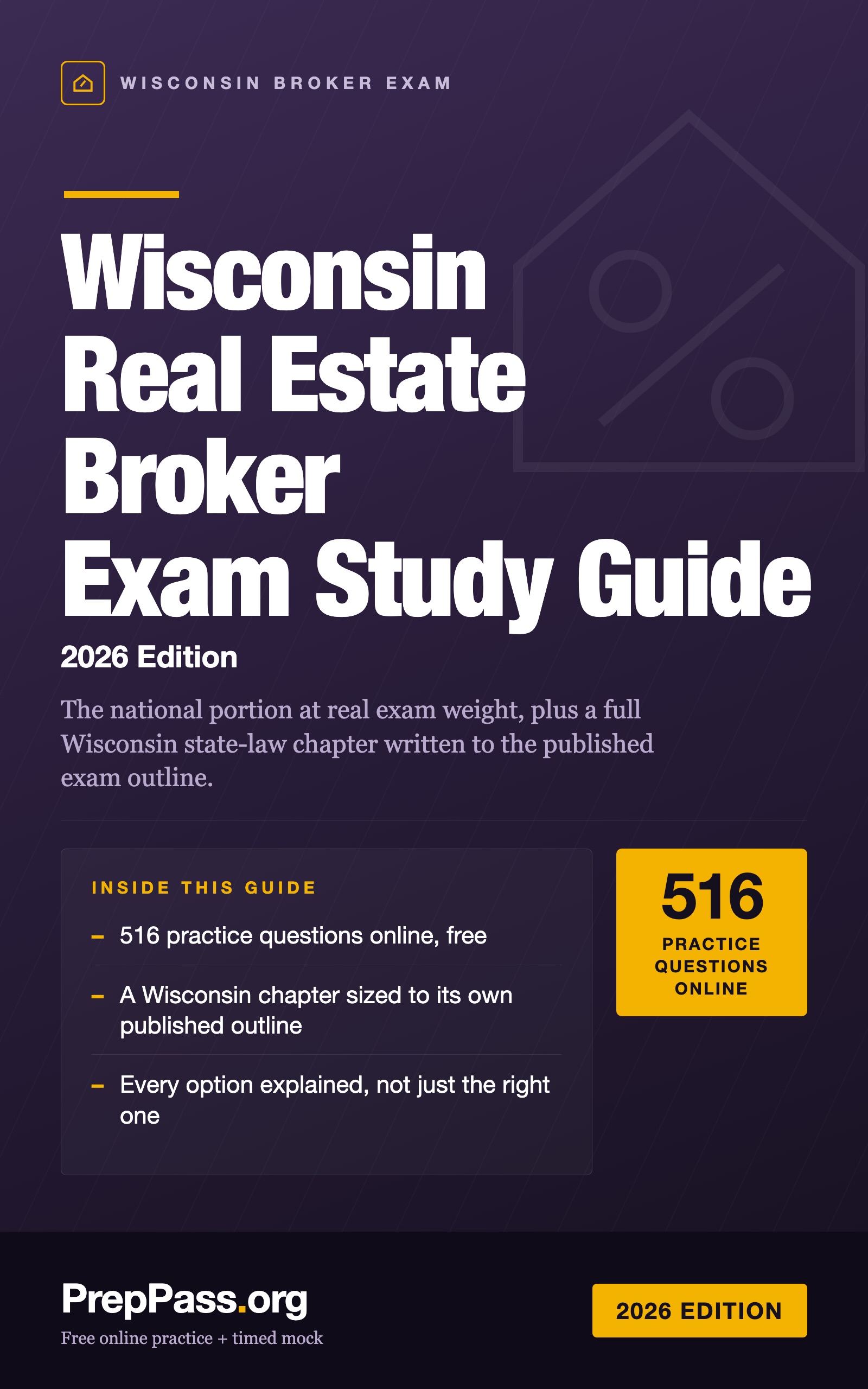
Wisconsin Real Estate Broker · 2026 版
Wisconsin Real Estate Broker Exam Study Guide (2026)
Wisconsin runs a single integrated paper with no separate national portion, so the whole exam is Wisconsin content. The Wisconsin chapter is sized to the published outline — 6 areas, 100 scored items — area by area, not flattened.
- 全国通用部分 8 章,外加一整章威斯康星房地产法 —— PDF + EPUB 永久保存
- 一套 60 题的全国部分模拟考,答案键逐一解释四个选项,而不只是正确的那个
- 另有 20 道威斯康星房地产法题目,并附答案键
先做 10 题,看看讲解 —— 免费
先答完这 10 题,交卷后每题都有解析 —— 还会指出本指南里讲这一点的那一节。约 5 分钟,无需注册。
开始 10 道免费题翻开这本书看看
三页真实内页,直接从你将下载的 PDF 渲染而来 —— 一页讲解、一道带解析的例题、一页速查。没有任何一页是为了好看而重画的。
- 怎么讲Part D — Disability: the distinction the exam always tests · PDF 第 86 页
讲解页:用文字把知识讲清楚,顺序与考试考查的顺序一致。
- 速查页Part C — Encumbrances a broker must read off a title report · PDF 第 102 页
一页可以随时翻回来的内容:把数字、期限或术语集中在一处。
- 一道题的完整解析Answer Key and Explanations · PDF 第 174 页
一道练习题,连同答案和背后的推理 —— 不只是一个答案键。
包含什么,不包含什么
包含
- A Wisconsin chapter written to the published exam outline, area by area
- Where Wisconsin law departs from the national rule — both stated, so neither is guessed
- Supervision, trust accounts, brokerage operation and broker math
- A Wisconsin practice set with every option explained, not just the right one
- 516 practice questions online, free, from the same bank
- PDF (print & tab it) + EPUB (phone / e-reader)
不包含
- 不寄送纸质书 —— 这是一份你下载后可自行打印的文件
- 购书不含视频课程、讲师或一对一辅导 —— 站上的免费视频是另一回事
- 不含考试报名费与考点费用,这些仍需向官方机构缴纳
目录
查看 29 章及各章起始页
- Part C — Advertising and recordkeeping compliance第 14 页
- Part D — Consumer contact and transaction integrity第 16 页
- 2. Trust Funds, Escrow, and the Client’s Money第 30 页
- Part C — Records that survive an audit第 33 页
- Part D — Disputed money第 34 页
- 3. Agency at the Broker Level第 40 页
- Part C — Fiduciary duties, at the level a broker is examined on第 44 页
- Part D — Dual agency, designated agency, and the alternatives第 46 页
- 4. Contracts and Brokerage Agreements第 55 页
- Part C — Options, rights of first refusal, and installment contracts第 60 页
- Part D — Between contract and closing第 61 页
- 5. Fair Housing, Accessibility, and Antitrust: The Exposure You Carry Personally第 72 页
- Part C — The exemptions, and why they rarely save anyone第 78 页
- Part D — Disability: the distinction the exam always tests第 79 页
- 6. Ownership, Land Use Controls, and Transfer of Title第 95 页
- Part C — Encumbrances a broker must read off a title report第 101 页
- Part D — Legal descriptions第 103 页
- 7. Valuation, Financing, and the Federal Lending Laws第 113 页
- Part C — The instruments第 121 页
- Part D — Loan programs, structures, and qualifying第 123 页
- 8. Disclosures, Environmental Risk, and Property Management第 136 页
- Part C — The management agreement and the manager’s authority第 142 页
- Part D — Leases and tenancies第 144 页
- Practice Exam — 60 Questions第 153 页
- Answer Key and Explanations第 170 页
- Appendix A — Broker Math Cheat Sheet第 221 页
- Appendix B — Glossary第 243 页
- Appendix C — Exam-Day Strategy第 262 页
- Part II — Wisconsin State Law & Practice第 267 页
取自你将下载的那份 PDF,并标明各章起始页 —— 不是在此手工录入的。
免费读完整一章
完整的一章,与电子书正文一字不差。直接在此窗口滚动阅读;无需下载,无需邮箱。
在本页直接阅读第 9 章
我们没有拿轻松的绪论充数 —— 免费章节直接翻到书里最见功力的部分,让你在考试真正难的地方检验这本书讲得好不好。
Every other state edition in this series opens by telling you that the national portion you have just read covers most of the paper and that the state chapter covers the rest. This edition cannot say that, because Wisconsin has no national portion. The broker examination is one integrated 100-item all-Wisconsin paper. The national-manuscript-plus-state-chapter split you are holding is a packaging convenience — the national material is genuine background and it will make you a better broker — but everything you actually sit is Wisconsin's own paper. This chapter is therefore not a supplement. It is the examination.
1. There is no national portion, and here is the evidence
This is the single most consequential fact about the Wisconsin broker examination, and it is also the fact most often gotten wrong by study material written from a national template. So it is worth setting out the evidence rather than simply asserting it.
The examination outline. Pearson VUE publishes the Wisconsin real estate content outlines as document #095006, revision 06/2026, with the broker outline itself carrying an effective date of July 1, 2016. Its own sentence describing the paper reads: "The state portion of the broker examination consists of 100 scored items and 5-10 pretest items." There is one outline for the broker, six areas, and the six areas sum to exactly 100. Nowhere in the document is a second, general, or national outline printed for the broker candidate.
The candidate handbook. Pearson VUE's Wisconsin real estate candidate handbook is document #095000, also revision 06/2026. Two of its tables settle the question on their own:
| Handbook table | Rows it contains |
|---|---|
| Exams and Fees | Broker $65; Salesperson $65 — that is the whole table |
| Exam Time Limits | Broker 3.25 hours; Salesperson 4 hours — that is the whole table |
Neither table has a national/state split, and no fee and no time limit is published anywhere for a separate national paper. In states that genuinely run two portions, the fee table and the time table are where the split shows itself first, because a candidate who fails one portion has to be told what re-sitting that portion costs and how long it takes. Wisconsin's tables have two rows each, and both rows are license levels.
The salesperson outline points the same way. It describes one integrated 140-item paper that itself covers ownership, transfer, valuation, financing, agency, disclosures, fair housing and antitrust — the subjects that in other states live on the national portion. Wisconsin does not buy those subjects from a national item bank; it writes them into its own paper.
Then what about the handbook language that mentions a national portion? It survives in exactly three places: the Practice Tests section, one sentence in "Real Estate Exam Content," and the Math Calculations conversions list. That is template residue — boilerplate carried across from the vendor's multi-state handbook shell — not evidence of a second paper. Weigh three sentences of shell text against two tables, an outline sentence, and an item count that sums to 100, and the conclusion is not close.
Why this matters to you, in one sentence. Because there is no national portion, the shared national base bank backfills nothing for Wisconsin. In a two-portion state, a candidate who is weak on, say, Wisconsin trust-account rules still has seventy or eighty national items to carry the score. In Wisconsin there is no such cushion: every area you have not covered is a real gap, worth real items, on the only paper you will sit. That is why this chapter has to carry the whole examination, and why it is longer than any other state chapter in this series.
One thing that does not change. The national manuscript is still worth reading, and this chapter will not repeat it. Agency theory, contract formation, valuation, financing, closing arithmetic, the federal statutes and the supervision principles are the intellectual scaffolding that makes the Wisconsin rules make sense. What this chapter does instead is tell you, area by area, what Wisconsin does differently and what Wisconsin will actually ask you — including the several places where Wisconsin law flatly contradicts the general rule the national chapters teach.
2. What the examination actually is
| Vendor | Pearson VUE |
| Outline | #095006, revision 2026-06; the broker outline effective 2016-07-01 |
| Handbook | #095000, revision 2026-06 |
| Scored items | 100 |
| Pretest items | 5–10, unidentified, scattered among the scored ones |
| Time | 195 minutes (3.25 hours), one sitting |
| Fee | $65 |
| Regulator | Wisconsin Department of Safety and Professional Services (DSPS), Real Estate Examining Board (REEB) |
| Pass | A scaled score of 75 on a 0–100 converted scale |
The passing score sentence nearly everybody misreads
The handbook says, in terms, that the scaled score is "neither the number of questions answered correctly nor the percentage" of questions answered correctly. That sentence is the most commonly misread line in the document, and misreading it costs candidates real preparation time, so it is worth unpacking.
A raw score is what you would compute yourself: items right, out of 100. A scaled score is that raw score run through a conversion that adjusts for the small differences in difficulty between one assembled test form and another. Test forms are not identical; the item pool rotates. If your form happened to draw a slightly harder set of trust-account items than the form somebody sat last Tuesday, a raw 74 on your form and a raw 76 on theirs might represent exactly the same level of competence. Scaling is the mechanism that makes the standard the same for both of you. The board sets one standard of competence; the conversion expresses every form's raw score on a common 0–100 ruler; 75 on that ruler is the line.
Three practical consequences:
- Do not compute a target as "75 items right." It may take slightly more or slightly fewer than 75 correct answers on your particular form to reach a scaled 75. You cannot know which, and you cannot see the conversion. The only safe target is knowing the material, with a margin.
- Do not read a failing scaled score as a percentage. A reported 68 does not mean you got 68 items right, and it does not tell you that you missed 32. It is a position on a converted scale.
- Do not try to arbitrage the pretest items. Five to ten of the items you see do not count, but they are unidentified and indistinguishable. Answer everything as though it counts, because from where you sit it does.
The six areas, and their published item counts
They sum to exactly 100. Nothing is estimated here; these are the counts printed on the outline.
| Area | Items | Share |
|---|---|---|
| I. Real Estate Practice | 19 | 19% |
| II. Trust Accounts | 12 | 12% |
| III. Conduct and Ethical Practices for Real Estate Licensees | 22 | 22% |
| IV. Approved Forms and Legal Advice | 6 | 6% |
| V. Drafting and Supervision Knowledge | 37 | 37% |
| VI. Miscellaneous | 4 | 4% |
The headline finding: 37 items are form drafting, not statute
Thirty-seven of the 100 items — the largest block on the paper, larger than areas I and III combined would be in most states' state portions — are FORM-DRAFTING items on the named WB-series forms. They are questions about what the WB-1 says, what the WB-11 defaults to, which form you reach for when a party gives a one-sided notice, and when a WB-46 becomes binding. That is document mechanics, not license law.
Say it plainly, because it is the single most valuable sentence in this book: a candidate who studies Wisconsin license law thoroughly and skips the forms will fail. Chapter 452 and chs. REEB 11 to 25 are worth areas I, II, III and IV — 59 items. The forms are worth 37 on their own, and a further slice of area IV is about how forms may be reproduced and modified. The exam even displays WB forms on screen for the items that need them, which tells you what kind of knowledge is being tested: not recall of a statute number, but the ability to read a form and know what its provisions do.
Budget your study time accordingly. If you are spending less than a third of your preparation inside the actual WB forms, you are preparing for a different examination.
Two structural traps in the outline itself, worth knowing before you start
First: area V is titled "Drafting and Supervision Knowledge," but none of its lettered subtopics is about supervision. Subtopic A names twelve documents. Subtopic B is two issues related to forms. Subtopic C is the obligation to furnish copies and maintain records. That is all of area V. If you go looking for supervision content there you will find none, and you may conclude that supervision is not tested. It is. Supervision belongs to area I.J, "Responsibilities of firms and licensees," which is Wis. Stat. s. 452.132 — the delegation of supervisory duty, the deemed-supervising-broker default, and the strictly bounded pre-closing review.
Second: area VI "Miscellaneous" is fair housing plus federal lead-based paint law, and nothing else. It has exactly two lettered subtopics. Do not confuse it with the salesperson outline's area X of the same name, which is a completely different list — trust accounts, fee splitting, responsibilities of firms and licensees, legal effect of leases, and rental residential practices. Two areas, same title, different exams, different content. A study guide that merges them will send you to the wrong material for 4% of your paper.
A note about citations, and about who supplies them
The vendor publishes no statute reference list at all. Neither outline #095006 nor handbook #095000 contains one. The only citation either document carries is a single generic note printed above both outlines: "Note: All Wisconsin references are to the Wisconsin Statutes chapter number (e.g., Ch. 452) or to the Rules of the Department of Safety and Professional Services (e.g., REEB 16), unless otherwise noted." The handbook's Study Materials section points to Wisconsin Statutes and Administrative Code for the Practice of Real Estate at dsps.wi.gov and to DOA Document Sales, and stops there.
That has one honest consequence for this book. Every citation in this chapter is ours. We derived each one by mapping the outline's subtopic headings onto the current statutes and rules and then checking the operative text. We keep that fact in front of you rather than hiding it, because it also means there is no vendor citation for us to verify as current or superseded — and, as § 9 shows, several of the outline's own subtopic headings now point at law that has been renamed, moved, or repealed outright.
3. Area I — Real Estate Practice (19 items, 19%)
The outline's subtopics: A. Licenses · B. Trust accounts · C. Duties of licensees · D. Confirmation and disclosure of relationships · E. Firms providing services to more than one client in a transaction · F. Changes in common law duties of brokers and parties · G. Disclosures, investigations and inspections by brokers and salespersons · H. Disclosure duty; immunity for providing notice about the sex offender registry · I. Disclosure requirements for condominiums · J. Responsibilities of firms and licensees · K. Change of name or address on license, trade name, or form of organization.
Nineteen items across eleven subtopics. Note that trust accounts appear here and get their own 12-item area — Wisconsin considers the subject worth roughly a seventh of the paper.
The structural fact that governs the whole area: Wisconsin is firm-based
This is the big departure from the national manuscript, and it is worth naming both rules side by side.
The national chapters teach the general American structure: the broker is the licensed principal; salespersons are the broker's agents; the client's agency relationship runs to the broker; the broker owes the fiduciary duties and the broker supervises. That is accurate as a description of most states.
Wisconsin rewrote it. 2015 Wis. Act 258, effective 7-1-2016 — the very date the current outline took effect — moved ch. 452 from a broker-based structure to a firm-based one. The duties in ch. 452 attach to the firm. The client's agency agreement is with the firm. Wis. Stat. s. 452.133 (4m) then extends those duties to each licensee associated with the firm. A "supervising broker" is a role that a firm delegates, not the entity that holds the relationship.
When you read a Wisconsin item, therefore, read the noun. If a stem or an option says "the broker" where the current statute says "the firm," that is very often the wrong answer — and it is also, as § 9 records, a place where the outline itself is out of date.
Wis. Stat. s. 452.12 (2) (a) completes the picture on the entity side: a broker's license may be issued to a business entity if the business entity has at least one business representative licensed as a broker, and the entity's license then permits each broker business representative to act as a broker on its behalf. There is no cap on salespersons per office, no ownership requirement for the supervising broker, and no county-by-county licensing. Under s. 452.12 (2) (c) a change in business representatives goes to the board on the same form within 30 days of the change's effective date.
A. Licenses — and the unlicensed-assistant line
Wis. Stat. s. 452.03 (2) is where the unlicensed-assistant question lives. No license is required for an individual who, on behalf of and under the direction of a firm or its licensees, provides services "that are limited to those that are purely administrative, clerical, or personal in nature." That is the whole permission, and the words limited to are doing the work. Showing property, negotiating a lease and presenting an offer are all brokerage activities inside the s. 452.01 (2) definition of broker, and each requires a license.
The trap is the open house. Wis. Stat. s. 452.34 (3) (b) provides that an unlicensed personal assistant may not assist at an open house without the direct, on-premises supervision and presence of a licensee. "The licensee stepped out for twenty minutes" is the fact pattern; the answer is that the arrangement failed the moment the licensee left the premises.
C. Duties of licensees — the seven-plus-one structure
Wis. Stat. s. 452.133 (1) lists the duties owed to every party, client or customer:
- (1) (a) provide brokerage services honestly and fairly;
- (1) (b) provide brokerage services with reasonable skill and care;
- (1) (c) disclose to each party, in writing and in a timely manner, "all material adverse facts that the firm knows and that the party does not know or cannot discover through reasonably vigilant observation, unless the disclosure of a material adverse fact is prohibited by law";
- (1) (d) keep confidential any information given to the firm in confidence, and any information obtained by the firm that the firm knows a reasonable party would want kept confidential — and this duty continues after the transaction is complete;
- (1) (e) provide accurate information about market conditions on request;
- (1) (f) safeguard trust funds and other property held;
- (1) (g) present contract proposals in an objective and unbiased manner.
Wis. Stat. s. 452.133 (2) then adds the duties owed only to clients, headed by (2) (a), the duty to loyally represent the client's interests by placing them ahead of the firm's own interests and ahead of the interests of persons in the transaction who are not the firm's clients.
Where it bites. The one-line test for a "client duty versus party duty" item is: would this duty appear on the plain-language Disclosure to Customers? That document, prescribed by s. 452.135 (1) (a), lists exactly the sub. (1) duties and no loyalty duty, because a customer is owed everything except advocacy. Honesty, confidentiality-after-closing, and safeguarding funds are owed to the person across the table from your client. Loyalty is not.
Waiver. Most of these duties may not be waived. s. 452.133 (6) permits a waiver of one thing only — the duty to negotiate under sub. (2) (d) — and only with a prescribed written disclosure. An item offering "the parties agreed in writing to waive the duty to disclose material adverse facts" is offering an impossibility.
Acting for yourself. s. 452.133 (3) (b) bars a licensee from acting on the licensee's own behalf, on behalf of the licensee's firm, or on behalf of an entity in which the licensee has an interest, "without the prior written consent of all parties to the transaction" — and then specifies where the consent goes: "a licensee shall obtain the written consent in the offer to purchase, option, lease, or other transaction contract." Not a side letter, not the file, not an email. The transaction contract. s. REEB 24.05 (2) simply routes licensees back to this statute.
D and E. Disclosure of relationships, and multiple representation
(Read § 9 before relying on the outline's headings here — neither I.D nor I.E names a current statute correctly.)
The operative provisions are s. 452.135 and s. 452.134.
s. 452.135 (1) (a): "No firm, and no licensee associated with a firm, may negotiate on behalf of a party who is not the firm's client unless" the firm first gives that party the statutory written Disclosure to Customers. The trigger is negotiating for a non-client — not a showing, not another firm's agency agreement, not the receipt of earnest money. s. 452.135 (1) (b) extends the same duty to a subagent as to any person who is not the principal firm's client and who receives brokerage services within the scope of the subagency.
s. 452.135 (2) requires the Disclosure to Clients no later than the time the firm enters into an agency agreement. s. 452.135 (2) (b) adds a step that gets tested: where the agency agreement covers real estate "primarily intended for use as a residential property containing one to 4 dwelling units" and the disclosure statement is not incorporated into the agreement, the firm "shall request the client's signed acknowledgment that the client has received a copy of the written disclosure statement." Nothing about recording it, delivering it to counsel, or filing it with the department. In practice the WB-1 and the WB-36 sidestep the whole issue by printing the Disclosure to Clients inside the form.
购买前
- 怎么拿到?
- 付款后下载入口立即出现在本页,链接同时发到你的邮箱。无需注册账号。
- 不合适怎么办?
- 14 天内发邮件即可全额退款,无需理由。
- 免费练习会取消吗?
- 不会。站上的每一道练习题、计时模考和免费章节都继续免费。这本书是「学」的那一半,不是把免费部分围起来的门。
- 能在手机上看吗?
- 可以 —— EPUB 适合手机和电子书阅读器,PDF 适合打印和贴标签,两种都给你。
详细信息
Wisconsin runs a single integrated paper with no separate national portion, so the whole exam is Wisconsin content. The Wisconsin chapter is sized to the published outline — 6 areas, 100 scored items — area by area, not flattened.
- Format: PDF + EPUB download · 347 pages
- 80 practice questions in the book, with a full answer key
- 516 free practice questions for this exam on PrepPass, included at no cost
- $14.99 one-time — no subscription
- 14-day money-back guarantee · refund policy
- Cross-referenced against: Wis. Stat. ch. 452 · Pearson VUE #095006 (rev 2026-06 (outline eff. 2016-07-01))
- Last updated: September 2026
- 官方来源核验(Wis. Stat. ch. 452 · Pearson VUE #095006 (rev 2026-06 (outline eff. 2016-07-01)))
- 516 道免费练习题
- 即时下载,永久拥有
real estate broker pre-license course 要 $200–$1,000。这本书讲的是同一门考试 —— 同样的规则、核对到最新标准 —— 只需一次性 $14.99,永久归你。
练习免费,为什么还要买书?
我们的练习题和计时模考一直免费 —— 网站上的东西不会因为这本书而收起来。这本 $14.99 的书是「学」的那一半:知识本身,按顺序讲清楚,存成一份属于你的文件。
- 系统讲解 —— 每个考试部分按章节从头讲到尾,不只是题目
- 可打印可贴标签 —— 一份适合打印的 PDF,能划重点、做批注、带到书桌前
- 随处离线学 —— EPUB 放手机或电子书阅读器;不用 wifi,不用一堆浏览器标签
- 全在一处 —— 章节、每章速记卡、练习题都在同一份文件里
- 永久归你 —— 一次 $14.99,即时下载,无订阅
而且零风险:14 天退款保证 —— 不满意?发邮件即可全额退款,无需理由。 详见退款政策。
14 天退款保证 · 全额退款,无需理由。
一次购买,永久下载访问。此电子书是完整的 Wisconsin Real Estate Broker 学习指南,含 PDF 与 EPUB。仅为教育性摘要,非专业或法律意见 —— 请始终以官方来源核实当前规定。最后更新:September 2026。