ATI TEAS 7 Academic Skills · 2026 版
ATI TEAS 7 Exam — Complete Study Guide (2026)
Reading, Mathematics, Science, and English — with a full-length 170-question practice test. Science is the biggest area; each nursing program sets its own required score.
- TEAS 的 4 个考查领域合成一本,PDF + EPUB 永久保存
- 4 个考查领域每个收尾都有点名的考试陷阱清单与自测
- 书末附一整套完整长度的模拟测验,按真实考试计时,每道题都写清答案背后的推理
$29.99一次买断 · 永久下载 · 无订阅
PDF + EPUB · 英文 · 854 页 · $29.99 一次买断
本书为英文版,下载的 PDF 与 EPUB 均为英文。
付款后立即下载 —— 无需注册账号,无订阅。
14 天退款保证:任何原因不满意?购买后 14 天内发邮件至 support@preppass.org 即可全额退款。 这是电子下载,无需寄回任何东西。 退款政策
考试事实最近一次对照官方资料核对:2026年9月。
先做 10 题,看看讲解 —— 免费
先答完这 10 题,交卷后每题都有解析 —— 还会指出本指南里讲这一点的那一节。约 5 分钟,无需注册。
开始 10 道免费题翻开这本书看看
三页真实内页,直接从你将下载的 PDF 渲染而来 —— 依次是一页速查、一页讲解、一道带解析的例题。没有任何一页是为了好看而重画的。
- 速查页Part I — The rest of the punctuation · PDF 第 624 页
一页可以随时翻回来的内容:把数字、期限或术语集中在一处。
- 怎么讲Part X — States of matter and physical properties · PDF 第 499 页
讲解页:用文字把知识讲清楚,顺序与考试考查的顺序一致。
- 一道题的完整解析Part X — States of matter and physical properties · PDF 第 471 页
一道练习题,连同答案和背后的推理 —— 不只是一个答案键。
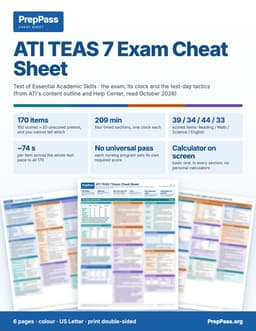
两周内就要考试?
这本指南是系统讲解,要花几周读。如果两周内就考,可打印的彩色速查表是另一款产品:考试涉及的关键数字,按章节排好。
6 页 · US Letter · 可打印 PDF · 永久保存
关于这场考试本身
| 主管机构 | Assessment Technologies Institute, LLC (ATI) 来源: ATI Help Center — What do I need to know before I register for the ATI TEAS exam? |
|---|---|
| 题目数量 | 170 道题 (150 道计分,20 道不计分预试题) |
| 考试时限 | 209 分钟 来源: ATI Help Center — What is the Time Limit for the ATI TEAS exam? |
| 及格标准 | TEAS 没有通过或不通过之分。ATI 原文:「每所学校为 ATI TEAS 考试自行设定分数线」,以及「没有统一的及格分;每个项目自行设定」。ATI 报告的总分和各内容领域分数范围为 0.0 至 100%,并按不同试卷的难度差异做了调整,因此并非简单的答对题目百分比;ATI 另外报告「学业准备水平」等级。请向你申请的每个项目询问其要求的分数。PrepPass 不为 TEAS 给出任何及格分。 我们查阅但未找到该数据的来源: ATI Help Center — What score do I need to get on the ATI TEAS exam? |
| 费用 |
来源: ATI Help Center — What is the cost of the ATI TEAS exam? |
| 考试语言 | ATI 未公布 我们查阅但未找到该数据的来源: ATI Help Center — What is the ATI TEAS Exam? (Table 1, ATI TEAS Content Specifications) |
How this book compares
ATI, which makes the TEAS, sells its own study guide with a full-length practice test. This book teaches all four sections with a full-length practice test; Mometrix sells a guide built around several practice tests.
| Resource | Price | What you get | Choose it if |
|---|---|---|---|
| This bookATI TEAS 7 Exam — Complete Study Guide (2026)PrepPass | $29.99 | Independent downloadable study guide for all four sections
| Choose this book if you want the four sections taught with worked maths and a timed full-length practice test, as one download. |
| From the exam bodyATI TEAS Study Guide 2026-2027 (opens the publisher's page in a new tab)ATI | $19.99 eBook; $24.99 printed book | The test maker's own study guide
| Choose ATI's guide if you want the review written by the company that makes the exam. |
| AlternativeATI TEAS Secrets Study Guide (opens the publisher's page in a new tab)Mometrix Test Preparation | $29.99 ebook; $34.99 printed book | Study guide with practice tests
| Choose Mometrix if you mainly want many full-length practice tests. |
This book
ATI TEAS 7 Exam — Complete Study Guide (2026)
PrepPass
- Price
- $29.99
- What you get
Independent downloadable study guide for all four sections
- 290 practice questions with explanations
- 854 pages, PDF + EPUB
- Choose it if
- Choose this book if you want the four sections taught with worked maths and a timed full-length practice test, as one download.
From the exam body
ATI TEAS Study Guide 2026-2027 (opens the publisher's page in a new tab)
ATI
- Price
- $19.99 eBook; $24.99 printed book
- What you get
The test maker's own study guide
- Review of all four subject areas and a full-length practice test (Form C) with answer explanations
- Choose it if
- Choose ATI's guide if you want the review written by the company that makes the exam.
Alternative
ATI TEAS Secrets Study Guide (opens the publisher's page in a new tab)
Mometrix Test Preparation
- Price
- $29.99 ebook; $34.99 printed book
- What you get
Study guide with practice tests
- Six full-length practice tests (1,000+ questions) and video tutorials (per the product title)
- Choose it if
- Choose Mometrix if you mainly want many full-length practice tests.
Other resources' prices and contents are as listed on each publisher's or seller's own page, checked September 24, 2026. Prices change; confirm on the linked page before you buy. This book's price and contents come from our own catalog.
Sources (2)
- https://www.atitesting.com/teas/study-manual — read September 24, 2026
- https://www.mometrix.com/studyguides/teas/ — read September 24, 2026
包含什么,不包含什么
包含
- All 4 ATI TEAS content areas — Reading, Math, Science and English
- Mathematics worked step by step with checked arithmetic
- Reading and English & Language Usage strategy with examples
- Anatomy, physiology, biology, and chemistry science review
- A full-length 170-question practice test in four timed sections (45/38/50/37 questions; 55/57/60/37 minutes), plus 120 questions by content area — every answer explained
- PDF (print & tab it) + EPUB (phone / e-reader)
不包含
- 不寄送纸质书 —— 这是一份你下载后可自行打印的文件
- 购书不含视频课程、讲师或一对一辅导 —— 站上的免费视频是另一回事
- 不含考试报名费与考点费用,这些仍需向官方机构缴纳
目录
查看 17 个部分及各部分起始页
- Part I — Graphic information第 72 页
- Part I — Data, statistics, and graphs第 177 页
- Part I — The integumentary system第 332 页
- Part V — Chemical reactions第 444 页
- Part X — States of matter and physical properties第 459 页
- Part I — The rest of the punctuation第 558 页
- Practice Questions第 657 页
- Answer Key & Explanations第 682 页
- Answer key — English and Language Usage第 691 页
- Section 4 — English and Language Usage第 723 页
- Answer Key & Explanations — Full-Length Practice Test第 731 页
- Answer key — Science (Questions 84–133)第 742 页
- Appendix A — Mathematics quick reference第 753 页
- Appendix B — Science quick reference第 774 页
- Appendix C — English quick reference第 809 页
- Appendix D — Word parts第 828 页
- Appendix E — Glossary of terms used in this book第 842 页
取自你将下载的那份 PDF,并标明各章起始页 —— 不是在此手工录入的。
免费读完整一章
完整的一章,与电子书正文一字不差。直接在此窗口滚动阅读;无需下载,无需邮箱。
在本页直接阅读第 2 章
我们没有拿轻松的绪论充数 —— 免费章节直接翻到书里最见功力的部分,让你在考试真正难的地方检验这本书讲得好不好。
Numbers and algebra, measurement and data — the section where method beats memory, because the exam changes the numbers and keeps the method.
Introduction
Of the four sections on this exam, Mathematics is the one that most rewards deliberate practice, and it is the one most people study wrong. They study it by reading. They read a worked solution, follow every line, nod, and conclude that they understand it. Then they sit a timed set and discover that following a solution and producing one are not the same skill at all. Reading a solution exercises recognition. Producing one exercises retrieval, and retrieval is what the exam measures.
So this chapter is built to be worked, not read. Every method carries a worked example set out line by line, and every major method also carries a wrong turn — the specific mistake that the method invites, spelled out with the wrong number it produces, so that when you produce that wrong number yourself you will recognize it as an old acquaintance instead of trusting it.
The second thing to understand about this section is that it is not a memory test. There is very little to memorize here. A short list of conversion factors, a short list of area and volume formulas, the order of operations, and the definition of the mean: that is close to the whole of it. Everything else is method. You are not asked whether you remember that 3/8 + 1/6 = 13/24; you are asked whether you can find a common denominator when the two numbers are ones you have never seen together before. The exam changes the numbers every time. It does not change the method. That is very good news, because methods are learnable in a way that long memorized lists are not.
The third thing is that this section is heavily weighted toward two clusters: numbers and algebra on one side, and measurement and data on the other. Numbers and algebra is the larger of the two. If your study time is limited, the parts of this chapter on fractions, decimals, percent, ratio and basic equation-solving will move your score further than anything else, because those four topics feed into almost every other question on the section. A measurement question often reduces to a proportion. A data question often reduces to a percent. A geometry question often reduces to substituting into a formula and doing decimal arithmetic without slipping a place value. Master the core arithmetic and you have partly mastered everything else.
Finally: a basic four-function on-screen calculator is available on the Mathematics items. Use it. But understand exactly what it protects you from and what it does not. It protects you from arithmetic slips. It does nothing whatever about a wrong setup. A calculator will divide 45 by 63 as cheerfully and as accurately as it will divide 63 by 45, and only one of those is the answer to the question you were asked. The whole of this chapter's discipline is aimed at the setup, because the setup is where the marks are lost.
What the Mathematics section asks you to do
Strip away the wording and the Mathematics items ask a small number of things over and over.
Compute cleanly with the four number forms. Whole numbers, fractions, decimals and percents are four ways of writing the same kind of quantity, and a great many items are simply asking whether you can move between them and operate on them without error. Items in this family look like bare arithmetic, or like a short word problem dressed around bare arithmetic.
Compare and order quantities. Given a mixed list — a fraction, a decimal, a percent, perhaps a negative number — put them in order. This looks trivial and is a reliable source of lost marks, because the comparison must happen in a single common form and people try to do it by eye.
Set up and solve a proportion. A very large number of items reduce to "these two things stay in the same relationship; one of the four numbers is missing." Recipes, dosages, map scales, unit prices, fuel economy, staffing ratios, and most unit conversions all live here.
Translate words into algebra and solve. One unknown, one equation, occasionally an inequality. The algebra itself is modest — linear equations, sometimes with fractions. The translation is the hard part, and it is a learnable skill with its own vocabulary.
Convert units, within a system and across systems. Metric to metric, customary to customary, and the handful of bridges between them. Rates and squared units make the same task harder, and both appear.
Measure figures. Perimeter, circumference, area, volume, surface area, and composite shapes built from those. The formulas you need are few, and the errors are almost never in the formula.
Read and interpret data. Mean, median, mode, range, and what a bar graph, a line graph, a circle graph or a scatterplot actually claims. Also — and this matters more than students expect — what a graph does not claim, and how a graph misleads.
Judge whether an answer is reasonable. This is not a named topic but it is present in every item. An estimate made before you compute is the single most efficient error-catcher available to you, and it costs a few seconds.
Learning objectives
By the end of this chapter you should be able to:
- Apply the order of operations correctly, including to expressions containing exponents, nested grouping symbols, and negative numbers.
- Add, subtract, multiply and divide fractions and mixed numbers, and explain why a common denominator is required for two of those operations and not the other two.
- Convert freely among fractions, decimals and percents, and order a mixed list of all three.
- Solve all three forms of percent question from a single setup, and handle percent increase, percent decrease, successive changes, and working backwards to an original amount.
- Build a proportion whose units line up, solve it by cross-multiplication, and check the result against the original relationship.
- Compute and compare unit rates and unit prices.
- Evaluate expressions, combine like terms, distribute, and solve one-step, two-step, two-sided, fractional and literal equations.
- Solve a linear inequality and state the one operation that reverses the inequality sign.
- Translate an English sentence into an equation, identifying what the variable stands for before writing anything.
- Convert within the metric system and within US customary units, and across the two systems using standard factors.
- Convert a rate and convert squared and cubed units, without treating them as ordinary units.
- Convert between Fahrenheit and Celsius in both directions.
- Compute perimeter, circumference, area, volume and surface area for the standard figures, and decompose a composite figure into figures you know.
- Compute mean, median, mode, range and a weighted mean, and choose the measure of center that a given data set deserves.
- Read a bar graph, line graph, circle graph and scatterplot, and identify the ways each can mislead.
- Estimate an answer before computing it and use that estimate to reject impossible answer choices.
Key concepts at a glance
| Idea | What it means in one line | Where it bites |
|---|---|---|
| Order of operations | Grouping, then exponents, then multiply/divide left to right, then add/subtract left to right | Left-to-right pairs; a minus sign in front of a square |
| Common denominator | Pieces must be the same size before you can count them together | Needed to add and subtract; never needed to multiply |
| Reciprocal | Flip the fraction; dividing by a number is multiplying by its reciprocal | Dividing by a fraction makes the result larger |
| Place value | Each column is ten times the one to its right | Decimal multiplication and division; rounding |
| Percent | A fraction whose denominator is one hundred | Every percent item; "of" means multiply |
| Base of a percent | The number the percent is taken of | Percent change; working backwards |
| Proportion | Two equal ratios; one of four numbers missing | Conversions, recipes, unit price, scale |
| Unit rate | How much per exactly one | Comparing two package sizes |
| Like terms | Same variable, same exponent | Combining terms; distributing |
| Inverse operation | Undo what was done, in reverse order | Solving every equation |
| Dimensional analysis | Write units as fractions and cancel them | Every conversion, especially rates |
| Measure of center | Mean, median or mode — they answer different questions | Skewed data; outliers |
| Estimate | A rough answer computed before the exact one | Filtering answer choices; catching a wrong setup |
How to read the worked examples in this chapter
Each worked example is set out in numbered steps, and each step does exactly one thing. That is deliberate. When you make an arithmetic error you almost never make it in the step you were thinking about; you make it in the step you performed automatically while thinking about the next one. Writing one action per line makes the automatic step visible.
After most worked examples you will find a paragraph headed The wrong turn. This is not padding, and it is not a joke at anyone's expense. It is the most useful part of the page. Every method in arithmetic has a characteristic failure — a plausible-looking move that produces a specific wrong number. Those wrong numbers are not random: they are the numbers that appear in the answer choices. A distractor is usually not a random near-miss; it is the result you get if you make the standard mistake. When you learn the standard mistake alongside the method, two things happen. You stop making it, and you start recognizing the choice that was placed there to catch it.
Read the wrong turn and ask yourself honestly whether it is the move you would have made. If it is, that subsection is one you should work rather than read.
You will also find callout boxes — blockquotes whose first line is a heading. They hold the things worth returning to: conversion factors, formula lists, and the short rules that are easier to look up than to reconstruct. If you are reviewing this chapter in a hurry, read the callouts and work the self-check problems at the end.
The four-step habit this chapter is built on
Every worked example in this chapter, whatever the topic, follows the same underlying shape. It is worth naming it, because the shape is transferable and the individual methods are not.
One: say what is being asked, in your own words, before you touch a number. "They want the percent, not the part." "They want how much is left, not how much was used." An astonishing share of lost marks are correct arithmetic answering the wrong question.
Two: estimate. One sentence, no pencil. "A bit less than half of forty, so call it eighteen." The estimate has no authority over the exact answer, but it has absolute authority over an exact answer that is wildly different from it.
Three: set up, then compute. Write the equation, the proportion or the expression completely before evaluating any part of it. Setting up and computing are different mental activities and interleaving them is where setups go wrong.
Four: check by a second route. Reverse the operation. Substitute the answer back in. Compare against the estimate. Convert to a different form and see whether it still looks right. A check that repeats the original method catches nothing, because it makes the same mistake again; a check that takes a different route catches almost everything.
### Remember this — the four-step habit | Step | Question you are answering | Time it costs | |---|---|---| | 1. Read | What exactly is being asked for? | A few seconds | | 2. Estimate | Roughly how big should the answer be? | A few seconds | | 3. Set up, then compute | What is the full expression before I evaluate anything? | Most of the item | | 4. Check a second way | Does it survive a route I have not already used? | A few seconds |
Part A — Number sense and whole numbers
Place value, and reading a number out loud
Place value is the reason our arithmetic works at all, and the reason a decimal point matters. Each column in a written number is worth ten times the column to its right. In 4,7 0 6, the 4 sits in the thousands column and is worth 4,000; the 7 sits in the hundreds column and is worth 700; the 0 holds the tens column open so that the 6 lands in the ones column and not the tens. That zero is doing real work. Remove it and you have 476, a different number entirely.
Reading a number out loud, properly, is a habit worth building, because the spoken form carries the place value with it. "Four thousand, seven hundred six" contains the information that the 7 is hundreds. "Four seven zero six" does not, and people who read numbers that way are the people who lose a place value when they write them down again.
Worked example. In the number 38,472, what is the value of the digit 8, and what is the value of the digit 4?
- Label the columns from the right: 2 is ones, 7 is tens, 4 is hundreds, 8 is thousands, 3 is ten-thousands.
- The 8 sits in the thousands column, so its value is 8 × 1,000 = 8,000.
- The 4 sits in the hundreds column, so its value is 4 × 100 = 400.
- Answer: the 8 is worth 8,000 and the 4 is worth 400.
- Check by rebuilding the number: 30,000 + 8,000 + 400 + 70 + 2 = 38,472. It reassembles, so the labeling was right.
The wrong turn. A student counts the columns from the left instead of the right and reports the 8 as being in the hundreds place, worth 800. Counting from the left cannot work, because the leftmost column's value depends on how long the number is, while the rightmost column is always ones. Always count from the ones column outward — and when a decimal point is present, count outward from the point in both directions.
The order of operations, and the two places people break it
An expression like 8 + 3 × 4 has two possible readings, and mathematics settles the dispute by convention: multiplication binds more tightly than addition. The conventional order is grouping symbols first, then exponents and roots, then multiplication and division, then addition and subtraction.
The two words that do the damage are "then". Multiplication and division are not two ranks; they are one rank, performed left to right in the order they appear. The same is true of addition and subtraction. Almost every order-of-operations error on this exam comes from treating them as two ranks — doing all the multiplying before any dividing, or all the adding before any subtracting.
### Remember this — order of operations | Rank | Operations | Direction | |---|---|---| | 1 | Grouping: parentheses, brackets, the bar of a fraction | Innermost first | | 2 | Exponents and roots | As written | | 3 | Multiplication and division together | Left to right | | 4 | Addition and subtraction together | Left to right |
Worked example. Evaluate 8 + 3 × (10 − 6)² ÷ 4 − 5.
- Grouping first: 10 − 6 = 4, so the expression is 8 + 3 × 4² ÷ 4 − 5.
- Exponent next: 4² = 16, giving 8 + 3 × 16 ÷ 4 − 5.
- Multiplication and division, left to right. The multiplication comes first as written: 3 × 16 = 48. Now 8 + 48 ÷ 4 − 5.
- Continue left to right at the same rank: 48 ÷ 4 = 12. Now 8 + 12 − 5.
- Addition and subtraction, left to right: 8 + 12 = 20, then 20 − 5 = 15.
- Answer: 15.
The wrong turn. A student who reaches step 3 and decides that multiplication outranks division computes 3 × 16 = 48 and then, seeing 8 + 48 ÷ 4 − 5, reaches the same place — this particular expression forgives that error. Change it to 3 ÷ 4 × 16 and it does not: left to right gives 0.75 × 16 = 12, while multiplying first gives 4 × 16 = 64, then 3 ÷ 64, which is about 0.047. The more common break is at the start: a student adds 8 + 3 = 11 first, then 11 × 16 = 176, ÷ 4 = 44, − 5 = 39. That 39 is a number you should learn to distrust on sight; it is the classic left-to-right-regardless answer.
Grouping symbols inside grouping symbols
When parentheses are nested, work from the innermost outward. A fraction bar is itself a grouping symbol: everything above the bar is grouped and everything below the bar is grouped, even though no parentheses are printed.
Worked example. Evaluate (24 − 4 × 3) ÷ (2 + 1)².
- Inside the first parentheses, multiplication before subtraction: 4 × 3 = 12, so 24 − 12 = 12.
- Inside the second parentheses: 2 + 1 = 3.
- Now the expression reads 12 ÷ 3². Exponent before division: 3² = 9.
- 12 ÷ 9 = 4/3, which is 1 1/3, or about 1.33.
- Answer: 4/3 (about 1.33).
- Check: 4/3 × 9 = 12, and 12 was the numerator. Reversing the division returns the numerator, so the division was performed correctly.
The wrong turn. A student squares before adding inside the parentheses, reading (2 + 1)² as 2 + 1², which is 2 + 1 = 3. The answer then comes out as 12 ÷ 3 = 4 instead of 4/3 — three times too large. The exponent applies to the whole grouped quantity, because the parentheses were closed before the exponent was written. Anything inside a grouping symbol is finished before the grouping symbol's own exponent is applied.
Adding and subtracting negative numbers
Think of a number line with zero in the middle, positives to the right and negatives to the left. Adding a positive moves you right; adding a negative moves you left. Subtracting is the same as adding the opposite, which is why subtracting a negative moves you right.
购买前
- 怎么拿到?
- 付款后下载入口立即出现在本页,链接同时发到你的邮箱。无需注册账号。
- 不合适怎么办?
- 14 天内发邮件即可全额退款,无需理由。
- 免费练习会取消吗?
- 不会。站上的每一道练习题、计时模考和免费章节都继续免费。这本书是「学」的那一半,不是把免费部分围起来的门。
- 能在手机上看吗?
- 可以 —— EPUB 适合手机和电子书阅读器,PDF 适合打印和贴标签,两种都给你。
详细信息
Reading, Mathematics, Science, and English — with a full-length 170-question practice test. Science is the biggest area; each nursing program sets its own required score.
- Format: PDF + EPUB download · 854 pages
- 290 practice questions in the book, with a full answer key
- 400 free practice questions for this exam on PrepPass, included at no cost
- $29.99 one-time — no subscription
- 14-day money-back guarantee · refund policy
- Cross-referenced against: ATI TEAS 7 content outline · Independent study aid — not affiliated with, endorsed by or approved by ATI
- Last updated: September 2026
- 官方来源核验(ATI TEAS 7 content outline · Independent study aid — not affiliated with, endorsed by or approved by ATI)
- 400 道免费练习题
- 即时下载,永久拥有
TEAS prep course 要 $99–$199。这本书讲的是同一门考试 —— 同样的规则、核对到最新标准 —— 只需一次性 $29.99,永久归你。
练习免费,为什么还要买书?
我们的练习题和计时模考一直免费 —— 网站上的东西不会因为这本书而收起来。这本 $29.99 的书是「学」的那一半:知识本身,按顺序讲清楚,存成一份属于你的文件。
- 系统讲解 —— 每个考试部分按章节从头讲到尾,不只是题目
- 可打印可贴标签 —— 一份适合打印的 PDF,能划重点、做批注、带到书桌前
- 随处离线学 —— EPUB 放手机或电子书阅读器;不用 wifi,不用一堆浏览器标签
- 全在一处 —— 章节和练习题都在同一份文件里
- 永久归你 —— 一次 $29.99,即时下载,无订阅
而且零风险:14 天退款保证 —— 不满意?发邮件即可全额退款,无需理由。 详见退款政策。
14 天退款保证 · 全额退款,无需理由。
一次购买,永久下载访问。此电子书是完整的 ATI TEAS 7 Academic Skills 学习指南,含 PDF 与 EPUB。仅为教育性摘要,非专业或法律意见 —— 请始终以官方来源核实当前规定。最后更新:September 2026。