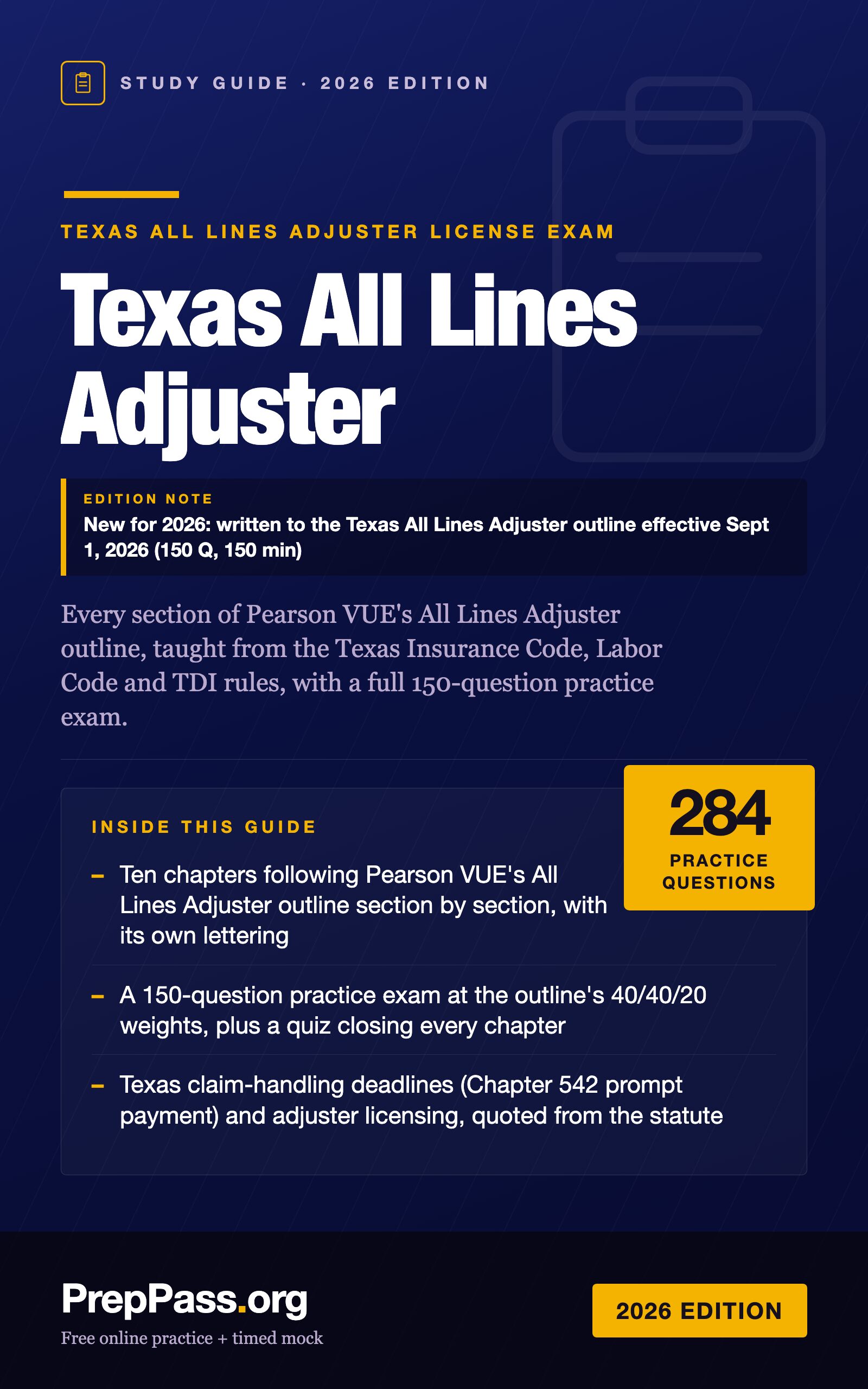
Texas All Lines Adjuster License Exam · 2026 版
Texas All Lines Adjuster Study Guide — 2026 Edition
版本说明New for 2026: written to the Texas All Lines Adjuster outline effective Sept 1, 2026 (150 Q, 150 min)
Every section of Pearson VUE's All Lines Adjuster outline, taught from the Texas Insurance Code, Labor Code and TDI rules, with a full 150-question practice exam.
- 284 道原创德州全险种理赔员(All Lines Adjuster)考试练习题,每题附解析,合成一本 PDF + EPUB 永久保存
PDF + EPUB · 英文 · 226 页 · $24.99 一次买断
本书为英文版,下载的 PDF 与 EPUB 均为英文。
付款后立即下载 —— 无需注册账号,无订阅。
14 天退款保证:任何原因不满意?购买后 14 天内发邮件至 support@preppass.org 即可全额退款。 退款政策
先做 10 题,看看讲解 —— 免费
先答完这 10 题,交卷后每题都有解析 —— 还会指出本指南里讲这一点的那一节。约 5 分钟,无需注册。
开始 10 道免费题翻开这本书看看
三页真实内页,直接从你将下载的 PDF 渲染而来 —— 依次是一页速查、一页讲解、一道带解析的例题。没有任何一页是为了好看而重画的。
- 速查页Chapter 1 — The Standard Fire Policy, Dwelling and Homeowners Coverage · PDF 第 15 页
一页可以随时翻回来的内容:把数字、期限或术语集中在一处。
- 怎么讲Chapter 8 — Texas Adjuster Licensing and the Commissioner · PDF 第 115 页
讲解页:用文字把知识讲清楚,顺序与考试考查的顺序一致。
- 一道题的完整解析Chapter 5 — Risk, Value and the Measure of a Loss · PDF 第 72 页
一道练习题,连同答案和背后的推理 —— 不只是一个答案键。
关于这场考试本身
| 主管机构 | Texas Department of Insurance (TDI) —— 考试由 Pearson VUE 承办 |
|---|---|
| 题目数量 | 150 道题 |
| 考试时限 | 150 分钟 |
| 及格标准 | 标准分 70(量表范围 0–100) |
| 费用 |
|
| 考试语言 | 英语 · 西班牙语 |
包含什么,不包含什么
包含
- Ten chapters following Pearson VUE's All Lines Adjuster outline section by section, with its own lettering
- A 150-question practice exam at the outline's 40/40/20 weights, plus a quiz closing every chapter
- Texas claim-handling deadlines (Chapter 542 prompt payment) and adjuster licensing, quoted from the statute
- Texas workers' compensation, with the benefit caps for injuries from October 1, 2026
- A master table of Texas deadlines and dollar figures, and a terms appendix
- 284 original questions, each with a worked explanation citing its source
- PDF + EPUB you keep
不包含
- 不寄送纸质书 —— 这是一份你下载后可自行打印的文件
- 购书不含视频课程、讲师或一对一辅导 —— 站上的免费视频是另一回事
- 不含考试报名费与考点费用,这些仍需向官方机构缴纳
目录
查看 15 个部分及各部分起始页
- Chapter 1 — The Standard Fire Policy, Dwelling and Homeowners Coverage第 10 页
- Chapter 2 — Auto Liability: Personal and Commercial第 30 页
- Chapter 3 — Commercial Lines: Property, Package, Boiler and Machinery, BOP, Cargo and Crime第 43 页
- Chapter 4 — Inland Marine, Ocean Marine, Additional Coverages, Bonds and Professional Liability第 55 页
- Chapter 5 — Risk, Value and the Measure of a Loss第 70 页
- Chapter 6 — Policy Provisions and Contract Law第 85 页
- Chapter 7 — Liability, Negligence and Legal Cause第 101 页
- Chapter 8 — Texas Adjuster Licensing and the Commissioner第 113 页
- Chapter 9 — Texas Claim- Handling Law and Adjuster Conduct第 129 页
- Chapter 10 — Texas Workers’ Compensation第 144 页
- Part II — Insurance Terms and Related Concepts (60 questions)第 173 页
- Practice exam answer key & explanations第 193 页
- Appendix A — The exam at a glance Item What the sources publish第 211 页
- Appendix B — Terms the exam expects you to use precisely第 212 页
- Appendix C — Master table of Texas deadlines and dollar figures第 216 页
取自你将下载的那份 PDF,并标明各章起始页 —— 不是在此手工录入的。
免费读完整一章
完整的一章,与电子书正文一字不差。直接在此窗口滚动阅读;无需下载,无需邮箱。
在本页直接阅读第 9 章
我们没有拿轻松的绪论充数 —— 免费章节直接翻到书里最见功力的部分,让你在考试真正难的地方检验这本书讲得好不好。
This is the chapter that governs an adjuster's working day in Texas. The Insurance Code sets deadlines measured in days and business days, lists practices that are unfair as a matter of law, and attaches a price — 18 percent interest plus attorney's fees — to missing a deadline. The exam tests the numbers and the lists; the job tests whether you can apply them to a file.
III.C.1 Functions of an adjuster
An adjuster "investigates or adjusts losses on behalf of an insurer" or "supervises the handling of claims"[1]. In practice the functions follow the claim's life: acknowledge the claim and request what is needed; investigate the facts (inspection, statements, documents, experts); determine coverage by reading the policy; evaluate the amount of the loss; communicate a decision with the reasons; negotiate and settle; and, where someone else caused the loss, preserve subrogation. Chapter 8 lists who is exempt from licensing — technical experts, clerical staff, agents processing undisputed losses on their own policies[1]. The dividing line is negotiation and judgment on disputed claims.
III.B.1.a Claims methods and practices — the prompt-payment law (Chapter 542, Subchapter B)
Scope
Subchapter B applies to first-party claims — a claim made by an insured, policyholder or named beneficiary that "must be paid by the insurer directly to the insured or beneficiary"[2]. It applies to nearly every kind of insurer, including "an eligible surplus lines insurer"[2], but not to "(1) workers' compensation insurance; (2) mortgage guaranty insurance; (3) title insurance; (4) fidelity, surety, or guaranty bonds; (5) marine insurance"[2]. It "shall be liberally construed to promote the prompt payment of insurance claims"[2].
Two definitions start every clock. Notice of claim is "any written notification provided by a claimant to an insurer that reasonably apprises the insurer of the facts relating to the claim"[2]. Business day is "a day other than a Saturday, Sunday, or holiday recognized by this state"[2].
The four deadlines
| Step | Deadline | Source |
|---|---|---|
| 1. Acknowledge, begin investigating, request all items the insurer then reasonably believes it needs | Not later than the 15th day after notice of claim (30th business day for an eligible surplus lines insurer) | [2] |
| 2. Accept or reject in writing | Not later than the 15th business day after receiving all items, statements and forms required to secure final proof of loss | [2] |
| 2a. Suspected arson | Not later than the 30th day after receiving all items | [2] |
| 2b. Needs more time | Tell the claimant the reasons within the same period, then accept or reject not later than the 45th day after that notice | [2] |
| 3. Pay | Not later than the 5th business day after notifying the claimant it will pay (or after the claimant performs a required act); 20th business day for an eligible surplus lines insurer | [2] |
| 4. Outside limit | Delay beyond the period set by other statutes or, if none, more than 60 days after receiving all items triggers statutory damages | [2] |
Details the exam likes:
- The first deadline is 15 days; the decision deadline is 15 business days. Read the question for the word "business."
- If the acknowledgment is not in writing, the insurer "shall make a record of the date, manner, and content of the acknowledgment"[2].
- The insurer may make additional requests later "if during the investigation of the claim the additional requests are necessary"[2] — but not as a device to restart the clock.
- A rejection "must state the reasons for the rejection"[2].
- "In the event of a weather-related catastrophe or major natural disaster, as defined by the commissioner, the claim-handling deadlines imposed under this subchapter are extended for an additional 15 days"[2].
Worked example. Notice of a hail claim arrives Monday, March 2. By March 17 (15 days) the insurer acknowledges it, assigns an adjuster and requests photos, the contractor's estimate and a signed proof of loss. The insured delivers the last item on Thursday, April 9. The insurer must accept or reject in writing within 15 business days — by Thursday, April 30, if there are no state holidays. It accepts on April 28; payment is due within five business days, by Tuesday, May 5.
What a violation costs
An insurer that is liable for a claim and does not comply with the subchapter must pay, in addition to the claim, "interest on the amount of the claim at the rate of 18 percent a year as damages, together with reasonable and necessary attorney's fees"[2]. In actions governed by Chapter 542A, a different rate applies instead: simple interest at the Finance Code judgment rate plus five percent[2]. These remedies "are in addition to any other remedy or procedure provided by law or at common law"[2].
Liability claims: telling the insured about settlements (Subchapter D)
On a casualty (liability) policy, the insurer must tell its own insured what it is doing with claims against him: "Not later than the 10th day after the date an initial offer to settle a claim against a named insured ... is made, the insurer shall notify the insured in writing of the offer"[2], and "Not later than the 30th day after the date a claim against a named insured ... is settled, the insurer shall notify the insured in writing of the settlement"[2]. The subchapter does not apply to a policy "that requires the insured's consent to settle a claim against the insured"[2], to bonds or to marine insurance.
III.B.1 Unfair claim settlement practices (Chapter 542, Subchapter A; 28 TAC §§21.201–21.205; Chapter 541)
The statutory list
Section 542.003 lists acts that are unfair claim settlement practices, including "knowingly misrepresenting to a claimant pertinent facts or policy provisions relating to coverage at issue"[2], failing to acknowledge pertinent communications with reasonable promptness, failing to adopt reasonable standards for prompt investigation, "not attempting in good faith to effect a prompt, fair, and equitable settlement of a claim submitted in which liability has become reasonably clear"[2], and compelling a policyholder to sue by offering substantially less than the amount ultimately recovered.
Tax returns. An insurer may not require a claimant to produce federal income tax returns as a condition of settlement unless "(1) the claimant is ordered to produce the tax returns by a court; or (2) the claim involves: (A) a fire loss; or (B) a loss of profits or income"[2]. A violation is also "a deceptive trade practice" under the Business & Commerce Code[2].
The rule: 28 TAC §21.203
TDI's "Unfair Claims Settlement Practices Rules"[3] expand the list to nineteen items, and the minimum standard of performance for all insurers is to comply with §21.203[4]. The items an adjuster meets every day:
- (1) Misrepresenting to claimants "pertinent facts or policy provisions relating to coverages at issue"[5].
- (2) Failing to acknowledge pertinent communications with reasonable promptness — "An acknowledgment within 15 business days is presumed to be reasonably prompt"[5].
- (3) "failing to adopt and implement reasonable standards for prompt investigation of claims"[5].
- (4) Not attempting in good faith to settle when liability is reasonably clear.
- (5) "compelling policyholders to institute suits to recover amounts due under its policies by offering substantially less than the amounts ultimately recovered"[5].
- (7) Failing to provide claim forms promptly when the insurer requires them[5].
- (8) Not settling a clear claim under one coverage "in order to influence settlement under other portions of the policy coverage"[5].
- (9) "failing to promptly provide to a policyholder a reasonable explanation of the basis in the insurance policy in relation to the facts or applicable law for denial of a claim or for the offer of a compromise settlement"[5].
- (10) Failing to affirm or deny coverage within a reasonable time — where a timely reservation of rights letter "is deemed compliance"[5].
- (11) Delaying a first-party payment "on the basis that other coverage may be available or third parties are responsible"[5].
- (13) "undertaking to enforce a full and final release from a policyholder when, in fact, only a partial payment has been made"[5].
- (15) "refusing to pay claims without conducting a reasonable investigation based upon all available information"[5].
- (16) "failing to respond promptly to a request by a claimant for personal contact about or review of the claim"[5].
- (17) On the Texas personal auto policy, the claimant who can recover from either or both insurers "is entitled to choose under which coverage and in what order payment is to be made"[5].
- (19) Requiring federal income tax returns except by court order or for fire or loss-of-income claims[5].
Chapter 541 makes the same core practices actionable as unfair or deceptive acts, including "refusing to pay a claim without conducting a reasonable investigation with respect to the claim"[6] and enforcing "a full and final release of a claim from a policyholder when only a partial payment has been made, unless the payment is a compromise settlement of a doubtful or disputed claim"[6]. When the department finds from complaints that an insurer needs closer supervision, it may require periodic reports of claims filed, denied, settled and litigated[7].
III.B.1.b Misrepresentation
TDI's rule defines misrepresentation as "any untrue statement of a material fact; (2) any omission to state a material fact necessary to make the statements made (considered in the light of the circumstances under which they are made) not misleading"[8], the making of a statement "in such manner or order as to mislead a reasonably prudent person to a false conclusion of a material fact," and "any material misstatement of law"[8]. Section 541.061 makes each of these an unfair or deceptive act when it misrepresents an insurance policy, including "making a statement in a manner that would mislead a reasonably prudent person to a false conclusion of a material fact"[6] and "(4) making a material misstatement of law"[6].
Worked example. A policyholder asks whether her policy covers a burst pipe. The adjuster says, truthfully, that "water damage from floods is excluded" and stops there, knowing the policy does cover sudden discharge from plumbing. Every word was true, but the omission of a material fact necessary to make the statement not misleading is itself a misrepresentation under the rule.
III.B.1.c Defamation
It is an unfair or deceptive act to make or circulate a statement that "(1) is false, maliciously critical of, or derogatory to the financial condition of an insurer; and (2) is calculated to injure a person engaged in the business of insurance"[6]. The rule reaches "any oral or written statement, including a statement in any pamphlet, circular, article, or literature"[6]. An adjuster who tells a claimant that a competitor "is about to go broke, so settle with us" commits defamation of an insurer.
III.C.2 Prohibited conduct — contractors as adjusters
The outline cites §4102.163, the public-adjuster conflict rule: "A contractor may not act as a public adjuster or advertise to adjust claims for any property for which the contractor is providing or may provide contracting services, regardless of whether the contractor" holds a public adjuster license[9] or "is authorized to act on behalf of the insured under a power of attorney or other agreement"[9]. A licensed public adjuster also "may not accept a fee, commission, or other valuable consideration ... in exchange for the referral" of an insured to a contractor, attorney, appraiser, umpire or salvage company[9].
Chapter 4101 imposes the same wall on company-side adjusters: a licensed adjuster "may not adjust a loss related to roofing damage on behalf of an insurer if the adjuster is a roofing contractor or otherwise provides roofing services or roofing products for compensation"[1], and a roofing contractor may not act as an adjuster on property it is or may be roofing[1]. The principle is the same on both sides: the person who values the loss may not be the person paid to repair it.
Sources cited in this excerpt
- Texas Insurance Code Chapter 4101, Insurance Adjusters. Texas Legislature, Current text as served 2026-09-25. https://tcss.legis.texas.gov/resources/IN/htm/IN.4101.htm
- Texas Insurance Code Chapter 542, Processing and Settlement of Claims. Texas Legislature, Current text as served 2026-09-25. https://tcss.legis.texas.gov/resources/IN/htm/IN.542.htm
- 28 Tex. Admin. Code § 21.201, Title (as reproduced by LII). Texas Department of Insurance / Cornell LII, read 2026-09-25. https://www.law.cornell.edu/regulations/texas/28-Tex-Admin-Code-SS-21-201
- 28 Tex. Admin. Code § 21.205, Minimum Standard of Performance (as reproduced by LII). Texas Department of Insurance / Cornell LII, read 2026-09-25. https://www.law.cornell.edu/regulations/texas/28-Tex-Admin-Code-SS-21-205
- 28 Tex. Admin. Code § 21.203, Unfair Claim Settlement Practices (as reproduced by LII). Texas Department of Insurance / Cornell LII, read 2026-09-25. https://www.law.cornell.edu/regulations/texas/28-Tex-Admin-Code-SS-21-203
- Texas Insurance Code Chapter 541, Unfair Methods of Competition and Unfair or Deceptive Acts or Practices. Texas Legislature, Current text as served 2026-09-25. https://tcss.legis.texas.gov/resources/IN/htm/IN.541.htm
- 28 Tex. Admin. Code § 21.204, Insurer Reports (as reproduced by LII). Texas Department of Insurance / Cornell LII, read 2026-09-25. https://www.law.cornell.edu/regulations/texas/28-Tex-Admin-Code-SS-21-204
- 28 Tex. Admin. Code § 21.4, Misrepresentation Defined (as reproduced by LII). Texas Department of Insurance / Cornell LII, read 2026-09-25. https://www.law.cornell.edu/regulations/texas/28-Tex-Admin-Code-SS-21-4
- Texas Insurance Code Chapter 4102, Public Insurance Adjusters. Texas Legislature, Current text as served 2026-09-25. https://tcss.legis.texas.gov/resources/IN/htm/IN.4102.htm
购买前
- 怎么拿到?
- 付款后下载入口立即出现在本页,链接同时发到你的邮箱。无需注册账号。
- 不合适怎么办?
- 14 天内发邮件即可全额退款,无需理由。
- 免费练习会取消吗?
- 不会。站上的每一道练习题、计时模考和免费章节都继续免费。这本书是「学」的那一半,不是把免费部分围起来的门。
- 能在手机上看吗?
- 可以 —— EPUB 适合手机和电子书阅读器,PDF 适合打印和贴标签,两种都给你。
详细信息
Every section of Pearson VUE's All Lines Adjuster outline, taught from the Texas Insurance Code, Labor Code and TDI rules, with a full 150-question practice exam.
- Format: PDF + EPUB download · 226 pages
- 284 practice questions in the book, with a full answer key
- 100 free practice questions for this exam on PrepPass, included at no cost
- $24.99 one-time — no subscription
- 14-day money-back guarantee · refund policy
- Cross-referenced against: Pearson VUE Texas candidate handbook (#124400) and content outline (#124401, effective September 1, 2026), the Texas Insurance and Labor Codes and TDI's adjuster pages, read September 2026
- 官方来源核验(Pearson VUE Texas candidate handbook (#124400) and content outline (#124401, effective September 1, 2026), the Texas Insurance and Labor Codes and TDI's adjuster pages, read September 2026)
- 100 道免费练习题
- 即时下载,永久拥有
adjuster pre-license course 要 $100–$400。这本书讲的是同一门考试 —— 同样的规则、核对到最新标准 —— 只需一次性 $24.99,永久归你。
练习免费,为什么还要买书?
我们的练习题和计时模考一直免费 —— 网站上的东西不会因为这本书而收起来。这本 $24.99 的书是「学」的那一半:知识本身,按顺序讲清楚,存成一份属于你的文件。
- 系统讲解 —— 每个考试部分按章节从头讲到尾,不只是题目
- 可打印可贴标签 —— 一份适合打印的 PDF,能划重点、做批注、带到书桌前
- 随处离线学 —— EPUB 放手机或电子书阅读器;不用 wifi,不用一堆浏览器标签
- 全在一处 —— 章节和练习题都在同一份文件里
- 永久归你 —— 一次 $24.99,即时下载,无订阅
而且零风险:14 天退款保证 —— 不满意?发邮件即可全额退款,无需理由。 详见退款政策。
14 天退款保证 · 全额退款,无需理由。
一次购买,永久下载访问。此电子书是完整的 Texas All Lines Adjuster License Exam 学习指南,含 PDF 与 EPUB。仅为教育性摘要,非专业或法律意见 —— 请始终以官方来源核实当前规定。