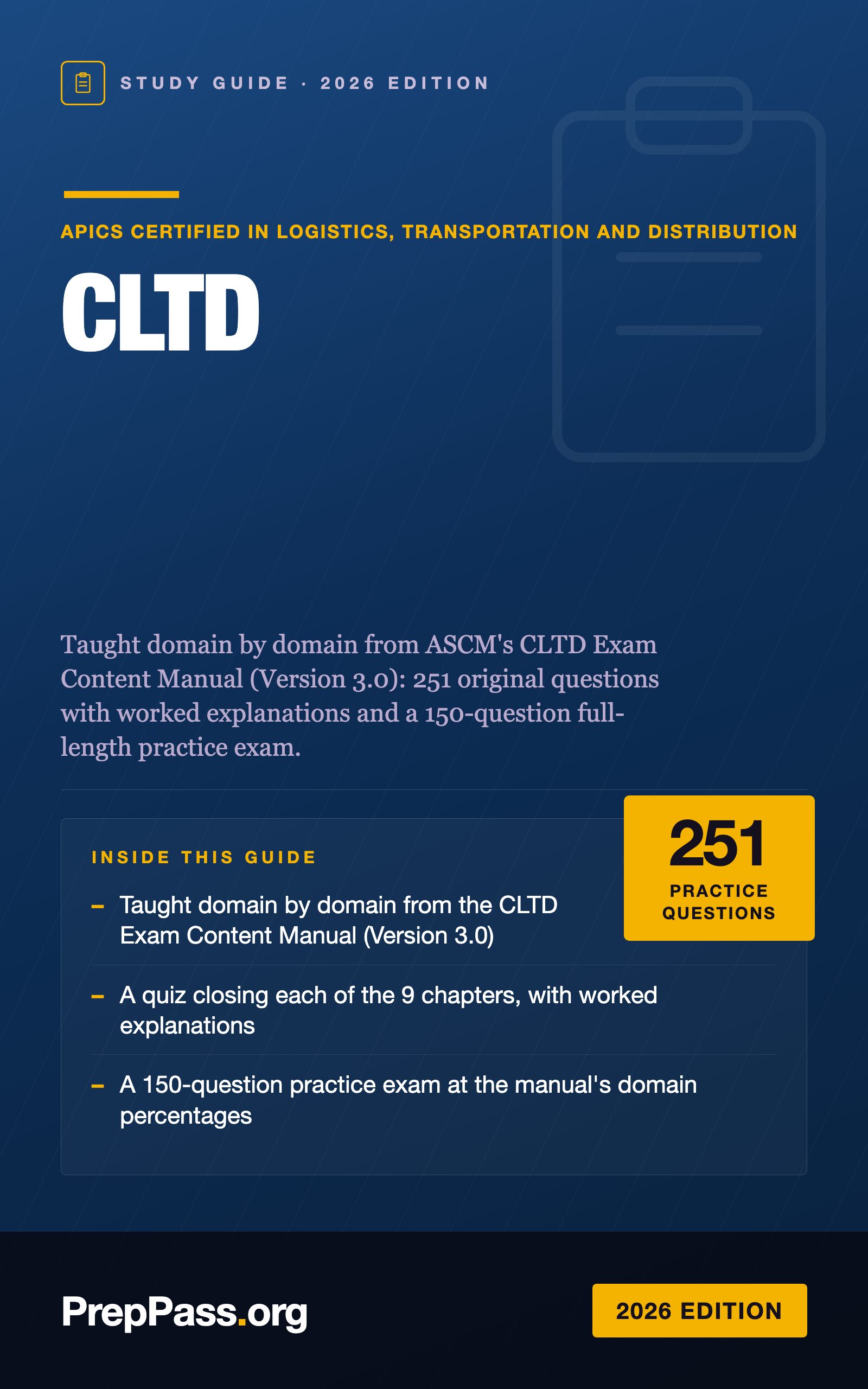
CLTD — APICS Certified in Logistics, Transportation and Distribution · 2026 Edition
CLTD Study Guide — 2026 Edition
Taught domain by domain from ASCM's CLTD Exam Content Manual (Version 3.0): 251 original questions with worked explanations and a 150-question full-length practice exam.
- 251 original CLTD practice questions, each with a worked explanation, in one PDF + EPUB you keep
PDF + EPUB · English · 158 pages · $24.99 one-time
This book is written in English.
Instant download after payment — no account needed, no subscription.
14-day money-back guarantee: not satisfied for any reason? Email support@preppass.org within 14 days of purchase for a full refund. Refund policy
Look inside the book
Three real pages, rendered straight from the PDF you download — a reference page, a teaching page, and a worked question, always in that order. Nothing here was redrawn to look better.
- Quick referenceChapter 2 — Capacity Planning and Demand Management · PDF page 21
A page you can turn back to: the numbers, deadlines or terms gathered in one place.
- How it's taughtChapter 7 — Global Logistics · PDF page 73
An explanation page: the material taught in prose, in the order the exam tests it.
- A question, workedPractice exam — Domain 2: Demand and Capacity Management · PDF page 108
A practice question with its answer and the reasoning behind it — not just a key.
About the CLTD exam
Logistics, transportation, warehousing, and distribution professionals seeking the APICS CLTD credential: planners, warehouse and inventory managers, transportation managers, and global logistics staff. This book teaches the public exam outline with original practice questions. It is an independent guide, not produced by ASCM, and it comes with no online practice.
| Awarding body | Association for Supply Chain Management (ASCM) |
|---|---|
| Questions | 150 multiple-choice questions |
| Time limit | 3.5 hours |
| Passing rule | Score range 200-350; scores above 300 are passing |
| Fees | CLTD Learning System + Exam + 2nd Chance Exam bundle: $1,980 for members with the certification upgrade; $2,760 for nonmembers and members without the certification upgrade. ASCM also offers an exam-only purchase; check its current price on ASCM's page. |
| Delivery | Computer-based testing at Pearson VUE test centers worldwide, and online through the OnVUE system |
| Retakes | A free retake (2nd Chance Exam) is included in the bundle only; a candidate qualifies only when the first exam is scheduled and failed within 365 days of purchasing the certification bundle |
| Content outline | CLTD Exam Content Manual, 3.0 |
| Domains and weights |
|
Questions buyers ask
- How many questions are on the CLTD exam and how long is it?
- The exam has 150 multiple-choice questions to complete within 3.5 hours.
- What is the CLTD passing rule?
- Scores range from 200 to 350, and scores above 300 are passing. ASCM reports scaled scores, never a percentage or a number of correct answers.
- What domains does the CLTD exam cover and how are they weighted?
- Nine domains: logistics fundamentals and strategy (10%), capacity planning and demand management (10%), order management (10%), inventory management (11%), warehouse management (12%), transportation management (15%), global logistics (13%), logistics network design (10%), and sustainability and reverse logistics (9%).
- Which edition of the exam outline is current, when did it take effect, and what changed?
- The CLTD Exam Content Manual, Version 3.0, copyright 2024. ASCM does not publish an effective date for this edition, and no change summary from a prior edition is published.
- Who is eligible to take the CLTD exam?
- ASCM does not publish eligibility or prerequisite requirements for the CLTD exam in its certification page or the Exam Content Manual.
- How much does the CLTD cost, and what happens if I fail?
- The Learning System + Exam + 2nd Chance Exam bundle costs $1,980 for members with the certification upgrade and $2,760 for others; ASCM also sells the exam alone. The free retake comes with the bundle only, and only if the first exam is taken and failed within 365 days of purchase.
- How is this book organised?
- Nine chapters follow the published domain weights, each ending with a quiz, followed by a 150-question practice exam — 251 original questions in all, each with an explanation. The book costs $24.99.
- Is the bundle price the exam fee, and who publishes this guide?
- No. The $1,980/$2,760 figure is a bundle that includes the Learning System and a 2nd Chance Exam; ASCM also offers an exam-only purchase. This is an independent study guide reviewed by the PrepPass team, not an ASCM product.
- Is a study guide enough for the CLTD — APICS Certified in Logistics, Transportation and Distribution exam, or do I need a course?
- A book is exam review: it does not replace any education, training or experience Association for Supply Chain Management (ASCM) requires before you may sit the exam, so check those requirements first. For the exam content itself, this 158-page guide teaches the material chapter by chapter with 251 practice questions and explanations inside. A prep course adds live instruction and a set schedule; whether you need one beyond any required education is your call.
- Does the CLTD — APICS Certified in Logistics, Transportation and Distribution study guide come as a PDF?
- Yes — CLTD Study Guide — 2026 Edition downloads as PDF and EPUB, 158 pages. The download link is emailed the moment payment clears and does not expire.
- How much does the CLTD — APICS Certified in Logistics, Transportation and Distribution study guide cost?
- $24.99, once. There is no subscription and no account to create; the PDF and EPUB files are yours to keep.
- Can I read part of the CLTD — APICS Certified in Logistics, Transportation and Distribution study guide before buying?
- Yes. A full chapter is free to read on this page — not a summary of one, the chapter itself.
- Is this the official CLTD — APICS Certified in Logistics, Transportation and Distribution study guide?
- No. This is an independent study guide and is not affiliated with or endorsed by the exam's awarding body. It is written from ASCM's CLTD Exam Content Manual (Version 3.0). Always confirm current requirements with the body that issues your licence.
What's included — and what isn't
Included
- Taught domain by domain from the CLTD Exam Content Manual (Version 3.0)
- A quiz closing each of the 9 chapters, with worked explanations
- A 150-question practice exam at the manual's domain percentages
- 251 original questions, each explained and cited to its source
- Worked calculations: EOQ, reorder point, landed cost, center of gravity
- PDF + EPUB you keep
Not included
- No printed copy is shipped — this is a file you download and can print yourself
- No video course, instructor, tutoring or online question bank comes with the book — everything is in the file
- Not your exam registration or the testing centre's fee, which you still pay to the official body
Contents
See 13 sections and the page each one starts on
- Chapter 1 — Logistics Fundamentals and Strategyp. 7
- Chapter 2 — Capacity Planning and Demand Managementp. 17
- Chapter 3 — Order Managementp. 26
- Chapter 4 — Inventory Managementp. 34
- Chapter 5 — Warehouse Distribution / Fulfillment Center Managementp. 42
- Chapter 6 — Transportation Managementp. 51
- Chapter 7 — Global Logisticsp. 64
- Chapter 8 — Logistics Network Designp. 75
- Chapter 9 — Sustainability and Reverse Logisticsp. 84
- Practice examp. 94
- Practice exam — Domain 2: Demand and Capacity Managementp. 100
- Practice exam — Domain 4: Inventory Managementp. 111
- Answer keyp. 128
Taken from the PDF you download, with the page each one starts on — not typed here.
Read a chapter free, in full
One complete chapter, exactly as it ships in the eBook. Scroll the window to read it right here; no download, no email.
Read chapter 6 here, without leaving the page
We didn't give you the easy intro — the free chapter opens on one of the hardest-working parts of the book, so you can judge the teaching where the exam gets difficult.
Transportation is the largest single logistics cost for most firms and the most visible to the customer — it is also the heaviest-weighted domain on the exam. This chapter covers the cost structure and players, the five modes plus intermodal and parcel, and the full execution cycle: network design, carrier selection, rates, documentation, visibility, and freight audit.
Transportation management fundamentals
Cost structure. Three elements: terminals (the fixed infrastructure — docks, hubs, ports), vehicles (the moving assets and their operating cost), and labor (drivers, handlers, planners). The structure explains mode economics: modes with heavy terminal/fixed costs and low variable costs (rail, pipeline, water) reward volume and distance; modes with low fixed costs and high variable costs (truck, air) reward flexibility and speed. Any question asking why a mode's rates behave as they do is really asking about this structure.
Stakeholders. The shipper (consignor) tenders the goods; the recipient (consignee) receives them; the carrier moves them; government regulates safety, security, and competition; the public bears externalities (congestion, emissions, safety); the sold-to party may differ from the consignee (a buyer vs. the delivery location). Confusion between consignor/consignee/sold-to is a staple distractor — read who pays, who ships, who receives separately.
Intermediaries. 3PLs execute logistics functions (transport, warehousing) for the shipper; 4PLs orchestrate multiple 3PLs and systems as an integrator — the exam contrasts doing (3PL) with managing (4PL). Freight forwarders act "as an intermediary between the shipper and the carrier, typically on international shipments"[1]; NVOCCs are ocean intermediaries that sell container space without operating vessels. Freight brokers match shippers with carriers (mostly truckload) without taking possession. Customs brokers clear goods through customs. EMCs/ETCs (export management/trading companies) handle exporting for firms without export departments. Shipping associations pool members' freight for volume rates. Agents represent carriers or shippers locally; export packing companies specialize in export-grade packing. The testable distinction: who takes possession, who takes title, who takes responsibility — most intermediaries take none of the first two.
Carrier types. Common carriers serve "the general public" on "a regular schedule at published rates"[2] — they must serve all shippers without discrimination. Contract carriers serve "one or a limited number of customers" under "continuing contract"[2] — negotiated terms, committed capacity. Dedicated contract carriage "dedicates equipment (vehicles) and drivers to a single customer for its exclusive use on a contractual basis"[2]. Exempt carriers haul commodities or in operations exempt from economic regulation. Private carriers move their own goods with their own (or leased) fleet and "does not charge a fee"[2] — control at the cost of fixed investment and empty backhauls. The exam asks which type fits which need: volatile spot demand → common; stable lanes → contract; control-critical → private/dedicated.
Modes of transportation and selection
The master tradeoff. "Air freight is typically the fastest mode for long-distance freight transport, but it is also the most expensive," while "ground transport is typically more affordable than air, but more expensive than sea"[3]. Globally, the ton-kilometer mix tells the story: about 70% by sea, 18% by road, 9% by rail, 2% by inland waterways, and less than 0.25% by air[3]. Sea dominates because "merchant shipping (or seaborne trade) carries 80–90% of international trade" by volume[3]. Selection weighs speed, cost, reliability, accessibility, capability (what fits), and security — no mode wins on all six.
Ground (motor carrier). Trailer types (dry van, reefer, flatbed, tanker) match product needs. Truckload (TL) buys the whole trailer — lower cost per unit, faster, less handling; less-than-truckload (LTL) consolidates multiple shippers — economical for smaller shipments, slower with more handling. Market structure is fragmented and competitive (low barriers to entry); operating characteristics: unmatched accessibility (door-to-door — ground transport "is required to take the cargo from its place of origin to the airport or seaport and then to its destination"[3]) and flexibility, with driver availability and hours-of-service rules as the binding constraints. FMCSA's property-carrier rules set the operating envelope: "a maximum of 11 hours" driving "after 10 consecutive hours off duty," no driving "beyond the 14th consecutive hour after coming on duty," a 30-minute break after 8 cumulative driving hours, and the 60/70-hour weekly limits[4]. The exam tests these numbers as capacity and scheduling constraints, not trivia.
Rail. Operations include TOFC (trailer on flatcar) and COFC (container on flatcar) — the intermodal workhorses — plus full carload and LCL. Equipment: boxcars, hopper cars (bulk), tank cars (liquids), flatcars, gondolas. Unit trains — an entire uninterrupted locomotive, car, and caboose movement between a single origin and destination[2] — are the ultimate bulk economy. Market structure: few large carriers, high fixed costs, price and service negotiated. Characteristics: the lowest line-haul cost for heavy/bulk over long land distances, but slower, less accessible ( siding-to-siding), and less reliable schedule-wise than truck. Issues: capacity constraints at interchange points, service variability.
Air. Carrier types: integrators (FedEx, UPS, DHL — the express parcel carriers that drove the industry's 1990s growth[5]), combination carriers (belly cargo in passenger aircraft — "a common practice"[5]), and all-cargo operators. Freight classification centers on dangerous goods (IATA maintains the industry's Dangerous Goods Regulations (DGR) as a global standard[6]) plus perishables, pharma, and live animals. Characteristics: fastest, most expensive, limited by weight/volume and airport access; the choice for high-value, time-critical, low-density goods. The exam's air questions hinge on the speed-cost extreme and DG compliance.
Water (ocean/waterways). Service types: FCL (full container load — one shipper's box), LCL (consolidated), bulk (tanker, dry bulk). Vessel types: container ships, bulk carriers, tankers, RoRo. Market structure: alliances and conferences on major lanes, volatile spot rates. Characteristics: lowest cost per ton-mile for large volumes over long distances; slowest; port-to-port (needs drayage at both ends — "transportation of materials and freight" on a local basis "to or from a congested area such as a shipping port"[1]). Issues: port congestion, schedule reliability, long lead times inflating pipeline inventory.
Pipeline. Freight: crude oil, refined products, natural gas, chemicals, slurries — flowable commodities. The U.S. network is vast (about 3.3 million miles), moving the energy products the economy runs on, under the Pipeline and Hazardous Materials Safety Administration[7]. Market structure: common-carrier pipelines regulated as utilities on many products. Characteristics: lowest variable cost and most reliable once flowing, but glacially slow, totally inflexible on route and product, and capital-intensive to build. Issues: environmental and safety regulation, permitting.
Multi-modal and multi-stop. Intermodal (containerized freight moving across modes under one journey — the exam's "multi-modal") combines each mode's strength; multi-stop truckloads serve several consignees on one route. Parcel/courier (integrators) own the small-shipment, time-definite space with hub-and-spoke air/ground networks. Selection questions give a product profile (value, density, urgency, distance) and ask for the mode — match the profile to the mode's extreme, and check accessibility (can it actually reach origin and destination?).
Implement transportation management
Network design and mode selection. Routing analysis and optimization (shortest path, vehicle routing with time windows), tradeoffs (cost vs. service vs. risk — the Domain 1 logic applied to lanes), and data-driven business intelligence (lane analytics, demand patterns). The exam rewards the process: analyze, model tradeoffs, decide with data — not the anecdote.
Carrier negotiations and selection. Selection factors: rates, service reliability, capacity commitment, coverage, financial stability, safety record, technology/visibility, and claims handling. Outsourcing considerations: control vs. cost vs. flexibility. RFI, RFP and RFQ: the request for information comes first, gathering information about vendors, products and services before any formal RFQ/RFP process[1]; the RFP then asks suppliers to propose how they would meet stated needs, and the RFQ asks for pricing and availability[2]. Organisations sequence the last two differently, so the exam-safe point is that the RFI precedes both. Contracts: master contracts (the relationship framework), purchase orders/tenders (the transaction — a load tender is "an offer of cargo for transport by a shipper"[2]), standard templates, and best practices (clear SLAs, rate structures, fuel surcharge mechanics, liability terms).
Fleet management. For private/dedicated fleets: sizing, replacement cycles, maintenance, driver management, utilization, and the eternal make-vs-buy against for-hire. Optimize by measuring cost per mile, empty miles (deadhead — the empty return leg; the backhaul is "the portion of a transport trip... incurred when returning a vehicle to its point of origin," ideally loaded[2]), and on-time performance.
Rate tariffs. Types of charges: line haul (the movement), fuel surcharge, plus accessorials — detention (holding equipment beyond free time; demurrage is its rail/ocean cousin: "charges and fees applied when rail freight cars and ships are retained beyond a specific loading or unloading time"[2]), dwell, inside delivery, liftgate, notification, re-delivery. Freight classification (notably LTL classes, and freight-all-kinds / FAK — a blended rate across commodities) determines the base rate. Tariff determinants: distance, weight/density, commodity, lane balance, fuel. The exam tests whether you can read a freight bill's anatomy and spot which charge applies to which delay.
Documentation. Terms of sale and freight payment terms (prepaid vs. collect — who pays the carrier). The bill of lading: the contract of carriage, receipt of goods, and (when negotiable) document of title. Under 49 U.S.C. §80103, "a bill of lading is negotiable if the bill" is drawn to order, while a nonnegotiable (straight) bill consigns goods to a named consignee and its indorsement does not make it negotiable[8]. Master vs. house B/L: the forwarder/NVOCC issues house bills to shippers and travels under the carrier's master bill. Freight bill/invoice (the carrier's charge), proof of delivery (the consignee's acknowledgment — the trigger for payment and claims defense), dangerous goods documentation (the shipper's declaration — the legal basis for hazmat compliance).
Visibility, tracking, tracing. Real-time tracking (GPS, milestones), optimization and consolidation (re-planning in motion), EDI/API integration with carriers, and exception management — the discipline of detecting deviations and expediting recovery. Visibility's value is not the dot on the map; it is the time to react.
Cost forecasting, budgeting, and freight audit. Forecast with economic (fuel, demand cycles), market (capacity tightness), security, and regulatory lenses. The freight pay and audit process verifies every freight bill against contract rates before payment — catching duplicates, wrong rates, and phantom accessorials — then settles. Freight claims (loss/damage/delay) require prompt filing with documentation (POD exceptions noted at delivery are gold). The governing law for interstate surface freight is the Carmack Amendment — "a uniform national liability system for interstate carriers" that lets a carrier require written claims "within nine months from the date of the loss" and limit its liability when prerequisites are met[9]. Internal vs. outsourced audit is a scale decision: high volume justifies specialists.
Key numbers & deadlines
| Figure | Value | Source |
|---|---|---|
| Exam weight, this domain | 15% of scored questions | [10] |
| Global freight by mode (2015) | ~70% sea, 18% road, 9% rail, 2% inland waterway, <0.25% air (tonne-km) | [3] |
| Seaborne share of international trade | 80–90% (UNCTAD 2018) | [3] |
| FMCSA 11-hour / 14-hour / 30-minute rules | 11h driving after 10h off; 14h window; 30-min break after 8h driving | [4] |
| FMCSA 60/70-hour rule | No driving after 60/70 on-duty hours in 7/8 days; 34-hour restart | [4] |
Key takeaways
- Cost structure (terminals, vehicles, labor) explains mode economics; stakeholders and intermediaries each own a distinct slice of responsibility.
- Carrier types: common (public, published rates), contract (limited customers, negotiated), dedicated (exclusive equipment/drivers), private (own goods, own fleet).
- Mode selection: air = fastest/most expensive; sea = cheapest per ton-mile for bulk long-haul; rail = bulk land economy; truck = accessible and flexible; pipeline = cheapest variable cost for flowables on fixed routes.
- Documentation is the control system: B/L (negotiable vs. straight), master vs. house, freight bill, POD, DG declaration.
- Rates = line haul + fuel + accessorials (detention/demurrage et al.); audit every bill, file claims with POD evidence, manage exceptions by reacting fast.
Chapter 6 quiz
1. Large fixed costs to build and operate a network that jointly serves many shippers best describe the economics of which carriers?
- A. For-hire truckload motor carriage operations
- B. Air express parcel networks
- C. Railroads that own their track networks
- D. Last-mile delivery van fleets
2. The consignor in a freight transaction is the:
- A. Shipper who tenders the goods
- B. Recipient who receives the delivered goods
- C. Bank financing the shipment
- D. Government agency regulating transport
3. The defining difference between a 4PL and a 3PL is that the 4PL:
- A. Owns more trucks than 3PLs
- B. Handles only domestic freight movements
- C. Always charges lower freight rates
- D. Integrates multiple 3PLs and systems
4. A common carrier is distinguished by its obligation to:
- A. Serve one contracted customer only
- B. Serve the general public at published rates
- C. Haul only its own company's freight
- D. Operate with no fixed schedule
5. A manufacturer wanting exclusive use of equipment and drivers under contract should choose:
- A. A for-hire common carrier service
- B. A dedicated contract carriage service
- C. An established freight brokerage service
- D. A registered exempt carrier service
6. Compared with truckload, less-than-truckload shipping is typically:
- A. Faster with much less freight handling
- B. Always cheaper per unit shipped
- C. Consolidated via a terminal network
- D. Limited to rail intermodal moves only
7. A unit train is best described as:
- A. One origin-to-destination movement without interruption
- B. A daily scheduled passenger train carrying express parcel freight
- C. One single railcar spotted at an industry siding
- D. A long convoy of trucks on a highway
8. In air freight, dangerous goods compliance centers on:
- A. The carrier's own classification of goods
- B. The consignee's import permit
- C. The airline's choice of aircraft
- D. Shipper classification and declaration
9. An importer with enough cargo to fill a container should book:
- A. FCL for a full container load
- B. LCL consolidation with other shippers' freight
- C. Bulk tanker vessel service
- D. A dedicated air charter for maximum speed
10. Under FMCSA hours-of-service rules, a property-carrying driver may drive up to:
- A. Only 8 hours after 10 consecutive hours off duty
- B. 11 hours after 10 consecutive hours off duty
- C. 14 hours without any off-duty break
- D. 16 hours after 8 consecutive hours off duty
11. In carrier sourcing, which document is used to gather information about carriers and their services before any formal request for quotation or proposal?
- A. A request for quotation (RFQ)
- B. A request for proposal (RFP)
- C. A request for information (RFI)
- D. A load tender sent to the carrier
12. Demurrage charges apply in which situation?
- A. Shipper freight is unfortunately lost somewhere while in transit
- B. Carriers voluntarily offer discounted freight rates
- C. A truck is held past free time at a dock
- D. Rail cars or ships are retained beyond free time
13. A negotiable bill of lading is one that is:
- A. Drawn to one named consignee
- B. Issued after delivery is complete
- C. Drawn to the order of a consignee
- D. Valid only for domestic freight moves
14. The primary purpose of the freight pay and audit process is to:
- A. Verify bills against contract rates before payment
- B. Renegotiate lower contracted freight rates with carriers annually
- C. Select new carriers for key freight lanes
- D. Design efficient warehouse layouts
15. A backhaul most accurately refers to:
- A. An empty truck driving back to its origin
- B. The return leg to origin, ideally loaded
- C. A shipment's first outbound leg
- D. A warehouse put-away move
Sources cited in this excerpt
- CSCMP Supply Chain Management Terms and Glossary (August 2013). https://www.cisco-eagle.com/uploads/cscmp/cscmp-glossary.pdf
- CSCMP Supply Chain Management Terms and Glossary (2013). https://www.cisco-eagle.com/uploads/cscmp/cscmp-glossary.pdf
- Freight transport. Wikipedia (tertiary summary). https://en.wikipedia.org/wiki/Freight_transport
- Summary of Hours of Service Regulations. U.S. Federal Motor Carrier Safety Administration. https://www.fmcsa.dot.gov/regulations/hours-service/summary-hours-service-regulations
- Air cargo. Wikipedia (tertiary summary). https://en.wikipedia.org/wiki/Air_cargo
- Cargo. International Air Transport Association. https://www.iata.org/en/programs/cargo
- Pipeline Safety: Federal Programs (CRS Report R44201). Congressional Research Service. https://www.congress.gov/crs_external_products/R/PDF/R44201/R44201.20.pdf
- 49 U.S.C. 80103 - Negotiable and nonnegotiable bills. U.S. House Office of the Law Revision Counsel. https://uscode.house.gov/view.xhtml?req=granuleid:USC-prelim-title49-section80103&num=0&edition=prelim
- The Carmack Amendment: A Uniform System Of Liability For Interstate Transportation Carriers (FindLaw). https://corporate.findlaw.com/business-operations/the-carmack-amendment-a-uniform-system-of-liability-for.html
- CLTD Exam Content Manual, Version 3.0. ASCM (Association for Supply Chain Management). http://www.mty.ascm.org/s/ECM-CLTD-n3nk.pdf
Before you buy
- How do I get it?
- Pay, and the download appears on this page straight away. The links are also emailed to you. No account is required.
- What if it isn't for me?
- Email us within 14 days for a full refund, no questions asked.
- Is there online practice for this exam too?
- No. PrepPass has no online question bank for this exam; the book is self-contained. Its chapter quizzes and full-length practice exam, each question with a worked explanation, are all in the PDF and EPUB.
- Can I read it on my phone?
- Yes — the EPUB is for phones and e-readers, the PDF is for printing and tabbing. You get both.
The details
Taught domain by domain from ASCM's CLTD Exam Content Manual (Version 3.0): 251 original questions with worked explanations and a 150-question full-length practice exam.
- Format: PDF + EPUB download · 158 pages
- 251 practice questions in the book, with a full answer key
- $24.99 one-time — no subscription
- 14-day money-back guarantee · refund policy
- Cross-referenced against: ASCM's CLTD Exam Content Manual (Version 3.0)
- Last updated: September 2026
- Verified from the official source(ASCM's CLTD Exam Content Manual (Version 3.0))
- Instant download, yours for life
A CLTD learning system or instructor-led course runs $1,100–$3,295. This book teaches the same exam — same rules, verified to current standards — for a one-time $24.99 you keep for life.
What the book gives you
PrepPass has no online question bank for this exam, so the $24.99 book is complete in itself: the material taught in order, a quiz closing each chapter and a full-length practice exam, in a file you own.
- Systematic teaching — every exam section explained chapter by chapter, start to finish, not just questions
- Print it & tab it — a paper-ready PDF you can highlight, mark up, and bring to your study table
- Study anywhere, offline — EPUB on your phone or e-reader; no wifi, no browser tabs
- Everything in one place — the chapters and the practice questions in one file
- Yours for life — one-time $24.99, instant download, no subscription
And it's risk-free: 14-day money-back guarantee — not satisfied? Email us for a full refund, no questions asked. See the refund policy.
14-day money-back guarantee · full refund, no questions asked.
One-time purchase, lifetime access to the download. The eBook is the full CLTD — APICS Certified in Logistics, Transportation and Distribution study guide in PDF and EPUB. Educational summary, not professional or legal advice — always confirm the current rules with the official source. Last updated: September 2026.