CCRN (Adult) — Acute/Critical Care Nursing Certification Exam · 2026 Edition
CCRN (Adult) Study Guide — 2026 Edition
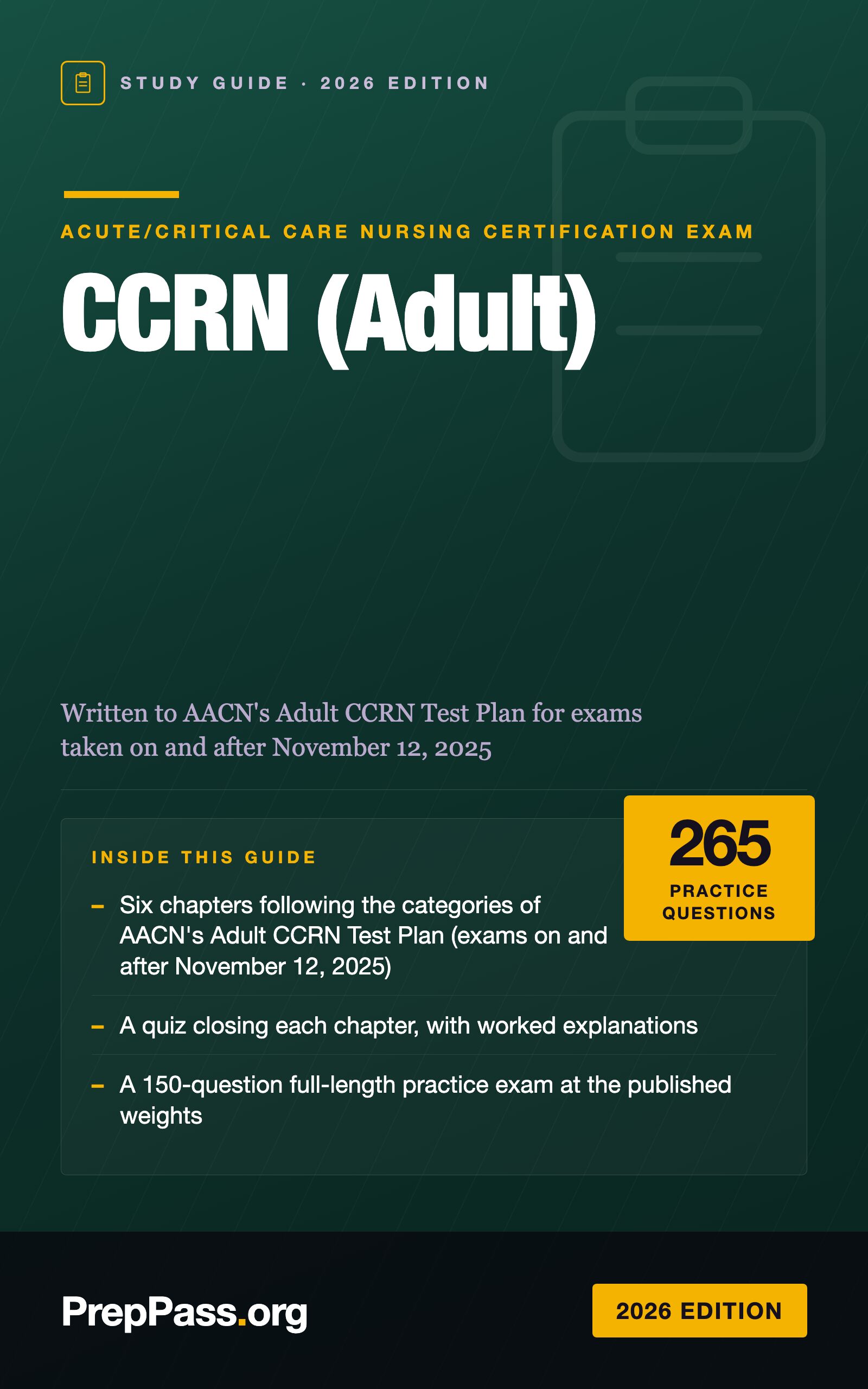
Written to AACN's Adult CCRN Test Plan for exams taken on and after November 12, 2025: six chapters, 265 original questions with worked explanations, and a 150-question full-length practice exam.
- 265 original CCRN practice questions, each with a worked explanation, in one PDF + EPUB you keep
PDF + EPUB · English · 136 pages · $24.99 one-time
This book is written in English.
Instant download after payment — no account needed, no subscription.
14-day money-back guarantee: not satisfied for any reason? Email support@preppass.org within 14 days of purchase for a full refund. Refund policy
Try 10 questions first — free
Answer all 10, then see every answer explained — with the section of this guide that teaches it. About 5 minutes, no sign-up.
Start 10 free questionsLook inside the book
Three real pages, rendered straight from the PDF you download — a reference page, a teaching page, and a worked question, always in that order. Nothing here was redrawn to look better.
- Quick referenceChapter 6 — Professional Caring & Ethical Practice · PDF page 64
A page you can turn back to: the numbers, deadlines or terms gathered in one place.
- How it's taughtSection 6 — Professional Caring & Ethical Practice (questions 121–150) · PDF page 111
An explanation page: the material taught in prose, in the order the exam tests it.
- A question, workedChapter 2 — Respiratory · PDF page 23
A practice question with its answer and the reasoning behind it — not just a key.
About the exam itself
| Administering body | AACN Certification Corporation — exam delivered by PSI Source: AACN Certification Corporation — CCRN Exam Handbook - Direct Care (July 2026, PDF) |
|---|---|
| Questions | 150 questions (125 scored, 25 unscored pretest) Source: AACN Certification Corporation — CCRN Exam Handbook - Direct Care (July 2026, PDF) |
| Time limit | 180 minutes Source: AACN Certification Corporation — CCRN Exam Handbook - Direct Care (July 2026, PDF) |
| Passing score | 83 of 125 correct |
| Fees |
Source: AACN Certification Corporation — CCRN Exam Handbook - Direct Care (July 2026, PDF) |
| Languages offered | Not published by AACN Certification Corporation What we read and found nothing in: AACN Certification Corporation — CCRN Exam Handbook - Direct Care (July 2026, PDF) |
Questions buyers ask
- Which outline is the CCRN (Adult) — Acute/Critical Care Nursing Certification Exam based on?
- Adult CCRN Test Plan, in force from 2025-11-12. Check AACN Certification Corporation for the current outline before you book.
- Is a study guide enough for the CCRN (Adult) — Acute/Critical Care Nursing Certification Exam, or do I need a course?
- Check eligibility first — per AACN Certification Corporation: a current, unencumbered U.S. RN or APRN license, plus either 1,750 hours of direct care of acutely/critically ill patients in the previous 2 years (875 of them in the most recent year) or 2,000 hours in the previous 5 years (144 of them in the most recent year). A book does not replace those requirements. For the exam content itself, this 136-page guide teaches the material chapter by chapter with 265 practice questions and explanations inside, and 118 more practice questions are free on PrepPass. A prep course adds live instruction and a set schedule; whether you need one beyond any required education is your call.
- What is the cheapest way to prepare for the CCRN (Adult) — Acute/Critical Care Nursing Certification Exam?
- Start with what costs nothing: 118 practice questions on PrepPass, with explanations and no signup. If you want it taught in one file you keep, the full study guide is $24.99 once. No subscription on any of them.
- What happens if I fail the CCRN (Adult) — Acute/Critical Care Nursing Certification Exam?
- You can retake it under AACN Certification Corporation's rule: you may apply for and take the same certification exam up to four times in a rolling 12-month period. A retest costs $185 for AACN members and $290 for nonmembers. Confirm the current policy with AACN Certification Corporation before you book.
- Who administers the CCRN (Adult) Certification Exam — Direct Care?
- AACN Certification Corporation — exam delivered by PSI. Candidates test at a PSI testing center or by Live Remote Proctoring. The Adult test plan for exams taken on and after November 12, 2025: Clinical Judgment 80% — Cardiovascular 13%, Respiratory 12%, Endocrine/Hematology and Immunology/GI/Renal and GU/Integumentary 21%, Musculoskeletal/Neurological/Behavioral and Psychosocial 18%, Multisystem 16% — and Professional Caring and Ethical Practice 20%.
- How many questions are on the CCRN (Adult) Certification Exam — Direct Care?
- 150 questions (125 scored, 25 unscored pretest). All items are multiple choice. The unscored items gather statistical data for future exams.
- How long is the CCRN (Adult) Certification Exam — Direct Care?
- 180 minutes
- What is the passing score for the CCRN (Adult) Certification Exam — Direct Care?
- 83 of 125 correct. AACN counts the cut score in scored questions answered correctly and says it is not a percentage. This cut score took effect on November 12, 2025; it is set by the modified Angoff method and may change when the exam is updated.
- How much does the CCRN (Adult) Certification Exam — Direct Care cost?
- $260 — Computer-based exam — AACN member (AACN Certification Corporation, per attempt); $375 — Computer-based exam — nonmember (AACN Certification Corporation, per attempt); $185 — Retest — AACN member (AACN Certification Corporation, per attempt); $290 — Retest — nonmember (AACN Certification Corporation, per attempt). Payable in U.S. funds; AACN states fees are subject to change without notice.
- What languages is the CCRN (Adult) Certification Exam — Direct Care offered in?
- Not published by AACN Certification Corporation. Neither the CCRN Exam Handbook nor AACN's CCRN (Adult) page states which languages the exam is offered in.
- Does the CCRN (Adult) — Acute/Critical Care Nursing Certification Exam study guide come as a PDF?
- Yes — CCRN (Adult) Study Guide — 2026 Edition downloads as PDF and EPUB, 136 pages. The download link is emailed the moment payment clears and does not expire.
- How much does the CCRN (Adult) — Acute/Critical Care Nursing Certification Exam study guide cost?
- $24.99, once. There is no subscription and no account to create; the PDF and EPUB files are yours to keep.
- Are there free CCRN (Adult) — Acute/Critical Care Nursing Certification Exam practice questions?
- Yes — 118 of them, free to use with no signup and an explanation on every one. They are separate from this study guide, which is what you are buying here.
- Can I read part of the CCRN (Adult) — Acute/Critical Care Nursing Certification Exam study guide before buying?
- Yes. A full chapter is free to read on this page — not a summary of one, the chapter itself.
- Is this the official CCRN (Adult) — Acute/Critical Care Nursing Certification Exam study guide?
- No. This is an independent study guide and is not affiliated with or endorsed by the exam's awarding body. It is written from AACN's CCRN Exam Handbook — Direct Care (July 2026) and its Adult CCRN Test Plan. Always confirm current requirements with the body that issues your licence.
What's included — and what isn't
Included
- Six chapters following the categories of AACN's Adult CCRN Test Plan (exams on and after November 12, 2025)
- A quiz closing each chapter, with worked explanations
- A 150-question full-length practice exam at the published weights
- 265 original questions, each explained and cited to its source
- Key-numbers and quick-reference tables for fast review
- PDF + EPUB you keep
Not included
- No printed copy is shipped — this is a file you download and can print yourself
- No video course, instructor or tutoring comes with the book — the free videos on the site are separate
- Not your exam registration or the testing centre's fee, which you still pay to the official body
Contents
See 14 sections and the page each one starts on
- Chapter 1 — Cardiovascularp. 7
- Chapter 2 — Respiratoryp. 17
- Chapter 3 — Endocrine, Hematology/Immunology, Gastrointestinal, Renal/Genitourinary, Integumentaryp. 27
- Chapter 4 — Musculoskeletal, Neurological, Behavioral/Psychosocialp. 40
- Chapter 5 — Multisystemp. 51
- Chapter 6 — Professional Caring & Ethical Practicep. 61
- Appendix A — Critical-care terminologyp. 73
- Appendix B — Quick-reference tablesp. 74
- Section 1 — Cardiovascular (questions 1–20)p. 76
- Section 2 — Respiratory (questions 21–38)p. 80
- Section 3 — Endocrine, Hematology/Immunology, GI, Renal/GU, Integumentary (questions 39–69)p. 84
- Section 4 — Musculoskeletal, Neurological, Behavioral/Psychosocial (questions 70–96)p. 90
- Section 5 — Multisystem (questions 97–120)p. 96
- Section 6 — Professional Caring & Ethical Practice (questions 121–150)p. 101
Taken from the PDF you download, with the page each one starts on — not typed here.
Read a chapter free, in full
One complete chapter, exactly as it ships in the eBook. Scroll the window to read it right here; no download, no email.
Read chapter 1 here, without leaving the page
Cardiovascular questions ask you to recognise a failing circulation from the bedside picture, name the mechanism, and choose the first intervention — and they reward knowing why the tempting intervention would make things worse. The test plan lists sixteen cardiovascular topics, from acute coronary syndrome to vascular interventions; this chapter teaches the ones that most often decide a patient's next hour.
Acute coronary syndrome
Most heart attacks are caused by a blood clot that blocks a coronary artery, starving the heart muscle of oxygen[1]. Unstable angina sits on the same continuum: chest pain that is new, worsening or no longer relieved the way it used to be. Nitroglycerin relaxes the blood vessels, but it may not fully relieve the pain of a heart attack[1], because it does nothing to the clot itself. For ST-elevation MI, time is muscle: when angioplasty is the chosen treatment, it should be done within 90 minutes of arrival at the hospital[1]. Heparin is part of acute treatment, and its principal hazard is bleeding — the FDA label records fatal haemorrhage[2].
How it is tested: the exam gives you a time or a drug and asks what matters about it. The trap is treating symptom relief (nitroglycerin, a falling pain score) as if it were reperfusion.
Heart failure and cardiogenic shock
When the heart cannot pump efficiently, blood backs up into the vessels that carry blood through the lungs, producing pulmonary oedema, crackles and breathlessness[3]. When the right side fails, blood backs up in the systemic veins instead[4]; distended neck veins signal high pressure on the right side of the heart[4], and dependent oedema follows.
Cardiogenic shock is the end of this road: the heart cannot supply enough blood and oxygen to the organs[5], most often during or after a heart attack[5]. Skin that is cool to the touch and decreased urination are its perfusion signs[5]. Treatment uses medicines to increase blood pressure and improve heart function[5] while the cause is fixed; a large fluid bolus is the classic wrong answer, because a failing left ventricle cannot handle the volume.
Haemodynamic ranges. This book uses the MedlinePlus normal values for right-heart catheterisation: cardiac index 2.8 to 4.2 L/min/m²[6] and pulmonary capillary wedge pressure 4 to 12 mm Hg[6]. Other references quote slightly different ranges; the exam tests the direction of change (low index with high wedge = pump failure), not the last decimal.
Two drug facts belong here. Spironolactone is a mineralocorticoid receptor antagonist and a listed cause of high potassium[7]. IV verapamil is contraindicated in severe congestive heart failure unless the failure is caused by a supraventricular tachycardia it can treat[8].
Obstructive shock: cardiac tamponade
In tamponade, fluid in the pericardial sac prevents the ventricles from expanding fully[9]. The examination shows neck veins that bulge while the blood pressure is low[9], faint heart sounds[9], and blood pressure that falls on deep inspiration — pulsus paradoxus[9]. Echocardiography, done at the bedside in an emergency, is the test of choice[9]. The fluid must be drained as quickly as possible[9]; IV fluids only hold the blood pressure until drainage happens[9]. Obstructive shock in general is caused by something outside the heart that prevents it from pumping enough blood[10].
Pericarditis and Dressler syndrome
Pericarditis pain is often relieved by sitting up and leaning forward[11], and the stethoscope may pick up a pericardial rub[11]. Late pericarditis after a heart attack — Dressler syndrome — usually develops several weeks or months later[12]. The trap is reading every post-MI chest pain as reinfarction.
Aortic dissection
In a dissection, a tear lets blood flow between the layers of the aortic wall, and the tear extends along it[13]. The pain is sudden and severe and described as sharp, stabbing, tearing or ripping[13]. Blood pressure is lowered with IV drugs, and beta-blockers are the medicines of first choice[13]; ascending dissections are treated with surgery[13]. Anticoagulants and thrombolytics are the dangerous distractors — the problem is a torn wall, not a clot.
Dysrhythmias: atrial fibrillation and flutter
In atrial fibrillation the atria contract chaotically — they quiver[14]; in atrial flutter they beat very rapidly but regularly[14]. The irregular rhythm of AF makes blood clots more likely to form[14], which is why anticoagulation is central to long-term care; warfarin is monitored with the INR[15]. Cardioversion can restore a normal rhythm right away and can be done as an emergency[14] — the answer for rapid AF with hypotension or chest pain. For planned cardioversion, some patients start blood thinners beforehand[16].
Hypertensive emergency
What turns severe hypertension into an emergency is organ damage — the brain, eyes, blood vessels, heart and kidneys may be damaged[17] — and the patient receives IV medicines to reduce the pressure[17], with diuretics if there is fluid in the lungs[17]. Nitroprusside is a common IV choice; its label warns that it can cause precipitous falls in blood pressure[18] and, at prolonged or high infusion rates, cyanide toxicity[18].
Structural heart disease: mechanical valves
Mechanical heart valves rarely fail, but clots can form on them and cause a stroke[19] — the reason for lifelong anticoagulation.
Key numbers & deadlines
| Figure | Value | Source |
|---|---|---|
| STEMI — angioplasty target when it is the chosen treatment | Within 90 minutes of arrival | [1] |
| Cardiac index (normal, MedlinePlus) | 2.8–4.2 L/min/m² | [6] |
| Pulmonary capillary wedge pressure (normal, MedlinePlus) | 4–12 mm Hg | [6] |
| Nitroprusside — cyanide risk | Except briefly or at < 2 mcg/kg/min | [18] |
Key takeaways
- Cardiogenic shock is pump failure: cool skin, low urine output, low index with high wedge. Support the pump; do not flood it.
- Tamponade: distended neck veins with low pressure, faint heart sounds, pulsus paradoxus. Drain it; fluids only buy time.
- Dissection: tearing pain; lower heart rate and pressure with IV beta-blockers first; ascending dissections go to surgery.
- AF with instability gets cardioversion; long-term, the clot risk drives anticoagulation.
- A hypertensive emergency is defined by organ damage, not by the number alone.
Chapter 1 quiz — 16 questions
Answer each question, then check the key that follows.
1. A patient develops hypotension, jugular venous distension, and muffled heart sounds a few hours after cardiac surgery. Which condition do these findings most suggest?
- A. Cardiogenic shock from pump failure
- B. Hypovolaemic shock from surgical bleeding
- C. Tamponade from pericardial fluid
- D. Septic shock from a wound infection
2. A patient with an acute aortic dissection is started on an IV beta-blocker. What is the main purpose of this drug?
- A. Dissolve thrombus in the false lumen
- B. Lower heart rate and wall stress
- C. Raise cardiac output to the kidneys
- D. Prevent ventricular dysrhythmias on transport
3. Why is anticoagulation a central part of long-term management of atrial fibrillation?
- A. The fast rate thickens the blood
- B. The irregular rhythm damages coronary arteries
- C. Chaotic atria let clots form
- D. Loss of atrial kick causes hypertension
4. A patient in cardiogenic shock after a large anterior MI has a blood pressure of 78/52 mm Hg, cool clammy skin, and urine output of 15 mL/hr. Which intervention does the nurse anticipate as the priority?
- A. A 2-litre crystalloid bolus
- B. Therapeutic hypothermia protocol
- C. Vasopressor or inotrope infusion
- D. High-dose loop diuretic
5. A patient's systolic blood pressure falls markedly each time they breathe in deeply. This finding (pulsus paradoxus) is most associated with which condition?
- A. Tension pneumothorax
- B. Abdominal compartment syndrome
- C. Massive pulmonary embolism
- D. Cardiac tamponade
6. A patient describes abrupt, severe, tearing chest pain that moves to the back. Blood pressure is 196/110 mm Hg in the right arm and 148/92 mm Hg in the left arm. Which condition does the nurse suspect first?
- A. Acute pericarditis
- B. Oesophageal spasm
- C. Aortic dissection
- D. Costochondritis
7. A patient's blood pressure is 232/134 mm Hg. Which additional finding makes this a hypertensive emergency needing IV treatment?
- A. Systolic pressure above 220 mm Hg
- B. New confusion and falling urine output
- C. A history of missed medication doses
- D. Diastolic pressure above 120 mm Hg
8. In left-sided heart failure, what causes the pulmonary congestion?
- A. Pressure backing up from the failing left ventricle
- B. The right ventricle pumping too much volume into the lungs
- C. Aortic valve stenosis blocking forward flow
- D. Pericardial constriction compressing the left atrium
9. A patient with new-onset atrial fibrillation has a heart rate of 168, blood pressure of 82/54 mm Hg, and chest pain. Which action does the nurse anticipate first?
- A. Oral rate-control drug and observation
- B. Synchronised cardioversion
- C. Vagal manoeuvres and carotid massage
- D. Outpatient anticoagulation teaching
10. After pericardiocentesis for cardiac tamponade, the patient's blood pressure rises and the jugular venous distension resolves. Why did the patient improve?
- A. The compressing pericardial fluid was removed
- B. The procedure strengthened the heart muscle
- C. The needle dilated the coronary arteries
- D. Drainage stimulated the vagus nerve
11. Which assessment finding points to right-sided rather than left-sided heart failure?
- A. Pulmonary crackles and dyspnoea
- B. Neck vein distension, ankle oedema
- C. Pink frothy sputum and hypoxaemia
- D. Paroxysmal nocturnal dyspnoea
12. A patient receiving nitroprusside for a hypertensive emergency must be continuously monitored. Which complication is the nurse chiefly guarding against?
- A. Ischaemia from abrupt hypotension
- B. Coronary vasospasm from nitrate withdrawal
- C. Pulmonary oedema from rising afterload
- D. Metabolic alkalosis from sodium loading
13. In cardiogenic shock, cool clammy skin and oliguria reflect which underlying problem?
- A. Vasodilation from inflammatory mediators
- B. Absolute volume loss from haemorrhage
- C. Obstruction of the great vessels
- D. Poor perfusion from pump failure
14. A patient with atrial fibrillation is started on warfarin. Which teaching point is most important?
- A. It dissolves existing atrial clots within hours
- B. It can stop once the heart rate is controlled
- C. It converts the rhythm back to sinus rhythm
- D. Regular INR blood tests guide the dose
15. A patient with an ST-elevation MI arrives at a hospital that performs angioplasty. Within what time of arrival should the angioplasty ideally be done?
- A. Within 90 minutes
- B. Within 24 hours
- C. After troponin peaks
- D. After 12 hours of observation
16. A patient with a Type A (ascending) aortic dissection is awaiting surgery. What is the nurse's priority goal until then?
- A. Heart rate and blood pressure control
- B. Aggressive fluids to maximise aortic flow
- C. Anticoagulation to prevent false-lumen clot
- D. Vasopressors to keep systolic pressure above 180
Answer key & explanations
1. C. Distended neck veins with a low blood pressure[9] and faint heart sounds[9] are the bedside picture of cardiac tamponade: fluid in the pericardial sac stops the ventricles expanding fully[9]. Bleeding after surgery is the tempting alternative, but hypovolaemia empties the veins, so the neck veins would be flat, not distended.
2. B. As a dissection extends, blood tracks between the layers of the aortic wall[13], so treatment lowers the pressure driving it; MedlinePlus lists IV blood-pressure-lowering drugs with beta-blockers as the first choice[13]. Slowing the heart and lowering pressure reduces the force on the torn wall. The drug does not dissolve clot, and raising cardiac output would increase that force rather than reduce it.
3. C. In AF the atria contract chaotically, or quiver[14], and this irregular rhythm makes blood clots more likely to form[14]; a clot that travels to the brain causes stroke. The rhythm does not injure the coronary arteries directly, and loss of atrial contraction lowers rather than raises output and pressure.
4. C. Cardiogenic shock means the heart cannot supply enough blood and oxygen to the organs[5], and treatment includes medicines to increase blood pressure and improve heart function[5]. A large fluid bolus is the tempting reflex for hypotension, but a failing left ventricle cannot handle the volume and pulmonary congestion worsens; a diuretic would drop an already low pressure further.
5. D. MedlinePlus lists blood pressure that falls when breathing deeply among the examination findings of cardiac tamponade[9]. Fluid in the fixed pericardial sac stops the ventricles expanding fully[9], so filling of the left heart on inspiration is squeezed further. Tension pneumothorax and massive PE also cause obstructive shock, but pulsus paradoxus is the classic tamponade sign.
6. C. Dissection pain is sudden and severe and is described as sharp, stabbing, tearing or ripping[13]; a tear that extends along the aortic wall[13] can reduce flow into one arm, which is why a pressure difference between arms raises the suspicion. Pericarditis is the tempting alternative, but its pain is typically eased by sitting up and leaning forward[11] and does not cause an arm-to-arm pressure difference.
7. B. What makes severe hypertension an emergency is organ damage — MedlinePlus notes that the brain, eyes, blood vessels, heart and kidneys may be damaged[17] — and patients are treated with IV medicines[17]. New confusion and reduced urine output are signs that the brain and kidneys are being injured. A very high number on its own, however alarming, does not show organ injury.
8. A. When the heart cannot pump efficiently, blood backs up into the vessels that carry blood through the lungs[3]: in left-sided failure, the left ventricle cannot move its volume forward, so pressure rises in the pulmonary veins and fluid enters the lungs. The right ventricle is not over-pumping; right-sided failure backs blood up into the systemic veins instead[4].
9. B. Rapid AF with hypotension and chest pain is unstable, and cardioversion can be used as an emergency method to restore a normal rhythm right away[14]. Oral rate control is the tempting choice, but it acts too slowly for a patient whose perfusion is already failing; vagal manoeuvres do not convert AF.
10. A. In tamponade the excess pressure from pericardial fluid stops the ventricles expanding fully[9]; pericardiocentesis drains that fluid[9], so the ventricles fill again and stroke volume and blood pressure recover. The heart muscle itself was never the problem, so the procedure does not strengthen it.
11. B. When the right heart fails, blood backs up in the systemic veins[4]; swollen neck veins are a sign of high pressure in the right side of the heart[4], and ankle swelling follows. Crackles, frothy sputum and nocturnal dyspnoea come from blood backing up into the lung vessels, the left-sided pattern[3].
12. A. The FDA label warns that nitroprusside can cause precipitous decreases in blood pressure that, without proper monitoring, can lead to irreversible ischaemic injury or death[18]. The drug lowers afterload rather than raising it, so pulmonary oedema from afterload is the wrong way round.
13. D. Cardiogenic shock is the heart failing to supply enough blood and oxygen to the organs[5]; skin that is cool to the touch[5] and decreased urination[5] are the signs of that poor perfusion. Distributive shock from inflammatory vasodilation is the tempting alternative, but it typically starts with warm, vasodilated skin.
14. D. Warfarin is monitored with a regular prothrombin time blood test reported as the INR[15]. It is given because the irregular AF rhythm makes clots more likely to form[14]; it prevents new clots rather than dissolving existing ones, and the clot risk persists even when the rate is controlled.
15. A. MedlinePlus states that angioplasty is often the first-choice treatment and should be done within 90 minutes after arrival at the hospital, and usually no later than 12 hours after the heart attack[1]. Waiting for the troponin to peak or for a period of observation wastes heart muscle; the 12-hour figure is an outer limit, not a target.
16. A. Ascending dissections are treated with surgery[13], and until then blood pressure is lowered with IV drugs, beta-blockers first[13], because pressure drives blood further along the torn wall[13]. Fluids and vasopressors raise that pressure, and anticoagulation adds bleeding risk to a torn aorta.
Sources cited in this excerpt
- Heart attack: MedlinePlus Medical Encyclopedia. U.S. National Library of Medicine (MedlinePlus). https://medlineplus.gov/ency/article/000195.htm
- DailyMed - HEPARIN SODIUM injection, solution. U.S. National Library of Medicine DailyMed (FDA-approved labeling). https://dailymed.nlm.nih.gov/dailymed/drugInfo.cfm?setid=c8c4edd2-ee9e-4558-6b8c-b83adc242a0a
- Pulmonary edema: MedlinePlus Medical Encyclopedia. U.S. National Library of Medicine (MedlinePlus). https://medlineplus.gov/ency/article/000140.htm
- Cor pulmonale: MedlinePlus Medical Encyclopedia. U.S. National Library of Medicine (MedlinePlus). https://medlineplus.gov/ency/article/000129.htm
- Cardiogenic shock: MedlinePlus Medical Encyclopedia. U.S. National Library of Medicine (MedlinePlus). https://medlineplus.gov/ency/article/000185.htm
- Swan-Ganz - right heart catheterization: MedlinePlus Medical Encyclopedia. U.S. National Library of Medicine (MedlinePlus). https://medlineplus.gov/ency/article/003870.htm
- High potassium level: MedlinePlus Medical Encyclopedia. U.S. National Library of Medicine (MedlinePlus). https://medlineplus.gov/ency/article/001179.htm
- DailyMed - VERAPAMIL HYDROCHLORIDE injection, solution. U.S. National Library of Medicine DailyMed (FDA-approved labeling). https://dailymed.nlm.nih.gov/dailymed/drugInfo.cfm?setid=d7a749d0-4ab3-4fbb-8d7b-e09d68413c41
- Cardiac tamponade: MedlinePlus Medical Encyclopedia. U.S. National Library of Medicine (MedlinePlus). https://medlineplus.gov/ency/article/000194.htm
- Shock: MedlinePlus Medical Encyclopedia. U.S. National Library of Medicine (MedlinePlus). https://medlineplus.gov/ency/article/000039.htm
- Pericarditis: MedlinePlus Medical Encyclopedia. U.S. National Library of Medicine (MedlinePlus). https://medlineplus.gov/ency/article/000182.htm
- Pericarditis - after heart attack: MedlinePlus Medical Encyclopedia. U.S. National Library of Medicine (MedlinePlus). https://medlineplus.gov/ency/article/000166.htm
- Aortic dissection: MedlinePlus Medical Encyclopedia. U.S. National Library of Medicine (MedlinePlus). https://medlineplus.gov/ency/article/000181.htm
- Atrial fibrillation and atrial flutter: MedlinePlus Medical Encyclopedia. U.S. National Library of Medicine (MedlinePlus). https://medlineplus.gov/ency/article/000184.htm
- Warfarin: MedlinePlus Drug Information. U.S. National Library of Medicine (MedlinePlus). https://medlineplus.gov/druginfo/meds/a682277.html
- Cardioversion: MedlinePlus Medical Encyclopedia. U.S. National Library of Medicine (MedlinePlus). https://medlineplus.gov/ency/article/007110.htm
- Malignant hypertension: MedlinePlus Medical Encyclopedia. U.S. National Library of Medicine (MedlinePlus). https://medlineplus.gov/ency/article/000491.htm
- DailyMed - SODIUM NITROPRUSSIDE injection, solution, concentrate. U.S. National Library of Medicine DailyMed (FDA-approved labeling). https://dailymed.nlm.nih.gov/dailymed/drugInfo.cfm?setid=6fbfb86c-da8d-4741-b1e0-7000e2bbad5f
- Heart valve surgery: MedlinePlus Medical Encyclopedia. U.S. National Library of Medicine (MedlinePlus). https://medlineplus.gov/ency/article/002954.htm
Before you buy
- How do I get it?
- Pay, and the download appears on this page straight away. The links are also emailed to you. No account is required.
- What if it isn't for me?
- Email us within 14 days for a full refund, no questions asked.
- Is the free practice going away?
- No. Every practice question, the timed mock and the free chapters on this site stay free. This book is the studying half, not a gate around the free half.
- Can I read it on my phone?
- Yes — the EPUB is for phones and e-readers, the PDF is for printing and tabbing. You get both.
The details
Written to AACN's Adult CCRN Test Plan for exams taken on and after November 12, 2025: six chapters, 265 original questions with worked explanations, and a 150-question full-length practice exam.
- Format: PDF + EPUB download · 136 pages
- 265 practice questions in the book, with a full answer key
- 118 free practice questions for this exam on PrepPass, included at no cost
- $24.99 one-time — no subscription
- 14-day money-back guarantee · refund policy
- Cross-referenced against: AACN's CCRN Exam Handbook — Direct Care (July 2026) and its Adult CCRN Test Plan
- Last updated: September 2026
- Verified from the official source(AACN's CCRN Exam Handbook — Direct Care (July 2026) and its Adult CCRN Test Plan)
- 118 free practice questions
- Instant download, yours for life
Why buy the book when the practice is free?
Our practice questions and timed mock stay free — nothing on the site moves behind this book. The $24.99 book is the studying half: the material itself, taught in order, in a file you own.
- Systematic teaching — every exam section explained chapter by chapter, start to finish, not just questions
- Print it & tab it — a paper-ready PDF you can highlight, mark up, and bring to your study table
- Study anywhere, offline — EPUB on your phone or e-reader; no wifi, no browser tabs
- Everything in one place — the chapters and the practice questions in one file
- Yours for life — one-time $24.99, instant download, no subscription
And it's risk-free: 14-day money-back guarantee — not satisfied? Email us for a full refund, no questions asked. See the refund policy.
14-day money-back guarantee · full refund, no questions asked.
One-time purchase, lifetime access to the download. The eBook is the full CCRN (Adult) — Acute/Critical Care Nursing Certification Exam study guide in PDF and EPUB. Educational summary, not professional or legal advice — always confirm the current rules with the official source. Last updated: September 2026.