CFE — Certified Fraud Examiner Exam · 2026 Edition
CFE Study Guide — 2026 Edition
Edition noteWritten to ACFE's CFE Exam Content Outline (updated May 2026): three exam sections, which replaced the former four.
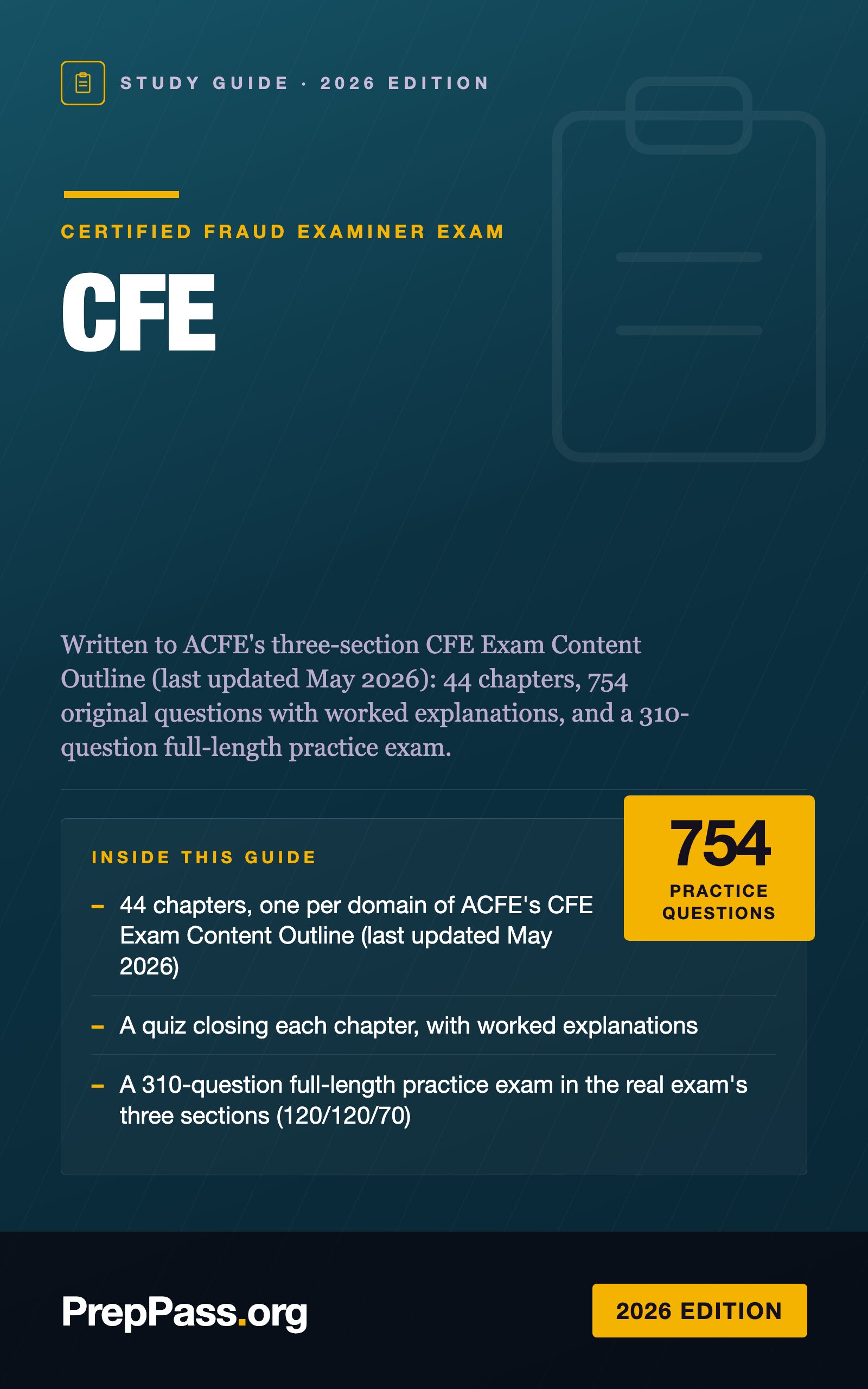
Written to ACFE's three-section CFE Exam Content Outline (last updated May 2026): 44 chapters, 754 original questions with worked explanations, and a 310-question full-length practice exam.
- 754 original CFE practice questions, each with a worked explanation, in one PDF + EPUB you keep
PDF + EPUB · English · 402 pages · $24.99 one-time
This book is written in English.
Instant download after payment — no account needed, no subscription.
14-day money-back guarantee: not satisfied for any reason? Email support@preppass.org within 14 days of purchase for a full refund. Refund policy
Look inside the book
Three real pages, rendered straight from the PDF you download — a reference page, a teaching page, and a worked question, always in that order. Nothing here was redrawn to look better.
- Quick referenceChapter 2 — Financial Statement Fraud · PDF page 16
A page you can turn back to: the numbers, deadlines or terms gathered in one place.
- How it's taughtChapter 16 — Bankruptcy Fraud · PDF page 105
An explanation page: the material taught in prose, in the order the exam tests it.
- A question, workedChapter 2 — Financial Statement Fraud · PDF page 18
A practice question with its answer and the reasoning behind it — not just a key.
About the CFE exam
For candidates preparing for the three-section Certified Fraud Examiner exam — auditors, accountants, investigators and compliance professionals. This book has one chapter per domain of ACFE's May 2026 content outline, with a quiz closing each chapter and a full-length practice exam. It is independent of ACFE, and it comes with no online practice: everything is in the book.
Outline changes: The exam is now three sections — Fraud Schemes and Financial Crimes, Fraud Investigations and Legal Issues, and Fraud Prevention and Deterrence — which the candidate handbook's section diagram maps from the former four (Financial Transactions and Fraud Schemes, Law, Investigation, Fraud Prevention).
| Awarding body | Association of Certified Fraud Examiners (ACFE) |
|---|---|
| Questions | 310 questions in three separately timed sections: Fraud Schemes and Financial Crimes 120, Fraud Investigations and Legal Issues 120, Fraud Prevention and Deterrence 70. Questions are multiple-choice and True/False. |
| Time limit | 2.5 hours for Section 1, 2.5 hours for Section 2, and 1.5 hours for Section 3; each section is timed separately. |
| Passing rule | To pass, you must correctly answer at least 75% of the questions in each section. |
| Fees | The CFE Exam Application Fee is $480. Retake fees are $110 per failed section. An expiring two-year application may be extended once, for one additional year, for a $150 extension fee. |
| Delivery | Continuously delivered and live-proctored by Prometric: candidates choose the online ProProctor platform or in-person testing at a Prometric Testing Center, available in locations worldwide. |
| Eligibility | At least 40 points (awarded for education, professional affiliations and experience) are required to sit the exam. Certification as a CFE after passing requires a minimum of two years of professional experience and 50 points, which may be earned before the exam or up to five years after passing the last section. |
| Retakes | Candidates have up to five attempts to pass each section. The first three attempts have no waiting period; the fourth and fifth require a 30-day wait. Each retake carries an updated 60-day eligibility window. If a section is not passed within five attempts, eligibility and all previous results expire, and a candidate must wait two years from the last attempt to reapply. |
| Languages | The CFE Exam is currently only available in English. |
| Content outline | CFE Exam Content Outline, Last updated May 2026 |
| Domains and weights |
|
Questions buyers ask
- How many questions are on the CFE Exam, and how long is it?
- The CFE Exam has 310 questions in three separately timed sections: Fraud Schemes and Financial Crimes (120 questions, 2.5 hours), Fraud Investigations and Legal Issues (120 questions, 2.5 hours) and Fraud Prevention and Deterrence (70 questions, 1.5 hours). It is closed-book and closed-notes, with multiple-choice and True/False questions.
- What do I need to pass the CFE Exam?
- ACFE's rule is: "To pass, you must correctly answer at least 75% of the questions in each section." Each section is passed separately, and a passed section does not need to be retaken.
- What domains does the CFE Exam cover, and how are they weighted?
- The May 2026 outline has 44 domains, each weighted as a percentage of its own section. The heaviest are Fraudulent Disbursements (13% of Section 1) and Procurement Fraud (8%); Collecting Evidence (11% of Section 2) and Interview Theory (9%); and Fraud Risk Assessment (20% of Section 3), Fraud Prevention Programs (16%) and Ethics (15%).
- Which content outline is current, and what changed?
- The current CFE Exam Content Outline is marked "Last updated May 2026"; ACFE does not publish an effective date in it. The exam is organised into three sections, which ACFE's handbook maps from the former four (Financial Transactions and Fraud Schemes, Law, Investigation, Fraud Prevention).
- Who is eligible to take the CFE Exam?
- You need at least 40 points, awarded for education, professional affiliations and experience, to sit the exam. To be certified after passing, you need at least two years of professional experience and 50 points, which can be earned up to five years after passing your last section.
- How much does the CFE Exam cost, and how do retakes work?
- The application fee is $480, and each failed section costs $110 to retake. You have up to five attempts per section; the fourth and fifth need a 30-day wait. The two-year application can be extended once, for a year, for $150.
- How is this book organised?
- The book has one chapter per outline domain, in ACFE's order, each closing with a quiz, and a 310-question practice exam split into the three sections at their published weights. It contains 754 questions with worked explanations and costs $24.99.
- Is the exam still four sections — Financial Transactions, Law, Investigation and Prevention?
- No. The current exam has three sections. Law and Investigation topics are now tested together in Fraud Investigations and Legal Issues; accounting and schemes are in Fraud Schemes and Financial Crimes; prevention and ethics are in Fraud Prevention and Deterrence.
- Is a study guide enough for the CFE — Certified Fraud Examiner Exam, or do I need a course?
- Check eligibility first — per Association of Certified Fraud Examiners (ACFE): at least 40 points (awarded for education, professional affiliations and experience) are required to sit the exam. Certification as a CFE after passing requires a minimum of two years of professional experience and 50 points, which may be earned before the exam or up to five years after passing the last section. A book does not replace those requirements. For the exam content itself, this 402-page guide teaches the material chapter by chapter with 754 practice questions and explanations inside. A prep course adds live instruction and a set schedule; whether you need one beyond any required education is your call.
- Does the CFE — Certified Fraud Examiner Exam study guide come as a PDF?
- Yes — CFE Study Guide — 2026 Edition downloads as PDF and EPUB, 402 pages. The download link is emailed the moment payment clears and does not expire.
- How much does the CFE — Certified Fraud Examiner Exam study guide cost?
- $24.99, once. There is no subscription and no account to create; the PDF and EPUB files are yours to keep.
- Can I read part of the CFE — Certified Fraud Examiner Exam study guide before buying?
- Yes. A full chapter is free to read on this page — not a summary of one, the chapter itself.
- Is this the official CFE — Certified Fraud Examiner Exam study guide?
- No. This is an independent study guide and is not affiliated with or endorsed by the exam's awarding body. It is written from ACFE's CFE Exam Content Outline (last updated May 2026) and CFE Exam Candidate Handbook (June 2026). Always confirm current requirements with the body that issues your licence.
What's included — and what isn't
Included
- 44 chapters, one per domain of ACFE's CFE Exam Content Outline (last updated May 2026)
- A quiz closing each chapter, with worked explanations
- A 310-question full-length practice exam in the real exam's three sections (120/120/70)
- 754 original questions, each explained and cited to its source
- Taught from public sources: U.S. statutes, regulations and court rules
- PDF + EPUB you keep
Not included
- No printed copy is shipped — this is a file you download and can print yourself
- No video course, instructor, tutoring or online question bank comes with the book — everything is in the file
- Not your exam registration or the testing centre's fee, which you still pay to the official body
Contents
See 50 sections and the page each one starts on
- Chapter 1 — Accounting Conceptsp. 7
- Answer key & explanationsp. 12
- Chapter 2 — Financial Statement Fraudp. 14
- Chapter 3 — Asset Misappropriation: Cash Receiptsp. 21
- Chapter 4 — Asset Misappropriation: Fraudulent Disbursementsp. 27
- Chapter 5 — Asset Misappropriation: Inventory and Other Assetsp. 34
- Chapter 6 — Corruptionp. 40
- Chapter 7 — Theft of Data and Intellectual Propertyp. 46
- Chapter 8 — Identity Theftp. 52
- Chapter 9 — Financial Institution Fraudp. 58
- Chapter 10 — Money Launderingp. 64
- Chapter 11 — Securities Fraudp. 71
- Chapter 12 — Payment Fraudp. 77
- Chapter 13 — Insurance Fraudp. 83
- Chapter 14 — Health Care Fraudp. 89
- Chapter 15 — Consumer Fraud and Scamsp. 95
- Chapter 16 — Bankruptcy Fraudp. 101
- Chapter 17 — Tax Fraudp. 107
- Chapter 18 — Cyberfraudp. 113
- Chapter 19 — Government and Public Sector Fraudp. 119
- Chapter 20 — Procurement Fraudp. 125
- Part II — Fraud Investigations and Legal Issuesp. 131
- Chapter 21 — Planning and Conducting a Fraud Examinationp. 132
- Chapter 22 — Legal Issues in Conducting Investigationsp. 138
- Chapter 23 — The Law Related to Fraudp. 144
- Chapter 24 — Basic Principles of Evidencep. 150
- Chapter 25 — Collecting Evidencep. 157
- Chapter 26 — Data Analysis and Reporting Toolsp. 163
- Chapter 27 — Sources of Informationp. 168
- Chapter 28 — Tracing Assetsp. 174
- Chapter 29 — Interview Theory and Applicationp. 180
- Chapter 30 — Admission-Seeking Interviewsp. 186
- Chapter 31 — Covert Operationsp. 193
- Chapter 32 — Report Writingp. 199
- Chapter 33 — Overview of the Legal Systemp. 205
- Chapter 34 — Criminal Prosecutionsp. 211
- Chapter 35 — Non-Criminal Actionsp. 218
- Chapter 36 — Testifyingp. 224
- Part III — Fraud Prevention and Deterrencep. 230
- Chapter 37 — Understanding Financial Crimep. 231
- Chapter 38 — Corporate Governancep. 237
- Chapter 39 — Management’s Fraud-Related Responsibilitiesp. 243
- Chapter 40 — Auditors’ Fraud- Related Responsibilitiesp. 249
- Chapter 41 — Fraud Prevention Programsp. 255
- Chapter 42 — Fraud Risk Assessmentp. 261
- Chapter 43 — Fraud Risk Managementp. 268
- Chapter 44 — Ethics for Fraud Examinersp. 274
- Section 1 — Fraud Schemes and Financial Crimes (120 questions)p. 281
- Section 2 — Fraud Investigations and Legal Issues (120 questions)p. 321
- Section 3 — Fraud Prevention and Deterrence (70 questions)p. 360
Taken from the PDF you download, with the page each one starts on — not typed here.
Read a chapter free, in full
One complete chapter, exactly as it ships in the eBook. Scroll the window to read it right here; no download, no email.
Read chapter 4 here, without leaving the page
We didn't give you the easy intro — the free chapter opens on one of the hardest-working parts of the book, so you can judge the teaching where the exam gets difficult.
Fraudulent disbursements steal money through the books: the payment is recorded, but the payee, amount, or purpose is a lie. This is the largest asset-misappropriation family, and at 15 questions (13% of Section 1) it deserves the most study time in Part I.
Billing schemes
An employee causes the company to pay a false invoice — the classic shell-vendor scheme:
- Shell companies. The perpetrator creates a fictitious vendor, submits invoices for goods or services never delivered, and approves the payment.
- Non-accomplice vendors. Real vendors are overbilled through pass-through or pay-and-return schemes, with the excess kicked back.
- Personal purchases. The employee buys personal items on company accounts.
Red flags: vendors with P.O.-box addresses, sequential invoice numbers, no phone listing, invoices just below approval thresholds, and a single employee who controls vendor setup, approval, and payment.
Check tampering
The perpetrator steals or alters a company check: forged maker (signing someone else's name), forged endorsement (signing the payee's name to cash it), altered payee (changing who the check is payable to), or authorized maker (a signatory writing checks for personal benefit). Concealment runs through the bank reconciliation — the reconciler intercepts the statement or forces the balance.
Payroll schemes
- Ghost employees. A fictitious (or terminated) person stays on the payroll; the perpetrator collects the check or direct deposit.
- Falsified hours or wages. Inflated timecards, overstated pay rates, commission fraud.
- False workers' compensation claims.
Detection: payroll headcount vs. HR records, no deductions or withholdings anomalies, duplicate bank accounts or addresses across employees, and checks never cashed by the "employee."
Expense reimbursement schemes
Mischaracterized expenses (personal costs claimed as business), overstated expenses (altered receipts), fictitious expenses (wholly invented claims), and multiple reimbursements (the same receipt submitted twice). Prevention: original receipts, supervisory approval by someone who knows the traveler's itinerary, and data analysis for duplicates and round-dollar patterns.
Register disbursements
At the cash register: false refunds (a refund is rung for a "customer" and the cash pocketed) and false voids (a sale is voided after the customer pays). Controls: managerial approval of refunds and voids, review of refund logs, and surveillance at the register.
Why this domain is weighted so heavily
These schemes are the everyday work of fraud examiners — small, repeatable, and committed by trusted insiders. The exam tests scheme identification from fact patterns, the red flags of each, and the control that would have prevented it.
Key numbers
| Figure | Value | Source |
|---|---|---|
| Exam weight of this domain | 13% of Section 1 (15 of its 120 questions) — the most questions of any domain | [1] |
| Core billing red flag | Invoices for fictitious goods or services, such as a shell company billing for services not rendered | [2] |
Key takeaways
- Billing = false invoices from shell or manipulated vendors; watch vendor-setup controls.
- Check tampering has four forms: forged maker, forged endorsement, altered payee, authorized maker.
- Ghost employees are detected by comparing payroll to HR records and hunting duplicate payment details.
- Expense fraud splits into mischaracterized, overstated, fictitious, and multiple-reimbursement claims.
- Register fraud = false refunds and false voids; both need managerial approval and log review.
Chapter 4 quiz — 12 questions
Answer each question, then check the key that follows.
1. An employee creates a fictitious vendor, submits invoices for services never performed, and approves the payments. Which scheme is this?
- A. Check tampering with forged endorsements
- B. A payroll scheme using ghost employees
- C. Billing scheme using a shell company
- D. An expense reimbursement fraud scheme
2. Which check-tampering method involves signing the payee's name to negotiate the check?
- A. Forged maker
- B. Altered payee
- C. Authorized maker
- D. Forged endorsement
3. A payroll clerk keeps a terminated employee on the payroll and diverts the direct deposits. This is best described as which scheme?
- A. Falsified hours
- B. Commission fraud
- C. A workers' compensation scheme
- D. A ghost-employee scheme
4. Which control most directly prevents an employee from both creating a vendor and approving its invoices?
- A. Surprise cash counts by supervisors
- B. Separating vendor setup from payment approval
- C. Mandatory password change policies
- D. Independent review of bank reconciliations
5. Submitting the same hotel receipt for reimbursement twice is an example of which expense scheme?
- A. Mischaracterized expenses
- B. Multiple reimbursements
- C. Overstated expenses
- D. Fictitious vendors
6. A cashier rings a $200 refund with no customer present and pockets the cash. Which scheme is this?
- A. False void
- B. Skimming
- C. False refund
- D. Check kiting
7. Which red flag most strongly suggests a shell-company billing scheme?
- A. A P.O.-box vendor with sequential invoices from one approver
- B. A vendor offering a two-percent early-payment discount
- C. Invoices consistently paid exactly on their due dates
- D. A vendor with a listed phone number and website
8. In an authorized-maker check scheme, who commits the fraud?
- A. An outsider who steals blank checks
- B. A customer who alters the payee line
- C. An authorized signer misusing that authority
- D. A bank teller who forges endorsements
9. Which analytical test best detects ghost employees?
- A. Confirming receivable balances with customers
- B. Reviewing utility bills for duplicate vendor payments
- C. Testing journal entries for round-dollar amounts
- D. Reconciling payroll headcount with HR records
10. A manager claims a family vacation as a client-development trip. Which expense scheme is this?
- A. Overstated expenses
- B. Mischaracterized expenses
- C. Fictitious expenses
- D. Multiple reimbursements
11. Concealment of check tampering most often runs through which record?
- A. The bank reconciliation
- B. The sales journal
- C. The inventory count sheets
- D. The payroll register
12. Which register control addresses both false refunds and false voids?
- A. Manager approval and review of refund/void logs
- B. Daily cash-drawer counts by the cashier alone
- C. Longer customer receipt tapes
- D. Rotating cashiers across registers weekly
Answer key & explanations
1. C. A billing scheme causes the employer to pay invoices for fictitious goods or services — the classic example is an employee creating a shell company to bill for services never rendered. Check tampering is the tempting label because a payment results, but here the company issues a legitimate payment on a false invoice; nothing is forged or altered.[2]
2. D. Signing the payee's name on the back to cash the check is a forged endorsement. Forged maker is the tempting confusion: that means forging the signature of the company's authorized signer on the front of the check.[3]
3. D. A payroll scheme includes adding ghost employees to the payroll; a terminated employee kept on the payroll while someone diverts the pay is a ghost. Falsified hours is the tempting alternative, but that inflates pay for a real, working employee.[4]
4. B. Separating vendor setup from payment approval means no one person controls the whole disbursement cycle; the CAQ guide gives separating approval and payment as a preventive control. Independent review of bank reconciliations is the tempting choice, but it detects problems after payments clear — it does not prevent one person from creating and paying a fake vendor.[5]
5. B. Claiming the same receipt twice is a multiple-reimbursement scheme. Overstated expenses is the tempting label, but that inflates the amount of one claim; here each claim is for the true amount, it is simply paid twice.[6]
6. C. A refund rung with no customer present is a false entry that conceals the removal of cash — a false refund, one of the register disbursement schemes. Skimming is the tempting label, but skimming takes cash before a sale is recorded; here the cash was recorded and a false refund is used to take it out.[7]
7. A. A shell vendor usually has a mail-drop address, invoices numbered in sequence because it bills only one customer, and a single insider approving its bills. An early-payment discount is the tempting distractor, but it is ordinary commercial practice and a shell has no reason to offer one.[2]
8. C. In an authorized-maker scheme, the employee with legitimate signing authority writes company checks for personal benefit. An outsider stealing blank checks is the tempting distractor, but that is forged-maker check tampering — the signature is forged because the thief lacks authority.[3]
9. D. A ghost is someone on the payroll with no real employment relationship, so reconciling payroll to HR's personnel records exposes names with no personnel file. Testing journal entries for round dollars is the tempting distractor, but payroll disbursements run through the payroll system, and the ghost's pay looks like any other net pay.[4]
10. B. The trip happened and was paid, but it is claimed for a false business purpose — a mischaracterized expense. Fictitious expenses is the tempting label, but that means claiming a cost that was never incurred at all.[6]
11. A. A tampered check still clears the bank, so the discrepancy surfaces when the bank statement is reconciled; perpetrators conceal it by controlling or forcing the reconciliation. The CAQ guide describes reconciling the cash account to the bank statement as a detective control. The payroll register is the tempting alternative, but check tampering is not routed through payroll.[3, 5]
12. A. False refunds and false voids are both false register entries, so requiring a manager's approval and independently reviewing the refund/void log addresses both. Daily drawer counts by the cashier alone are the tempting choice, but a false refund or void makes the drawer balance to the register, and a cashier counting their own drawer is not independent.[7]
Sources cited in this excerpt
- ACFE CFE Exam Content Outline (Last updated May 2026). http://cms.acfe.com/-/media/files/acfe/pdfs/cfe-exam/cfe-exam-content-outline_2026.pdf
- Occupational Fraud 2024: A Report to the Nations — Glossary: billing scheme. https://www.acfe.com/-/media/files/acfe/pdfs/report-to-the-nations/2024-report-to-the-nations.pdf
- Occupational Fraud 2024: A Report to the Nations — Glossary: check or payment tampering scheme. https://www.acfe.com/-/media/files/acfe/pdfs/report-to-the-nations/2024-report-to-the-nations.pdf
- Occupational Fraud 2024: A Report to the Nations — Glossary: payroll scheme. https://www.acfe.com/-/media/files/acfe/pdfs/report-to-the-nations/2024-report-to-the-nations.pdf
- Center for Audit Quality — Guide to Internal Control Over Financial Reporting. https://www.thecaq.org/wp-content/uploads/2019/03/caq_icfr_042513.pdf
- Occupational Fraud 2024: A Report to the Nations — Glossary: expense reimbursements scheme. https://www.acfe.com/-/media/files/acfe/pdfs/report-to-the-nations/2024-report-to-the-nations.pdf
- Occupational Fraud 2024: A Report to the Nations — Glossary: register disbursements scheme. https://www.acfe.com/-/media/files/acfe/pdfs/report-to-the-nations/2024-report-to-the-nations.pdf
Before you buy
- How do I get it?
- Pay, and the download appears on this page straight away. The links are also emailed to you. No account is required.
- What if it isn't for me?
- Email us within 14 days for a full refund, no questions asked.
- Is there online practice for this exam too?
- No. PrepPass has no online question bank for this exam; the book is self-contained. Its chapter quizzes and full-length practice exam, each question with a worked explanation, are all in the PDF and EPUB.
- Can I read it on my phone?
- Yes — the EPUB is for phones and e-readers, the PDF is for printing and tabbing. You get both.
The details
Written to ACFE's three-section CFE Exam Content Outline (last updated May 2026): 44 chapters, 754 original questions with worked explanations, and a 310-question full-length practice exam.
- Format: PDF + EPUB download · 402 pages
- 754 practice questions in the book, with a full answer key
- $24.99 one-time — no subscription
- 14-day money-back guarantee · refund policy
- Cross-referenced against: ACFE's CFE Exam Content Outline (last updated May 2026) and CFE Exam Candidate Handbook (June 2026)
- Last updated: September 2026
- Verified from the official source(ACFE's CFE Exam Content Outline (last updated May 2026) and CFE Exam Candidate Handbook (June 2026))
- Instant download, yours for life
What the book gives you
PrepPass has no online question bank for this exam, so the $24.99 book is complete in itself: the material taught in order, a quiz closing each chapter and a full-length practice exam, in a file you own.
- Systematic teaching — every exam section explained chapter by chapter, start to finish, not just questions
- Print it & tab it — a paper-ready PDF you can highlight, mark up, and bring to your study table
- Study anywhere, offline — EPUB on your phone or e-reader; no wifi, no browser tabs
- Everything in one place — the chapters and the practice questions in one file
- Yours for life — one-time $24.99, instant download, no subscription
And it's risk-free: 14-day money-back guarantee — not satisfied? Email us for a full refund, no questions asked. See the refund policy.
14-day money-back guarantee · full refund, no questions asked.
One-time purchase, lifetime access to the download. The eBook is the full CFE — Certified Fraud Examiner Exam study guide in PDF and EPUB. Educational summary, not professional or legal advice — always confirm the current rules with the official source. Last updated: September 2026.