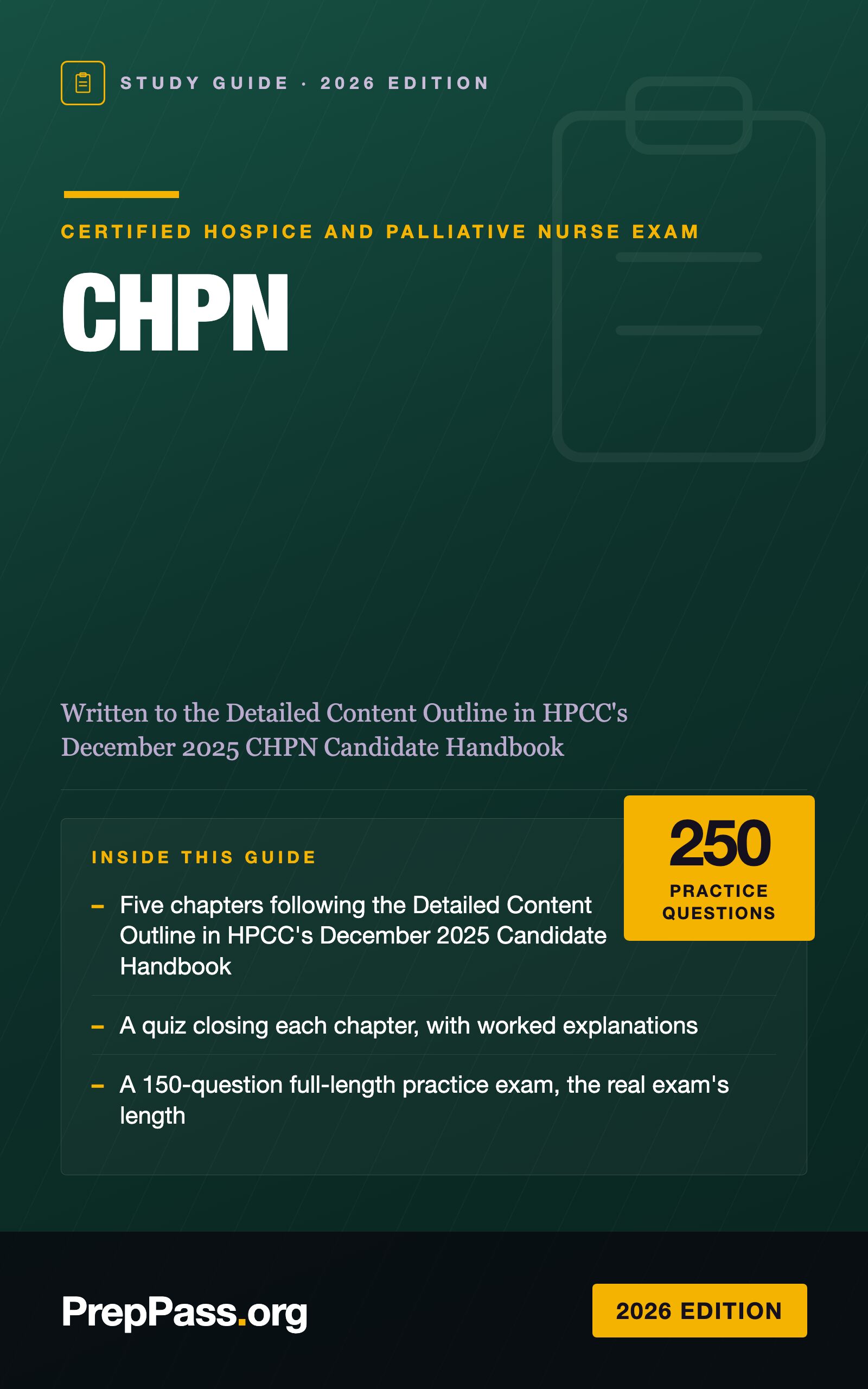
CHPN — Certified Hospice and Palliative Nurse Exam · 2026 Edition
CHPN Study Guide — 2026 Edition
Written to the Detailed Content Outline in HPCC's December 2025 CHPN Candidate Handbook: five chapters, 250 original questions with worked explanations, and a 150-question full-length practice exam.
- 250 original CHPN practice questions, each with a worked explanation, in one PDF + EPUB you keep
PDF + EPUB · English · 146 pages · $24.99 one-time
This book is written in English.
Instant download after payment — no account needed, no subscription.
14-day money-back guarantee: not satisfied for any reason? Email support@preppass.org within 14 days of purchase for a full refund. Refund policy
Look inside the book
Three real pages, rendered straight from the PDF you download — a reference page, a teaching page, and a worked question, always in that order. Nothing here was redrawn to look better.
- Quick referenceAppendix B — Quick-Reference Tables Exam at a glance · PDF page 140
A page you can turn back to: the numbers, deadlines or terms gathered in one place.
- How it's taughtSection 5: Practice Issues (28 questions) · PDF page 126
An explanation page: the material taught in prose, in the order the exam tests it.
- A question, workedSection 3: Symptom Management (28 questions) · PDF page 103
A practice question with its answer and the reasoning behind it — not just a key.
About the CHPN exam
Registered nurses preparing for HPCC's CHPN certification who want a source-grounded study guide with original practice questions covering all five exam domains.
| Awarding body | Hospice and Palliative Credentialing Center |
|---|---|
| Questions | 150 multiple-choice items: 135 scored, 15 unscored pretest interspersed |
| Time limit | 3 hours |
| Passing rule | Scaled score of 500 required to pass; scores reported on a 200–800 scale |
| Fees | $455 non-member / $305 member initial; reTEST Assured $135 for one additional sitting |
| Delivery | Computer-based at PSI test centers and by live remote proctoring |
| Eligibility | Current active RN license in the US or its territories, and at least 500 hours as a hospice and palliative RN in the most recent 12 months, or 1,000 hours in the most recent 24 months |
| Retakes | Reapply with a new application during an open testing window; unlimited attempts while eligible |
| Content outline | CHPN Detailed Content Outline (HPCC Candidate Handbook), December 2025 Candidate Handbook (labeled for 2026 candidates) |
| Domains and weights |
|
Questions buyers ask
- How many questions are on the CHPN exam and how long is it?
- The exam has 150 multiple-choice questions — 135 scored plus 15 unscored pretest items — with 3 hours to complete.
- What is the passing score for the CHPN exam?
- A scaled score of 500 is required to pass. Scores are reported on a 200–800 scale using the Angoff method.
- What are the five exam domains and their weights?
- Assessment and Planning (25), Pain Management (26), Symptom Management (28), Support Education and Advocacy (28), and Practice Issues (28) — 135 scored items total.
- Which outline edition does this book follow?
- The December 2025 Candidate Handbook labeled for 2026 candidates. HPCC's April 2026 role delineation sketches a future outline, but the handbook governs current test forms.
- Who is eligible for the CHPN exam?
- You need a current active RN license in the US or its territories, plus 500 hours as a hospice and palliative RN in the last 12 months or 1,000 hours in the last 24 months.
- What are the fees and what happens if I do not pass?
- Initial fee is $455 non-member or $305 member. If you do not pass, reapply during an open testing window; attempts are unlimited while eligible. reTEST Assured allows one more sitting for $135.
- How is this book organized?
- Five chapters with quizzes plus a full practice exam: 250 original questions total, including a 150-question practice exam. Price: $24.99.
- Is a study guide enough for the CHPN — Certified Hospice and Palliative Nurse Exam, or do I need a course?
- Check eligibility first — per Hospice and Palliative Credentialing Center: current active RN license in the US or its territories, and at least 500 hours as a hospice and palliative RN in the most recent 12 months, or 1,000 hours in the most recent 24 months. A book does not replace those requirements. For the exam content itself, this 146-page guide teaches the material chapter by chapter with 250 practice questions and explanations inside. A prep course adds live instruction and a set schedule; whether you need one beyond any required education is your call.
- What happens if I fail the CHPN — Certified Hospice and Palliative Nurse Exam?
- You can retake it under Hospice and Palliative Credentialing Center's rule: reapply with a new application during an open testing window; unlimited attempts while eligible. Confirm the current policy with Hospice and Palliative Credentialing Center before you book.
- Does the CHPN — Certified Hospice and Palliative Nurse Exam study guide come as a PDF?
- Yes — CHPN Study Guide — 2026 Edition downloads as PDF and EPUB, 146 pages. The download link is emailed the moment payment clears and does not expire.
- How much does the CHPN — Certified Hospice and Palliative Nurse Exam study guide cost?
- $24.99, once. There is no subscription and no account to create; the PDF and EPUB files are yours to keep.
- Can I read part of the CHPN — Certified Hospice and Palliative Nurse Exam study guide before buying?
- Yes. A full chapter is free to read on this page — not a summary of one, the chapter itself.
- Is this the official CHPN — Certified Hospice and Palliative Nurse Exam study guide?
- No. This is an independent study guide and is not affiliated with or endorsed by the exam's awarding body. It is written from HPCC's CHPN Candidate Handbook (December 2025) and its Detailed Content Outline. Always confirm current requirements with the body that issues your licence.
What's included — and what isn't
Included
- Five chapters following the Detailed Content Outline in HPCC's December 2025 Candidate Handbook
- A quiz closing each chapter, with worked explanations
- A 150-question full-length practice exam, the real exam's length
- 250 original questions, each explained and cited to its source
- Worked opioid dose-conversion arithmetic, with the caveats
- PDF + EPUB you keep
Not included
- No printed copy is shipped — this is a file you download and can print yourself
- No video course, instructor, tutoring or online question bank comes with the book — everything is in the file
- Not your exam registration or the testing centre's fee, which you still pay to the official body
Contents
See 14 sections and the page each one starts on
- Chapter 1 — Patient Care: Assessment and Planningp. 6
- Chapter 2 — Patient Care: Pain Managementp. 19
- Chapter 3 — Patient Care: Symptom Managementp. 33
- Answer key — Chapter 3 quizp. 44
- Chapter 4 — Support, Education, and Advocacyp. 47
- Chapter 5 — Practice Issuesp. 63
- Answer key — Chapter 5 quizp. 72
- Section 2: Pain Management (26 questions)p. 86
- Section 3: Symptom Management (28 questions)p. 97
- Section 4: Support, Education, and Advocacy (28 questions)p. 108
- Section 5: Practice Issues (28 questions)p. 119
- Section 6: Additional mixed items (15 questions)p. 130
- Appendix A — Key Termsp. 137
- Appendix B — Quick-Reference Tables Exam at a glancep. 140
Taken from the PDF you download, with the page each one starts on — not typed here.
Read a chapter free, in full
One complete chapter, exactly as it ships in the eBook. Scroll the window to read it right here; no download, no email.
Read chapter 2 here, without leaving the page
We didn't give you the easy intro — the free chapter opens on one of the hardest-working parts of the book, so you can judge the teaching where the exam gets difficult.
Pain is the symptom hospice and palliative nurses are most expected to master, and the examination gives it a full domain: 26 scored items, covering assessment, drug therapy, non-drug therapy, barriers, adverse effects, equianalgesic principles, and pain crisis[1]. The through-line of the domain is simple: pain is common and treatable, assessment never stops, and "Opioids remain an essential component of excellent pain control during the end of life"[2].
2A. Etiology of pain, types of pain, and pain syndromes
Pain treatment starts with naming what kind of pain it is, because different pains respond to different drugs. "Nociceptive pain, which may be either somatic or visceral in nature, originates with a chemical, mechanical, or thermal injury to tissue that stimulates pain receptors"[3]. Somatic nociceptive pain (bone metastasis, wound pain) is usually well localized; visceral pain (liver capsule stretch, bowel involvement) is diffuse and hard to pinpoint. "Neuropathic pain is pain caused by damage to the peripheral nervous system or the CNS (spinal cord or brain)"[3] — burning, shooting, or electric-shock sensations, for example from tumor compressing a nerve plexus or chemotherapy-induced peripheral neuropathy.
Then distinguish baseline pain from flares. "Breakthrough pain is a transitory increase or flare of pain in the setting of relatively well-controlled acute or chronic pain"[3], and "Incident pain is a type of breakthrough pain related to certain often-defined activities or factors such as movement increasing vertebral body pain from metastatic disease"[3]. The distinction drives prescribing: baseline pain gets around-the-clock dosing, breakthrough pain gets a rapid-onset as-needed dose.
2B. Verbal and nonverbal indicators of pain and pain scales
Assessment discipline carries over from Chapter 1: "Effective pain treatment begins with screening at every visit and a thorough assessment if pain is present"[3], and "Patient self-report is the standard of care for evaluating pain"[3]. When a patient can report pain, believe the report and quantify it. The most commonly used tools include the numerical rating scale — "0–10: 0 = no pain, 10 = worst pain imaginable"[3] — alongside categorical scales (none, mild, moderate, severe) and the visual analogue scale[3].
At the end of life, "Pain assessment at the end of life must be thorough, ongoing, and evidence-based, as some patients with advanced disease cannot verbalize their discomfort"[2] — with behavioral scales such as the PAINAD for patients who cannot report[3]. The principle to carry into the exam: never document "no pain" merely because a nonverbal patient did not complain; use a behavioral scale and keep assessing, because unrelieved pain in a patient who cannot speak is still pain.
2C. Factors that may influence the patient's experience of pain
Pain is never purely physical. Fear, depression, anxiety, cultural beliefs, and spiritual distress all modulate how pain is experienced and reported — which is why the comprehensive assessment from Chapter 1 covers all four dimensions. A patient who fears addiction may underreport pain; a patient whose culture values stoicism may minimize it; a patient in spiritual crisis may experience pain as punishment.
Unrelieved pain at the end of life is usually a systems failure, not a pharmacology failure. HPNA and ASPMN document the barriers plainly: "Nurses report fear of hastening death, causing addiction, or facing legal or licensing consequences; they also report inadequate knowledge and education regarding pain management for people at the end of life"[2]. The nurse's advocacy role is explicit: "All nurses and other healthcare professionals must advocate for effective, efficient, and safe pain and symptom management to alleviate suffering at the end of life"[2].
One barrier deserves a direct quote because the exam loves it: "Understanding that the national response to the opioid crisis does not negate the ethical responsibility to relieve pain and suffering"[2]. Related: the CDC's 2022 opioid guideline excludes "pain management related to sickle cell disease, cancer-related pain treatment, palliative care, and end-of-life care"[4]. Restrictive opioid policies written for chronic non-cancer pain do not govern end-of-life prescribing.
2D. Medications appropriate to severity and specific type of pain
Non-opioids. "Often initiated when an individual has mild pain, acetaminophen and NSAIDs are useful in managing moderate and severe pain as adjunct agents to opioids"[3]. Note the role: adjuncts, not replacements, for moderate and severe pain. As opioid adjuncts, they "have shown benefit both in improved analgesia and in decreased opioid use," though they "are used with care or perhaps avoided in older patients or those who have renal, hepatic, or cardiac disease"[5].
Opioids. The core principles the exam tests: "The management of acute pain begins with an immediate-release opioid formulation"[3] — rapid titration to control, then conversion to a longer-acting around-the-clock regimen based on the previous 24-hour consumption, with an as-needed dose reserved for breakthrough pain. "Opioids are often considered the preferred first-line treatment option for dyspnea" as well[6], which is why opioid knowledge does double duty in the symptom domain.
Methadone deserves special attention because of its danger profile: "Rapid titration of methadone may result in delayed respiratory depression because of its long half-life"[3]. Start low, go slow, and never titrate methadone like morphine.
Adjuvants. "Corticosteroids (dexamethasone, methylprednisolone, and prednisone) may be used as adjuvant analgesics for cancer pain originating in bone, neuropathy, and malignant intestinal obstruction"[3]. The exam pairs pain types with adjuvants: neuropathic pain with gabapentinoids/antidepressants, bone pain with corticosteroids, and so on — match the mechanism to the pain.
Routes. As patients approach death, swallowing fails. HPNA and ASPMN call for "Recognition of the need for different routes of medication administration during the dying process"[2] — sublingual, buccal, rectal, transdermal, and subcutaneous routes keep analgesia going when the oral route is lost.
Adverse effects. "Adverse effects from opioids are common and may interfere with achieving adequate pain control"[5], and the standard responses are "aggressive management of the adverse effects, opioid rotation, or dose reduction"[3]. The exam's favorite adverse effect is constipation. NCI's table rates it common (+++) with both acute use and chronic use — "consistent use for >2–3 months at stable doses" — whereas nausea falls from common to rare with chronic use[3, 7, 8]. Constipation does not wear off, so prevention starts with the opioid. "A scheduled stimulant laxative, such as senna, is started with opioid initiation. The addition of a stool softener offers no further benefit"[3], and "Laxatives are titrated to a goal of one unforced bowel movement every 1 to 2 days"[3]. Sedation is most common at opioid initiation and usually resolves. If respiratory depression occurs with "pinpoint pupils and sedation," "naloxone, a nonselective competitive opioid antagonist, may be useful" — but "careful titration should be considered because it may compromise pain control and may precipitate withdrawal in opioid-dependent individuals"[3]. Titrate to respirations, not to full alertness.
2E. Titration of medication to determine baseline and breakthrough doses
Titration is how the right dose is found. Start with an immediate-release opioid, titrate rapidly to pain control, then convert the total 24-hour requirement into an around-the-clock regimen — with a breakthrough dose available for flares. The breakthrough dose is typically a fraction of the total daily dose, available as needed for the transitory flares described in 2A. Reassess after each titration step; the goal is the lowest dose that controls baseline pain with a rescue dose that controls breakthrough pain.
2F. Dosage equivalents when changing analgesics or route of administration
When rotating opioids or changing routes, clinicians use equianalgesic tables and morphine milligram equivalents. This book works its conversions from the table in NCI's cancer pain summary, which lists morphine as "Oral: 30 mg, IV: 10 mg"[3], oxycodone as "20 mg" against that 30 mg of oral morphine[3], hydromorphone as "Oral: 6-7.5 mg, IV: 1.5 mg"[3], and transdermal fentanyl as "12 µg/h × 24 h ~ 25 mg oral morphine/day"[3]. Tables differ: the CDC's conversion factors put hydromorphone at 5.0 and oxycodone at 1.5 times morphine[4], close to but not identical with NCI's ratios. Two rules hold whichever table you use. "Equianalgesic dose conversions are only estimates," and when converting, "the new opioid is typically dosed at a substantially lower dose than the calculated MME dose to avoid overdose because of incomplete cross-tolerance and individual variability"[4]. The figures here are study material for the exam's arithmetic, not dosing instructions: in practice, use the table your program has adopted and verify the math with the prescriber and pharmacist.
A pain crisis — severe, uncontrolled pain with distress — is managed like any crisis: rapid assessment, immediate-release opioid titration to effect, reassessment at short intervals, and treatment of the cause when one is found. Continuous home care during a period of crisis can include nursing "on a continuous basis for as much as 24 hours a day" when needed "to maintain an individual at home"[9], because "A period of crisis is a period in which the individual requires continuous care to achieve palliation and management of acute medical symptoms"[9].
2G. Non-pharmacologic interventions
HPNA and ASPMN call for "effective, efficient, safe, and multimodal pain management plans"[2] and for "Access to the pharmacologic and nonpharmacologic treatments that are most effective for each patient"[2]. Nonpharmacologic measures — ice, positioning, heat and cold, massage, relaxation and breathing techniques, psychological therapy, palliative surgery, palliative radiation — do not replace analgesics for moderate to severe pain, but they reduce suffering, give families a role, and belong in every multimodal plan.
2H. Complementary and alternative therapies
Complementary therapies — Reiki, hypnosis, acupressure, massage, pet therapy, music therapy — can reduce anxiety, promote relaxation, and improve the patient's sense of well-being as part of a multimodal plan. They are adjuncts, not substitutes for pharmacologic management of moderate to severe pain. The nurse's role is to ensure these therapies are safe, do not interfere with the medical plan, and align with the patient's cultural and spiritual values.
Key numbers — Pain Management
- Breakthrough pain: transitory flare on top of relatively well-controlled baseline pain; incident pain is the activity-related subtype[3].
- Acute pain: begin with an immediate-release opioid formulation[3].
- Bowel regimen: scheduled stimulant laxative (e.g., senna) with opioid initiation; stool softener adds no benefit; goal one unforced bowel movement every 1–2 days[3].
- Methadone: long half-life; rapid titration risks delayed respiratory depression[3].
- Naloxone: titrate carefully; can reverse analgesia and precipitate withdrawal[3].
- CDC 2022 opioid guideline: excludes palliative care and end-of-life care[4].
Quiz — Chapter 2: Pain Management
1. A patient describes deep, aching pain in the femur where imaging shows a metastasis. Which mechanism best explains this pain?
- A. Damage to peripheral nerves producing burning, electric-shock sensations in the limbs.
- B. Chemical, mechanical, or thermal injury to tissue stimulating pain receptors that signal the brain.
- C. A purely psychological response with no peripheral pain receptor involvement at all.
- D. Referred pain from a completely unrelated organ without any local tissue injury at the painful site.
2. A patient reports burning, shooting pain down the leg after tumor compression of the lumbosacral plexus. How is this pain classified?
- A. Somatic nociceptive pain from direct injury to bone or muscle tissue.
- B. Visceral nociceptive pain from stretching of an internal organ capsule.
- C. Idiopathic pain with no identifiable physiologic mechanism or source.
- D. Neuropathic pain caused by damage to the peripheral nervous system.
3. A patient's baseline pain is well controlled on extended-release morphine, but he reports brief flares of severe pain twice daily. What is this called?
- A. Tolerance to the baseline opioid requiring immediate dose escalation.
- B. Opioid-induced hyperalgesia from the extended-release formulation itself.
- C. Withdrawal pain clearly signaling the urgent need for a different opioid molecule.
- D. Breakthrough pain: a transitory flare in the setting of relatively well-controlled pain.
4. A patient with vertebral metastases reports sharp pain only when moving from bed to chair. Which term best describes this pain?
- A. Baseline pain requiring an increase in the around-the-clock dose.
- B. Incident pain, a movement-related form of breakthrough pain.
- C. Referred pain originating from a distant, unaffected spinal level.
- D. Chronic persistent pain that is unrelated to any specific trigger.
5. A hospice patient presents with severe acute pain from a new pathologic fracture. What is the recommended starting approach?
- A. An immediate-release opioid formulation.
- B. A transdermal patch for steady levels.
- C. An intramuscular injection of a sedative.
- D. Watchful waiting for 48 hours.
6. A patient has moderate cancer pain already treated with an opioid. What role do acetaminophen and NSAIDs play here?
- A. They are contraindicated whenever any opioid is already prescribed.
- B. They are useful only for mild pain and have no role beyond that.
- C. They should replace the opioid entirely to reduce adverse effects.
- D. They serve as adjuncts that improve analgesia and spare opioid.
7. The team considers adding an NSAID for an 82-year-old patient with chronic kidney disease and heart failure. What is the guidance?
- A. Use with care or avoid in older patients and those with renal, hepatic, or cardiac disease.
- B. NSAIDs are always safe in older adults regardless of any comorbid conditions present.
- C. NSAIDs require no caution because hospice patients are exempt from adverse effects entirely.
- D. NSAIDs should be given at double the usual dose to overcome any organ dysfunction that is present.
8. A patient is being titrated on methadone for complex pain. What specific risk must the nurse monitor for?
- A. Immediate allergic reaction within minutes of every single dose.
- B. Hypertensive crisis caused by methadone's stimulant properties.
- C. Permanent and irreversible liver failure occurring after the first week of therapy.
- D. Delayed respiratory depression because of methadone's long half-life.
9. A patient has painful bone metastases with a neuropathic component. Which adjuvant class is specifically noted for cancer pain originating in bone, neuropathy, and malignant intestinal obstruction?
- A. Corticosteroids such as dexamethasone, methylprednisolone, and prednisone.
- B. First-generation antihistamines used primarily for their sedating effects.
- C. Oral hypoglycemics that lower blood sugar during painful episodes.
- D. Topical antifungals applied to the skin over the painful area.
10. A patient is starting around-the-clock morphine. What bowel regimen should be started at the same time?
- A. A scheduled stimulant laxative, such as senna, from the start.
- B. A stool softener alone, which is sufficient for opioid-induced constipation.
- C. No bowel regimen until the patient reports a full week without stool.
- D. An as-needed laxative only after severe impaction has developed.
11. The nurse is titrating the bowel regimen for a patient on chronic opioids. What is the therapeutic goal?
- A. One forced bowel movement every 4 to 5 days with straining.
- B. One unforced bowel movement every 1 to 2 days.
- C. Three urgent bowel movements daily regardless of comfort.
- D. Complete absence of stool to rest the bowel fully.
12. A family asks whether constipation from opioids improves on its own over time. What does the evidence show?
- A. It stays common with long-term use, unlike nausea.
- B. It fades within a few days as the bowel adapts.
- C. It occurs only with injected opioids, not oral ones.
- D. It is rare and needs no preventive bowel regimen.
13. A patient on stable opioids develops nausea and sedation that interfere with pain control. What are the general options for addressing opioid adverse effects?
- A. Aggressive management of the adverse effects, opioid rotation, or dose reduction.
- B. Immediate discontinuation of all analgesics without any replacement plan in place.
- C. Continuing the same regimen unchanged while completely ignoring the adverse effects.
- D. Switching to intramuscular placebos to test whether the reported symptoms are real.
14. A patient on high-dose opioids shows pinpoint pupils, sedation, and slow respirations. The team gives naloxone. What precaution applies?
- A. Titrate naloxone carefully; it may compromise pain control and precipitate withdrawal.
- B. A single large bolus is always the safest way to guarantee full alertness.
- C. Naloxone has no effect on pain control and can be given freely without any caution at all.
- D. Naloxone should be withheld until the patient stops breathing entirely.
15. A dying patient can no longer swallow oral medications but has ongoing pain. What principle guides the next step?
- A. All analgesia must stop immediately once the oral route is lost.
- B. Pain medication can only be given intravenously in the hospital.
- C. The route must change as the dying process progresses.
- D. The family should crush all tablets regardless of formulation.
16. A nurse admits feeling reluctant to give adequate opioid doses, fearing she might hasten death or face legal consequences. What does the professional literature report about this barrier?
- A. Nurses report fear of hastening death, addiction, or legal consequences.
- B. Nurses never experience such fears, so this concern can be completely dismissed.
- C. The law strictly prohibits all opioid use at the end of life in every care setting.
- D. Addiction is the expected and unavoidable outcome of any end-of-life opioid use.
17. A colleague suggests limiting opioids because of the national opioid crisis. What is the ethical position of HPNA and ASPMN?
- A. The ongoing opioid crisis means that comfort can no longer be a legitimate goal of care.
- B. Pain relief should be abandoned whenever public health campaigns exist today.
- C. The opioid crisis does not negate the ethical duty to relieve suffering.
- D. Only nonpharmacologic measures are ethically acceptable during a drug crisis period.
18. A prescriber asks whether the CDC's 2022 opioid prescribing guideline governs end-of-life pain management. What is correct?
- A. The CDC guideline is the primary authority for all end-of-life pain care decisions.
- B. The CDC guideline requires stopping opioids in the last weeks of life.
- C. The CDC guideline does not apply to palliative or end-of-life care.
- D. The CDC guideline bans hospice nurses from discussing opioids with families.
Sources cited in this excerpt
- CHPN Computer Based Examination Candidate Handbook (December 2025). Hospice and Palliative Credentialing Center (HPCC).
- Position Statement: Pain Management at the End of Life. Hospice and Palliative Nurses Association and American Society for Pain Management Nursing.
- Cancer Pain (PDQ®). https://www.cancer.gov/about-cancer/treatment/side-effects/pain/pain-hp-pdq
- CDC Clinical Practice Guideline for Prescribing Opioids for Pain, 2022. https://www.cdc.gov/mmwr/volumes/71/rr/rr7103a1.htm
- NCI PDQ Cancer Pain (HP). https://www.cancer.gov/about-cancer/treatment/side-effects/pain/pain-hp-pdq
- NCI PDQ Last Days of Life (HP). https://www.cancer.gov/about-cancer/advanced-cancer/caregivers/planning/last-days-hp-pdq
- NCI PDQ Cancer Pain (HP), Table 5 legend. https://www.cancer.gov/about-cancer/treatment/side-effects/pain/pain-hp-pdq
- NCI PDQ Cancer Pain (HP), Table 5. https://www.cancer.gov/about-cancer/treatment/side-effects/pain/pain-hp-pdq
- 42 CFR Part 418 — Hospice Care. https://www.ecfr.gov/current/title-42/chapter-IV/subchapter-B/part-418
Before you buy
- How do I get it?
- Pay, and the download appears on this page straight away. The links are also emailed to you. No account is required.
- What if it isn't for me?
- Email us within 14 days for a full refund, no questions asked.
- Is there online practice for this exam too?
- No. PrepPass has no online question bank for this exam; the book is self-contained. Its chapter quizzes and full-length practice exam, each question with a worked explanation, are all in the PDF and EPUB.
- Can I read it on my phone?
- Yes — the EPUB is for phones and e-readers, the PDF is for printing and tabbing. You get both.
The details
Written to the Detailed Content Outline in HPCC's December 2025 CHPN Candidate Handbook: five chapters, 250 original questions with worked explanations, and a 150-question full-length practice exam.
- Format: PDF + EPUB download · 146 pages
- 250 practice questions in the book, with a full answer key
- $24.99 one-time — no subscription
- 14-day money-back guarantee · refund policy
- Cross-referenced against: HPCC's CHPN Candidate Handbook (December 2025) and its Detailed Content Outline
- Last updated: September 2026
- Verified from the official source(HPCC's CHPN Candidate Handbook (December 2025) and its Detailed Content Outline)
- Instant download, yours for life
What the book gives you
PrepPass has no online question bank for this exam, so the $24.99 book is complete in itself: the material taught in order, a quiz closing each chapter and a full-length practice exam, in a file you own.
- Systematic teaching — every exam section explained chapter by chapter, start to finish, not just questions
- Print it & tab it — a paper-ready PDF you can highlight, mark up, and bring to your study table
- Study anywhere, offline — EPUB on your phone or e-reader; no wifi, no browser tabs
- Everything in one place — the chapters and the practice questions in one file
- Yours for life — one-time $24.99, instant download, no subscription
And it's risk-free: 14-day money-back guarantee — not satisfied? Email us for a full refund, no questions asked. See the refund policy.
14-day money-back guarantee · full refund, no questions asked.
One-time purchase, lifetime access to the download. The eBook is the full CHPN — Certified Hospice and Palliative Nurse Exam study guide in PDF and EPUB. Educational summary, not professional or legal advice — always confirm the current rules with the official source. Last updated: September 2026.