CPA Exam — Auditing and Attestation (AUD) · 2026 Edition
CPA AUD Study Guide — 2026 Edition
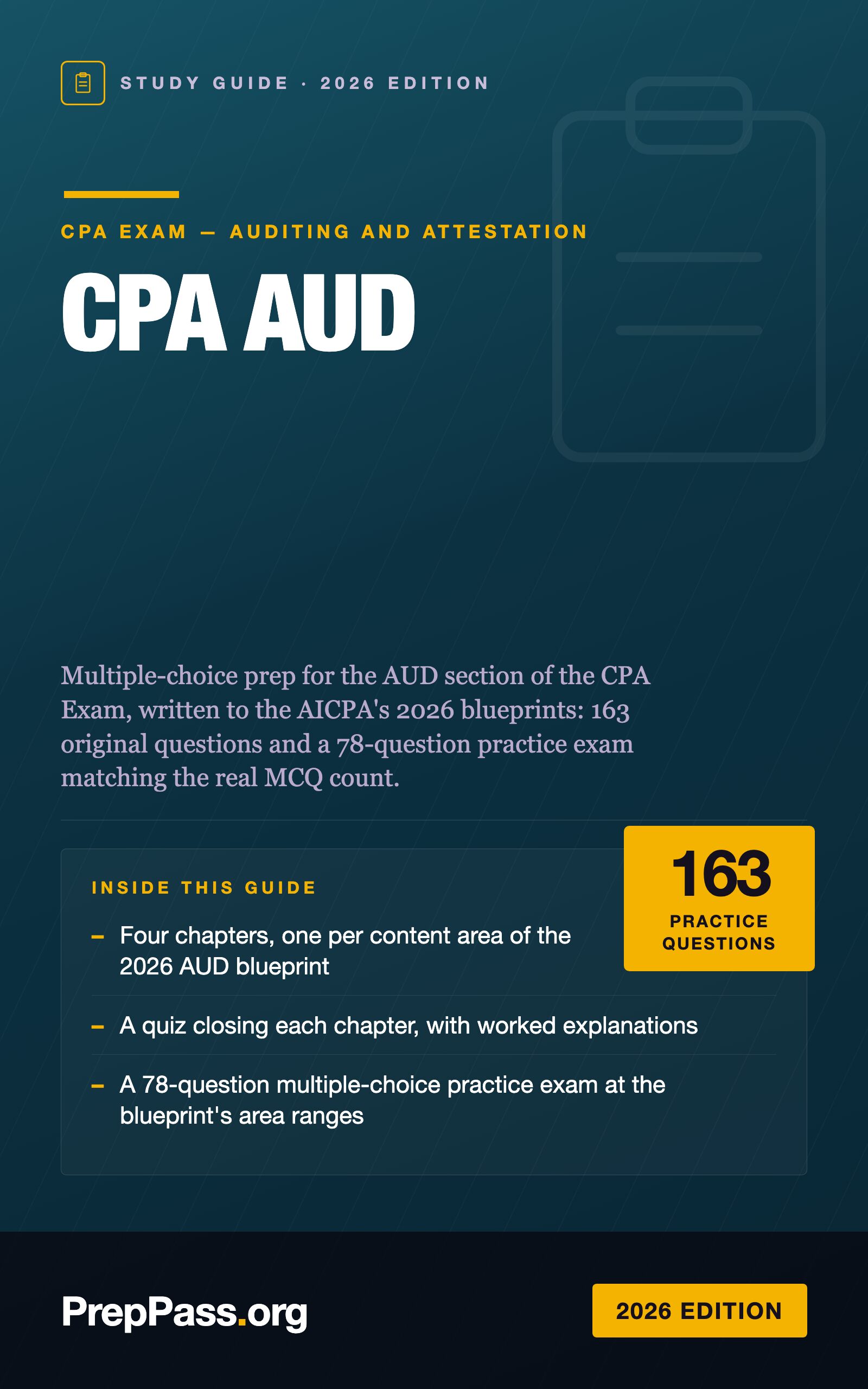
Multiple-choice prep for the AUD section of the CPA Exam, written to the AICPA's 2026 blueprints: 163 original questions and a 78-question practice exam matching the real MCQ count. No simulations.
- 163 original CPA AUD practice questions, each with a worked explanation, in one PDF + EPUB you keep
PDF + EPUB · English · 115 pages · $24.99 one-time
This book is written in English.
Instant download after payment — no account needed, no subscription.
14-day money-back guarantee: not satisfied for any reason? Email support@preppass.org within 14 days of purchase for a full refund. Refund policy
Try 10 questions first — free
Answer all 10, then see every answer explained — with the section of this guide that teaches it. About 5 minutes, no sign-up.
Start 10 free questionsLook inside the book
Three real pages, rendered straight from the PDF you download — a reference page, a teaching page, and a worked question, always in that order. Nothing here was redrawn to look better.
- Quick referenceChapter 1 — Ethics, Professional Responsibilities and General Principles · PDF page 17
A page you can turn back to: the numbers, deadlines or terms gathered in one place.
- How it's taughtChapter 3 — Performing Further Procedures and Obtaining Evidence · PDF page 59
An explanation page: the material taught in prose, in the order the exam tests it.
- A question, workedChapter 1 — Ethics, Professional Responsibilities and General Principles · PDF page 20
A practice question with its answer and the reasoning behind it — not just a key.
About the exam itself
| Administering body | American Institute of Certified Public Accountants (AICPA) — exam delivered by Prometric |
|---|---|
| Questions | 78 questions Source: AICPA — Uniform CPA Examination Blueprints (effective January 2026, PDF) |
| Time limit | 240 minutes Source: AICPA — Uniform CPA Examination Blueprints (effective January 2026, PDF) |
| Passing score | Scaled score of 75 on a 0–99 scale Source: AICPA & CIMA — Learn more about CPA Exam scoring and pass rates |
| Fees | Not published by Boards of Accountancy / NASBA What we read and found nothing in: NASBA — CPA Exam Candidate Guide (07162026, PDF) |
| Languages offered | English |
Questions buyers ask
- What has changed on the CPA Exam — Auditing and Attestation (AUD)?
- Uniform CPA Examination Blueprints — Auditing and Attestation (AUD) (in force from January 1, 2026): The AICPA Board of Examiners approved the revisions on August 18, 2025 and says they are not intended to significantly change the nature or scope of what AUD tests. They update the references to the AICPA Quality Management standards, emphasize entity-level controls, add examples on fraud-or-error risks and external confirmations, and clarify that the inputs to an accounting estimate include methods and data.
- Is a study guide enough for the CPA Exam — Auditing and Attestation (AUD), or do I need a course?
- Check eligibility first — per American Institute of Certified Public Accountants (AICPA): eligibility is set by each of the 55 U.S. states and territories (jurisdictions). You must be declared eligible by one of them, and each jurisdiction sets its own requirements for education, examination and experience. A book does not replace those requirements. For the exam content itself, this 115-page guide teaches the material chapter by chapter with 163 practice questions and explanations inside, and 111 more practice questions are free on PrepPass. A prep course adds live instruction and a set schedule; whether you need one beyond any required education is your call.
- What is the cheapest way to prepare for the CPA Exam — Auditing and Attestation (AUD)?
- Start with what costs nothing: 111 practice questions on PrepPass, with explanations and no signup. If you want it taught in one file you keep, the full study guide is $24.99 once. No subscription on any of them.
- What happens if I fail the CPA Exam — Auditing and Attestation (AUD)?
- You can retake it under American Institute of Certified Public Accountants (AICPA)'s rule: if you fail AUD, you re-register for the section and obtain a new Notice to Schedule (NTS), paying all fees for the new NTS. NASBA says it takes at least 72 hours after you receive your score before you can re-register for the same section. Confirm the current policy with American Institute of Certified Public Accountants (AICPA) before you book.
- Who administers the Uniform CPA Examination — Auditing and Attestation (AUD)?
- American Institute of Certified Public Accountants (AICPA) — exam delivered by Prometric. The AICPA writes and scores the exam; each state or territorial Board of Accountancy decides who is eligible, and NASBA acts as the central clearinghouse. AUD is one of three Core sections. Under the 2026 blueprint its content areas are Ethics, Professional Responsibilities and General Principles 15–25%, Assessing Risk and Developing a Planned Response 25–35%, Performing Further Procedures and Obtaining Evidence 30–40% and Forming Conclusions and Reporting 10–20%.
- How many questions are on the Uniform CPA Examination — Auditing and Attestation (AUD)?
- 78 questions. The count is the AICPA's 78 multiple-choice questions; the section also has 7 task-based simulations, each a multi-part case rather than a single question. The section runs as five testlets: two of multiple-choice questions (39 each), then three of simulations (2, 3 and 2).
- How long is the Uniform CPA Examination — Auditing and Attestation (AUD)?
- 240 minutes
- What is the passing score for the Uniform CPA Examination — Auditing and Attestation (AUD)?
- Scaled score of 75 on a 0–99 scale. The AICPA states the reported score is not a percentage correct and is not curved. For AUD the total score weights multiple-choice questions and task-based simulations 50% each.
- How much does the Uniform CPA Examination — Auditing and Attestation (AUD) cost?
- Not published by Boards of Accountancy / NASBA. NASBA's candidate guide says examination fees are set by the Boards of Accountancy, NASBA, the AICPA and Prometric, and are paid to the candidate's Board of Accountancy or CPAES. It prints no single national amount; the fee depends on the jurisdiction.
- What languages is the Uniform CPA Examination — Auditing and Attestation (AUD) offered in?
- English
- Does the CPA Exam — Auditing and Attestation (AUD) study guide come as a PDF?
- Yes — CPA AUD Study Guide — 2026 Edition downloads as PDF and EPUB, 115 pages. The download link is emailed the moment payment clears and does not expire.
- How much does the CPA Exam — Auditing and Attestation (AUD) study guide cost?
- $24.99, once. There is no subscription and no account to create; the PDF and EPUB files are yours to keep.
- Are there free CPA Exam — Auditing and Attestation (AUD) practice questions?
- Yes — 111 of them, free to use with no signup and an explanation on every one. They are separate from this study guide, which is what you are buying here.
- Can I read part of the CPA Exam — Auditing and Attestation (AUD) study guide before buying?
- Yes. A full chapter is free to read on this page — not a summary of one, the chapter itself.
- Is this the official CPA Exam — Auditing and Attestation (AUD) study guide?
- No. This is an independent study guide and is not affiliated with or endorsed by the exam's awarding body. It is written from AICPA's Uniform CPA Examination Blueprints (effective January 2026), the PCAOB Auditing Standards and the AICPA Code of Professional Conduct. Always confirm current requirements with the body that issues your licence.
Free CPA Exam — Auditing and Attestation (AUD) practice questions and study chapters →
What's included — and what isn't
Included
- Four chapters, one per content area of the 2026 AUD blueprint
- A quiz closing each chapter, with worked explanations
- A 78-question multiple-choice practice exam at the blueprint's area ranges
- 163 original questions, each explained and cited to its source
- Issuer rules cited to the PCAOB Auditing Standards by number
- PDF + EPUB you keep
Not included
- No printed copy is shipped — this is a file you download and can print yourself
- No video course, instructor or tutoring comes with the book — the free videos on the site are separate
- Not your exam registration or the testing centre's fee, which you still pay to the official body
Contents
See 7 sections and the page each one starts on
- Chapter 1 — Ethics, Professional Responsibilities and General Principlesp. 9
- Chapter 2 — Assessing Risk and Developing a Planned Responsep. 28
- Chapter 3 — Performing Further Procedures and Obtaining Evidencep. 45
- Chapter 4 — Forming Conclusions and Reportingp. 63
- Practice exam — 78 multiple- choice questionsp. 74
- Appendix A — Key figuresp. 107
- Appendix B — Terms to use preciselyp. 110
Taken from the PDF you download, with the page each one starts on — not typed here.
Read a chapter free, in full
One complete chapter, exactly as it ships in the eBook. Scroll the window to read it right here; no download, no email.
Read chapter 3 here, without leaving the page
We didn't give you the easy intro — the free chapter opens on one of the hardest-working parts of the book, so you can judge the teaching where the exam gets difficult.
The risk assessment from Chapter 2 dictates the nature, timing and extent of the further procedures in this chapter. Higher assessed risk means more persuasive evidence, more experienced staff, less predictability and procedures closer to year-end. The exam tests the area as matching: given a risk, choose the procedure; given a procedure, say what it evidences and how strong the evidence is.
III-A Use of data and information
Auditors now run procedures over whole populations of client data, so the blueprint expects working knowledge of how data is structured and made fit for use. A relational database stores data in tables of records (rows) and fields (attributes); a primary key identifies each record uniquely, and a foreign key links a record to another table — an invoice's customer ID linking to the customer master file. Normalisation removes redundancy by splitting data into related tables. Measurement scales matter for choosing an analysis: nominal (categories without order), ordinal (ordered categories), interval (equal steps, no true zero), ratio (equal steps and a true zero, such as dollars), and data may be discrete (counts) or continuous.
Before relying on a report or data set produced by the client, the auditor must make it trustworthy. Under PCAOB AS 1105, when using information produced by the company as evidence, the auditor evaluates whether it is sufficient and appropriate by testing its accuracy and completeness — or testing the controls over them, including IT general controls and automated application controls — and by evaluating whether it is sufficiently precise and detailed. Practical steps: agree totals to the general ledger, validate the query or report parameters used to extract the data, and reconcile record counts. Outputs of audit data analytics — outlier reports, visualisations, three-way matches across a whole population — are evidence only to the extent the underlying data is reliable, and each outlier they surface needs an audit response.
III-B Sufficient appropriate evidence
Sufficiency is the quantity of evidence; appropriateness is its quality — relevance and reliability. PCAOB AS 1105 states the reliability presumptions the exam loves: evidence from a knowledgeable source independent of the company is more reliable than evidence from internal sources alone; evidence obtained directly by the auditor is more reliable than evidence obtained indirectly; and original documents are more reliable than photocopies, facsimiles or documents converted to electronic form, whose reliability depends on the controls over conversion. Inquiry alone is never enough: for a control, inquiry alone does not provide sufficient evidence of effectiveness. When evidence conflicts, the auditor does more work — never averages the two stories, and never keeps only the convenient one.
III-C Sampling techniques
Audit sampling applies a procedure to less than 100% of a population to evaluate a characteristic of the whole. Sampling risk is the risk that the sample conclusion differs from the conclusion a 100% examination would reach; nonsampling risk covers everything else — the wrong procedure, a misread document. The two aspects of sampling risk the exam asks for:
| Test | Risk that hurts effectiveness | Risk that hurts efficiency |
|---|---|---|
| Substantive test of details | Incorrect acceptance | Incorrect rejection |
| Test of controls | Assessing control risk too low | Assessing control risk too high |
Tests of controls (attribute sampling). The tolerable rate is the maximum deviation rate the auditor will accept without changing the planned assessed level of control risk. The sample deviation rate is the best estimate of the population rate. If it exceeds the tolerable rate, the control cannot support the planned reliance. Even when it is below, the auditor considers the risk that the true rate exceeds the tolerable rate — which is small when a large sample shows no deviations.
Substantive tests (variables or monetary-unit sampling). Misstatements found must be projected to the population. AS 2315's own example: select every twentieth item (50 of 1,000), find $3,000 of overstatement, and divide by the fraction sampled (1/20) to project $60,000. Add the misstatements in items examined 100%, and compare the total projected misstatement with tolerable misstatement, allowing for sampling risk.
III-D Procedures to obtain sufficient appropriate evidence
Tests of controls. In order of the evidence they ordinarily provide, from least to most: inquiry, observation, inspection of documentation, and reperformance — the auditor's independent execution of the control. Observation evidences a control only at the moment it is observed.
Tests of details include inspection, observation, recalculation (checking mathematical accuracy), reperformance, external confirmation and inquiry — with follow-up questions that probe motives as well as facts. Direction matters: vouching from recorded entries back to support tests existence/occurrence; tracing from source documents forward to the records tests completeness.
Substantive analytical procedures. Their effectiveness depends on the nature of the assertion, the plausibility and predictability of the relationship, the availability and reliability of the data, and the precision of the expectation. The auditor develops an independent expectation, sets a threshold for investigating differences, and investigates differences above it with corroborated explanations. Analytical procedures are also required near the end of the audit, as an overall review of whether the statements are consistent with the auditor's understanding.
External confirmations (PCAOB AS 2310, effective for fiscal years ending on or after 15 June 2025). The objective is relevant and reliable evidence from a knowledgeable external source. The auditor must maintain control over requests and responses to minimise interception or alteration. Negative confirmation requests alone never provide sufficient appropriate evidence, because silence is not a response. Exceptions are evaluated to decide whether they indicate a misstatement, a control deficiency, or both. Nonresponses to positive requests are followed up; if no response comes, the auditor performs alternative procedures (for receivables, typically examining subsequent cash receipts and shipping documents). A response returned to anyone other than the auditor is re-requested directly — or treated as a nonresponse.
III-E Specific matters that require special consideration
Accounting estimates (PCAOB AS 2501). Three approaches, alone or combined: test management's process (evaluate its methods, data and significant assumptions), develop an independent expectation, or evaluate evidence from events after the measurement date. Methods must conform to the financial reporting framework. Look for bias: a pattern of estimates at the optimistic end of reasonable ranges is an indicator even when each estimate is individually reasonable.
Investments in securities. Existence (custodian confirmations), valuation (the fair value hierarchy — observable market prices versus models with unobservable inputs), and classification and disclosure.
Inventory. Observation of inventories is a generally accepted auditing procedure; an auditor who issues an opinion without it bears the burden of justifying that opinion. At the count the auditor observes procedures, makes test counts in both directions (floor to sheet for completeness, sheet to floor for existence), notes obsolete or damaged goods, and captures cut-off information. Inventory held by others is confirmed with the custodian.
Litigation, claims and assessments. Management is the primary source; the auditor reads minutes and contracts and sends a letter of audit inquiry to the client's lawyers. A lawyer's refusal to furnish the information requested is a limitation on the scope of the audit sufficient to preclude an unqualified opinion.
Going concern. Management (under US GAAP, ASU 2014-15) evaluates whether conditions and events, in the aggregate, make it probable that the entity will be unable to meet its obligations within one year after the date the financial statements are issued (or available to be issued). The issuer auditor (PCAOB AS 2415) evaluates substantial doubt for a reasonable period not to exceed one year beyond the date of the financial statements being audited — so the auditor's window can be shorter than management's. For nonissuers, AU-C 570 aligns the auditor's period with the framework's. Useful procedures: analytical procedures, review of subsequent events, debt covenant compliance, minutes, legal letters, and confirmation of financial support arrangements.
Single audits. The auditor tests compliance for each major program and the internal control over compliance, and reports findings (Chapter 4).
III-F Misstatements and internal control deficiencies
The auditor accumulates misstatements identified during the audit, other than those that are clearly trivial, evaluates uncorrected ones individually and in aggregate, and considers both quantitative and qualitative factors. Control deficiencies are classified by severity: a material weakness creates a reasonable possibility that a material misstatement will not be prevented or detected on a timely basis; a significant deficiency is less severe but merits the attention of those responsible for oversight.
III-G Written representations
The auditor obtains written representations from management to complement other procedures — never to replace them. If a representation is contradicted by other evidence, the auditor investigates and reconsiders the reliability of management's other representations. Management's refusal to furnish written representations is a limitation on the scope of the audit sufficient to preclude an unqualified opinion, and is ordinarily sufficient to cause the auditor to disclaim or withdraw.
III-H Subsequent events and subsequently discovered facts
Subsequent events (PCAOB AS 2801) come in two types. The first type provides additional evidence about conditions that existed at the balance sheet date — the statements are adjusted (a customer's bankruptcy after year-end that reveals a receivable was already uncollectible; a lawsuit settled for an amount different from the accrual, where the underlying event happened before year-end). The second type concerns conditions that did not exist at the balance sheet date but arose afterwards — no adjustment, but disclosure if needed to keep the statements from being misleading (a fire after year-end; a bond issue after year-end).
Subsequently discovered facts (AS 2905): if after the report date the auditor becomes aware of information that existed at the report date and would have been investigated had it been known, the auditor determines as soon as practicable whether it is reliable and whether the facts existed at that date — and, if the report would have been affected and people are relying on it, acts to prevent further reliance.
Key numbers
| Figure | Value | Source |
|---|---|---|
| PCAOB confirmation standard | AS 2310; negative requests alone are never sufficient | [1] |
| Sample projection (AS 2315 example) | $3,000 in a 1-in-20 sample projects to $60,000 | [1] |
| Management's going-concern horizon (US GAAP) | One year after the statements are issued | [2] |
| Issuer auditor's going-concern horizon | Not beyond one year after the balance sheet date | [2] |
Key takeaways
- Test the accuracy and completeness of client data before using it as evidence.
- Direct, external and original beat indirect, internal and copied; inquiry alone never suffices.
- Project sample misstatements and compare with tolerable misstatement; a sample deviation rate above the tolerable rate defeats planned reliance.
- Control the confirmation process; evaluate exceptions; follow up and apply alternative procedures to nonresponses.
- Estimates: methods, data, significant assumptions, and a watch for bias.
- Lawyer refusal and management refusal of representations are both scope limitations.
- First-type subsequent events adjust; second-type events disclose.
Chapter 3 quiz — 25 questions
1. Before using an aged receivables report generated by an issuer's ERP system to select confirmation items, what does PCAOB AS 1105 require the auditor to do with the report?
- A. Recompute the aging of the ten largest customers only.
- B. Test its accuracy and completeness, or test the related controls.
- C. Accept it, because it was produced by an automated system.
- D. Obtain a written representation that the report is correct.
2. In an issuer audit, which item of evidence is generally the most reliable under PCAOB AS 1105?
- A. A photocopy of the bank statement supplied by the controller.
- B. A bank statement the auditor got from the bank.
- C. The client's own bank reconciliation, prepared by the treasurer.
- D. The controller's explanation of the reconciling items.
3. The auditor of an issuer wants the strongest evidence that a three-way-match control over purchases operated effectively. Which procedure provides it?
- A. Asking the accounts payable supervisor how the match is performed.
- B. Reading the procedures manual that describes the match.
- C. Independently re-performing the match for a sample of transactions.
- D. Watching the clerk perform the match on one afternoon.
4. An issuer auditor selects every twentieth invoice (100 of 2,000) and finds overstatements totalling $4,500. Items examined 100% contain a further $6,000 of overstatement. Tolerable misstatement is $80,000. Using the ratio projection AS 2315 illustrates, what should the auditor conclude?
- A. Total projected misstatement is $51,000, below tolerable misstatement.
- B. Total projected misstatement is $90,000, above tolerable misstatement.
- C. Total projected misstatement is $10,500, well below tolerable misstatement.
- D. Total projected misstatement is $96,000, which is above tolerable misstatement.
5. In a substantive test of details for an issuer, the sample leads the auditor to conclude that receivables are not materially misstated when in fact they are. Which risk has materialised?
- A. The risk of incorrect acceptance.
- B. The risk of incorrect rejection.
- C. Nonsampling risk.
- D. The risk of assessing control risk too low.
6. Testing an issuer's approval control, the auditor sets a tolerable rate of 5%, examines 80 items and finds 6 deviations. What does the result mean?
- A. The 7.5% sample rate exceeds 5%, but the control is effective overall.
- B. The 6% sample rate exceeds 5%, so the auditor should expand the sample to 100.
- C. The 4.8% sample rate is below 5%, so planned reliance is supported.
- D. The 7.5% sample rate exceeds 5%, so the planned reliance is not supported.
7. An issuer's auditor concludes, from a sample, that a control is operating effectively when its true deviation rate is above the tolerable rate. Which aspect of sampling risk is this?
- A. Incorrect rejection.
- B. Assessing control risk too high.
- C. Nonsampling risk.
- D. Assessing control risk too low.
8. To save time, the auditor of an issuer proposes to send negative confirmation requests as the only evidence for a significant receivables balance with a high assessed risk. Under PCAOB AS 2310, is that sufficient?
- A. Yes, if the requests are sent by the auditor rather than the client.
- B. No, unless the client signs each request in advance.
- C. No. Negative requests alone never provide sufficient appropriate evidence here.
- D. Yes, if the auditor receives no replies disagreeing with the balances.
9. A customer of an issuer mails its confirmation reply to the client's controller, who hands it to the auditor. What does PCAOB AS 2310 require?
- A. Ignore the reply and select a different customer.
- B. Accept the reply, since it came from the customer.
- C. Treat the balance as confirmed if the controller vouches for it.
- D. Ask the customer to re-send the reply directly to the auditor.
10. A confirmation reply shows a customer's balance as $38,000 lower than the issuer's records. What should the auditor do?
- A. Accept the client's explanation without further evidence.
- B. Evaluate whether it indicates a misstatement or deficiency.
- C. Discard the reply and confirm a different customer instead.
- D. Record the $38,000 as a timing difference and move on.
11. Two positive confirmation requests to an issuer's customers get no reply after follow-up. What does PCAOB AS 2310 require?
- A. Perform alternative procedures for those items.
- B. Replace them with two other customers.
- C. Treat the balances as confirmed.
- D. Treat the balances as misstatements and adjust them.
12. For an issuer, the auditor plans a substantive analytical procedure on payroll expense. Which factor most determines whether it can provide the evidence needed?
- A. Whether last year's payroll was audited without exceptions.
- B. Whether management agrees with the expectation.
- C. Whether the payroll balance exceeds materiality.
- D. The precision of the auditor's own expectation.
13. An issuer holds its inventory in its own warehouses. Which procedure best tests the existence of recorded inventory?
- A. Reviewing the client's written counting instructions.
- B. Selecting items on the warehouse floor and tracing them to the count sheets.
- C. Selecting items from the count sheets and locating them in the warehouse.
- D. Asking the warehouse manager whether the counts were accurate.
14. An issuer's outside counsel declines to comment on pending litigation in response to the auditor's letter of audit inquiry, either in writing or orally. What does PCAOB AS 2505 say about this?
- A. It is a scope limitation that precludes an unqualified opinion.
- B. It requires an adverse opinion on the financial statements.
- C. The auditor may rely on management's description instead.
- D. It is acceptable, because counsel owes duties to the client.
15. An issuer's financial statements for the year ended 31 December 2025 are issued on 15 March 2026. Which statement about the going-concern horizons is correct?
- A. Both management and the auditor look to 31 December 2026.
- B. Management looks to 31 December 2026; the auditor to 15 March 2027.
- C. Management to 15 March 2027; the auditor to 31 December 2026.
- D. Both management and the auditor look to 15 March 2027.
16. After considering management's plans, the auditor of an issuer concludes that substantial doubt about its ability to continue as a going concern remains, and the disclosures are adequate. What does PCAOB AS 2415 require in the report?
- A. No change, because the disclosures are adequate.
- B. A titled explanatory paragraph immediately after the opinion.
- C. A disclaimer of opinion, because the future cannot be audited.
- D. A qualified opinion, because the going-concern basis may be wrong.
17. An issuer's year ends 31 December. On 20 January, before the report is issued, a major customer files for bankruptcy because of losses it had suffered over the previous year. How should the receivable be treated?
- A. Ignore it, because events after year-end never affect the statements.
- B. Disclose the bankruptcy only, because it occurred after year-end.
- C. Defer the matter to next year's financial statements.
- D. Adjust the allowance, because the condition existed at year-end.
18. On 15 February, before the report date, fire destroys an issuer's main warehouse. Its year ended 31 December. How should the loss be reflected?
- A. Adjusted in the statements, because it occurred before the report date.
- B. Disclosed if material, but not adjusted in the year-end statements.
- C. Adjusted, and the prior year restated.
- D. Ignored, because it occurred after the balance sheet date.
19. The CEO and CFO of an issuer refuse to sign the management representation letter. What does PCAOB AS 2805 say about this?
Sources cited in this excerpt
- Auditing Standards of the Public Company Accounting Oversight Board.
- Going Concern: Management and Auditor Responsibilities (April 2020). Center for Audit Quality.
Before you buy
- How do I get it?
- Pay, and the download appears on this page straight away. The links are also emailed to you. No account is required.
- What if it isn't for me?
- Email us within 14 days for a full refund, no questions asked.
- Is the free practice going away?
- No. Every practice question, the timed mock and the free chapters on this site stay free. This book is the studying half, not a gate around the free half.
- Can I read it on my phone?
- Yes — the EPUB is for phones and e-readers, the PDF is for printing and tabbing. You get both.
The details
Multiple-choice prep for the AUD section of the CPA Exam, written to the AICPA's 2026 blueprints: 163 original questions and a 78-question practice exam matching the real MCQ count. No simulations.
- Format: PDF + EPUB download · 115 pages
- 163 practice questions in the book, with a full answer key
- 111 free practice questions for this exam on PrepPass, included at no cost
- $24.99 one-time — no subscription
- 14-day money-back guarantee · refund policy
- Cross-referenced against: AICPA's Uniform CPA Examination Blueprints (effective January 2026), the PCAOB Auditing Standards and the AICPA Code of Professional Conduct
- Last updated: September 2026
- Verified from the official source(AICPA's Uniform CPA Examination Blueprints (effective January 2026), the PCAOB Auditing Standards and the AICPA Code of Professional Conduct)
- 111 free practice questions
- Instant download, yours for life
Why buy the book when the practice is free?
Our practice questions and timed mock stay free — nothing on the site moves behind this book. The $24.99 book is the studying half: the material itself, taught in order, in a file you own.
- Systematic teaching — every exam section explained chapter by chapter, start to finish, not just questions
- Print it & tab it — a paper-ready PDF you can highlight, mark up, and bring to your study table
- Study anywhere, offline — EPUB on your phone or e-reader; no wifi, no browser tabs
- Everything in one place — the chapters and the practice questions in one file
- Yours for life — one-time $24.99, instant download, no subscription
And it's risk-free: 14-day money-back guarantee — not satisfied? Email us for a full refund, no questions asked. See the refund policy.
14-day money-back guarantee · full refund, no questions asked.
One-time purchase, lifetime access to the download. The eBook is the full CPA Exam — Auditing and Attestation (AUD) study guide in PDF and EPUB. Educational summary, not professional or legal advice — always confirm the current rules with the official source. Last updated: September 2026.