CPA Exam — Financial Accounting and Reporting (FAR) · 2026 Edition
CPA FAR Study Guide — 2026 Edition
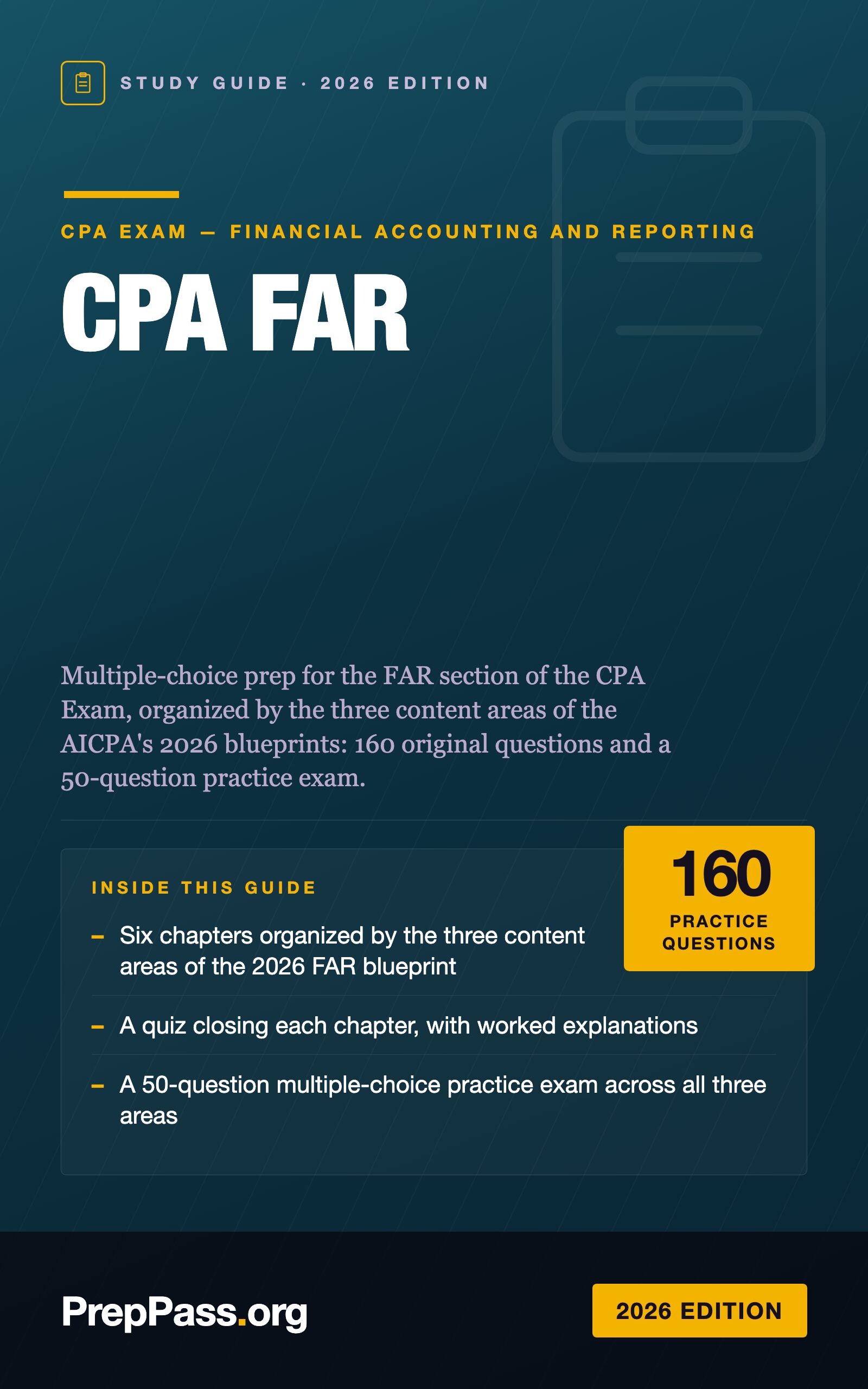
Multiple-choice prep for the FAR section of the CPA Exam, organized by the three content areas of the AICPA's 2026 blueprints: 160 original questions and a 50-question practice exam. No simulations.
- 160 original CPA FAR practice questions, each with a worked explanation, in one PDF + EPUB you keep
PDF + EPUB · English · 102 pages · $24.99 one-time
This book is written in English.
Instant download after payment — no account needed, no subscription.
14-day money-back guarantee: not satisfied for any reason? Email support@preppass.org within 14 days of purchase for a full refund. Refund policy
Try 10 questions first — free
Answer all 10, then see every answer explained — with the section of this guide that teaches it. About 5 minutes, no sign-up.
Start 10 free questionsLook inside the book
Three real pages, rendered straight from the PDF you download — a reference page, a teaching page, and a worked question, always in that order. Nothing here was redrawn to look better.
- Quick referenceAnswer key · PDF page 93
A page you can turn back to: the numbers, deadlines or terms gathered in one place.
- How it's taughtChapter 3 — Area II-A–D: Cash, Receivables, Inventory, and PP&E · PDF page 39
An explanation page: the material taught in prose, in the order the exam tests it.
- A question, workedChapter 4 — Area II-E–I: Investments, Intangibles, Liabilities, Debt, and Equity · PDF page 57
A practice question with its answer and the reasoning behind it — not just a key.
About the exam itself
| Administering body | American Institute of Certified Public Accountants (AICPA) — exam delivered by Prometric |
|---|---|
| Questions | 50 questions Source: AICPA — Uniform CPA Examination Blueprints (effective January 2026, PDF) |
| Time limit | 240 minutes Source: AICPA — Uniform CPA Examination Blueprints (effective January 2026, PDF) |
| Passing score | Scaled score of 75 on a 0–99 scale Source: AICPA & CIMA — Learn more about CPA Exam scoring and pass rates |
| Fees | Not published by Boards of Accountancy / NASBA What we read and found nothing in: NASBA — CPA Exam Candidate Guide (07162026, PDF) |
| Languages offered | English |
Questions buyers ask
- What has changed on the CPA Exam — Financial Accounting and Reporting (FAR)?
- Uniform CPA Examination Blueprints (in force from 2026-01-01): The AICPA says the January 2026 revisions are not intended to significantly change the nature or scope of FAR content; they clarify the scope of tasks on the statement of activities, financial statement ratios and fair value measurements.
- Is a study guide enough for the CPA Exam — Financial Accounting and Reporting (FAR), or do I need a course?
- Check eligibility first — per American Institute of Certified Public Accountants (AICPA): each of the 55 U.S. jurisdictions sets its own education, examination and experience requirements, and you must be declared eligible by one of them. A book does not replace those requirements. For the exam content itself, this 102-page guide teaches the material chapter by chapter with 160 practice questions and explanations inside, and 122 more practice questions are free on PrepPass. A prep course adds live instruction and a set schedule; whether you need one beyond any required education is your call.
- What is the cheapest way to prepare for the CPA Exam — Financial Accounting and Reporting (FAR)?
- Start with what costs nothing: 122 practice questions on PrepPass, with explanations and no signup. If you want it taught in one file you keep, the full study guide is $24.99 once. No subscription on any of them.
- What happens if I fail the CPA Exam — Financial Accounting and Reporting (FAR)?
- You can retake it under American Institute of Certified Public Accountants (AICPA)'s rule: if you fail a section you must re-register for it, pay the fees again and obtain a new Notice to Schedule (NTS). There is no other limit on attempts beyond the time it takes to receive your score, re-register, get the new NTS and find a testing date. Confirm the current policy with American Institute of Certified Public Accountants (AICPA) before you book.
- Who administers the Uniform CPA Examination — Financial Accounting and Reporting (FAR)?
- American Institute of Certified Public Accountants (AICPA) — exam delivered by Prometric. The AICPA writes and scores the exam; each state or territorial Board of Accountancy decides who is eligible, and NASBA acts as the central clearinghouse. FAR is one of three Core sections. Under the 2026 blueprint its content areas are Financial Reporting 30–40%, Select Balance Sheet Accounts 30–40% and Select Transactions 25–35%. The AICPA has announced that from July 2027 the exam moves to a new delivery platform, with no testing from July 1 to July 11, 2027.
- How many questions are on the Uniform CPA Examination — Financial Accounting and Reporting (FAR)?
- 50 questions. The count is the AICPA's 50 multiple-choice questions; the section also has 7 task-based simulations, each a multi-part case rather than a single question. The section runs as five testlets: two of multiple-choice questions (25 each), then three of simulations (2, 3 and 2).
- How long is the Uniform CPA Examination — Financial Accounting and Reporting (FAR)?
- 240 minutes
- What is the passing score for the Uniform CPA Examination — Financial Accounting and Reporting (FAR)?
- Scaled score of 75 on a 0–99 scale. The AICPA states the reported score is not a percentage correct and is not curved. For FAR the total score weights multiple-choice questions and task-based simulations 50% each.
- How much does the Uniform CPA Examination — Financial Accounting and Reporting (FAR) cost?
- Not published by Boards of Accountancy / NASBA. NASBA's candidate guide says examination fees are set by the Boards of Accountancy, NASBA, the AICPA and Prometric, and are paid to the candidate's Board of Accountancy or CPAES. It prints no single national amount; the fee depends on the jurisdiction.
- What languages is the Uniform CPA Examination — Financial Accounting and Reporting (FAR) offered in?
- English
- Does the CPA Exam — Financial Accounting and Reporting (FAR) study guide come as a PDF?
- Yes — CPA FAR Study Guide — 2026 Edition downloads as PDF and EPUB, 102 pages. The download link is emailed the moment payment clears and does not expire.
- How much does the CPA Exam — Financial Accounting and Reporting (FAR) study guide cost?
- $24.99, once. There is no subscription and no account to create; the PDF and EPUB files are yours to keep.
- Are there free CPA Exam — Financial Accounting and Reporting (FAR) practice questions?
- Yes — 122 of them, free to use with no signup and an explanation on every one. They are separate from this study guide, which is what you are buying here.
- Can I read part of the CPA Exam — Financial Accounting and Reporting (FAR) study guide before buying?
- Yes. A full chapter is free to read on this page — not a summary of one, the chapter itself.
- Is this the official CPA Exam — Financial Accounting and Reporting (FAR) study guide?
- No. This is an independent study guide and is not affiliated with or endorsed by the exam's awarding body. It is written from AICPA's Uniform CPA Examination Blueprints (effective January 1, 2026), FASB standards and Updates, and the NASBA CPA Exam Candidate Guide. Always confirm current requirements with the body that issues your licence.
Free CPA Exam — Financial Accounting and Reporting (FAR) practice questions and study chapters →
What's included — and what isn't
Included
- Six chapters organized by the three content areas of the 2026 FAR blueprint
- A quiz closing each chapter, with worked explanations
- A 50-question multiple-choice practice exam across all three areas
- 160 original questions, each explained and cited to its source
- Original FASB pronouncements mapped to their ASC topics
- PDF + EPUB you keep
Not included
- No printed copy is shipped — this is a file you download and can print yourself
- No video course, instructor or tutoring comes with the book — the free videos on the site are separate
- Not your exam registration or the testing centre's fee, which you still pay to the official body
Contents
See 8 sections and the page each one starts on
- Chapter 6 — Fair value, leases and subsequent events (Area III-E to III- G)p. 7
- Chapter 1 — For-profit financial reporting The full set of statementsp. 8
- Chapter 3 — Area II-A–D: Cash, Receivables, Inventory, and PP&Ep. 36
- Chapter 4 — Area II-E–I: Investments, Intangibles, Liabilities, Debt, and Equityp. 49
- Chapter 5 — Area III-A–D: Accounting Changes, Errors, Contingencies, Revenue, and Income Taxesp. 62
- Answer key & explanationsp. 69
- Chapter 6 — Area III-E–G: Fair Value, Leases, and Subsequent Eventsp. 72
- Answer keyp. 92
Taken from the PDF you download, with the page each one starts on — not typed here.
Read a chapter free, in full
One complete chapter, exactly as it ships in the eBook. Scroll the window to read it right here; no download, no email.
Read chapter 3 here, without leaving the page
We didn't give you the easy intro — the free chapter opens on one of the hardest-working parts of the book, so you can judge the teaching where the exam gets difficult.
This chapter covers Area II, sections A through D: cash and cash equivalents, receivables (including credit losses and notes), inventory cost flows and measurement, and property, plant, and equipment. Area II carries a 30–40% weight on the FAR section and has the highest concentration of analysis tasks in the 2026 blueprint, so work these computations until the mechanics are automatic.
Cash and Cash Equivalents
Cash includes currency, coins, and demand deposits. Cash equivalents are short-term, highly liquid investments that are both readily convertible to known amounts of cash and so near maturity that they present insignificant risk of changes in value because of interest-rate changes. Generally, only investments with original maturities of three months or less qualify; Treasury bills, commercial paper, money market funds, and federal funds sold are common examples.
Cash that is set aside and not available for general operations is restricted cash — a separate category of cash and cash equivalents, presented apart from unrestricted cash on the balance sheet. Examples include a minimum balance a lender requires as collateral or funds earmarked for a plant expansion. The balance sheet must differentiate restricted cash from unrestricted amounts, the footnotes must disclose the nature of the restriction, and restricted cash is classified as current or noncurrent depending on whether it will be available within one year. On the statement of cash flows, restricted cash is included with cash and cash equivalents in the beginning- and end-of-period reconciliation, and transfers between cash and restricted cash are not reported as operating, investing, or financing activities.
Bank Reconciliations
A bank reconciliation compares the cash balance in the entity's accounting records with the bank statement balance to identify differences and record adjustments. Start with the bank's ending balance: add deposits in transit (recorded by the entity but not yet by the bank) and subtract outstanding checks (recorded by the entity but not yet cleared). Then adjust the company's book balance: deduct bank service charges, NSF checks and penalties, and add interest earned. The adjusted bank balance should equal the adjusted book balance. Only the book-side adjustments require journal entries, because the bank-side items are timing differences the bank will clear on its own.
Receivables and Credit Losses
Receivables are reported at net realizable value — the amount expected to be collected. Under the CECL model (ASC 326), the allowance for credit losses reflects the organization's current estimate of all expected credit losses over the contractual term, eliminating the old "probable" recognition threshold and broadening the information considered to include forward-looking information.
For bad debts, GAAP requires the allowance method, not the direct write-off method. The direct write-off method delays expense recognition until a specific account is identified as uncollectible, which violates the matching principle; the allowance method estimates bad debt during the period and matches it with related sales. The journal entry debits Bad Debt Expense and credits the Allowance for Doubtful Accounts — a contra asset subtracted from Accounts Receivable to arrive at net realizable value on the balance sheet. When a specific account is later written off, the entry debits the allowance and credits Accounts Receivable (no expense at that point, because the expense was already estimated).
Notes receivable are formal written promises (promissory notes) to pay a definite sum on demand or at a specific date, usually with interest. At maturity the maker owes principal plus interest — the maturity value. If the maker fails to pay, the note is dishonored: the payee removes it from Notes Receivable and records the amount due (maturity value) in Accounts Receivable, recognizing any earned interest.
When receivables are transferred to another party — for example, factored to a finance company — ASC 860 asks whether the transfer is a sale or a secured borrowing. A transfer is a sale only if the transferor surrenders all three forms of control: legal, actual, and effective. Sales result in derecognition of the asset with a gain or loss; if any criterion fails, the transfer is a secured borrowing — the asset stays on the balance sheet, the cash received is a liability, and no gain or loss is recognized.
Inventory
Inventory ownership follows title, not physical location. Under FOB shipping point, the seller transfers title and responsibility to the buyer at the shipping point, so the buyer records the goods (and owes the freight). Under FOB destination, title passes at the destination, so the seller keeps the goods on its books until delivery. Consigned goods belong to a third party (the consignor) but are displayed for sale by the company (the consignee); they are not the consignee's assets and must not appear on the consignee's balance sheet — the consignor reports them until they sell.
The four cost flow methods are specific identification, FIFO, LIFO, and weighted average. Specific identification tracks the actual cost of each item sold and is used only for expensive, highly customized, or inherently distinctive items (automobiles, diamonds). FIFO records costs as if the earliest-purchased items were sold first; LIFO as if the latest-purchased items were sold first; weighted average blends all lots. The cost flow assumption does not have to match the physical flow of goods. In inflationary times, FIFO ending inventory balances grow larger (ending inventory reflects the most recent, higher costs), COGS reflects older lower costs, and reported profits are higher than under LIFO; the effects reverse in deflationary periods.
Measurement: inventory other than LIFO or the retail inventory method is measured at the lower of cost and net realizable value (NRV) — estimated ordinary-course selling prices less reasonably predictable costs of completion, disposal, and transportation. When NRV is below cost, the difference is recognized as a loss in earnings in the period it occurs (damage, obsolescence, price declines, and similar causes all qualify).
Inventory errors flow through COGS. An overstated ending inventory understates cost of goods sold and overstates net income, assets, and equity; an understated ending inventory does the reverse. (Beginning-inventory errors affect only the income statement.) The gross profit method can estimate ending inventory when a count is impossible — for example, after a disaster — by applying a standard gross profit percentage to sales to estimate COGS, then subtracting COGS from goods available for sale.
Consistency matters: once a costing method is chosen, it is applied period after period under the consistency principle. And under the LIFO conformity rule, a company may not use LIFO on its tax return unless it also uses LIFO in its financial statements.
Property, Plant, and Equipment
PP&E is recorded at historical cost — all costs necessary to place the asset into service — and depreciated (except land, which has an unlimited useful life) by allocating that cost over the asset's useful life. Book value equals original cost less accumulated depreciation; accumulated depreciation is a contra-asset account. Straight-line depreciation divides the depreciable base (cost less salvage value) by the useful life. Double-declining-balance applies twice the straight-line rate to the beginning book value and may never drive book value below salvage value.
Interest capitalization: interest incurred while constructing an asset for the entity's own use (such as a facility) or a discrete project built for sale or lease (such as a real estate development) is capitalized as part of the asset's cost, because the asset requires time to get ready for its intended use. Interest is not capitalized for inventories routinely produced in large quantities, for assets already in use or ready for use, or for idle assets not undergoing preparation.
Impairment (ASC 360) is a two-step test. Step 1, recoverability: compare the carrying amount with the sum of the undiscounted cash flows expected from the asset's use and disposal. If undiscounted flows are below carrying amount, the asset is not recoverable. Step 2: the impairment loss equals carrying value minus fair value. The test is performed when circumstances indicate the carrying amount may not be recoverable — not on every asset every period.
Chapter 3 quiz
1. Which of the following items qualifies as a cash equivalent?
- A. A certificate of deposit with an original maturity of six months
- B. A trade account receivable due in 45 days
- C. Cash held in a separate account as loan collateral
- D. A Treasury bill with an original maturity of 60 days
2. A company maintains a separate bank account holding the minimum balance its lender requires as loan collateral. The funds cannot be used for operations for the next two years. How should the company report this cash?
- A. As part of cash and cash equivalents on the balance sheet
- B. As a prepaid expense until the loan is repaid
- C. As restricted cash, reported separately from cash and classified as noncurrent
- D. As an offset against the related loan payable
3. In preparing a bank reconciliation, how should a deposit in transit be treated?
- A. Added to the bank statement balance
- B. Subtracted from the bank statement balance
- C. Added to the company's book cash balance
- D. Subtracted from the company's book cash balance
4. In preparing a bank reconciliation, how should outstanding checks be treated?
- A. Added to the bank statement balance
- B. Subtracted from the company's book cash balance
- C. Added to the company's book cash balance
- D. Subtracted from the bank statement balance
5. The bank statement shows a customer's check returned for insufficient funds. The company had not yet recorded the return. Which adjustment belongs in the bank reconciliation?
- A. Deduct the NSF check from book cash
- B. Add the NSF check to the bank statement balance
- C. Subtract the NSF check from the bank statement balance
- D. Make no adjustment until the customer pays
6. Under the CECL model, the allowance for credit losses on trade receivables is based on:
- A. The current estimate of all expected credit losses over the contractual term, including forward-looking information
- B. Only losses that are probable as of the balance sheet date
- C. Actual write-offs from the prior fiscal year, carried forward as the full allowance without estimation
- D. The historical loss rate applied to total sales for the period, with no forward-looking adjustment
7. Why does GAAP require the allowance method rather than the direct write-off method for uncollectible accounts?
- A. The direct write-off method overstates accounts receivable
- B. The allowance method is required on corporate tax returns
- C. The allowance method eliminates the need for an aging schedule
- D. The direct write-off method violates the matching principle
8. A company reports accounts receivable of $90,000 and an allowance for doubtful accounts with a $4,800 credit balance. What amount appears on the balance sheet, and how is the allowance classified?
- A. $90,000 gross receivables; the allowance is reported as a current liability
- B. $94,800; the allowance is added to receivables as a deferred credit
- C. $85,200; the allowance is reported within operating expenses
- D. $85,200 net realizable value; the allowance is a contra asset
9. A company holds a $12,000, 8%, 90-day note receivable (interest computed on a 360-day year). What is the maturity value of the note?
- A. $12,000
- B. $12,960
- C. $12,240
- D. $12,080
10. The maker of a note receivable fails to pay at maturity. How should the payee account for the dishonored note?
- A. Keep the note in Notes Receivable until the maker eventually pays in cash
- B. Write off the note's face value directly to Bad Debt Expense as uncollectible
- C. Reclassify the note as a long-term investment until the dispute is resolved
- D. Remove the note and record a receivable from the maker
11. Under ASC 860, a transfer of receivables qualifies for sale accounting (derecognition) only when:
- A. The transferor surrenders legal, actual, and effective control over the receivables
- B. The transferor surrenders legal control but retains effective control
- C. The receivables are transferred with recourse to the transferor
- D. Management elects sale treatment as an accounting policy choice
12. At year-end, goods are in transit from the seller to the buyer under FOB shipping point terms. Which company includes the goods in its inventory?
- A. The seller, because the goods have not yet arrived
- B. Neither company, until the goods are received
- C. The buyer, because title and responsibility transfer at the shipping point
- D. Both companies, each reporting one-half of the cost
13. A retailer displays merchandise owned by a manufacturer and will earn a commission when the goods sell. How should the retailer report the consigned goods?
- A. Exclude them from its balance sheet; the consignor reports them as its asset until sold
- B. Include them in its merchandise inventory at cost, because physical possession establishes ownership
- C. Include them in its merchandise inventory at selling price, recording a payable to the consignor
- D. Report them as a receivable from the consignor, recognizing the commission in advance
14. During a period of rising purchase prices, which statement about FIFO is correct?
- A. Ending inventory reflects the oldest lower costs, and reported profits are lower than under LIFO
- B. Ending inventory reflects the most recent higher costs, and reported profits are higher than under LIFO
- C. Cost of goods sold reflects the most recent costs, reducing reported profits
- D. Ending inventory and profits are identical under FIFO and LIFO
15. For which type of inventory is the specific identification method most appropriate?
- A. Large quantities of identical, interchangeable screws bought in bulk
- B. Expensive, highly customized items such as automobiles sold by a dealer
- C. Bulk chemicals stored in common tanks where production lots are indistinguishable
- D. Gasoline held in underground storage tanks and sold by the gallon
16. A company uses FIFO. At year-end, inventory costing $50,000 has a net realizable value of $46,000. How should the company report the inventory?
- A. Report inventory at $50,000 and disclose the decline in the notes only
- B. Report inventory at $48,000, the midpoint of cost and net realizable value
- C. Report inventory at $46,000 and recognize a $4,000 loss in earnings
- D. Report inventory at $46,000 with no loss recognized until the goods sell
17. A physical count reveals that ending inventory was overstated by $10,000. What is the effect of the error?
- A. Cost of goods sold is overstated and net income is understated
- B. Both cost of goods sold and net income are overstated
- C. Cost of goods sold is understated and net income is overstated
- D. Neither cost of goods sold nor net income is affected
18. A machine cost $120,000, has an estimated salvage value of $20,000, and a 10-year useful life. What is annual straight-line depreciation?
- A. $12,000; the $120,000 cost divided by 10 years, ignoring salvage value
- B. $10,000; the $100,000 depreciable base divided by the 10-year life
- C. $14,000; the salvage value added to cost before dividing by 10 years
- D. $8,000; the salvage value subtracted from cost twice before dividing
19. Which of the following assets qualifies for interest capitalization?
- A. A manufacturing facility the company is constructing for its own use
- B. Inventory that is routinely produced in large quantities
- C. Equipment already in use in the company's operations
- D. Land held for speculation with no development activities underway
20. A machine has a carrying value of $80,000. Expected undiscounted cash flows from its use and disposal total $70,000, and its fair value is $65,000. What impairment loss should be recognized?
- A. $10,000, equal to carrying value minus undiscounted cash flows
- B. $15,000; the asset is not recoverable, so the loss equals carrying value minus fair value
- C. $5,000, equal to undiscounted cash flows minus fair value
- D. No loss, because the undiscounted cash flows of $70,000 exceed the $65,000 fair value
Answer key & explanations
1. D. A Treasury bill with a 60-day original maturity qualifies as a cash equivalent: cash equivalents are short-term, highly liquid investments that are readily convertible to known amounts of cash with insignificant interest-rate risk, and generally only investments with original maturities of three months or less qualify. A six-month certificate of deposit exceeds the three-month limit, a trade receivable is not an investment, and collateral cash is restricted cash, a separate category.[1]
2. C. Cash the lender requires as collateral is restricted cash — a separate category of cash and cash equivalents that is not available for general operations. The balance sheet must differentiate restricted cash from unrestricted amounts, the footnotes must disclose the nature of the restriction, and because the cash is unavailable for more than one year it is classified as noncurrent rather than combined with cash on the balance sheet.[2]
3. A. A deposit in transit is cash the entity has recorded but the bank has not yet recorded, so it does not appear on the bank statement. The reconciliation therefore starts with the bank's ending balance and adds deposits in transit (and subtracts outstanding checks) to reach the adjusted bank balance, which should equal the adjusted book balance.[3]
4. D. An outstanding check has been recorded by the issuing entity but has not yet cleared the bank, so it does not appear as a deduction on the month-end bank statement. The reconciliation starts with the bank's ending balance, adds deposits in transit, and subtracts checks that have not yet cleared the bank to arrive at the adjusted bank balance.[3]
5. A. An NSF check was recorded by the bank (the deposit was reversed) but not yet by the company, so it is a book-side adjustment: the company's ending cash balance is reduced for NSF checks and penalties while interest earned is added.[3]
6. A. The CECL model eliminated the old probable-loss threshold and instead reflects the organization's current estimate of all expected credit losses over the contractual term, broadening the information considered to include forward-looking information. An allowance based only on probable losses or on last year's actual write-offs understates the required estimate.[4]
7. D. Under GAAP the direct write-off method is not acceptable because it delays recognition of bad debt until a specific account is identified as uncollectible, which violates the matching principle — the expense lands in a later period than the related sale. The allowance method satisfies the matching principle by estimating bad debt in the same period as the sales.[5]
Sources cited in this excerpt
- Statement of Financial Accounting Standards No. 95 — FASB. https://www.fasb.org/
- Reporting Restricted Cash — GBQ. https://gbq.com/reporting-restricted-cash/
- Bank reconciliation definition — AccountingTools. https://www.accountingtools.com/articles/bank-reconciliation
- FASB In Focus: Accounting for Credit Losses — FASB. https://www.fasb.org/
- OpenStax Financial Accounting — Allowance method (LibreTexts). https://biz.libretexts.org/Bookshelves/Accounting/Financial_Accounting_(OpenStax)/09:_Accounting_for_Receivables/9.02:_Account_for_Uncollectible_Accounts_Using_the_Balance_Sheet_and_Income_Statement_Approaches
Before you buy
- How do I get it?
- Pay, and the download appears on this page straight away. The links are also emailed to you. No account is required.
- What if it isn't for me?
- Email us within 14 days for a full refund, no questions asked.
- Is the free practice going away?
- No. Every practice question, the timed mock and the free chapters on this site stay free. This book is the studying half, not a gate around the free half.
- Can I read it on my phone?
- Yes — the EPUB is for phones and e-readers, the PDF is for printing and tabbing. You get both.
The details
Multiple-choice prep for the FAR section of the CPA Exam, organized by the three content areas of the AICPA's 2026 blueprints: 160 original questions and a 50-question practice exam. No simulations.
- Format: PDF + EPUB download · 102 pages
- 160 practice questions in the book, with a full answer key
- 122 free practice questions for this exam on PrepPass, included at no cost
- $24.99 one-time — no subscription
- 14-day money-back guarantee · refund policy
- Cross-referenced against: AICPA's Uniform CPA Examination Blueprints (effective January 1, 2026), FASB standards and Updates, and the NASBA CPA Exam Candidate Guide
- Last updated: September 2026
- Verified from the official source(AICPA's Uniform CPA Examination Blueprints (effective January 1, 2026), FASB standards and Updates, and the NASBA CPA Exam Candidate Guide)
- 122 free practice questions
- Instant download, yours for life
Why buy the book when the practice is free?
Our practice questions and timed mock stay free — nothing on the site moves behind this book. The $24.99 book is the studying half: the material itself, taught in order, in a file you own.
- Systematic teaching — every exam section explained chapter by chapter, start to finish, not just questions
- Print it & tab it — a paper-ready PDF you can highlight, mark up, and bring to your study table
- Study anywhere, offline — EPUB on your phone or e-reader; no wifi, no browser tabs
- Everything in one place — the chapters and the practice questions in one file
- Yours for life — one-time $24.99, instant download, no subscription
And it's risk-free: 14-day money-back guarantee — not satisfied? Email us for a full refund, no questions asked. See the refund policy.
14-day money-back guarantee · full refund, no questions asked.
One-time purchase, lifetime access to the download. The eBook is the full CPA Exam — Financial Accounting and Reporting (FAR) study guide in PDF and EPUB. Educational summary, not professional or legal advice — always confirm the current rules with the official source. Last updated: September 2026.