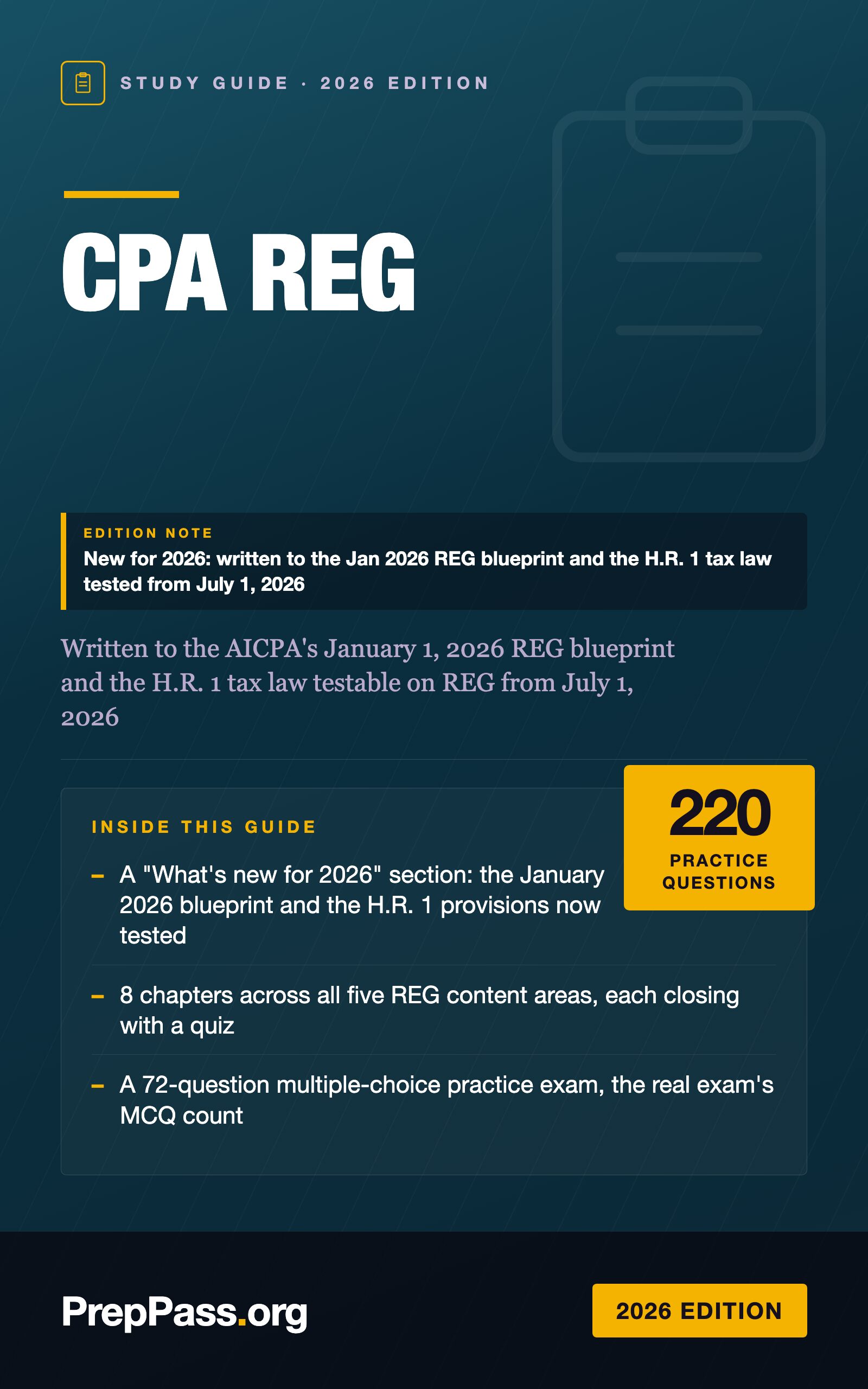
CPA REG (Taxation and Regulation) · 2026 Edition
CPA REG Study Guide — 2026 Edition
Edition noteNew for 2026: written to the Jan 2026 REG blueprint and the H.R. 1 tax law tested from July 1, 2026
Written to the AICPA's January 1, 2026 REG blueprint and the H.R. 1 tax law testable on REG from July 1, 2026: 220 original questions, a 72-question practice exam and 5 worked simulation cases.
- 220 original CPA REG practice questions, each with a worked explanation, in one PDF + EPUB you keep
PDF + EPUB · English · 241 pages · $19.99 one-time
This book is written in English.
Instant download after payment — no account needed, no subscription.
14-day money-back guarantee: not satisfied for any reason? Email support@preppass.org within 14 days of purchase for a full refund. Refund policy
Try 10 questions first — free
Answer all 10, then see every answer explained — with the section of this guide that teaches it. About 5 minutes, no sign-up.
Start 10 free questionsLook inside the book
Three real pages, rendered straight from the PDF you download — a reference page, a teaching page, and a worked question, always in that order. Nothing here was redrawn to look better.
- Quick referenceChapter 1 — Ethics, Professional Responsibilities and Federal Tax Procedures (Area I) · PDF page 22
A page you can turn back to: the numbers, deadlines or terms gathered in one place.
- How it's taughtChapter 2 — Business Law I: Agency and Contracts (Area II.A–II.B) · PDF page 50
An explanation page: the material taught in prose, in the order the exam tests it.
- A question, workedAnswer key — Area II · PDF page 188
A practice question with its answer and the reasoning behind it — not just a key.
About the exam itself
| Administering body | American Institute of Certified Public Accountants (AICPA) — exam delivered by Prometric |
|---|---|
| Questions | 72 questions Source: AICPA — Uniform CPA Examination Blueprints (effective January 2026, PDF) |
| Time limit | 240 minutes Source: AICPA — Uniform CPA Examination Blueprints (effective January 2026, PDF) |
| Passing score | Scaled score of 75 on a 0–99 scale Source: AICPA & CIMA — Learn more about CPA Exam scoring and pass rates |
| Fees | Not published by Boards of Accountancy / NASBA What we read and found nothing in: NASBA — CPA Exam Candidate Guide (07162026, PDF) |
| Languages offered | English |
Questions buyers ask
- What has changed on the CPA REG (Taxation and Regulation) exam?
- New for 2026: written to the Jan 2026 REG blueprint and the H.R. 1 tax law tested from July 1, 2026. Uniform CPA Examination Blueprints — Taxation and Regulation (REG) (in force from January 1, 2026): The AICPA Board of Examiners approved the revisions on August 18, 2025 and says they are not intended to significantly change the nature or scope of what REG tests. They add an assumption that references to individual wages or compensation do not include overtime or tips unless otherwise stated, and clarify that bonus depreciation is in scope. Separately, the AICPA says H.R. 1 (One Big Beautiful Bill Act) provisions with effective dates in 2024 and 2025 became eligible for REG testing on July 1, 2026, and all other provisions become eligible in the calendar quarter beginning six months after their effective date.
- Is a study guide enough for the CPA REG (Taxation and Regulation) exam, or do I need a course?
- Check eligibility first — per American Institute of Certified Public Accountants (AICPA): eligibility is set by each of the 55 U.S. states and territories (jurisdictions). You must be declared eligible by one of them, and each jurisdiction sets its own requirements for education, examination and experience. A book does not replace those requirements. For the exam content itself, this 241-page guide teaches the material chapter by chapter with 220 practice questions and explanations inside, and 112 more practice questions are free on PrepPass. A prep course adds live instruction and a set schedule; whether you need one beyond any required education is your call.
- What is the cheapest way to prepare for the CPA REG (Taxation and Regulation) exam?
- Start with what costs nothing: 112 practice questions on PrepPass, with explanations and no signup. If you want it taught in one file you keep, the full study guide is $19.99 once. No subscription on any of them.
- What happens if I fail the CPA REG (Taxation and Regulation) exam?
- You can retake it under American Institute of Certified Public Accountants (AICPA)'s rule: if you fail REG, you re-register for the section and obtain a new Notice to Schedule (NTS), paying all fees for the new NTS. NASBA says it takes at least 72 hours after you receive your score before you can re-register for the same section. Confirm the current policy with American Institute of Certified Public Accountants (AICPA) before you book.
- Who administers the Uniform CPA Examination — Taxation and Regulation (REG)?
- American Institute of Certified Public Accountants (AICPA) — exam delivered by Prometric. The AICPA writes and scores the exam; each state or territorial Board of Accountancy decides who is eligible, and NASBA acts as the central clearinghouse. REG is one of three Core sections. Under the 2026 blueprint its content areas are Ethics, Professional Responsibilities and Federal Tax Procedures 10–20%, Business Law 15–25%, Federal Taxation of Property Transactions 5–15%, Federal Taxation of Individuals 22–32% and Federal Taxation of Entities (including tax preparation) 23–33%. Which tax law is tested: under the AICPA's CPA Exam Policy on New Pronouncements, a change to the Internal Revenue Code or federal tax regulations becomes eligible for testing in the calendar quarter beginning six months after its effective date or enactment date, whichever is later. For H.R. 1 (One Big Beautiful Bill Act) the AICPA made a planned exception: provisions with effective dates in 2024 and 2025 became eligible for testing on REG and TCP starting July 1, 2026; every other provision becomes eligible in the calendar quarter beginning six months after its effective date; provisions that were scheduled to sunset in 2025 stayed eligible through June 30, 2026. Candidates are not tested on inflation-indexed rates, amounts or limitations, and should assume wages exclude overtime and tips unless stated.
- How many questions are on the Uniform CPA Examination — Taxation and Regulation (REG)?
- 72 questions. The count is the AICPA's 72 multiple-choice questions; the section also has 8 task-based simulations, each a multi-part case rather than a single question. The section runs as five testlets: two of multiple-choice questions (36 each), then three of simulations (2, 3 and 3).
- How long is the Uniform CPA Examination — Taxation and Regulation (REG)?
- 240 minutes
- What is the passing score for the Uniform CPA Examination — Taxation and Regulation (REG)?
- Scaled score of 75 on a 0–99 scale. The AICPA states the reported score is not a percentage correct and is not curved. For REG the total score weights multiple-choice questions and task-based simulations 50% each.
- How much does the Uniform CPA Examination — Taxation and Regulation (REG) cost?
- Not published by Boards of Accountancy / NASBA. NASBA's candidate guide says examination fees are set by the Boards of Accountancy, NASBA, the AICPA and Prometric, and are paid to the candidate's Board of Accountancy or CPAES. It prints no single national amount; the fee depends on the jurisdiction.
- What languages is the Uniform CPA Examination — Taxation and Regulation (REG) offered in?
- English
- Does the CPA REG (Taxation and Regulation) study guide come as a PDF?
- Yes — CPA REG Study Guide — 2026 Edition downloads as PDF and EPUB, 241 pages. The download link is emailed the moment payment clears and does not expire.
- How much does the CPA REG (Taxation and Regulation) study guide cost?
- $19.99, once. There is no subscription and no account to create; the PDF and EPUB files are yours to keep.
- Are there free CPA REG (Taxation and Regulation) practice questions?
- Yes — 112 of them, free to use with no signup and an explanation on every one. They are separate from this study guide, which is what you are buying here.
- Can I read part of the CPA REG (Taxation and Regulation) study guide before buying?
- Yes. A full chapter is free to read on this page — not a summary of one, the chapter itself.
- Is this the official CPA REG (Taxation and Regulation) study guide?
- No. This is an independent study guide and is not affiliated with or endorsed by the exam's awarding body. It is written from AICPA Uniform CPA Examination Blueprints (effective January 1, 2026), the AICPA's H.R. 1 testing statement, the Internal Revenue Code and Rev. Proc. 2025-32, read September 2026. Always confirm current requirements with the body that issues your licence.
Free CPA REG (Taxation and Regulation) practice questions and study chapters →
What's included — and what isn't
Included
- A "What's new for 2026" section: the January 2026 blueprint and the H.R. 1 provisions now tested
- 8 chapters across all five REG content areas, each closing with a quiz
- A 72-question multiple-choice practice exam, the real exam's MCQ count
- 5 worked task-based simulation cases: return review, depreciation, S corporation basis, Schedule M-1, research
- 220 original questions, each with a worked explanation citing its source
- PDF + EPUB you keep
Not included
- No printed copy is shipped — this is a file you download and can print yourself
- No video course, instructor or tutoring comes with the book — the free videos on the site are separate
- Not your exam registration or the testing centre's fee, which you still pay to the official body
Contents
See 13 sections and the page each one starts on
- Chapter 1 — Ethics, Professional Responsibilities and Federal Tax Procedures (Area I)p. 10
- Chapter 2 — Business Law I: Agency and Contracts (Area II.A–II.B)p. 33
- Chapter 3 — Business Law II: Debtor-Creditor Relationships, Federal Regulation and Business Structure (Area II.C–II.E)p. 52
- Chapter 4 — Federal Taxation of Property Transactions: Basis and Cost Recovery (Area III)p. 75
- Chapter 5 — Federal Taxation of Individuals I: Gross Income, Pass-Through Items, Adjustments and Deductions (Area IV.A–IV.C)p. 91
- Chapter 6 — Federal Taxation of Individuals II: Loss Limitations, Filing Status, Tax and Credits (Area IV.D–IV.F)p. 112
- Chapter 7 — Federal Taxation of Entities I: Book-Tax Differences, C Corporations and State and Local Taxes (Area V.A–V.B)p. 132
- Chapter 8 — Federal Taxation of Entities II: S Corporations, Partnerships, LLCs and Tax-Exempt Organizations (Area V.C–V.F)p. 152
- Answer key & explanationsp. 169
- Answer key — Area IIp. 180
- Appendix A — The exam at a glancep. 211
- Appendix B — Terms to use preciselyp. 214
- Appendix C — Quick-reference sheet Procedure and penaltiesp. 217
Taken from the PDF you download, with the page each one starts on — not typed here.
Read a chapter free, in full
One complete chapter, exactly as it ships in the eBook. Scroll the window to read it right here; no download, no email.
Read chapter 8 here, without leaving the page
We didn't give you the easy intro — the free chapter opens on one of the hardest-working parts of the book, so you can judge the teaching where the exam gets difficult.
Pass-through entities are tested in two ways. First, classification: can this corporation be an S corporation, and what is this LLC for tax purposes? Second, flow-through arithmetic: split the entity's items into ordinary business income and separately stated items, then roll each owner's basis forward. The basis roll-forward is where most candidates lose marks, so this chapter spends the most time on it.
V.C S corporations
V.C.1 Eligibility and election
A corporation can elect S status only if it is a small business corporation: a domestic corporation, not an ineligible corporation, that does not[1]
- have more than 100 shareholders (a husband and wife, and all members of a family, are treated as one shareholder[1]);
- have a shareholder that is not an individual, other than an estate, certain trusts and certain exempt organizations — so no corporations or partnerships as shareholders;
- have a nonresident alien shareholder; or
- have more than one class of stock. Differences in voting rights among common shares do not create a second class[1]; differences in rights to distributions or liquidation proceeds do.
Making the election. The corporation files Form 2553 with the consents of its shareholders — for an election filed before its effective date, every shareholder who owns stock on the day the election is made must consent[2]. An election is effective for a tax year if made during the preceding year or on or before the 15th day of the third month of the tax year[3]; a later election generally takes effect the following year. Relief for late elections is available.
Termination.
- Revocation — by shareholders holding more than one-half of the shares on the day of revocation[3].
- Ceasing to qualify — for example, a 101st shareholder, a corporate shareholder or a second class of stock; the termination is effective on the date of the terminating event.
- Excess passive investment income — the election terminates if the corporation has accumulated earnings and profits (from C corporation years) at the close of each of three consecutive years and passive investment income is more than 25% of gross receipts in each of those years[3].
After a termination, the corporation generally cannot re-elect until its fifth tax year after the year the termination took effect[3].
V.C.2 Ordinary business income and separately stated items
An S corporation generally pays no income tax. Each shareholder takes into account a pro rata share of the corporation's items of income (including tax-exempt income), loss, deduction and credit whose separate treatment could affect any shareholder's tax, and of its nonseparately computed income or loss[4].
| Ordinary business income (Form 1120-S page 1) | Separately stated (Schedule K / K-1) |
|---|---|
| Sales less cost of goods sold | Interest, dividends and royalties (portfolio income) |
| Salaries and wages, including reasonable compensation to shareholder-employees | Net rental real estate income or loss |
| Rent, taxes, repairs, depreciation (MACRS) | Capital gains and losses; §1231 gains and losses |
| Advertising, employee benefits | Charitable contributions |
| §179 deduction | |
| Tax-exempt interest (affects basis) | |
| Not deductible anywhere: fines, 50% of meals, federal income tax, entertainment | Nondeductible expenses (reduce basis) |
Pro rata share. Each item is assigned equally to each day of the year and then divided among the shares outstanding on that day[5] — so a shareholder who owned 40% for half the year is allocated 20% of the year's items.
The accumulated adjustments account (AAA)
The AAA tracks S corporation earnings that have been taxed to shareholders but not yet distributed. It is adjusted like stock basis, with two differences: no adjustment for tax-exempt income and its related expenses, and the AAA can go negative (the "but not below zero" limit in the basis rules is disregarded)[6]. Distributions reduce the AAA but cannot make it negative.
Distributions.
- S corporation with no accumulated E&P: a distribution is tax-free to the extent of the shareholder's stock basis; any excess is gain from the sale or exchange of property[6].
- S corporation with accumulated E&P from C years: distributions come first from the AAA (tax-free to the extent of basis), then as a dividend to the extent of accumulated E&P, then as a return of remaining basis and gain[6].
V.C.3 Shareholder's stock and debt basis
A shareholder's stock basis starts with the amount paid (or basis of property contributed). Each year it is[7]:
- increased by the shareholder's share of all income items — separately stated income, including tax-exempt income, and nonseparately computed income;
- decreased (not below zero) by non-taxable distributions, by losses and deductions, and by nondeductible, noncapital expenses[7].
Under the regulations the order is: increases, then distributions, then nondeductible expenses, then losses and deductions. Because distributions come before losses, a distribution is tested against basis before that year's losses reduce it.
Debt basis. A shareholder who lends money directly to the S corporation has basis in that debt. Losses that exceed stock basis reduce debt basis (not below zero)[7]. In later years, net increases restore debt basis first, before any increase to stock basis[7]. If the corporation repays a loan whose basis has been reduced, part of each repayment is income to the shareholder. Losses above combined stock and debt basis carry forward indefinitely[4].
A shareholder's guarantee of a bank loan to the corporation does not create debt basis; only a loan the shareholder actually made to the corporation does.
V.D Partnerships
V.D.1 Ordinary business income, separately stated items and guaranteed payments
A partnership files Form 1065 but pays no income tax. Its items flow to the partners on Schedule K-1 in the same two groups as an S corporation's: ordinary business income (loss) and separately stated items. The difference is guaranteed payments.
Guaranteed payments — payments to a partner for services or for the use of capital, determined without regard to the partnership's income — are treated as made to a non-partner for purposes of gross income and the deduction for business expenses[8]. So the partnership deducts them in computing ordinary business income, and the partner reports them as ordinary income in addition to his or her distributive share[9]. Guaranteed payments are not QBI (Chapter 5).
Contributions
No gain or loss is recognized by the partnership or the partner when property is contributed in exchange for a partnership interest[10]. The partner's initial basis in the interest (outside basis) is the money plus the adjusted basis of the property contributed[11]; the partnership's basis in the property (inside basis) is the partner's adjusted basis carried over[12].
V.D.2 Basis of a partner's interest
A partner's basis is[13]:
- increased by the distributive share of partnership taxable income, tax-exempt income and additional contributions;
- decreased (not below zero) by distributions, the distributive share of losses, and nondeductible expenditures not chargeable to capital[13].
Liabilities. An increase in a partner's share of partnership liabilities is treated as a contribution of money by the partner, increasing basis; a decrease is treated as a distribution of money, decreasing basis[14]. This is the key difference from an S corporation, where a shareholder gets no basis for the corporation's bank debt.
Distributions (non-liquidating).
- A partner recognizes gain only to the extent money distributed exceeds his or her basis immediately before the distribution; loss is not recognized in a current distribution[15].
- Property distributed takes the partnership's basis, but not more than the partner's outside basis reduced by any money distributed in the same transaction[16].
A partner's loss deduction is limited to outside basis at year-end (Chapter 6)[17].
Reviewing Form 1065 and Form 1120-S
The blueprint's review tasks ask you to classify items from a trial balance as ordinary, separately stated or nondeductible. Common errors: portfolio interest or dividends netted into ordinary income; charitable contributions deducted on page 1; §179 deducted on page 1 instead of passing through; guaranteed payments omitted from the deduction list (partnership) or treated as distributions; a shareholder's health insurance or a shareholder's salary misclassified; fines and the nondeductible part of meals deducted.
V.E Limited liability companies — classification
Under the "check-the-box" regulations, a domestic eligible entity that does not elect otherwise is a partnership if it has two or more members, or is disregarded as separate from its owner if it has a single owner[18]. Either kind of LLC may elect to be taxed as a corporation on Form 8832[19], and an LLC taxed as a corporation may then elect S status if it meets the S requirements. A disregarded single-member LLC is still treated as a separate entity for employment and certain excise taxes[19].
V.F Tax-exempt organizations
Section 501(c) lists the types of exempt organization. The ones REG expects you to recall:
| Section | Type |
|---|---|
| 501(c)(3) | Organized and operated exclusively for religious, charitable, scientific, literary or educational purposes (and certain others); no private inurement; no substantial lobbying; no political campaign activity[20] |
| 501(c)(4) | Civic leagues and social welfare organizations |
| 501(c)(5) | Labor, agricultural and horticultural organizations |
| 501(c)(6) | Business leagues (trade associations, chambers of commerce) |
| 501(c)(7) | Social and recreation clubs |
Source for (c)(4)–(c)(7):[21].
Only contributions to 501(c)(3)-type organizations (and certain others, such as government units) are generally deductible charitable contributions. A 501(c)(3) organization is either a public charity or a private foundation; private foundations face additional excise taxes.
Unrelated business income tax. An exempt organization pays tax at corporate rates on its unrelated business taxable income[22] — gross income from an unrelated trade or business regularly carried on, less directly connected deductions[23]. A trade or business is unrelated if its conduct is not substantially related (apart from the need for income) to the organization's exempt purpose[24]. A museum's gift shop selling reproductions of its collection is related; the same museum running a commercial car wash every weekend is not.
Worked example: a partner's year from K-1 to basis
Cedar Partners has three equal general partners. At January 1, Mia's outside basis is $50,000, which includes her one-third share ($20,000) of the partnership's $60,000 of recourse bank debt. During the year:
| Item | Partnership total | Mia's one-third |
|---|---|---|
| Ordinary business income (after a $36,000 guaranteed payment to Mia) | $90,000 | $30,000 |
| Guaranteed payment to Mia for services | $36,000 | $36,000 (hers alone) |
| Interest income | $6,000 | $2,000 |
| Tax-exempt interest | $3,000 | $1,000 |
| Charitable contributions | $9,000 | $3,000 |
| Nondeductible penalties | $1,500 | $500 |
| Bank debt at December 31 | $30,000 | $10,000 |
| Cash distribution to Mia | $25,000 |
Mia's return. Ordinary income $30,000 plus the $36,000 guaranteed payment, both reported as ordinary income[9]; interest $2,000; a $3,000 charitable contribution that she claims on her own return under the individual charitable rules (Chapter 5).
Mia's outside basis at December 31.
| Step | Amount |
|---|---|
| Beginning basis | $50,000 |
| + Distributive share of taxable income: ordinary $30,000 + interest $2,000 | $32,000 |
| + Tax-exempt interest | $1,000 |
| − Decrease in share of liabilities ($20,000 → $10,000), treated as a distribution of money | ($10,000) |
| − Cash distribution | ($25,000) |
| − Charitable contribution (a separately stated deduction item) | ($3,000) |
| − Nondeductible penalties | ($500) |
| Ending basis | $44,500 |
Sources: basis increases for taxable and tax-exempt income and decreases for distributions, losses and nondeductible expenditures[13]; a decrease in a partner's share of liabilities is a deemed distribution of money[14]. The guaranteed payment does not change basis: it is paid to Mia as if she were not a partner, and the partnership deducted it before computing the ordinary income she was allocated[8]. Because the total money distributed ($35,000 including the deemed distribution) never exceeds her basis, she recognizes no gain[15].
Choosing among entities — the tax comparison
| Feature | C corporation | S corporation | Partnership / multi-member LLC |
|---|---|---|---|
| Entity-level income tax | Yes, 21% | Generally no | No |
| Owners taxed on | Dividends when paid | Pro rata share of income, whether or not distributed | Distributive share, whether or not distributed |
| Allocation of items | Not applicable | Strictly per share, per day | By the partnership agreement |
| Owners' basis includes entity debt | No | No — only loans the shareholder makes | Yes — share of partnership liabilities |
| Ownership limits | None | ≤ 100 shareholders; eligible shareholders; one class of stock | None |
| Payments to owner-workers | Deductible salary | Reasonable salary, subject to payroll tax | Guaranteed payments |
| Losses | Stay in the corporation (NOL) | Pass through, limited by stock and debt basis | Pass through, limited by outside basis |
Worked example: an S corporation with C-corporation earnings and profits
Birch Inc. was a C corporation until 2023 and has $30,000 of accumulated E&P from those years. At the end of 2026, before distributions, its AAA is $50,000. Its sole shareholder, whose stock basis is $90,000, receives a $100,000 cash distribution.
- From AAA: $50,000 — tax-free to the extent of basis, reducing basis to $40,000[6].
- Then from accumulated E&P: $30,000 — a dividend[6].
- Remainder: $20,000 — applied against remaining basis ($40,000 → $20,000), tax-free[6].
Result: $30,000 dividend income; stock basis $20,000; AAA zero. Had Birch never been a C corporation, the whole $100,000 would have been measured only against basis: $90,000 tax-free and $10,000 capital gain.
Sources cited in this excerpt
- 26 U.S. Code § 1361 - S corporation defined. Legal Information Institute, Cornell Law School (U.S. Code), current text as retrieved. https://www.law.cornell.edu/uscode/text/26/1361
- Instructions for Form 2553, Election by a Small Business Corporation (Rev. December 2020). Internal Revenue Service, 2020-12. https://www.irs.gov/pub/irs-pdf/i2553.pdf
- 26 U.S. Code § 1362 - Election; revocation; termination. Legal Information Institute, Cornell Law School (U.S. Code), current text as retrieved. https://www.law.cornell.edu/uscode/text/26/1362
- 26 U.S. Code § 1366 - Pass-thru of items to shareholders. Legal Information Institute, Cornell Law School (U.S. Code), current text as retrieved. https://www.law.cornell.edu/uscode/text/26/1366
- 26 U.S. Code § 1377 - Definitions and special rule. Legal Information Institute, Cornell Law School (U.S. Code), current text as retrieved. https://www.law.cornell.edu/uscode/text/26/1377
- 26 U.S. Code § 1368 - Distributions. Legal Information Institute, Cornell Law School (U.S. Code), current text as retrieved. https://www.law.cornell.edu/uscode/text/26/1368
- 26 U.S. Code § 1367 - Adjustments to basis of stock of shareholders, etc. Legal Information Institute, Cornell Law School (U.S. Code), current text as retrieved. https://www.law.cornell.edu/uscode/text/26/1367
- 26 U.S. Code § 707 - Transactions between partner and partnership. Legal Information Institute, Cornell Law School (U.S. Code), current text as retrieved. https://www.law.cornell.edu/uscode/text/26/707
- Publication 541, Partnerships (Rev. December 2025). Internal Revenue Service, 2025-12. https://www.irs.gov/pub/irs-pdf/p541.pdf
- 26 U.S. Code § 721 - Nonrecognition of gain or loss on contribution. Legal Information Institute, Cornell Law School (U.S. Code), current text as retrieved. https://www.law.cornell.edu/uscode/text/26/721
- 26 U.S. Code § 722 - Basis of contributing partner’s interest. Legal Information Institute, Cornell Law School (U.S. Code), current text as retrieved. https://www.law.cornell.edu/uscode/text/26/722
- 26 U.S. Code § 723 - Basis of property contributed to partnership. Legal Information Institute, Cornell Law School (U.S. Code), current text as retrieved. https://www.law.cornell.edu/uscode/text/26/723
- 26 U.S. Code § 705 - Determination of basis of partner’s interest. Legal Information Institute, Cornell Law School (U.S. Code), current text as retrieved. https://www.law.cornell.edu/uscode/text/26/705
- 26 U.S. Code § 752 - Treatment of certain liabilities. Legal Information Institute, Cornell Law School (U.S. Code), current text as retrieved. https://www.law.cornell.edu/uscode/text/26/752
- 26 U.S. Code § 731 - Extent of recognition of gain or loss on distribution. Legal Information Institute, Cornell Law School (U.S. Code), current text as retrieved. https://www.law.cornell.edu/uscode/text/26/731
- 26 U.S. Code § 732 - Basis of distributed property other than money. Legal Information Institute, Cornell Law School (U.S. Code), current text as retrieved. https://www.law.cornell.edu/uscode/text/26/732
- 26 U.S. Code § 704 - Partner’s distributive share. Legal Information Institute, Cornell Law School (U.S. Code), current text as retrieved. https://www.law.cornell.edu/uscode/text/26/704
- 26 CFR § 301.7701-3 - Classification of certain business entities. Legal Information Institute, Cornell Law School (e-CFR), current text as retrieved. https://www.law.cornell.edu/cfr/text/26/301.7701-3
- Limited liability company (LLC). Internal Revenue Service, page as retrieved. https://www.irs.gov/businesses/small-businesses-self-employed/limited-liability-company-llc
- 26 U.S. Code § 501 - Exemption from tax on corporations, certain trusts, etc. Legal Information Institute, Cornell Law School (U.S. Code), current text as retrieved. https://www.law.cornell.edu/uscode/text/26/501
- Other tax-exempt organizations. Internal Revenue Service, page as retrieved. https://www.irs.gov/charities-non-profits/other-tax-exempt-organizations
- 26 U.S. Code § 511 - Imposition of tax on unrelated business income of charitable, etc., organizations. Legal Information Institute, Cornell Law School (U.S. Code), current text as retrieved. https://www.law.cornell.edu/uscode/text/26/511
- 26 U.S. Code § 512 - Unrelated business taxable income. Legal Information Institute, Cornell Law School (U.S. Code), current text as retrieved. https://www.law.cornell.edu/uscode/text/26/512
- 26 U.S. Code § 513 - Unrelated trade or business. Legal Information Institute, Cornell Law School (U.S. Code), current text as retrieved. https://www.law.cornell.edu/uscode/text/26/513
Before you buy
- How do I get it?
- Pay, and the download appears on this page straight away. The links are also emailed to you. No account is required.
- What if it isn't for me?
- Email us within 14 days for a full refund, no questions asked.
- Is the free practice going away?
- No. Every practice question, the timed mock and the free chapters on this site stay free. This book is the studying half, not a gate around the free half.
- Can I read it on my phone?
- Yes — the EPUB is for phones and e-readers, the PDF is for printing and tabbing. You get both.
The details
Written to the AICPA's January 1, 2026 REG blueprint and the H.R. 1 tax law testable on REG from July 1, 2026: 220 original questions, a 72-question practice exam and 5 worked simulation cases.
- Format: PDF + EPUB download · 241 pages
- 220 practice questions in the book, with a full answer key
- 112 free practice questions for this exam on PrepPass, included at no cost
- $19.99 one-time — no subscription
- 14-day money-back guarantee · refund policy
- Cross-referenced against: AICPA Uniform CPA Examination Blueprints (effective January 1, 2026), the AICPA's H.R. 1 testing statement, the Internal Revenue Code and Rev. Proc. 2025-32, read September 2026
- Verified from the official source(AICPA Uniform CPA Examination Blueprints (effective January 1, 2026), the AICPA's H.R. 1 testing statement, the Internal Revenue Code and Rev. Proc. 2025-32, read September 2026)
- 112 free practice questions
- Instant download, yours for life
Why buy the book when the practice is free?
Our practice questions and timed mock stay free — nothing on the site moves behind this book. The $19.99 book is the studying half: the material itself, taught in order, in a file you own.
- Systematic teaching — every exam section explained chapter by chapter, start to finish, not just questions
- Print it & tab it — a paper-ready PDF you can highlight, mark up, and bring to your study table
- Study anywhere, offline — EPUB on your phone or e-reader; no wifi, no browser tabs
- Everything in one place — the chapters and the practice questions in one file
- Yours for life — one-time $19.99, instant download, no subscription
And it's risk-free: 14-day money-back guarantee — not satisfied? Email us for a full refund, no questions asked. See the refund policy.
14-day money-back guarantee · full refund, no questions asked.
One-time purchase, lifetime access to the download. The eBook is the full CPA REG (Taxation and Regulation) study guide in PDF and EPUB. Educational summary, not professional or legal advice — always confirm the current rules with the official source.