CPSM — Certified Professional in Supply Management · 2026 Edition
CPSM Study Guide — 2026 Edition
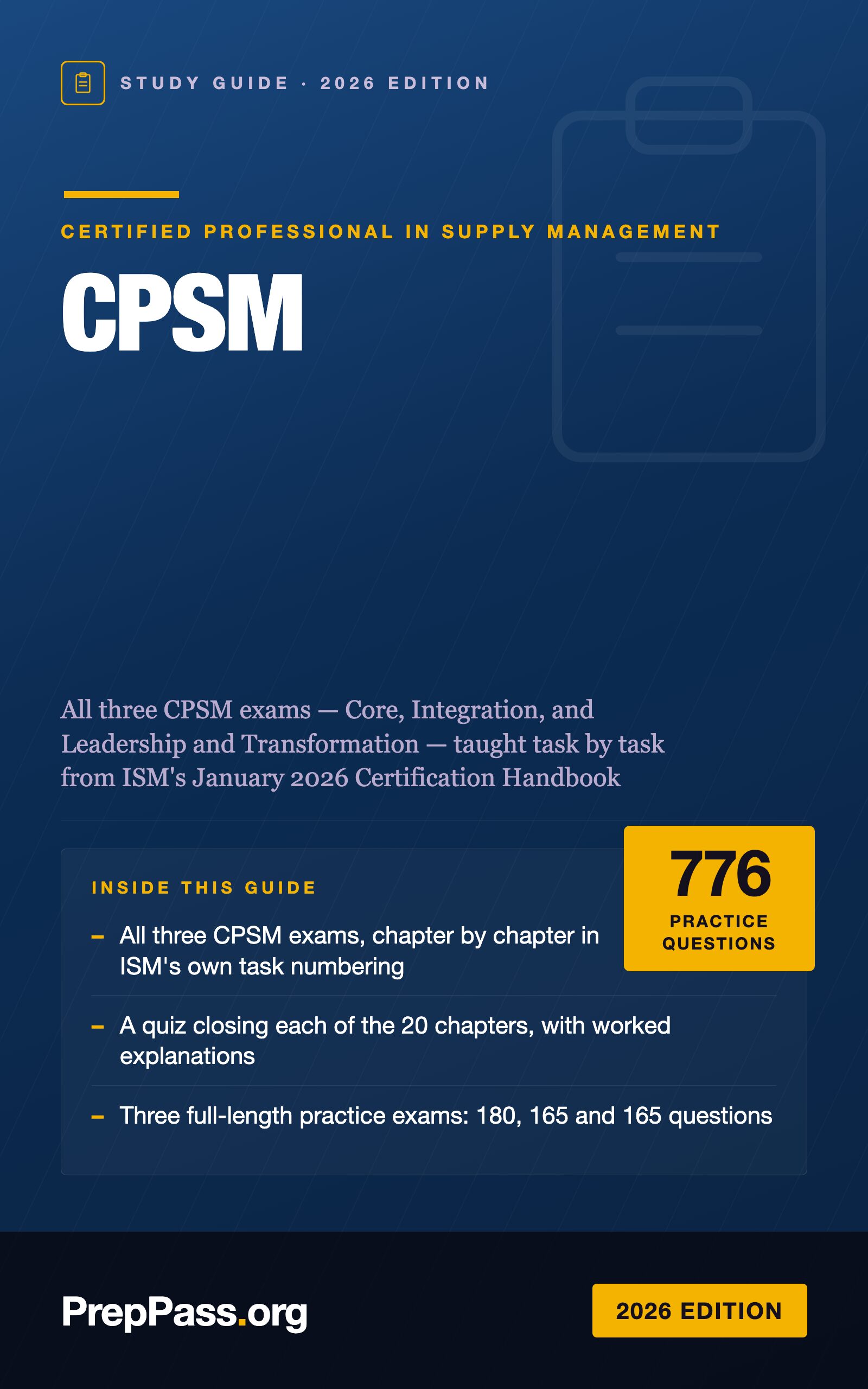
All three CPSM exams — Core, Integration, and Leadership and Transformation — taught task by task from ISM's January 2026 Certification Handbook, with 776 original questions and three full-length practice exams (180, 165 and 165 questions).
- 776 original CPSM practice questions, each with a worked explanation, in one PDF + EPUB you keep
PDF + EPUB · English · 347 pages · $24.99 one-time
This book is written in English.
Instant download after payment — no account needed, no subscription.
14-day money-back guarantee: not satisfied for any reason? Email support@preppass.org within 14 days of purchase for a full refund. Refund policy
Look inside the book
Three real pages, rendered straight from the PDF you download — a reference page, a teaching page, and a worked question, always in that order. Nothing here was redrawn to look better.
- Quick referenceChapter 1 — Sourcing · PDF page 14
A page you can turn back to: the numbers, deadlines or terms gathered in one place.
- How it's taughtChapter 20 — Corporate Social Responsibility · PDF page 322
An explanation page: the material taught in prose, in the order the exam tests it.
- A question, workedChapter 3 — Negotiation · PDF page 31
A practice question with its answer and the reasoning behind it — not just a key.
About the CPSM exam
Supply management professionals preparing for the three CPSM exams. This independent study guide reviews all 20 content domains and includes three full-length practice exams with sourced explanations. It is not produced or endorsed by ISM and includes no online practice.
| Awarding body | Institute for Supply Management (ISM) |
|---|---|
| Questions | Core: 180 questions; Integration: 165; Leadership and Transformation: 165. |
| Time limit | Core: 180 minutes; Integration: 165 minutes; Leadership and Transformation: 165 minutes. |
| Passing rule | Scaled score of 400 on a 100-600 scale for each exam; scores cannot be converted to a percentage. |
| Delivery | Pearson VUE testing centers, OnVUE online testing, and onsite exams at the candidate's location. |
| Eligibility | Bachelor's degree plus 3 years full-time professional supply management experience, or 5 years without the degree. |
| Retakes | Candidates must wait 30 days before registering to retake a failed exam. |
| Languages | CPSM exams are administered in English, Chinese, and Korean. |
| Content outline | CPSM exam specifications (Supply Management Core; Supply Management Integration; Leadership and Transformation in Supply Management), ISM Certification Handbook, last updated January 2026 — effective January 2026 |
| Domains and weights |
|
Questions buyers ask
- How many questions and how much time?
- Three exams: Supply Management Core has 180 questions in 180 minutes; Integration and Leadership and Transformation each have 165 questions in 165 minutes. Each includes 15 unscored questions.
- What score is needed to pass?
- A scaled score of 400 on ISM's 100–600 scale is required on each of the three exams; ISM does not express the passing standard as a percentage.
- What are the domains and their weights?
- ISM publishes question counts per task. Scored questions: Core 165 across seven domains (Sourcing 50 is largest); Integration 150 across seven (Logistics and Material Management 53 is largest); Leadership 150 across six (People Development and Coaching 39 is largest).
- Which outline edition is current?
- The current specifications are in ISM's Certification Handbook, last updated January 2026. The sources consulted do not describe changes from a previous edition.
- Who is eligible?
- Candidates need three years of full-time professional supply management experience with a bachelor's degree, or five years without a qualifying degree.
- What are the fees, and what if I fail?
- The handbook consulted does not list the exam fees. After an unsuccessful attempt, a candidate must wait 30 days before registering to retake that exam.
- How is this book organized?
- Twenty chapters follow ISM's domains, each with a quiz, plus three practice exams at full length, for 776 questions in total. The book is priced at $24.99.
- How do the CPSM and APSM relate?
- The APSM uses the same Supply Management Core exam required for the CPSM; APSM holders who meet CPSM requirements then take the remaining two exams to earn the CPSM.
- Is a study guide enough for the CPSM — Certified Professional in Supply Management exam, or do I need a course?
- Check eligibility first — per Institute for Supply Management (ISM): bachelor's degree plus 3 years full-time professional supply management experience, or 5 years without the degree. A book does not replace those requirements. For the exam content itself, this 347-page guide teaches the material chapter by chapter with 776 practice questions and explanations inside. A prep course adds live instruction and a set schedule; whether you need one beyond any required education is your call.
- Does the CPSM — Certified Professional in Supply Management study guide come as a PDF?
- Yes — CPSM Study Guide — 2026 Edition downloads as PDF and EPUB, 347 pages. The download link is emailed the moment payment clears and does not expire.
- How much does the CPSM — Certified Professional in Supply Management study guide cost?
- $24.99, once. There is no subscription and no account to create; the PDF and EPUB files are yours to keep.
- Can I read part of the CPSM — Certified Professional in Supply Management study guide before buying?
- Yes. A full chapter is free to read on this page — not a summary of one, the chapter itself.
- Is this the official CPSM — Certified Professional in Supply Management study guide?
- No. This is an independent study guide and is not affiliated with or endorsed by the exam's awarding body. It is written from ISM's Certification Handbook (last updated January 2026) and its CPSM exam specifications. Always confirm current requirements with the body that issues your licence.
What's included — and what isn't
Included
- All three CPSM exams, chapter by chapter in ISM's own task numbering
- A quiz closing each of the 20 chapters, with worked explanations
- Three full-length practice exams: 180, 165 and 165 questions
- 776 original questions, each explained and cited to its source
- Contract and procurement law taught from US sources (UCC Article 2, FAR), labelled as US-specific
- PDF + EPUB you keep
Not included
- No printed copy is shipped — this is a file you download and can print yourself
- No video course, instructor, tutoring or online question bank comes with the book — everything is in the file
- Not your exam registration or the testing centre's fee, which you still pay to the official body
Contents
See 23 sections and the page each one starts on
- Chapter 1 — Sourcingp. 8
- Chapter 2 — Category Managementp. 21
- Chapter 3 — Negotiationp. 27
- Chapter 4 — Legal and Contractualp. 34
- Answer key & explanationsp. 41
- Chapter 5 — Supplier Relationship Managementp. 43
- Chapter 6 — Cost and Price Managementp. 52
- Chapter 7 — Financial Analysisp. 59
- Chapter 8 — Supply Chain Strategyp. 64
- Chapter 9 — S&OP — Demand Planningp. 70
- Chapter 10 — S&OP — Forecastingp. 74
- Chapter 11 — S&OP — Product and Service Developmentp. 80
- Chapter 12 — Quality Managementp. 85
- Chapter 13 — Logistics and Material Managementp. 90
- Chapter 14 — Project Managementp. 99
- Chapter 15 — Strategy Developmentp. 103
- Chapter 16 — Stakeholder Engagement Stakeholder Engagement has 25 scored Leadership questions across fivep. 109
- Chapter 17 — People Development and Coachingp. 115
- Chapter 18 — Systems Capability and Technologyp. 123
- Chapter 19 — Risk and Compliancep. 128
- Chapter 20 — Corporate Social Responsibilityp. 135
- Appendix A — Key Terminologyp. 329
- Appendix B — Quick-Reference Sheet Exam structurep. 331
Taken from the PDF you download, with the page each one starts on — not typed here.
Read a chapter free, in full
One complete chapter, exactly as it ships in the eBook. Scroll the window to read it right here; no download, no email.
Read chapter 1 here, without leaving the page
Sourcing is the largest domain on the Supply Management Core exam: ISM's handbook assigns it 50 of the exam's 165 scored questions, spread across ten tasks[1]. The questions are rarely about definitions. They describe a requester, a market or a set of offers and ask what a competent supply professional does next. This chapter teaches the sequence the tasks follow — need, feasibility, sources, method, make-or-buy, technology, leverage, strategy, solicitation, evaluation — and the trap that sits at each step.
Throughout the book, the US Federal Acquisition Regulation (FAR) and the Uniform Commercial Code (UCC) are used as public, citable statements of good sourcing practice. They are US-specific and bind public buyers (the FAR) or US sales of goods (the UCC). The principles they codify — state needs as functions, compete where you can, document why you did not — are the same ones a private-sector CPSM candidate is expected to apply.
1.1 Stakeholder needs and sourcing plans (ISM task 1-A-1)
The concept. A sourcing plan starts from what the organization needs, not from what someone asked for. The two are often different. A requisition for "Model KX-400, no substitutes" may conceal a need for a certain output at a certain quality. Good practice is to identify legitimate needs and evaluate the trade-offs among them before buying anything[2], and to state requirements in terms of the functions to be performed, the performance required, or essential physical characteristics[3].
Why it matters. A requirement written around one product shuts out every alternative that could meet the need, and a design fixed too early locks in cost. Requiring units are advised not to dictate detailed design solutions prematurely and to let potential suppliers comment on requirements and propose alternatives[3].
The plan itself. A written acquisition plan opens with a statement of need, the history of the requirement and the feasible alternatives[4], and it says how life-cycle cost — the total cost of acquiring, operating, supporting and disposing of the item — will be considered[4, 5]. Market research belongs before the requirements document is written, not after the solicitation is out[2].
How it is tested. Expect a requester who has specified a brand, a drawing or a model number, and options that range from "issue the RFQ as written" to "restate the need." The key is almost always to confirm and restate the need first.
The trap. Adding "or equal" to a model number and calling the job done. It helps, but it still anchors suppliers to one design rather than to the function.
1.2 Feasibility of internal requests (1-A-2)
The concept. Not every request should become a purchase order as written. Supply management checks whether the request can be met within budget and schedule, whether it duplicates an existing contract, and whether a condition in it is actually needed.
Three recurring cases.
- Splitting. A requester asks for several small orders to stay under an approval threshold. Breaking one requirement into smaller purchases merely to avoid a threshold is prohibited in federal purchasing[6], and most private-sector delegation policies say the same.
- Brand-name demands. A description that names a product peculiar to one manufacturer does not provide full competition however many resellers are asked to quote, and it needs a written justification; a "brand-name or equal" description does allow competition[7].
- Restrictive conditions. A clause such as "office within five miles" belongs in a solicitation only if a real need requires it[3].
How it is tested. Scenarios in which the requester is senior, the deadline is short, or the workaround looks harmless. The right answer advises the requester and offers a compliant alternative.
The trap. Treating feasibility as a yes/no gate. The value lies in explaining the gap and proposing another route.
1.3 Analyzing potential sources (1-A-3)
The concept. Source analysis asks whether a supplier can perform over the life of the need. The federal responsibility standards are a useful checklist: adequate financial resources or the ability to obtain them[8]; the ability to meet the schedule given all existing commitments[8]; a satisfactory record of integrity and business ethics[8]; and the necessary organization, controls and technical skills[8].
Financial signals. The current ratio (current assets ÷ current liabilities) is a first test of short-term liquidity; below one, the analyst should look closely at the composition of current assets and the timing of liabilities[9]. A debt-to-equity ratio of 2 to 1 means two dollars of debt for every dollar invested by shareholders[10]. A cash flow statement shows whether the company has cash to pay its bills, which profit alone does not[10].
Finding sources. Requests for information, industry days and presolicitation conferences are standard market-research techniques for discovering capable suppliers[11]. A new supplier with no track record is neither qualified nor disqualified by that fact alone[8], and a supplier that is not yet on a qualified list may still have its offer considered if it can show it meets the standard[12].
The trap. Reading one ratio as a verdict. A current ratio of 0.7 is a warning to probe, not proof of insolvency — and a thin balance sheet may be offset by committed financing.
1.4 Processing requirements (1-A-4)
The concept. The method should fit the value, urgency and existing agreements. Low-value routine buys go through purchase cards and electronic purchasing[6]. If an existing contract already covers the need, it is used before a new competition is run[6]. When quantities or delivery dates cannot be known in advance, indefinite-delivery contracts — requirements or indefinite-quantity contracts — fit[13]; an indefinite-quantity contract limits the buyer's obligation to the stated minimum[13].
Competition and its exceptions. Full and open competition is the default[14]. Sole-sourcing needs a real basis; the mere existence of data rights or patents does not by itself justify it[7].
The trap. Choosing a formal competition because it feels safe. Its administrative cost can exceed the value of a small purchase.
1.5 Insourcing versus outsourcing (1-A-5)
The concept. Make-or-buy compares total cost and strategic fit. Break-even analysis finds the quantity at which the total cost of making equals the total cost of buying[15]: fixed cost ÷ (buy price − variable make cost). Below that volume, buying is cheaper.
Worked example. Making needs $300,000 a year of fixed cost plus $2.50 a unit; buying costs $4.00. Break-even = 300,000 ÷ 1.50 = 200,000 units. At 150,000 units, making costs $675,000 and buying $600,000.
Beyond the numbers. Break-even should be complemented by quality, supply-chain risk, strategic alignment and long-term implications[15]. Federal make-or-buy programs sort work into "must make," "must buy" and "can either make or buy"[16], and a proposed "make" is normally declined when outside firms supply the item at an equal or lower price[16]. Where costs fall in different years, compare present values: all future costs should be discounted[17].
The trap. Comparing only variable costs — which always makes in-house look cheaper — and forgetting the fixed cost.
1.6 Technology in supply management (1-A-6)
The concept. Technology earns its place by lowering transaction cost and raising visibility. Electronic commerce and purchase cards are the default for simplified buys[6]. Spend dashboards let each unit monitor its spending profile[18]. A reverse auction lets bidders see competing prices, but not identities, and bid lower until the event closes[19] — well suited to clearly specified items where price decides.
Security from the start. When the technology will hold sensitive data, security requirements belong early in the acquisition process[20], and after award the buyer checks that the supplier meets the contract's terms[20].
The trap. Buying a tool without redesigning the process and training people to use it.
1.7 Leveraging spend (1-A-7)
The concept. Category management means buying common goods and services as an enterprise to remove redundancy, raise efficiency and deliver more value[18]. Its levers include demand management — changing what and how much is consumed[18] — and sharing prices-paid data so buyers can see value differences[18]. A requirements contract can bring faster deliveries because the supplier, assured of all actual requirements, is willing to keep limited stock[13].
Balance. Consolidating spend affects smaller suppliers; market research should consider whether consolidation is justified and consult small-business specialists[2].
The trap. Copying the best local price instead of consolidating the duplicate contracts.
1.8 Implementing strategic sourcing plans (1-A-8)
The concept. A strategy becomes results through vendor-management strategies for critical suppliers[18], a contract type matched to the risk — firm-fixed-price where risk is minimal or predictable[21] — and regular conversations with industry to keep the strategy current[18]. Organizational objectives such as sustainability must be written into specifications and source-selection factors to change what is bought[3], and leverage must coexist with small-business goals[18].
The trap. Treating implementation as a single sourcing event rather than ongoing management.
1.9 Preparing solicitations (1-A-9)
The concept. A solicitation must let suppliers compete on the same basis. It states all evaluation factors and their relative importance[22], and whether non-price factors combined are more, about equal to, or less important than price[22]. Performance-based work statements describe required results rather than methods or hours[23], with measurable standards and an assessment method[24]. A statement of objectives lets offerors write their own performance work statement; the SOO itself stays outside the contract[23]. Some performance levels may be stated as targets rather than minimums[3].
Offer validity. Under UCC §2-205 (US law), a merchant's signed written offer that promises to stay open cannot be revoked for lack of consideration during the stated time — but never for more than three months[25].
The trap. Over-asking. Requests for information should seek only the minimum information necessary[2], or small and new suppliers drop out.
1.10 Evaluating offers (1-A-10)
The concept. "Best offer" means best value: the outcome that provides the greatest overall benefit for the requirement[19]. In a tradeoff, a higher-priced offer can win when its benefits merit the extra cost and the rationale is documented[26]; in lowest-price-technically-acceptable selection, tradeoffs are not permitted[27].
Price analysis. Adequate price competition normally establishes a fair and reasonable price[28]. Historical prices are a valid comparison only when adjusted for time, terms and quantity differences[28]. For labor-heavy work, check cost realism: are the proposed costs realistic for the work and consistent with the technical proposal[19]?
Exchanges. Clarifications resolve minor or clerical errors without allowing proposal revisions[29].
The trap. Awarding automatically to the lowest price, or assuming a higher price signals quality.
Key numbers
- Sourcing: 50 of 165 scored Core questions, the largest domain[1].
- Break-even volume for make-or-buy = fixed cost ÷ (buy price − variable make cost)[15].
- Current ratio = current assets ÷ current liabilities; below 1 calls for scrutiny[9].
- A UCC firm offer cannot be irrevocable without consideration for more than three months[25].
- An indefinite-quantity contract obligates the buyer only to its stated minimum[13].
Key takeaways
Restate the need before sourcing it. Treat feasibility as advice, not a gate. Judge suppliers on capacity, finance and integrity, not price. Fit the method to value and existing contracts. Compare make-or-buy on total, discounted cost and strategic fit. Compete on stated, weighted criteria and document every tradeoff.
Chapter 1 quiz — 18 questions
Answer each question, then check the key that follows.
1. Which way of describing a requirement gives suppliers the most room to offer alternatives?
- A. By a single manufacturer's part number
- B. By the function or performance needed
- C. By copying the incumbent's product sheet
- D. By listing the brand the user prefers
2. A written acquisition plan should begin with which element?
- A. A statement of need and alternatives
- B. The award decision and the chosen supplier's name
- C. The final negotiated price
- D. The contract's termination clause
3. Life-cycle cost includes which costs?
- A. The purchase price only
- B. The purchase price plus freight and duty only
- C. All costs of owning it, through disposal
- D. The supplier's own production cost
4. A requester asks for one requirement to be split into several orders so each stays under an approval limit. What is the problem?
- A. Small orders always cost more to process
- B. Splitting to dodge a threshold is not allowed
- C. Suppliers refuse to accept split orders
- D. Nothing, if the orders go to one supplier
5. Which description allows competition when a requester wants a particular brand?
- A. "Brand-name or equal" with the salient features
- B. The brand name alone with "no substitutes"
- C. The brand name plus three resellers
- D. A drawing of the branded product
6. A supplier's current assets are $3 million and current liabilities $2 million. What is its current ratio?
- A. 0.67
- B. 1.0
- C. 5.0
- D. 1.5
7. Which market-research technique brings potential suppliers together with the buyer early in the process?
- A. An industry day
- B. An internal spend report on last year
- C. A sealed-bid opening
- D. A post-award debriefing
8. A prospective supplier has never held a contract like this one. How should that fact alone be treated?
- A. As disqualifying
- B. As proof of capability
- C. As neither qualifying nor disqualifying it
- D. As grounds to demand a larger bond
9. Which item is one of the standards for judging a supplier responsible?
- A. An office located in the buyer's own city
- B. The lowest price in the competition
- C. Membership in a trade association
- D. A sound record of integrity and ethics
10. An existing enterprise contract already covers a new requirement. What should normally happen?
- A. Run a new competition to test prices
- B. Split the requirement across suppliers
- C. Buy on a purchase card from any vendor
- D. Order under the existing contract
11. When is an indefinite-delivery contract the right structure?
- A. When the buyer knows the exact quantity and date
- B. When the item is a one-time capital purchase
- C. When quantities or timing are unknown at award
- D. When the supplier insists on it
12. Making a part costs $120,000 a year fixed plus $6 a unit; buying costs $10 a unit. At what annual volume are the two options equal?
- A. 12,000 units
- B. 20,000 units
- C. 60,000 units
- D. 30,000 units
13. Besides cost, what should a make-or-buy decision consider?
- A. Only the unit price of the supplier
- B. Quality, risk and strategic fit
- C. Only the internal labor rate
- D. Only the current year's budget
14. In which purchasing event can bidders see competing prices, but not who submitted them, and bid lower until the close?
- A. A sealed bid
- B. A reverse auction
- C. A request for information
- D. A sole-source negotiation
15. What is the main idea of category management?
- A. Buying as one enterprise
- B. Letting every unit buy independently
- C. Choosing suppliers by rotation
- D. Negotiating each order separately
16. Which contract type fits a well-defined requirement with minimal or predictable cost risk?
- A. Firm-fixed-price
- B. Cost-plus-fixed-fee
- C. Time-and-materials
- D. Cost-reimbursement with award fee
17. What must a best-value solicitation state about its evaluation factors?
- A. Only the price ceiling
- B. All factors and their relative importance
- C. The names of the evaluators
- D. The scoring worksheet for each evaluator
18. In a tradeoff source selection, when may a higher-priced offer win?
- A. Never; the lowest price always wins
- B. Whenever the evaluators prefer it
- C. When documented benefits justify it
- D. Only if the lowest bidder withdraws
Answer key & explanations
1. B. Requirements stated in terms of functions to be performed or performance required let any product that meets the need compete. Part numbers, product sheets and brand preferences tie the requirement to one design.[3]
2. A. An acquisition plan opens with a brief statement of need, summarizes the acquisition's history and discusses feasible alternatives. The award decision and final price come at the end of the process, not the start of the plan.[4]
3. C. Life-cycle cost is the total cost of acquiring, operating, supporting and, where applicable, disposing of the items acquired. Price and freight are only the first part of that total.[5]
4. B. Breaking down a requirement into smaller purchases merely to avoid a threshold is prohibited in federal purchasing, and most organizations' delegation rules say the same. Sending all orders to one supplier does not change that it is one requirement.[6]
5. A. A brand-name-or-equal description lets suppliers offer products other than the named brand and provides for full and open competition; a description naming one manufacturer's product does not, however many resellers quote.[7]
6. D. The current ratio is current assets divided by current liabilities: 3 ÷ 2 = 1.5, above one, suggesting a buffer to meet short-term obligations. Dividing the other way (0.67) is the common slip.[9]
7. A. Interchange meetings and presolicitation conferences involve potential offerors early in the acquisition process. A spend report is internal, and bid openings and debriefings come later.[11]
8. C. A prospective supplier should not be judged responsible or nonresponsible solely because it lacks relevant performance history. Other evidence — capacity, skills, finance — decides.[8]
9. D. Responsibility standards include a satisfactory record of integrity and business ethics, along with financial resources, schedule capability and controls. Location and association membership are not responsibility standards.[8]
10. D. Existing indefinite-delivery and other established contracts are used before new simplified purchases. A new competition duplicates effort and weakens the enterprise contract's volume.[6]
Sources cited in this excerpt
- ISM Certification Handbook (last updated January 2026). Institute for Supply Management.
- Federal Acquisition Regulation (FAR) 10.001 (FAC 2026-01). Acquisition.gov (GSA). https://www.acquisition.gov/far/10.001
- Federal Acquisition Regulation (FAR) 11.002 (FAC 2026-01). Acquisition.gov (GSA). https://www.acquisition.gov/far/11.002
- Federal Acquisition Regulation (FAR) 7.105 (FAC 2026-01). Acquisition.gov (GSA). https://www.acquisition.gov/far/7.105
- Federal Acquisition Regulation (FAR) 7.101 (FAC 2026-01). Acquisition.gov (GSA). https://www.acquisition.gov/far/7.101
- Federal Acquisition Regulation (FAR) 13.003 (FAC 2026-01). Acquisition.gov (GSA). https://www.acquisition.gov/far/13.003
- Federal Acquisition Regulation (FAR) 6.302-1 (FAC 2026-01). Acquisition.gov (GSA). https://www.acquisition.gov/far/6.302-1
- Federal Acquisition Regulation (FAR) 9.104-1 (FAC 2026-01). Acquisition.gov (GSA). https://www.acquisition.gov/far/9.104-1
- Principles of Finance (OpenStax, via LibreTexts), 6-4-liquidity. OpenStax / LibreTexts. https://biz.libretexts.org/Bookshelves/Finance/Principles_of_Finance_(OpenStax)/06%3A_Measures_of_Financial_Health/6.04%3A_Liquidity_Ratios
- Beginners' Guide to Financial Statements. U.S. Securities and Exchange Commission. https://www.sec.gov/about/reports-publications/beginners-guide-financial-statements
- Federal Acquisition Regulation (FAR) 10.002 (FAC 2026-01). Acquisition.gov (GSA). https://www.acquisition.gov/far/10.002
- Federal Acquisition Regulation (FAR) 9.202 (FAC 2026-01). Acquisition.gov (GSA). https://www.acquisition.gov/far/9.202
- Federal Acquisition Regulation (FAR) 16.501-2 (FAC 2026-01). Acquisition.gov (GSA). https://www.acquisition.gov/far/16.501-2
- Federal Acquisition Regulation (FAR) 6.101 (FAC 2026-01). Acquisition.gov (GSA). https://www.acquisition.gov/far/6.101
- Fundamentals of Operations Management (open textbook), section 4.10. Open textbook (Pressbooks). https://ecampusontario.pressbooks.pub/fundamentalsopsmgmt/chapter/4-10-break-even-analysis-a-fundamental-tool-for-capacity-evaluation/
- Federal Acquisition Regulation (FAR) 15.407-2 (FAC 2026-01). Acquisition.gov (GSA). https://www.acquisition.gov/far/15.407-2
- OMB Circular A-94 (revised Nov. 9, 2023). Office of Management and Budget.
- OMB Memorandum M-19-13, Category Management. Office of Management and Budget.
- Federal Acquisition Regulation (FAR) 2.101 (FAC 2026-01). Acquisition.gov (GSA). https://www.acquisition.gov/far/2.101
- NIST SP 800-161r1-upd1, Cybersecurity Supply Chain Risk Management Practices. National Institute of Standards and Technology. https://doi.org/10.6028/NIST.SP.800-161r1-upd1
- Federal Acquisition Regulation (FAR) 16.103 (FAC 2026-01). Acquisition.gov (GSA). https://www.acquisition.gov/far/16.103
- Federal Acquisition Regulation (FAR) 15.304 (FAC 2026-01). Acquisition.gov (GSA). https://www.acquisition.gov/far/15.304
- Federal Acquisition Regulation (FAR) 37.602 (FAC 2026-01). Acquisition.gov (GSA). https://www.acquisition.gov/far/37.602
- Federal Acquisition Regulation (FAR) 37.601 (FAC 2026-01). Acquisition.gov (GSA). https://www.acquisition.gov/far/37.601
- Uniform Commercial Code § 2-205 (US law). Cornell Law School Legal Information Institute. https://www.law.cornell.edu/ucc/2/2-205
- Federal Acquisition Regulation (FAR) 15.101-1 (FAC 2026-01). Acquisition.gov (GSA). https://www.acquisition.gov/far/15.101-1
- Federal Acquisition Regulation (FAR) 15.101-2 (FAC 2026-01). Acquisition.gov (GSA). https://www.acquisition.gov/far/15.101-2
- Federal Acquisition Regulation (FAR) 15.404-1 (FAC 2026-01). Acquisition.gov (GSA). https://www.acquisition.gov/far/15.404-1
- Federal Acquisition Regulation (FAR) 15.306 (FAC 2026-01). Acquisition.gov (GSA). https://www.acquisition.gov/far/15.306
Before you buy
- How do I get it?
- Pay, and the download appears on this page straight away. The links are also emailed to you. No account is required.
- What if it isn't for me?
- Email us within 14 days for a full refund, no questions asked.
- Is there online practice for this exam too?
- No. PrepPass has no online question bank for this exam; the book is self-contained. Its chapter quizzes and full-length practice exam, each question with a worked explanation, are all in the PDF and EPUB.
- Can I read it on my phone?
- Yes — the EPUB is for phones and e-readers, the PDF is for printing and tabbing. You get both.
The details
All three CPSM exams — Core, Integration, and Leadership and Transformation — taught task by task from ISM's January 2026 Certification Handbook, with 776 original questions and three full-length practice exams (180, 165 and 165 questions).
- Format: PDF + EPUB download · 347 pages
- 776 practice questions in the book, with a full answer key
- $24.99 one-time — no subscription
- 14-day money-back guarantee · refund policy
- Cross-referenced against: ISM's Certification Handbook (last updated January 2026) and its CPSM exam specifications
- Last updated: September 2026
- Verified from the official source(ISM's Certification Handbook (last updated January 2026) and its CPSM exam specifications)
- Instant download, yours for life
What the book gives you
PrepPass has no online question bank for this exam, so the $24.99 book is complete in itself: the material taught in order, a quiz closing each chapter and a full-length practice exam, in a file you own.
- Systematic teaching — every exam section explained chapter by chapter, start to finish, not just questions
- Print it & tab it — a paper-ready PDF you can highlight, mark up, and bring to your study table
- Study anywhere, offline — EPUB on your phone or e-reader; no wifi, no browser tabs
- Everything in one place — the chapters and the practice questions in one file
- Yours for life — one-time $24.99, instant download, no subscription
And it's risk-free: 14-day money-back guarantee — not satisfied? Email us for a full refund, no questions asked. See the refund policy.
14-day money-back guarantee · full refund, no questions asked.
One-time purchase, lifetime access to the download. The eBook is the full CPSM — Certified Professional in Supply Management study guide in PDF and EPUB. Educational summary, not professional or legal advice — always confirm the current rules with the official source. Last updated: September 2026.