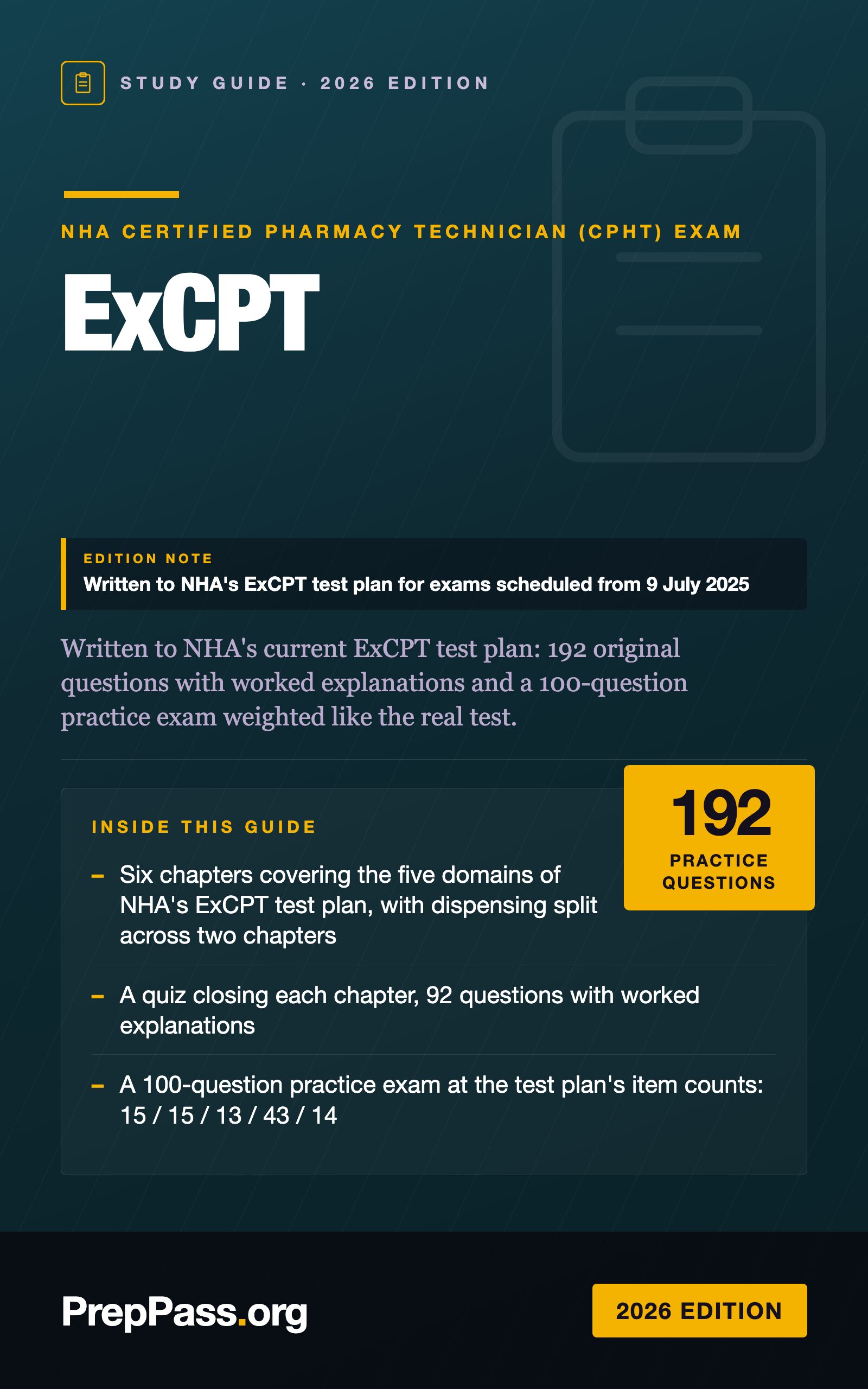
ExCPT — NHA Certified Pharmacy Technician (CPhT) Exam · 2026 Edition
ExCPT Study Guide — 2026 Edition
Edition noteWritten to NHA's ExCPT test plan for exams scheduled from 9 July 2025
Written to NHA's current ExCPT test plan: 192 original questions with worked explanations and a 100-question practice exam weighted like the real test.
- 192 original ExCPT practice questions, each with a worked explanation, in one PDF + EPUB you keep
PDF + EPUB · English · 203 pages · $24.99 one-time
This book is written in English.
Instant download after payment — no account needed, no subscription.
14-day money-back guarantee: not satisfied for any reason? Email support@preppass.org within 14 days of purchase for a full refund. Refund policy
Look inside the book
Three real pages, rendered straight from the PDF you download — a reference page, a teaching page, and a worked question, always in that order. Nothing here was redrawn to look better.
- Quick referenceChapter 1: Role, Responsibilities, and General Duties of the Pharmacy Technician · PDF page 10
A page you can turn back to: the numbers, deadlines or terms gathered in one place.
- How it's taughtPractice Exam — Domains 4–5 (57 questions) · PDF page 162
An explanation page: the material taught in prose, in the order the exam tests it.
- A question, workedChapter 1: Role, Responsibilities, and General Duties of the Pharmacy Technician · PDF page 23
A practice question with its answer and the reasoning behind it — not just a key.
About the ExCPT exam
For pharmacy technician candidates preparing for NHA's ExCPT exam. This independent study guide covers the five tested domains from primary sources, with chapter quizzes and a full-length practice exam. No online practice or companion question bank is included. It is not affiliated with NHA. State pharmacy technician licensing requirements vary; confirm yours with your state board.
Outline changes: NHA's post on the new exam says Role, Responsibilities, and General Duties is now separate from Laws & Regulations as its own knowledge and task domain, several knowledge and task domains were revised, and there is reduced focus on historical pharmacy laws and acts.
| Awarding body | National Healthcareer Association (NHA) |
|---|---|
| Questions | 100 scored items and 20 pretest items |
| Time limit | 2 hours 10 minutes |
| Passing rule | Scaled scores range from 200 to 500; passing requires a scaled score of 390 or higher |
| Delivery | At a PSI testing center, or through live remote proctoring |
| Eligibility | High school diploma or GED (or scheduled to earn one within 60 days), plus either a completed pharmacy technician training or education program within the last 5 years, or at least 1,200 hours of supervised pharmacy-related work experience within the last 3 years |
| Retakes | After a first failure you may retake after a 30-day waiting period; three attempts allowed with at least 30 days between attempts; after a third failure you must wait one year; each retake requires re-registration and the full examination price |
| Languages | English — the exam is written and administered in English and is not translated into foreign languages |
| Content outline | NHA Certified Pharmacy Technician (CPhT) — Test Plan for the ExCPT Exam, 2023 job analysis (test plan PDF dated 2024-04-30; in force for exams scheduled on or after 2025-07-09) — effective July 9, 2025 |
| Domains and weights |
|
Questions buyers ask
- How many questions are on the ExCPT and how long is it?
- The exam has 100 scored items plus 20 pretest items, taken in 2 hours 10 minutes. The exam is written and administered in English; it is not translated into foreign languages.
- What is the passing rule for the ExCPT?
- NHA reports scaled scores from 200 to 500, and you pass with a scaled score of 390 or higher.
- What domains does the ExCPT cover and how are they weighted?
- Role and General Duties 15, Laws 15, Drugs and Drug Therapy 13, Dispensing Process 43, Medication and Patient Safety and Quality Assurance 14 — 100 scored items total.
- Which outline edition is current and what changed?
- The current plan is the 2023 job-analysis test plan (PDF dated 2024-04-30), in force for exams scheduled on or after July 9, 2025. NHA says Role, Responsibilities, and General Duties is now separate from Laws & Regulations as its own knowledge and task domain, several domains were revised, and there is reduced focus on historical pharmacy laws and acts.
- Who is eligible to sit for the ExCPT?
- You need a high school diploma or GED (or be earning one within 60 days), plus either a pharmacy technician training program completed within 5 years or 1,200 hours of supervised pharmacy work within 3 years.
- How much does the ExCPT cost and what if I fail?
- NHA does not publish the fee in its handbook or test plan; it directs candidates to the fee on the NHA website shop. If you fail, you may retake after 30 days, up to three attempts with 30 days between them, then a one-year wait.
- How is this book organised?
- Six chapters follow the five exam domains, each with a quiz, plus a full-length 100-question practice exam weighted like the real test — 192 original questions in all, every one with a worked explanation. No companion online question bank is included.
- Is the ExCPT the same as the PTCB exam?
- No. Both lead to the Certified Pharmacy Technician (CPhT) credential, but the ExCPT is NHA's exam and the PTCE is PTCB's. The ExCPT has 100 scored items plus 20 pretest items in 2 hours 10 minutes; PTCB's PTCE has 90 multiple-choice questions in up to 110 minutes (1 hour and 50 minutes). This book prepares you for NHA's ExCPT only.
- Is a study guide enough for the ExCPT — NHA Certified Pharmacy Technician (CPhT) Exam, or do I need a course?
- Check eligibility first — per National Healthcareer Association (NHA): high school diploma or GED (or scheduled to earn one within 60 days), plus either a completed pharmacy technician training or education program within the last 5 years, or at least 1,200 hours of supervised pharmacy-related work experience within the last 3 years. A book does not replace those requirements. For the exam content itself, this 203-page guide teaches the material chapter by chapter with 192 practice questions and explanations inside. A prep course adds live instruction and a set schedule; whether you need one beyond any required education is your call.
- Does the ExCPT — NHA Certified Pharmacy Technician (CPhT) Exam study guide come as a PDF?
- Yes — ExCPT Study Guide — 2026 Edition downloads as PDF and EPUB, 203 pages. The download link is emailed the moment payment clears and does not expire.
- How much does the ExCPT — NHA Certified Pharmacy Technician (CPhT) Exam study guide cost?
- $24.99, once. There is no subscription and no account to create; the PDF and EPUB files are yours to keep.
- Can I read part of the ExCPT — NHA Certified Pharmacy Technician (CPhT) Exam study guide before buying?
- Yes. A full chapter is free to read on this page — not a summary of one, the chapter itself.
- Is this the official ExCPT — NHA Certified Pharmacy Technician (CPhT) Exam study guide?
- No. This is an independent study guide and is not affiliated with or endorsed by the exam's awarding body. It is written from NHA Test Plan for the ExCPT Exam (PDF dated 2024-04-30) and NHA candidate handbook (updated 06/01/2026), with eCFR, FDA, DEA, CDC, USP, ISMP and DailyMed sources, read 2026-09-27. Always confirm current requirements with the body that issues your licence.
What's included — and what isn't
Included
- Six chapters covering the five domains of NHA's ExCPT test plan, with dispensing split across two chapters
- A quiz closing each chapter, 92 questions with worked explanations
- A 100-question practice exam at the test plan's item counts: 15 / 15 / 13 / 43 / 14
- 192 original questions, each explained and cited to its source
- Calculations, military time, and compounding basics under USP <795>, <797> and <800>
- Quick-reference tables: controlled-substance schedules, DAW codes, conversions and error-prone abbreviations
- PDF + EPUB you keep
Not included
- No printed copy is shipped — this is a file you download and can print yourself
- No video course, instructor, tutoring or online question bank comes with the book — everything is in the file
- Not your exam registration or the testing centre's fee, which you still pay to the official body
Contents
See 13 sections and the page each one starts on
- Chapter 1: Role, Responsibilities, and General Duties of the Pharmacy Technicianp. 7
- Chapter 2: Laws and Regulationsp. 27
- Chapter 3: Drugs and Drug Therapyp. 47
- Chapter 4: The Dispensing Process I — Prescription Intake, Entry, and Dispensingp. 64
- Chapter 5: The Dispensing Process II — Calculations, Sterile and Non-Sterile Compoundingp. 90
- Answer Key — Chapter 5p. 109
- Chapter 6: Medication and Patient Safety and Quality Assurancep. 112
- Answer Key — Chapter 6p. 127
- Practice Exam — Domains 1–3 (ExCPT)p. 130
- Practice Exam — Domain 2: Laws and Regulations and Controlled Substancesp. 137
- Answer Key — Practice Exam, Domain 2: Laws and Regulations and Controlled Substancesp. 141
- Practice Exam — Domains 4–5 (57 questions)p. 148
- Appendix B: Quick-Reference Tablesp. 185
Taken from the PDF you download, with the page each one starts on — not typed here.
Read a chapter free, in full
One complete chapter, exactly as it ships in the eBook. Scroll the window to read it right here; no download, no email.
Read chapter 5 here, without leaving the page
We didn't give you the easy intro — the free chapter opens on one of the hardest-working parts of the book, so you can judge the teaching where the exam gets difficult.
Reviewed by the PrepPass team.
Chapter 4 covered getting the prescription right. This chapter covers the math that turns the prescription into a safe, accurate dispense — and the compounding rules that govern what the technician may prepare, how, and for how long it stays good. The NHA outline splits this territory into two domains: 4C (pharmaceutical calculations) and 4D (sterile and non-sterile products, compounding, unit dose, and repackaging)[1]. Calculation questions reward a calm, mechanical process; compounding questions reward knowing the exact numbers — BUDs, competency intervals, and label elements — because the numbers, not general impressions, are what you must know.
4C.1–4C.8 — The calculation mindset
Every calculation on this exam is arithmetic plus unit awareness. Set up each problem the same way: write what the question asks for, write what you know, cancel the units, and only then touch the numbers. Most errors are unit errors — grams versus milligrams, pounds versus kilograms, percent versus ratio strength — not math errors. When a question gives you a formula in words (for example, "days' supply equals doses dispensed divided by doses per day"), translate it to symbols before plugging in numbers[2]. Round only at the end, and round the way the question asks: tablets and capsules round to whole units you can actually dispense, while milliliters and milligrams keep their decimals until the final step.
4C.1, 4C.6 — Measurement systems, conversions, and temperature
Concept. Pharmacy work moves between the metric system and household measurements. The metric prefixes you must know cold: kilo means 1,000, milli means 0.001 (one-thousandth), and micro means 0.000001 (one-millionth)[3]. These prefixes come from the international metric standard maintained with reference to NIST[3]. The conversions to know cold: 1 kilogram equals 2.21 pounds and 1 pound equals 0.45 kilograms[4]; 1 inch equals 2.54 centimeters[4]; 1 fluid ounce equals 29.57 milliliters and 1 cup equals 0.24 liter[4]; 1 gallon equals 3.78 liters[4]. Temperature crosses scales with two formulas: Fahrenheit to Celsius, subtract 32 then multiply by 0.55; Celsius to Fahrenheit, multiply by 1.80 then add 32[4].
Worked example. Convert 25°C to Fahrenheit. Step 1: multiply by 1.80 → 25 × 1.80 = 45. Step 2: add 32 → 45 + 32 = 77°F. Reverse check with 77°F to Celsius: 77 − 32 = 45; 45 × 0.55 = 24.75 ≈ 25°C.
Exam use. The outline lists measurement systems — metric, household, and military time — plus temperature scales as tested knowledge[1]. Practise one-step conversions embedded inside larger problems, such as converting a patient's weight before a weight-based dose.
Military time
Concept. Military time is a 24-hour time system used to eliminate confusion between AM and PM[5]. Instead of restarting the clock after 12, the day runs continuously from 0000 (midnight) to 2359 (11:59 PM)[5]. The conversion rule is one line: morning stays the same, afternoon adds 12[5]. To go back, subtract 12 from any time 1300 or higher to get the PM hour[5]. The two anchors are midnight = 0000 and noon = 1200[5].
Worked example. Convert 2:45 PM to military time, then convert 1645 back. 2 + 12 = 14, so 2:45 PM = 1445. Reverse: 1645 − 12 = 4, so 1645 = 4:45 PM. Interval math across the clock: a dose is due at 0800 and the next dose comes 8 hours later — 8 + 8 = 16, so the next dose is due at 1600, which is 4:00 PM.
Exam use. The NHA outline lists military time under measurement systems[1]. Practise conversion in either direction, and durations computed across noon.
Traps. 1200 is noon, not midnight, and 0000 is midnight[5]. Do not add 12 to a 12:xx PM time: 12:30 PM is 1230, not 2430.
Traps. The temperature formulas are not symmetric — subtracting 32 happens before multiplying when going °F→°C, but adding 32 happens after multiplying when going °C→°F. Household "ounce" is ambiguous: fluid ounces measure volume (29.57 mL), weight ounces measure mass — the question will specify. And 2.2 lb/kg (the rounded value used in dosing examples[6]) versus 2.21 lb/kg (the table value[4]) can shift an answer by a rounding step, so use the value the question gives.
4C.2 — Individual dose, total daily dose, and weight-based dosing
Concept. The individual dose is what the patient takes at one time; the total daily dose is the individual dose multiplied by the number of doses per day. Weight-based dosing expresses the daily amount per unit of body weight, typically mg/kg/day[1]. To find one dose from a daily amount, divide by the frequency; to find the quantity to dispense, multiply one dose by doses per day by days.
Worked example. An order reads 10 mg/kg/day for a 20 kg child, divided twice daily, tablets are 100 mg. Step 1: total daily dose = 10 × 20 = 200 mg/day. Step 2: one dose = 200 ÷ 2 = 100 mg. Step 3: tablets per dose = 100 ÷ 100 = 1 tablet. For a 30-day supply: 1 tablet × 2 × 30 = 60 tablets.
Exam use. Calculating individual and total daily dosages and medication quantities from dosage are explicit 4C tasks[1]. These calculations chain together — miss the daily dose and every downstream number is wrong.
Traps. "Divided twice daily" means split the daily total; "10 mg/kg/dose" is a different order from "10 mg/kg/day" — read the denominator. Convert pounds to kilograms before multiplying by a mg/kg factor, never after.
4C.3–4C.4 — Days' supply and medication quantities
Concept. Days' supply is the estimate of how many days a prescription is intended to last, calculated as the number of doses dispensed divided by the number of doses taken per day[2]. Package-size math is the same idea for liquids and injectables: total units on hand divided by units used per day[1]. Package-size conversions also include drops per mL and milligrams per package[1]: if a dropper is given as delivering 20 drops per mL, then 2 mL is 40 drops — once the drops-per-mL factor is stated, it is a straight unit conversion.
Worked example. An insulin prescription dispenses two 10 mL vials of 100 units/mL, used as 30 units before each meal, three times daily. Step 1: units per vial = 100 × 10 = 1,000. Step 2: total units = 2 × 1,000 = 2,000. Step 3: units per day = 30 × 3 = 90. Step 4: days' supply = 2,000 ÷ 90 = 22.2, recorded as a 22-day supply[2].
Exam use. Days'-supply calculation is its own 4C task, and accuracy matters beyond the exam: days' supply drives insurance audits, accurate billing, and fraud/waste/abuse controls[1, 2].
Traps. For inhalers, convert to doses per day first — 2 puffs every 4 hours is 2 × 6 = 12 doses/day, so 200 puffs ÷ 12 = a 17-day supply, not 100 days[2]. Do not round up a days' supply past what is actually dispensed. Combination products and "as directed" sigs cannot be calculated — flag them, don't guess.
4C.5, 4C.7 — Percent strength, ratio strength, and dilution
Concept. Percent strength is grams of drug per 100 units: for liquids, % w/v means grams per 100 mL (5% = 5 g/100 mL); for solids, % w/w means grams of active drug per 100 g of total preparation (1% hydrocortisone cream = 1 g per 100 g)[7]. The w/v, w/w, and v/v expressions each name what is in the numerator and denominator: weight per volume, weight per total weight, volume per total volume[7]. Ratio strength writes the same idea as 1 part drug to a stated number of parts total — 1:1000 epinephrine is 1 g of solute per 1000 mL ("one in one thousand")[7]. Dilution conserves drug mass: starting strength × starting volume = final strength × final volume.
Worked example. How many grams of drug are in 250 mL of a 5% (w/v) solution? Step 1: 5% = 5 g per 100 mL. Step 2: 250 ÷ 100 = 2.5. Step 3: 5 × 2.5 = 12.5 g. Dilution check: to make 500 mL of 10% from 70% stock, starting volume = (10 × 500) ÷ 70 = 71.4 mL of stock, then add diluent to 500 mL.
Exam use. Percent concentration, ratio strength, and dilution/concentration are all listed 4C knowledge[1]. Ratio-strength work almost always resolves to "convert to mg/mL first": 1:1000 = 1 g/1000 mL = 1 mg/mL. A v/v worked example: 4 mL of liquid drug brought to 100 mL total volume is 4% v/v[7].
Traps. % w/v versus % w/w differ in the denominator (100 mL vs. 100 g) — creams and ointments are w/w. A 1:100 ratio is stronger than a 1:1000 ratio; the bigger the second number, the more dilute. In dilution math, the unknown goes on the side you are solving for, and volumes must be in the same units on both sides.
4C.1 — Milliequivalents
Concept. Milliequivalents express the chemical combining power of ions: 1 mEq equals the molecular weight in milligrams divided by the valence[7]. They are used for cations such as sodium, potassium, calcium, and magnesium and anions such as chloride, acetate, and bicarbonate[7]. The atomic weights you need: Na 22.990, K 39.098, Cl 35.453, Ca 40.078, Mg 24.305[8].
Worked example. How many milligrams are in 20 mEq of potassium chloride (KCl)? Step 1: molecular weight = 39 (K) + 35.5 (Cl) = 74.5 mg per mEq, since KCl has valence 1[7]. Step 2: 20 × 74.5 = 1,490 mg. For a divalent ion such as calcium: 40.078 ÷ 2 ≈ 20 mg per mEq.
Exam use. mEq calculations are named 4C knowledge[1]. Also learn that 0.9% saline carries 154 mEq of sodium per liter[7].
Traps. Valence is the trap: Ca²⁺ and Mg²⁺ divide the atomic weight by 2. Do not confuse mEq with mg — convert before comparing. For salts, use the molecular weight of the whole salt (KCl = 74.5), not just the ion.
4C.2 — Pediatric dosing: Young's, Clark's, Fried's, and BSA
Concept. Pediatric doses scale the adult dose by age or size. Young's rule = age in years ÷ (age + 12) × adult dose[6]. Clark's rule = weight in pounds ÷ 150 × adult dose[6]. Fried's rule = age in months ÷ 150 × adult dose, used for children under 1 year of age[6]. The body-surface-area method = child's BSA (m²) ÷ 1.73 m² × adult dose, where the Mosteller formula gives BSA as the square root of (height in cm × weight in kg ÷ 3600)[6, 9].
Worked example. Adult dose 100 mg; child is 7 years old. Young's rule: Step 1: 7 ÷ (7 + 12) = 7 ÷ 19 = 0.368. Step 2: 0.368 × 100 = 36.8 ≈ 37 mg[6]. BSA check for a child with BSA 0.6 m² and adult dose 75 mg: 0.6 ÷ 1.73 = 0.347; 0.347 × 75 = 26 mg.
Exam use. Pediatric dosage calculations (Young's, Clark's, Fried's) and BSA are explicit 4C knowledge[1]. The outline names the rule — you supply the formula.
Traps. Fried's uses months, Young's uses years — a 4-year-old is 48 months under Fried's. Clark's divides by 150 (pounds), Fried's divides by 150 (months); same number, different units. BSA's 1.73 m² is the standard adult surface area, not the child's.
4C.4 — Intravenous flow rate
Concept. IV infusion rate is measured in milliliters per hour: rate = total volume ÷ time in hours. The mL/hr unit is listed 4C knowledge[1]; the rate itself is plain division once the units line up.
Worked example. Run 1 liter of D5W over 4 hours. Step 1: convert liters to milliliters → 1,000 mL. Step 2: 1,000 ÷ 4 = 250 mL/hr.
Exam use. IV flow rate (mL/hr) is listed 4C knowledge[1]. It is one step once the volume is in milliliters.
Traps. Convert liters to milliliters before dividing. If the order gives minutes, convert to hours first. The rate answers "how fast," not "how much" — don't confuse it with total volume.
Sources cited in this excerpt
- nha-plan-full. https://knowledge.nhanow.com/hubfs/Test%20Plans/2023%20ExCPT%20Test%20Plan.pdf
- ihs-days-supply. https://www.ihs.gov/rpms/training/course-materials/
- ucsd-metric-prefixes. https://casswww.ucsd.edu/archive/physics/ph7/Units.html
- nist-conversions-census. https://www2.census.gov/library/publications/2002/compendia/statab/121ed/tables/app4.pdf
- military-time-24h. https://lifeisaspecialoperation.com/military-time-converter/
- medcrave-pediatric-dosage-formulas. https://medcraveonline.com/JPNC/JPNC-12-00463.pdf
- uw-pharm309-lesson2-drug-amounts. http://courses.washington.edu/pharm309/calculations/Lesson2.pdf
- iupac-atomic-weights. http://media.iupac.org/publications/analytical_compendium/Cha01sec8.pdf
- metabolism-mosteller-bsa. https://www.metabolismjournal.com/article/S0026-0495(05)00437-3/abstract
Before you buy
- How do I get it?
- Pay, and the download appears on this page straight away. The links are also emailed to you. No account is required.
- What if it isn't for me?
- Email us within 14 days for a full refund, no questions asked.
- Is there online practice for this exam too?
- No. PrepPass has no online question bank for this exam; the book is self-contained. Its chapter quizzes and full-length practice exam, each question with a worked explanation, are all in the PDF and EPUB.
- Can I read it on my phone?
- Yes — the EPUB is for phones and e-readers, the PDF is for printing and tabbing. You get both.
The details
Written to NHA's current ExCPT test plan: 192 original questions with worked explanations and a 100-question practice exam weighted like the real test.
- Format: PDF + EPUB download · 203 pages
- 192 practice questions in the book, with a full answer key
- $24.99 one-time — no subscription
- 14-day money-back guarantee · refund policy
- Cross-referenced against: NHA Test Plan for the ExCPT Exam (PDF dated 2024-04-30) and NHA candidate handbook (updated 06/01/2026), with eCFR, FDA, DEA, CDC, USP, ISMP and DailyMed sources, read 2026-09-27
- Verified from the official source(NHA Test Plan for the ExCPT Exam (PDF dated 2024-04-30) and NHA candidate handbook (updated 06/01/2026), with eCFR, FDA, DEA, CDC, USP, ISMP and DailyMed sources, read 2026-09-27)
- Instant download, yours for life
What the book gives you
PrepPass has no online question bank for this exam, so the $24.99 book is complete in itself: the material taught in order, a quiz closing each chapter and a full-length practice exam, in a file you own.
- Systematic teaching — every exam section explained chapter by chapter, start to finish, not just questions
- Print it & tab it — a paper-ready PDF you can highlight, mark up, and bring to your study table
- Study anywhere, offline — EPUB on your phone or e-reader; no wifi, no browser tabs
- Everything in one place — the chapters and the practice questions in one file
- Yours for life — one-time $24.99, instant download, no subscription
And it's risk-free: 14-day money-back guarantee — not satisfied? Email us for a full refund, no questions asked. See the refund policy.
14-day money-back guarantee · full refund, no questions asked.
One-time purchase, lifetime access to the download. The eBook is the full ExCPT — NHA Certified Pharmacy Technician (CPhT) Exam study guide in PDF and EPUB. Educational summary, not professional or legal advice — always confirm the current rules with the official source.