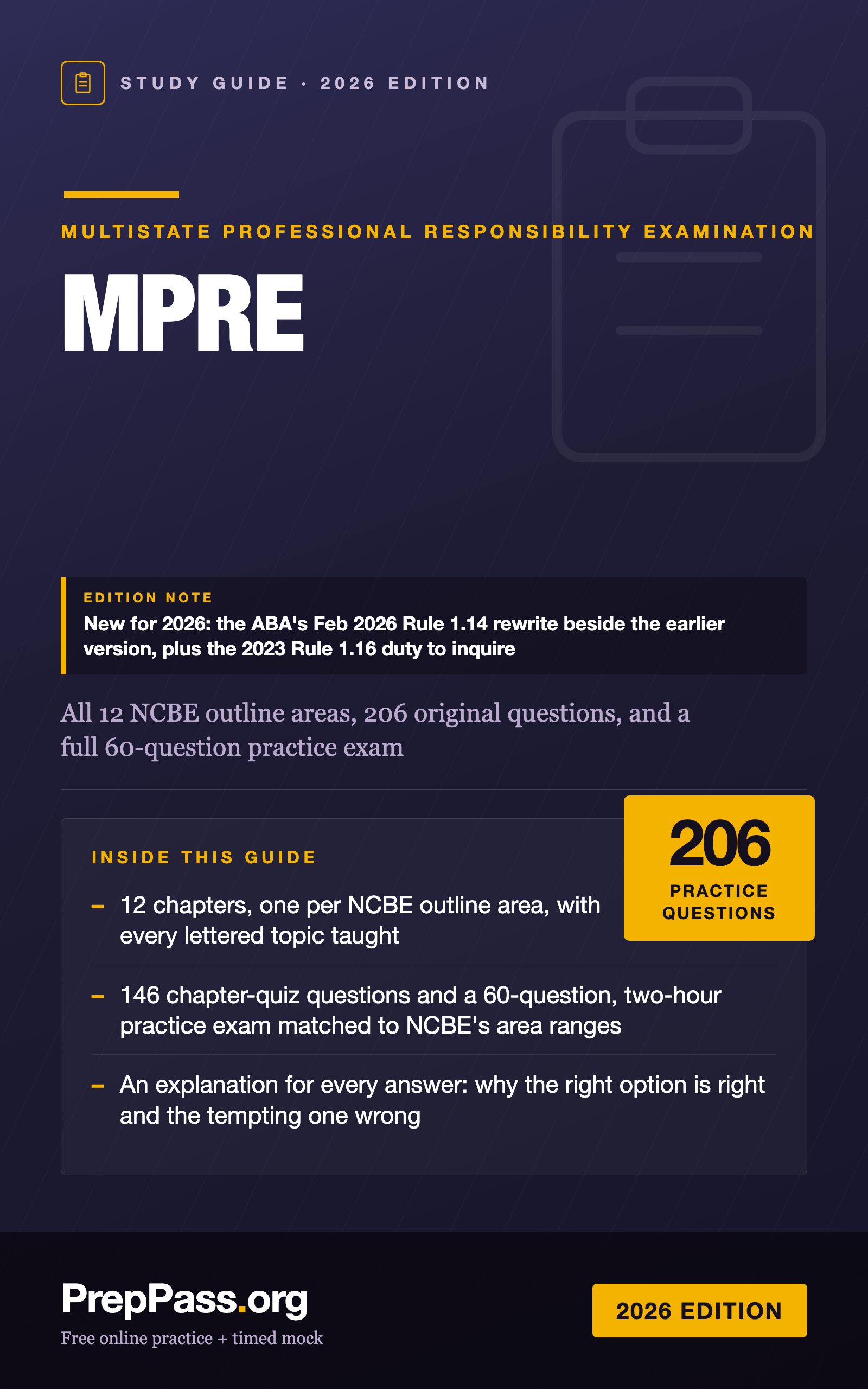
MPRE — Multistate Professional Responsibility Examination · 2026 Edition
MPRE Study Guide — 2026 Edition
Edition noteNew for 2026: the ABA's Feb 2026 Rule 1.14 rewrite beside the earlier version, plus the 2023 Rule 1.16 duty to inquire
All 12 NCBE outline areas, 206 original questions, and a full 60-question practice exam
- 206 original MPRE practice questions, each with a worked explanation, in one PDF + EPUB you keep
PDF + EPUB · English · 241 pages · $24.99 one-time
This book is written in English.
Instant download after payment — no account needed, no subscription.
14-day money-back guarantee: not satisfied for any reason? Email support@preppass.org within 14 days of purchase for a full refund. Refund policy
Try 10 questions first — free
Answer all 10, then see every answer explained — with the section of this guide that teaches it. About 5 minutes, no sign-up.
Start 10 free questionsLook inside the book
Three real pages, rendered straight from the PDF you download — a reference page, a teaching page, and a worked question, always in that order. Nothing here was redrawn to look better.
- Quick referenceChapter 4 — Conflicts of Interest · PDF page 85
A page you can turn back to: the numbers, deadlines or terms gathered in one place.
- How it's taughtChapter 6 — Litigation and Other Forms of Advocacy · PDF page 109
An explanation page: the material taught in prose, in the order the exam tests it.
- How it's taughtChapter 8 — Different Roles of the Lawyer · PDF page 135
An explanation page: the material taught in prose, in the order the exam tests it.
Questions buyers ask
- What has changed on the MPRE — Multistate Professional Responsibility Examination exam?
- New for 2026: the ABA's Feb 2026 Rule 1.14 rewrite beside the earlier version, plus the 2023 Rule 1.16 duty to inquire.
- Is a study guide enough for the MPRE — Multistate Professional Responsibility Examination exam, or do I need a course?
- A book is exam review: it does not replace any education, training or experience your licensing body requires before you may sit the exam, so check those requirements first. For the exam content itself, this 241-page guide teaches the material chapter by chapter with 206 practice questions and explanations inside, and 120 more practice questions are free on PrepPass. A prep course adds live instruction and a set schedule; whether you need one beyond any required education is your call.
- What is the cheapest way to prepare for the MPRE — Multistate Professional Responsibility Examination exam?
- Start with what costs nothing: 120 practice questions on PrepPass, with explanations and no signup. If you want it taught in one file you keep, the full study guide is $24.99 once. No subscription on any of them.
- Does the MPRE — Multistate Professional Responsibility Examination study guide come as a PDF?
- Yes — MPRE Study Guide — 2026 Edition downloads as PDF and EPUB, 241 pages. The download link is emailed the moment payment clears and does not expire.
- How much does the MPRE — Multistate Professional Responsibility Examination study guide cost?
- $24.99, once. There is no subscription and no account to create; the PDF and EPUB files are yours to keep.
- Are there free MPRE — Multistate Professional Responsibility Examination practice questions?
- Yes — 120 of them, free to use with no signup and an explanation on every one. They are separate from this study guide, which is what you are buying here.
- Can I read part of the MPRE — Multistate Professional Responsibility Examination study guide before buying?
- Yes. A full chapter is free to read on this page — not a summary of one, the chapter itself.
- Is this the official MPRE — Multistate Professional Responsibility Examination study guide?
- No. This is an independent study guide and is not affiliated with or endorsed by the exam's awarding body. It is written from NCBE MPRE pages and Subject Matter Outline (read Sept 25, 2026); ABA Model Rules of Professional Conduct and Model Code of Judicial Conduct; ABA House of Delegates resolutions (Aug 2023, Feb 2026). Always confirm current requirements with the body that issues your licence.
What's included — and what isn't
Included
- 12 chapters, one per NCBE outline area, with every lettered topic taught
- 146 chapter-quiz questions and a 60-question, two-hour practice exam matched to NCBE's area ranges
- An explanation for every answer: why the right option is right and the tempting one wrong
- Both versions of Model Rule 1.14 (before and after February 2026), with when each may be tested
- NCBE's key MPRE phrases ("subject to discipline," "may," "subject to disqualification") decoded
- A quick-reference decision guide (Appendix C): conflicts, confidentiality, candor, fees, client funds, contacts, solicitation, reporting and judges
- PDF + EPUB you keep
Not included
- No printed copy is shipped — this is a file you download and can print yourself
- No video course, instructor or tutoring comes with the book — the free videos on the site are separate
- Not your exam registration or the testing centre's fee, which you still pay to the official body
Contents
See 15 sections and the page each one starts on
- Chapter 1 — Regulation of the Legal Professionp. 11
- Chapter 2 — The Client-Lawyer Relationshipp. 31
- Chapter 3 — Client Confidentialityp. 52
- Chapter 4 — Conflicts of Interestp. 67
- Chapter 5 — Competence, Legal Malpractice, and Other Civil Liabilityp. 89
- Chapter 6 — Litigation and Other Forms of Advocacyp. 104
- Chapter 7 — Transactions and Communications with Persons Other Than Clientsp. 121
- Chapter 8 — Different Roles of the Lawyerp. 132
- Chapter 9 — Safekeeping Funds and Other Propertyp. 146
- Chapter 10 — Communications About Legal Servicesp. 156
- Chapter 11 — Lawyers’ Duties to the Public and the Legal Systemp. 168
- Chapter 12 — Judicial Conductp. 179
- Appendix A — The Exam at a Glancep. 219
- Appendix B — The Words the MPRE Uses Preciselyp. 220
- Appendix C — One-Page Decision Guidep. 223
Taken from the PDF you download, with the page each one starts on — not typed here.
Read a chapter free, in full
One complete chapter, exactly as it ships in the eBook. Scroll the window to read it right here; no download, no email.
Read chapter 4 here, without leaving the page
We didn't give you the easy intro — the free chapter opens on one of the hardest-working parts of the book, so you can judge the teaching where the exam gets difficult.
Outline area IV · NCBE's approximate share of the exam: 12–18%, the largest single area[1]
Conflicts of interest are the heaviest area on the MPRE, and the one where a method pays off most. Almost every conflicts question can be solved with the four steps the comment to Rule 1.7 lays out: "1) clearly identify the client or clients; 2) determine whether a conflict of interest exists; 3) decide whether the representation may be undertaken despite the existence of a conflict, i.e., whether the conflict is consentable; and 4) if so, consult with the clients affected under paragraph (a) and obtain their informed consent, confirmed in writing."[2] Then ask a fifth question the rule does not state but the exam always does: does the conflict spread to the lawyer's firm?
This chapter follows the outline: current-client conflicts (multiple clients, then the lawyer's own interests), former clients, prospective clients, imputation, the specific prohibitions of Rule 1.8, government lawyers, and former judges and neutrals.
IV.A Current client conflicts — multiple clients and joint representation
The two kinds of conflict. Rule 1.7(a): "a lawyer shall not represent a client if the representation involves a concurrent conflict of interest. A concurrent conflict of interest exists if: (1) the representation of one client will be directly adverse to another client; or (2) there is a significant risk that the representation of one or more clients will be materially limited by the lawyer's responsibilities to another client, a former client or a third person or by a personal interest of the lawyer."[3]
Direct adversity is simple and strict. "Absent consent, a lawyer may not act as an advocate in one matter against a person the lawyer represents in some other matter, even when the matters are wholly unrelated."[2] Suing a current client on behalf of another client is direct adversity even if the two matters have nothing in common. Cross-examining a current client who is a witness in another case usually is too.
Material limitation is subtler. "Even where there is no direct adverseness, a conflict of interest exists if there is a significant risk that a lawyer's ability to consider, recommend or carry out an appropriate course of action for the client will be materially limited as a result of the lawyer's other responsibilities or interests." The comment's example: "a lawyer asked to represent several individuals seeking to form a joint venture is likely to be materially limited in the lawyer's ability to recommend or advocate all possible positions that each might take because of the lawyer's duty of loyalty to the others."[2] The word significant matters: a remote or speculative possibility is not a conflict.
Consent, and when consent is not enough. Rule 1.7(b): notwithstanding a conflict, the lawyer may proceed if "(1) the lawyer reasonably believes that the lawyer will be able to provide competent and diligent representation to each affected client; (2) the representation is not prohibited by law; (3) the representation does not involve the assertion of a claim by one client against another client represented by the lawyer in the same litigation or other proceeding before a tribunal; and (4) each affected client gives informed consent, confirmed in writing."[3]
Three things fall out of that list.
- Some conflicts are nonconsentable. "Some conflicts are nonconsentable, meaning that the lawyer involved cannot properly ask for such agreement or provide representation on the basis of the client's consent."[2] The clearest: representing both sides of the same lawsuit. "Paragraph (b)(3) prohibits representation of opposing parties in the same litigation, regardless of the clients' consent."[2] Also nonconsentable: any case in which a disinterested lawyer could not reasonably believe competent and diligent representation is possible.
- "Confirmed in writing" is not a signature requirement. It means "informed consent that is given in writing by the person or a writing that a lawyer promptly transmits to the person confirming an oral informed consent."[4] Contrast Rule 1.8(a), (g), and 1.5(c), which require a writing signed by the client.
- Consent must be informed. If a lawyer cannot disclose enough to one client for the other to decide — because the first client refuses to allow the disclosure — "the lawyer cannot properly ask the latter to consent."[2]
Co-parties. Representing co-plaintiffs or co-defendants is not direct adversity; it is "governed by paragraph (a)(2)." A conflict may arise from "substantial discrepancy in the parties' testimony, incompatibility in positions in relation to an opposing party or the fact that there are substantially different possibilities of settlement."[2] In criminal cases the comment warns that the potential for conflict in representing multiple defendants "is so grave that ordinarily a lawyer should decline to represent more than one co-defendant."[2]
Joint representation in transactions. A lawyer may represent several clients in one deal — two founders forming a company, spouses making an estate plan — with informed consent. The lawyer must advise the clients at the outset about two consequences:
- Privilege. "As between commonly represented clients, the privilege does not attach. Hence, it must be assumed that if litigation eventuates between the clients, the privilege will not protect any such communications, and the clients should be so advised."[2]
- No secrets. "Continued common representation will almost certainly be inadequate if one client asks the lawyer not to disclose to the other client information relevant to the common representation."[2]
If the joint representation fails, "ordinarily, the lawyer will be forced to withdraw from representing all of the clients." And the comment is blunt about hopeless cases: "a lawyer cannot undertake common representation of clients where contentious litigation or negotiations between them are imminent or contemplated."[2]
Aggregate settlements. When a lawyer represents several clients, Rule 1.8(g) forbids participating "in making an aggregate settlement of the claims of or against the clients … unless each client gives informed consent, in a writing signed by the client," with disclosure of "the existence and nature of all the claims or pleas involved and of the participation of each person in the settlement."[5] A defendant's lump-sum offer to settle with all five of a lawyer's plaintiffs cannot be divided up by the lawyer and accepted by majority vote.
Positional conflicts. "Ordinarily a lawyer may take inconsistent legal positions in different tribunals at different times on behalf of different clients." A conflict exists only if there is a significant risk that winning for one client "will create a precedent likely to seriously weaken the position taken on behalf of the other client."[2]
Organizational affiliates. Representing a corporation does not automatically mean representing its parent or subsidiary: "the lawyer for an organization is not barred from accepting representation adverse to an affiliate in an unrelated matter, unless the circumstances are such that the affiliate should also be considered a client of the lawyer," there is an understanding to avoid such adversity, or the lawyer's obligations would be materially limited.[2]
IV.B Current client conflicts — lawyer's personal interest or duties
Rule 1.7(a)(2) also reaches the lawyer's own interests. The comment gives examples: when "the probity of a lawyer's own conduct in a transaction is in serious question"; when "a lawyer has discussions concerning possible employment with an opponent of the lawyer's client, or with a law firm representing the opponent"; and when a lawyer refers clients "to an enterprise in which the lawyer has an undisclosed financial interest."[2]
Related lawyers. Lawyers related as parent, child, sibling, or spouse who represent opposing sides in the same matter have a personal-interest conflict; each ordinarily may not represent a client against the other without informed consent. The conflict is personal and, under Rule 1.10(a)(1), generally not imputed to the rest of their firms.
Sexual relations. Rule 1.8(j): "A lawyer shall not have sexual relations with a client unless a consensual sexual relationship existed between them when the client-lawyer relationship commenced."[5] The comment explains the reason: the relationship "is almost always unequal; thus, a sexual relationship between lawyer and client can involve unfair exploitation of the lawyer's fiduciary role."[6] Consent does not cure it; a preexisting relationship does. Unlike the other 1.8 conflicts, 1.8(j) is not imputed to other lawyers in the firm (Rule 1.8(k) covers only paragraphs (a) through (i)).[5]
Gifts from clients. Rule 1.8(c): a lawyer "shall not solicit any substantial gift from a client, including a testamentary gift, or prepare on behalf of a client an instrument giving the lawyer or a person related to the lawyer any substantial gift unless the lawyer or other recipient of the gift is related to the client." Related persons include "a spouse, child, grandchild, parent, grandparent or other relative or individual with whom the lawyer or the client maintains a close, familial relationship."[5] The comment clarifies what is allowed: "a simple gift such as a present given at a holiday or as a token of appreciation is permitted," and a lawyer may accept an unsolicited substantial gift, although it "may be voidable by the client under the doctrine of undue influence."[6] What the lawyer may not do is draft the will that leaves the lawyer a substantial bequest; another, independent lawyer must draft it.
Literary and media rights. Rule 1.8(d): "Prior to the conclusion of representation of a client, a lawyer shall not make or negotiate an agreement giving the lawyer literary or media rights to a portrayal or account based in substantial part on information relating to the representation."[5] After the case ends, such an agreement is permitted (subject to Rule 1.8(a) and confidentiality).
Financial assistance. Rule 1.8(e) bars financial assistance "in connection with pending or contemplated litigation," except that a lawyer "may advance court costs and expenses of litigation, the repayment of which may be contingent on the outcome of the matter"; a lawyer for an indigent client "may pay court costs and expenses of litigation on behalf of the client"; and, since August 2020,[7] a lawyer representing an indigent client pro bono (including through a legal-services organization or law school clinic) "may provide modest gifts to the client for food, rent, transportation, medicine and other basic living expenses," as long as the lawyer does not promise the gifts before retention, seek reimbursement, or advertise them.[5] The pro bono exception does not reach "contingent-fee personal injury cases."[6]
IV.C Former client conflicts
The rule. Rule 1.9(a): "A lawyer who has formerly represented a client in a matter shall not thereafter represent another person in the same or a substantially related matter in which that person's interests are materially adverse to the interests of the former client unless the former client gives informed consent, confirmed in writing."[8]
Three elements must all be present: (1) same or substantially related matter, (2) material adversity to the former client, and (3) no informed consent confirmed in writing. Remove any one and the representation is permitted under 1.9(a).
Substantially related. Matters are substantially related "if they involve the same transaction or legal dispute or if there otherwise is a substantial risk that confidential factual information as would normally have been obtained in the prior representation would materially advance the client's position in the subsequent matter." The comment's examples: a lawyer who learned a businessperson's private finances may not represent the spouse in a divorce; a lawyer who obtained environmental permits for a shopping center may not represent neighbors opposing its rezoning on environmental grounds.[9]
Lawyers who change firms. Rule 1.9(b) applies when a lawyer's former firm represented a client: the moving lawyer is personally disqualified from being adverse to that client in a substantially related matter only if the lawyer "had acquired information protected by Rules 1.6 and 1.9(c) that is material to the matter."[8] A lawyer who never worked on or learned about the former firm's matter is not disqualified.
Using and revealing former-client information. Rule 1.9(c) forbids using a former client's information "to the disadvantage of the former client except as these Rules would permit or require with respect to a client, or when the information has become generally known," and revealing it except as the Rules permit.[8]
Current versus former. Whether someone is a current or former client matters enormously — adversity to a current client is barred even in unrelated matters, while adversity to a former client is barred only in substantially related ones. A lawyer may not drop a current client "like a hot potato" to convert it into a former client; the conflict analysis looks at the relationship as it stood.
Sources cited in this excerpt
- MPRE Subject Matter Outline (PDF). National Conference of Bar Examiners (NCBE), PDF dated 2013 (copyright line); linked as the current outline from NCBE's Preparing for the MPRE page, read 2026-09-25. https://www.ncbex.org/sites/default/files/2023-01/MPRE_Subject_Matter_Outline.pdf
- ABA Model Rule of Professional Conduct 1.7 — Comment: Conflict of Interest: Current Clients. American Bar Association, Internet Archive capture 2026-09-01. https://www.americanbar.org/groups/professional_responsibility/publications/model_rules_of_professional_conduct/rule_1_7_conflict_of_interest_current_clients/comment_on_rule_1_7/
- ABA Model Rule of Professional Conduct 1.7: Conflict of Interest: Current Clients. American Bar Association, Internet Archive capture 2026-09-13. https://www.americanbar.org/groups/professional_responsibility/publications/model_rules_of_professional_conduct/rule_1_7_conflict_of_interest_current_clients/
- ABA Model Rule of Professional Conduct 1.0: Terminology. American Bar Association, Internet Archive capture 2025-11-30. https://www.americanbar.org/groups/professional_responsibility/publications/model_rules_of_professional_conduct/rule_1_0_terminology/
- ABA Model Rule of Professional Conduct 1.8: Current Clients: Specific Rules. American Bar Association, Internet Archive capture 2025-08-30. https://www.americanbar.org/groups/professional_responsibility/publications/model_rules_of_professional_conduct/rule_1_8_current_clients_specific_rules/
- ABA Model Rule of Professional Conduct 1.8 — Comment: Conflict of Interest: Current Clients: Specific Rules. American Bar Association, Internet Archive capture 2025-12-07. https://www.americanbar.org/groups/professional_responsibility/publications/model_rules_of_professional_conduct/rule_1_8_current_clients_specific_rules/comment_on_rule_1_8/
- Model Rules of Professional Conduct (landing page, 'Most Recent Changes to the Model Rules'). American Bar Association, Internet Archive capture 2026-09-12. https://www.americanbar.org/groups/professional_responsibility/publications/model_rules_of_professional_conduct/
- ABA Model Rule of Professional Conduct 1.9: Duties to Former Clients. American Bar Association, Internet Archive capture 2026-07-04. https://www.americanbar.org/groups/professional_responsibility/publications/model_rules_of_professional_conduct/rule_1_9_duties_of_former_clients/
- ABA Model Rule of Professional Conduct 1.9 — Comment: Duties to Former Clients. American Bar Association, Internet Archive capture 2025-08-10. https://www.americanbar.org/groups/professional_responsibility/publications/model_rules_of_professional_conduct/rule_1_9_duties_of_former_clients/comment_on_rule_1_9/
Before you buy
- How do I get it?
- Pay, and the download appears on this page straight away. The links are also emailed to you. No account is required.
- What if it isn't for me?
- Email us within 14 days for a full refund, no questions asked.
- Is the free practice going away?
- No. Every practice question, the timed mock and the free chapters on this site stay free. This book is the studying half, not a gate around the free half.
- Can I read it on my phone?
- Yes — the EPUB is for phones and e-readers, the PDF is for printing and tabbing. You get both.
The details
All 12 NCBE outline areas, 206 original questions, and a full 60-question practice exam
- Format: PDF + EPUB download · 241 pages
- 206 practice questions in the book, with a full answer key
- 120 free practice questions for this exam on PrepPass, included at no cost
- $24.99 one-time — no subscription
- 14-day money-back guarantee · refund policy
- Cross-referenced against: NCBE MPRE pages and Subject Matter Outline (read Sept 25, 2026); ABA Model Rules of Professional Conduct and Model Code of Judicial Conduct; ABA House of Delegates resolutions (Aug 2023, Feb 2026)
- Verified from the official source(NCBE MPRE pages and Subject Matter Outline (read Sept 25, 2026); ABA Model Rules of Professional Conduct and Model Code of Judicial Conduct; ABA House of Delegates resolutions (Aug 2023, Feb 2026))
- 120 free practice questions
- Instant download, yours for life
Why buy the book when the practice is free?
Our practice questions and timed mock stay free — nothing on the site moves behind this book. The $24.99 book is the studying half: the material itself, taught in order, in a file you own.
- Systematic teaching — every exam section explained chapter by chapter, start to finish, not just questions
- Print it & tab it — a paper-ready PDF you can highlight, mark up, and bring to your study table
- Study anywhere, offline — EPUB on your phone or e-reader; no wifi, no browser tabs
- Everything in one place — the chapters and the practice questions in one file
- Yours for life — one-time $24.99, instant download, no subscription
And it's risk-free: 14-day money-back guarantee — not satisfied? Email us for a full refund, no questions asked. See the refund policy.
14-day money-back guarantee · full refund, no questions asked.
One-time purchase, lifetime access to the download. The eBook is the full MPRE — Multistate Professional Responsibility Examination study guide in PDF and EPUB. Educational summary, not professional or legal advice — always confirm the current rules with the official source.