CHES — Certified Health Education Specialist Examination · 2026 Edition
CHES Study Guide — 2026 Edition
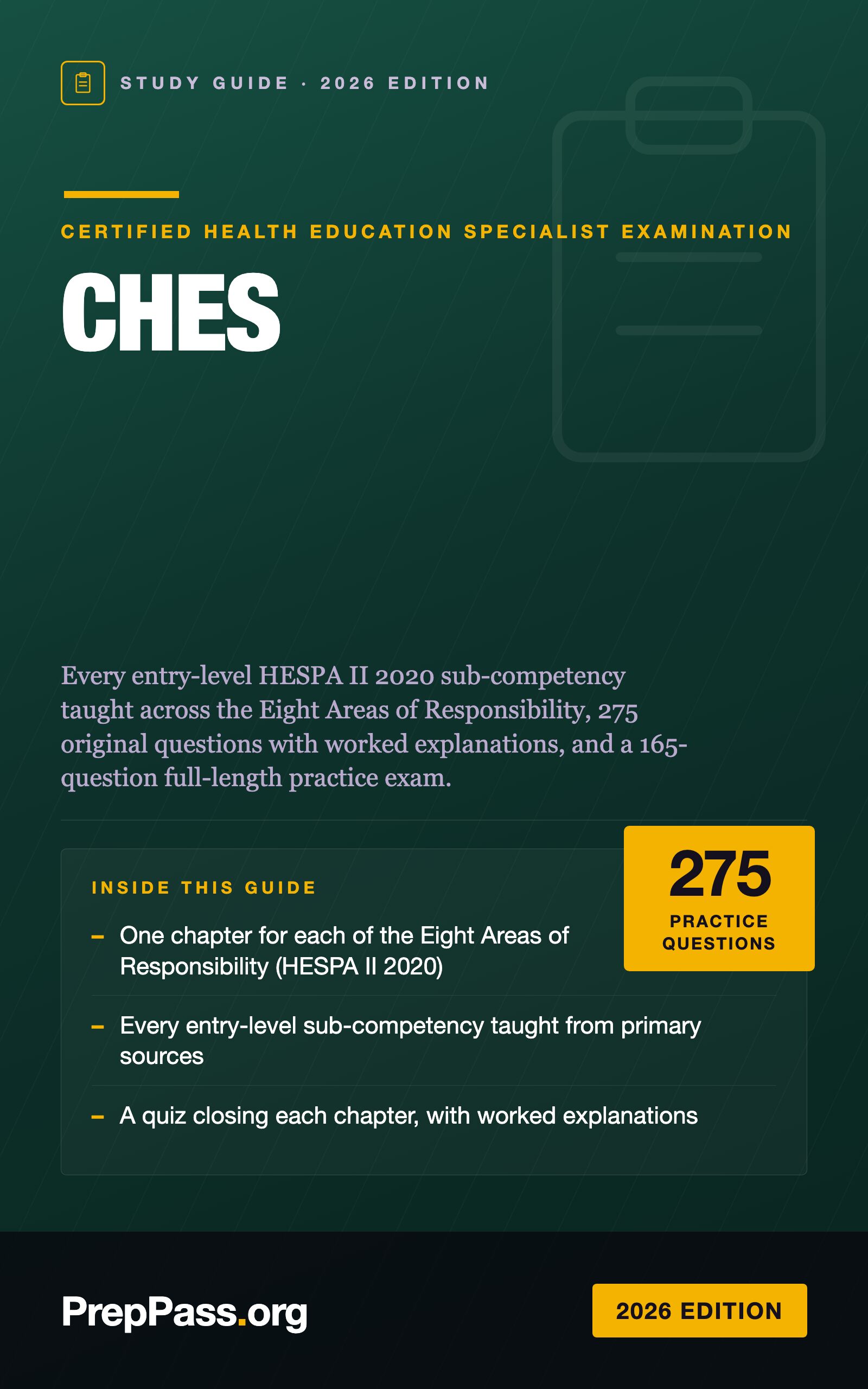
Every entry-level HESPA II 2020 sub-competency taught across the Eight Areas of Responsibility, 275 original questions with worked explanations, and a 165-question full-length practice exam.
- 275 original CHES practice questions, each with a worked explanation, in one PDF + EPUB you keep
PDF + EPUB · English · 165 pages · $24.99 one-time
This book is written in English.
Instant download after payment — no account needed, no subscription.
14-day money-back guarantee: not satisfied for any reason? Email support@preppass.org within 14 days of purchase for a full refund. Refund policy
Look inside the book
Three real pages, rendered straight from the PDF you download — a reference page, a teaching page, and a worked question, always in that order. Nothing here was redrawn to look better.
- Quick referenceChapter 3 Quiz · PDF page 45
A page you can turn back to: the numbers, deadlines or terms gathered in one place.
- How it's taughtChapter 1 Quiz · PDF page 21
An explanation page: the material taught in prose, in the order the exam tests it.
- A question, workedChapter 6 Quiz · PDF page 74
A practice question with its answer and the reasoning behind it — not just a key.
About the CHES exam
For graduates and practitioners preparing for NCHEC's entry-level CHES exam. This independent study guide teaches the eight Areas of Responsibility from primary sources, with a quiz for every chapter and a full-length 165-question practice exam. It is not produced or endorsed by NCHEC and has no online practice component.
| Awarding body | National Commission for Health Education Credentialing (NCHEC) |
|---|---|
| Questions | 165 four-response multiple-choice questions, of which 15 are unidentified pretest items that do not count toward the score |
| Time limit | 3 hours of testing; the appointment, including tutorial and survey, lasts at most 3 hours 30 minutes |
| Passing rule | A criterion-referenced passing point set in advance with the Modified Angoff method and its variations; NCHEC publishes no fixed percentage or number correct |
| Fees | Per the handbook revised 2025-04-25: non-student $280 early-bird / $340 regular / $400 final; student $230 / $290 / $350; each includes a $100 nonrefundable processing fee |
| Delivery | Computer-based, at a PSI test center or by Live Remote Proctoring through PSI Bridge (candidate chooses one); three blocks with an optional 10-minute break after question 83, during which the clock keeps running |
| Eligibility | A bachelor's, master's or doctoral degree from an accredited institution, plus either a health education major or at least 25 semester (37 quarter) hours of coursework with a grade of C or better addressing the Eight Areas of Responsibility |
| Retakes | No retest in the same testing window; a candidate may retake in the next consecutive window at a reduced rate; no limit on the number of attempts |
| Content outline | Areas of Responsibility, Competencies and Sub-competencies for Health Education Specialist Practice Analysis II 2020 (HESPA II 2020) — entry-level sub-competencies |
| Domains and weights |
|
Questions buyers ask
- How many questions are on the CHES exam, and how long is it?
- The CHES exam has 165 four-response multiple-choice questions, 15 of them unscored pretest items you cannot identify, and you have 3 hours. With the tutorial and survey the appointment lasts at most 3 hours 30 minutes.
- What score do I need to pass the CHES exam?
- NCHEC does not publish a fixed percentage or number of correct answers. The passing point is set in advance with the Modified Angoff method, a criterion-referenced procedure based on experts' judgments of just-qualified candidates, so it is independent of how other examinees perform.
- What does the CHES exam cover, and how is it weighted?
- It covers the eight Areas of Responsibility: Assessment of Needs and Capacity 17%, Planning 14%, Implementation 15%, Evaluation and Research 12%, Advocacy 12%, Communication 12%, Leadership and Management 6%, and Ethics and Professionalism 12%.
- Which content outline is the CHES exam based on?
- The exam is based on the entry-level sub-competencies of NCHEC's Health Education Specialist Practice Analysis II 2020 (HESPA II 2020). Advanced-level sub-competencies are excluded from the CHES and appear on the MCHES exam.
- Who is eligible to take the CHES exam?
- You need a bachelor's, master's or doctoral degree from an accredited institution, plus either a health education major or at least 25 semester (37 quarter) hours of coursework, grade C or better, addressing the Eight Areas of Responsibility.
- How much does the CHES exam cost, and can I retake it?
- Per the April 2025 handbook, non-students pay $280, $340 or $400 and students $230, $290 or $350 depending on registration timing, including a $100 nonrefundable fee. You cannot retest in the same window but may retake in the next one at a reduced rate, with no attempt limit.
- Can I take the CHES exam from home?
- Yes. Candidates choose either a PSI test center or Live Remote Proctoring through PSI Bridge, which requires a computer with a camera, microphone and internet connection. Either way the exam allows one optional 10-minute break, and the clock keeps running.
- How is this book organized?
- The book has one chapter for each Area of Responsibility, each ending with a quiz, plus a 165-question practice exam weighted like the real exam: 275 original questions in all, each with a sourced explanation.
- Is a study guide enough for the CHES — Certified Health Education Specialist Examination exam, or do I need a course?
- Check eligibility first — per National Commission for Health Education Credentialing (NCHEC): a bachelor's, master's or doctoral degree from an accredited institution, plus either a health education major or at least 25 semester (37 quarter) hours of coursework with a grade of C or better addressing the Eight Areas of Responsibility. A book does not replace those requirements. For the exam content itself, this 165-page guide teaches the material chapter by chapter with 275 practice questions and explanations inside. A prep course adds live instruction and a set schedule; whether you need one beyond any required education is your call.
- Does the CHES — Certified Health Education Specialist Examination study guide come as a PDF?
- Yes — CHES Study Guide — 2026 Edition downloads as PDF and EPUB, 165 pages. The download link is emailed the moment payment clears and does not expire.
- How much does the CHES — Certified Health Education Specialist Examination study guide cost?
- $24.99, once. There is no subscription and no account to create; the PDF and EPUB files are yours to keep.
- Can I read part of the CHES — Certified Health Education Specialist Examination study guide before buying?
- Yes. A full chapter is free to read on this page — not a summary of one, the chapter itself.
- Is this the official CHES — Certified Health Education Specialist Examination study guide?
- No. This is an independent study guide and is not affiliated with or endorsed by the exam's awarding body. It is written from NCHEC's HESPA II 2020 Areas of Responsibility, Competencies and Sub-competencies and the CHES Examination Handbook (revised April 25, 2025). Always confirm current requirements with the body that issues your licence.
What's included — and what isn't
Included
- One chapter for each of the Eight Areas of Responsibility (HESPA II 2020)
- Every entry-level sub-competency taught from primary sources
- A quiz closing each chapter, with worked explanations
- A 165-question full-length practice exam at the published area weights
- 275 original questions, each explained and cited to its source
- PDF + EPUB you keep
Not included
- No printed copy is shipped — this is a file you download and can print yourself
- No video course, instructor, tutoring or online question bank comes with the book — everything is in the file
- Not your exam registration or the testing centre's fee, which you still pay to the official body
Contents
See 21 sections and the page each one starts on
- Chapter 1 — Assessment of Needs and Capacityp. 7
- Chapter 1 Quizp. 13
- Chapter 2 — Planningp. 24
- Chapter 2 Quizp. 28
- Answer Key — Chapter 2 Quizp. 33
- Chapter 3 — Implementationp. 36
- Chapter 3 Quizp. 40
- Chapter 4 — Evaluation and Researchp. 47
- Chapter 4 Quizp. 50
- Chapter 5 — Advocacyp. 57
- Chapter 5 Quizp. 60
- Chapter 6 — Communicationp. 67
- Chapter 6 Quizp. 70
- Chapter 7 — Leadership and Managementp. 78
- Chapter 7 Quizp. 80
- Chapter 8 — Ethics and Professionalismp. 86
- Chapter 8 Quizp. 89
- Practice Examp. 95
- Practice Exam — Area 6: Communication (20 questions)p. 140
- Answer Key — Practice Exam Area 7p. 150
- Appendix A — Terms to knowp. 159
Taken from the PDF you download, with the page each one starts on — not typed here.
Read a chapter free, in full
One complete chapter, exactly as it ships in the eBook. Scroll the window to read it right here; no download, no email.
Read chapter 1 here, without leaving the page
Area I — Assessment of Needs and Capacity carries the largest single share of the CHES examination: 17% of scored items (NCHEC 2025)[1, 2]. Every program a health education specialist plans, implements, or evaluates begins here. An assessment answers three questions before any intervention is designed: Whose health are we trying to improve? What does the data say about their needs? And what capacity — resources, policies, programs, partners — already exists to help?
1.1 Defining the purpose, scope, and partners
The first task is to define the purpose and scope of the assessment (1.1.1): what decisions the findings will inform and how broadly the inquiry will reach. A vague purpose ("improve community health") produces vague findings; a precise one ("determine whether a diabetes self-management program is warranted for adults aged 45 and older in the county's east side") tells the specialist exactly what data to collect.
Closely tied to purpose is identifying the priority population (1.1.2) — the group whose health the program intends to affect. Priority populations may be defined by geography, age, condition, setting (a school, a workplace), or shared risk factors. Everything downstream — data sources, instruments, sampling, recommendations — flows from this choice, so it must be explicit and defensible.
Before collecting anything new, the specialist also identifies the existing and available resources, policies, programs, practices, and interventions that bear on the issue (1.1.3). This early inventory shapes the plan — it shows what data partners already hold and which programs already reach the population — and it sets up the later, fuller assessment of those same resources and of the capacity they represent (1.3.4, 1.3.5).
Assessment is never a solo activity. The specialist recruits and engages priority populations, partners, and stakeholders to participate throughout all steps of the assessment, planning, implementation, and evaluation processes (1.1.5). CDC's evaluation framework defines stakeholders as "people or organizations invested in the program, interested in the results of the evaluation, and/or with a stake in what will be done with the results of the evaluation," adding that "representing their needs and interests throughout the process is fundamental to good program evaluation"[3]. The same logic applies to needs assessment: the people affected by the findings should help shape the questions, interpret the data, and act on the results. Engagement also means examining the factors and determinants that influence the assessment process itself (1.1.4) — political sensitivities, organizational mandates, funding constraints, and cultural dynamics that can enable or obstruct honest inquiry.
1.2 Gathering and judging data
A complete assessment draws on three kinds of information (1.2.1): primary data, secondary data, and evidence-informed resources.
- Secondary data already exist: census figures, vital statistics, hospital discharge records, school health records, Behavioral Risk Factor Surveillance System results, and published literature. The specialist procures secondary data (1.2.4) and conducts a literature review (1.2.3) to learn what is already known and which interventions have worked elsewhere.
- Primary data are collected for the specific assessment at hand. CDC's framework defines primary data as "data collected by an evaluation team specifically for the evaluation study"[3] — the same distinction holds for needs assessment: surveys, interviews, focus groups, and observations designed around the assessment's questions.
- Evidence-informed resources include planning models, practice guidelines, and program registries that connect the assessment to what the field already knows works.
Secondary data are convenient but never accepted uncritically. The specialist determines the validity and reliability of the secondary data (1.2.5): Do the numbers measure what they claim to measure? Were they collected with sound methods? Are they current and applicable to the priority population? Data collected for billing, for example, may misrepresent the true prevalence of a condition. Where existing sources fall short, the specialist identifies data gaps (1.2.6) and then determines primary data collection needs, instruments, methods, and procedures (1.2.7): which questions remain unanswered, who can answer them, and which methods — survey, interview, focus group, observation — fit the question and the population. Some methods yield qualitative data and some yield quantitative data, and "if the question involves an abstract concept or one where measurement is poor, using multiple methods is often helpful"[3]. CDC defines the distinction plainly: "Qualitative data: observations that are categorical rather than numerical, and often involve knowledge, attitudes, perceptions, and intentions. Quantitative data: observations that are numerical"[3]. Once collection begins, the specialist adheres to established procedures to collect data (1.2.8) — protocols for sampling, consent, administration, and documentation that protect data quality and the people providing it.
1.3 Determining health status, influences, and capacity
With data in hand, the specialist determines the health status of the priority population (1.3.1). Two epidemiologic measures do most of this work, and confusing them is a classic error:
- Incidence "refers to the occurrence of new cases of disease or injury in a population over a specified period of time"[4].
- Prevalence "is the proportion of persons in a population who have a particular disease or attribute at a specified point in time or over a specified period of time"[4].
The key difference is in the numerator: "prevalence includes new and pre-existing cases whereas incidence includes new cases only"[4]. Incidence answers "how fast is this spreading?"; prevalence answers "how much of it is out there right now?" A program targeting newly diagnosed diabetics leans on incidence; a program planning clinic capacity leans on prevalence.
Beyond disease counts, the specialist determines the knowledge, attitudes, beliefs, skills, and behaviors that impact the health and health literacy of the priority population (1.3.2). Health literacy itself is now defined in two parts: personal health literacy "is the degree to which individuals have the ability to find, understand, and use information and services to inform health-related decisions and actions for themselves and others," while organizational health literacy "is the degree to which organizations enable individuals to find, understand, and use information and services to inform health-related decisions and actions for themselves and others"[5]. An assessment that finds low personal health literacy points toward plain-language materials and teach-back methods; one that finds low organizational health literacy points toward fixing the clinic's signage, forms, and phone systems.
The specialist also identifies the social, cultural, economic, political, and environmental factors that impact the health and learning processes of the priority population (1.3.3). A useful organizing scheme comes from PRECEDE-PROCEED's diagnostic factors: predisposing factors "motivate or provide a reason for behavior" and "include knowledge, attitudes, cultural beliefs, and readiness to change"; enabling factors "enable persons to act on their predispositions" and "include available resources, supportive policies, assistance, and services"; reinforcing factors "come into play after a behavior has been initiated" and "encourage repetition or persistence of behaviors by providing continuing rewards or incentives," with "social support, praise, reassurance, and symptom relief" as examples[6]. Sorting assessment findings into these three buckets turns a pile of facts into a diagnosis of why a behavior does or does not occur.
Finally, the specialist assesses existing and available resources, policies, programs, practices, and interventions (1.3.4) and determines the capacity — those same resources, policies, programs, practices, and interventions — to improve or maintain health (1.3.5). Capacity assessment prevents the common mistake of designing a program the community cannot sustain: the staff, funding, partnerships, and policies must exist or be buildable. The assessment concludes this phase by listing the needs of the priority population (1.3.6) — a complete, documented inventory before any ranking begins.
1.4 Prioritizing, recommending, and reporting
Needs always exceed resources, so the specialist prioritizes health education and promotion needs (1.4.2). Common prioritization criteria include the magnitude of the problem, its severity, the feasibility of intervening, community concern, and alignment with organizational mission. The specialist also summarizes the capacity of the priority population to meet its own needs (1.4.3) — an honest accounting of what the community can do with support versus what requires outside investment.
The assessment then becomes actionable: the specialist develops recommendations based on findings (1.4.4). Recommendations are specific, tied to the evidence, and realistic about capacity — they say what should be done, for whom, and by whom, not merely what would be nice. Last, the specialist reports assessment findings (1.4.5) to stakeholders in formats they can use: an executive summary for decision makers, a full technical report for planners, and community-friendly briefs for the priority population itself. Reporting closes the loop that stakeholder engagement opened — the people who helped ask the questions deserve to hear the answers.
How the exam tests this — and the traps
Choosing a data-collection method. Questions in this Area usually hand you a population and ask which method fits. CDC's comparison of survey methods is the rule book. Personal interviews have the "least selection bias: can interview people without telephones—even homeless people" and the greatest response rate. Telephone interviews are fast but have the "most selection bias: omits homeless people and people without telephones." Self-completed instruments offer the "most anonymity: therefore, least bias toward socially acceptable responses," but they are "dependent on respondent's reading level" and "mailed instruments have lowest response rate"[7]. The trap is picking the cheapest or fastest method without asking who it leaves out.
Why, not just how many. When existing data describe a pattern but not its causes, the answer is qualitative: "Evaluators can also use qualitative methods (e.g., focus groups, semi-structured or open-ended interviews) to gain insight"[7]. Several methods that agree strengthen a conclusion — CDC calls this triangulation.
Counting correctly. Three calculations recur:
- Incidence proportion (risk, attack rate) = new cases during a period ÷ population at risk at the start. It is "the proportion of an initially disease-free population that develops disease, becomes injured, or dies during a specified (usually limited) period of time"[8].
- Point prevalence = people ill on a date ÷ population on that date.
- Food-specific attack rate = people who ate a food and became ill ÷ everyone who ate that food.
The denominator "should be limited to the 'population at risk'" — women only for cervical cancer, for example[8]. And because "prevalence is based on both incidence and duration of illness," a treatment that keeps people alive without curing them raises prevalence even when incidence is flat[4].
PRECEDE-PROCEED's five assessment phases appear constantly: "(1) social assessment, (2) epidemiological assessment, (3) behavioral and environmental assessment, (4) educational and ecological assessment, and (5) administrative and policy assessment"[6]. Social assessment asks people about their own needs and quality of life; epidemiological assessment documents which problems matter most for which groups. The trap is treating a resident survey about quality of life as epidemiological, or mortality data as social.
Engaging a community before assessing it. CDC/ATSDR's Principles of Community Engagement open with two steps that exam questions reward: "Be clear about the purposes or goals of the engagement effort and the populations and/or communities you want to engage," and "Become knowledgeable about the community's culture, economic conditions, social networks, political and power structures, norms and values, demographic trends, history, and experience with efforts by outside groups"[9].
Key numbers
| Figure | What it means | Source |
|---|---|---|
| 17% | Area I's share of the CHES exam — the largest of the eight | NCHEC handbook |
| 5 | Assessment phases in PRECEDE (social, epidemiological, behavioral/environmental, educational/ecological, administrative/policy) | NCI, Theory at a Glance |
| New ÷ at-risk | Incidence proportion: new cases during a period over the disease-free population at its start | CDC, Principles of Epidemiology, Lesson 3 |
| Ill ÷ population, same date | Point prevalence | CDC, Principles of Epidemiology, Lesson 3 |
Key takeaways
- Define the purpose, scope and priority population before choosing any data source.
- Secondary data were collected by someone else for another purpose; check that they fit before you use them.
- Match the method to the people: personal interviews reach people without phones; anonymous self-completed forms reduce socially acceptable answers but need readers.
- Incidence counts new cases; prevalence counts all current cases and grows when people live longer with a disease.
- Predisposing factors come before a behavior, enabling factors make it possible, reinforcing factors follow it.
- Engage the community early and give findings back to the people who supplied them.
Chapter 1 Quiz
1. A hospital asks a newly hired health education specialist to "do a community health assessment." Before choosing any data source or instrument, what should the specialist do first?
- A. Agree with the hospital and partners on the decisions the findings will inform and the population and area the assessment will cover
- B. Draft a household survey covering the leading chronic diseases so fieldwork can start quickly
- C. Download every county indicator available from state surveillance systems so no relevant data are missed
- D. Schedule community forums to ask residents which programs the hospital should fund next year
2. A specialist assembling data on infant health lists four sources. Which one is secondary data?
- A. Interviews the specialist's team conducts with new mothers at two clinics this spring
- B. A questionnaire the team writes and distributes to parents enrolled in the county WIC program
- C. Structured observations the team makes of breastfeeding support in maternity wards
- D. State vital-statistics files on infant deaths, compiled by the state for its own records
3. A specialist wants to estimate asthma prevalence from hospital discharge records that were collected for billing. What should happen before those figures are used?
- A. Replace them with a new survey, since secondary data cannot be used for assessments
- B. Adjust the figures upward because billing records always undercount chronic conditions
- C. Judge whether the records measure asthma accurately and consistently for this population
- D. Use the records as they are, since data from an official source need no review
4. A small nonprofit has no budget for its own survey and plans to use county Behavioral Risk Factor Surveillance System (BRFSS) estimates. What is the chief advantage of doing so?
- A. The data were collected specifically to answer the nonprofit's assessment questions
- B. The instrument has already been pretested and designed to yield valid, reliable data
- C. The estimates describe the nonprofit's own program participants rather than the county
- D. The survey captures residents' explanations of their behavior in their own words
5. A review of existing data shows that fathers in a county rarely attend well-child visits, but no source explains why. Which method best fills this gap?
- A. Statewide BRFSS estimates of health-care use among adult men in the region
- B. A second extract of the county's well-child visit records for the prior five years
- C. Birth-certificate data on the ages and education levels of fathers in the county
- D. Focus groups or open-ended interviews with fathers about what keeps them away
6. A specialist must survey adults using a drop-in shelter, many of whom have no telephone or stable address. Which survey mode best limits selection bias?
- A. Personal, face-to-face interviews conducted at the shelter
- B. A telephone survey using numbers listed in shelter intake records
- C. An online questionnaire linked from the shelter's social-media page
- D. A mailed questionnaire sent to each person's last known address
7. A college health center wants to measure illegal drug use among literate undergraduates and worries that students will under-report. Which mode best reduces bias toward socially acceptable answers?
- A. Telephone interviews conducted by the health center's nursing staff
- B. Face-to-face interviews conducted by trained peer health educators
- C. An anonymous self-administered questionnaire completed privately
- D. Small focus groups in which students discuss use in their residence hall
8. During one year, 60 new cases of type 2 diabetes are diagnosed among 12,000 adults who were free of diabetes at the start of the year. What is the incidence proportion?
- A. 5 per 1,000 adults
- B. 50 per 1,000 adults
- C. 20 per 1,000 adults
- D. 0.5 per 1,000 adults
9. On January 1, 450 of a town's 3,000 adults have diagnosed hypertension. Another 30 adults are diagnosed during January. What is the point prevalence on January 1?
- A. 15 percent
- B. 6.7 percent
- C. 1 percent
- D. 16 percent
10. After a church picnic, 40 of the 160 people who ate the chicken salad became ill. Which measure has the specialist calculated, and what is its value?
- A. A point prevalence of 25 percent among church members
- B. A food-specific attack rate of 25 percent
- C. A food-specific attack rate of 4 percent
- D. An overall attack rate of 25 percent for everyone at the picnic
11. A specialist is calculating the incidence of cervical cancer for a county. What should the denominator be?
- A. Every resident who saw a health-care provider during the year
- B. Women in the county, the population at risk of the disease
- C. Women who were screened for cervical cancer during the year
- D. The total county population, because every resident is counted
12. A health department wants to know how many residents currently need diabetes self-management education so it can size next year's classes. Which measure is most useful?
- A. The incidence of diabetes diagnosed during the past month
- B. The case-fatality rate among residents with diabetes
- C. The prevalence of diagnosed diabetes among adult residents
- D. The attack rate of diabetes in the county's largest employer
13. In a helmet-use assessment, teens report that friends tease anyone who starts wearing a helmet, so most stop within a week. In PRECEDE-PROCEED terms, the teasing is which kind of factor?
- A. An epidemiological factor, because it describes the injury rate among teens
- B. An enabling factor, because it determines whether helmets are available
- C. A predisposing factor, because it shapes teens' beliefs before they act
- D. A reinforcing factor, because it follows the behavior and discourages repeating it
14. Residents tell a specialist they want to walk for exercise, but the only park closes at 5 p.m. and there are no sidewalks near their homes. How should these findings be classified?
- A. Social assessment findings: residents' views of their own quality of life
- B. Enabling factors: missing resources that block acting on an existing intention
- C. Predisposing factors: beliefs that keep residents from wanting to walk at all
- D. Reinforcing factors: rewards that follow walking and keep it going
Sources cited in this excerpt
- NCHEC CHES Examination Handbook (revised 2025-04-25). https://www.nchec.org/ches
- Areas of Responsibility, Competencies and Sub-Competencies for Health Education Specialist Practice Analysis II 2020 (HESPA II 2020). https://www.nchec.org/hespa
- Introduction to Program Evaluation for Public Health Programs (CDC). https://www.cdc.gov/evaluation-guide/introduction-to-program-evaluation-for-public-health-programs.html
- Principles of Epidemiology in Public Health Practice, Lesson 3: Measures of Risk (CDC, archived). https://www.cdc.gov/csels/dsepd/ss1978/lesson3/section2.html
- Health Literacy in Healthy People 2030 (health.gov). https://health.gov/healthypeople/priority-areas/health-literacy-healthy-people-2030
- Theory at a Glance: A Guide for Health Promotion Practice, 2nd edition (NCI). https://cancercontrol.cancer.gov/brp/research/theories_project/theory.pdf
- CDC, Introduction to Program Evaluation for Public Health Programs: A Self-Study Guide (2011). https://www.cdc.gov/evaluation/
- CDC, Principles of Epidemiology in Public Health Practice, 3rd ed., Lesson 3: Measures of Risk. https://archive.cdc.gov/www_cdc_gov/csels/dsepd/ss1978/lesson3/section2.html
- CDC/ATSDR, Principles of Community Engagement, 2nd ed. (2011). https://stacks.cdc.gov/view/cdc/11699
Before you buy
- How do I get it?
- Pay, and the download appears on this page straight away. The links are also emailed to you. No account is required.
- What if it isn't for me?
- Email us within 14 days for a full refund, no questions asked.
- Is there online practice for this exam too?
- No. PrepPass has no online question bank for this exam; the book is self-contained. Its chapter quizzes and full-length practice exam, each question with a worked explanation, are all in the PDF and EPUB.
- Can I read it on my phone?
- Yes — the EPUB is for phones and e-readers, the PDF is for printing and tabbing. You get both.
The details
Every entry-level HESPA II 2020 sub-competency taught across the Eight Areas of Responsibility, 275 original questions with worked explanations, and a 165-question full-length practice exam.
- Format: PDF + EPUB download · 165 pages
- 275 practice questions in the book, with a full answer key
- $24.99 one-time — no subscription
- 14-day money-back guarantee · refund policy
- Cross-referenced against: NCHEC's HESPA II 2020 Areas of Responsibility, Competencies and Sub-competencies and the CHES Examination Handbook (revised April 25, 2025)
- Last updated: September 2026
- Verified from the official source(NCHEC's HESPA II 2020 Areas of Responsibility, Competencies and Sub-competencies and the CHES Examination Handbook (revised April 25, 2025))
- Instant download, yours for life
What the book gives you
PrepPass has no online question bank for this exam, so the $24.99 book is complete in itself: the material taught in order, a quiz closing each chapter and a full-length practice exam, in a file you own.
- Systematic teaching — every exam section explained chapter by chapter, start to finish, not just questions
- Print it & tab it — a paper-ready PDF you can highlight, mark up, and bring to your study table
- Study anywhere, offline — EPUB on your phone or e-reader; no wifi, no browser tabs
- Everything in one place — the chapters and the practice questions in one file
- Yours for life — one-time $24.99, instant download, no subscription
And it's risk-free: 14-day money-back guarantee — not satisfied? Email us for a full refund, no questions asked. See the refund policy.
14-day money-back guarantee · full refund, no questions asked.
One-time purchase, lifetime access to the download. The eBook is the full CHES — Certified Health Education Specialist Examination study guide in PDF and EPUB. Educational summary, not professional or legal advice — always confirm the current rules with the official source. Last updated: September 2026.