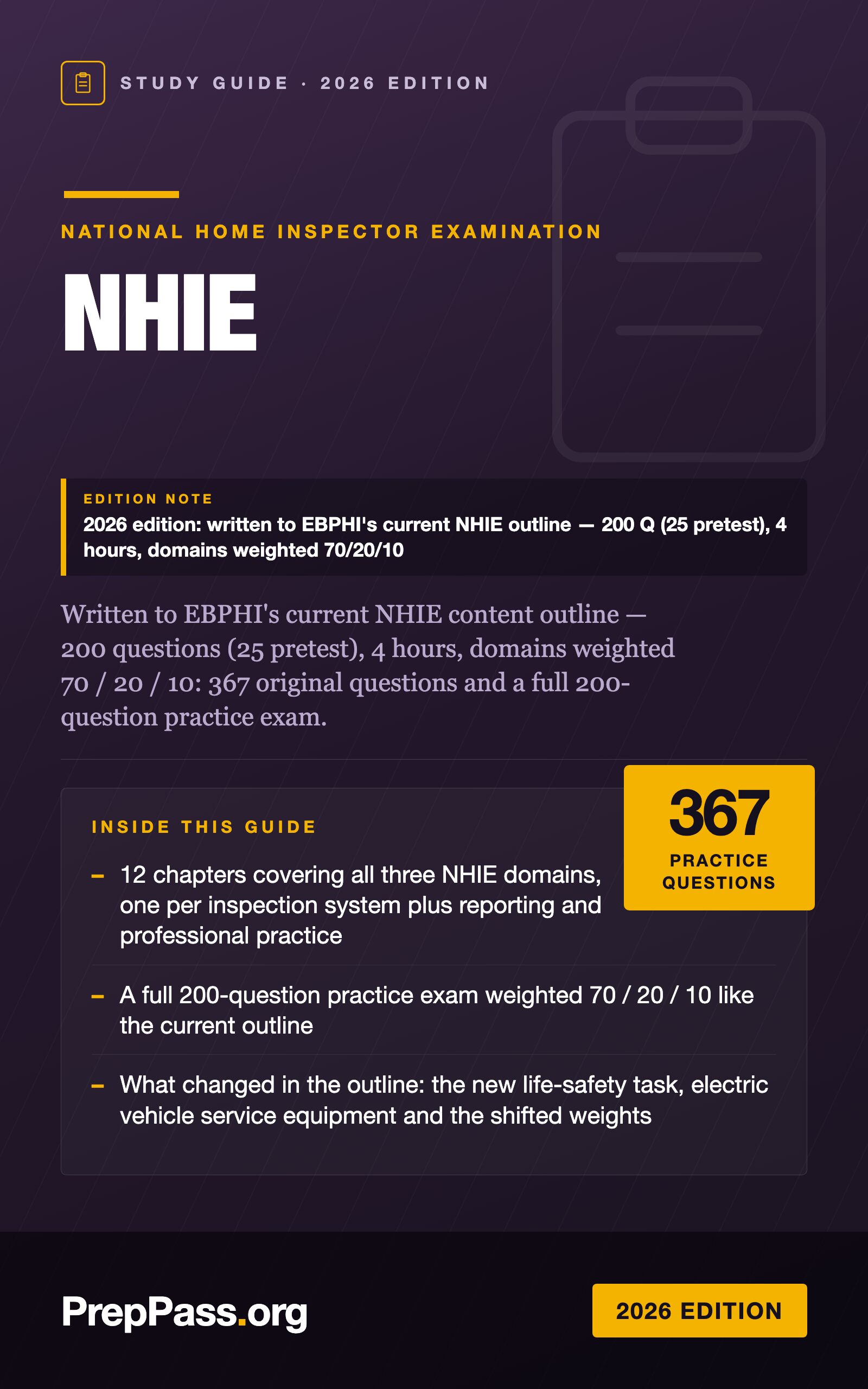
National Home Inspector Examination (NHIE) · 2026 Edition
NHIE Study Guide — 2026 Edition
Edition note2026 edition: written to EBPHI's current NHIE outline — 200 Q (25 pretest), 4 hours, domains weighted 70/20/10
Written to EBPHI's current NHIE content outline — 200 questions (25 pretest), 4 hours, domains weighted 70 / 20 / 10: 367 original questions and a full 200-question practice exam.
- 367 original NHIE practice questions, each with a worked explanation, in one PDF + EPUB you keep
PDF + EPUB · English · 234 pages · $19.99 one-time
This book is written in English.
Instant download after payment — no account needed, no subscription.
14-day money-back guarantee: not satisfied for any reason? Email support@preppass.org within 14 days of purchase for a full refund. Refund policy
Look inside the book
Three real pages, rendered straight from the PDF you download — a reference page, a teaching page, and a worked question, always in that order. Nothing here was redrawn to look better.
- Quick referenceChapter 1 — Site and Exterior (Domain 1, Tasks 1–2) · PDF page 21
A page you can turn back to: the numbers, deadlines or terms gathered in one place.
- How it's taughtChapter 6 — Insulation, Moisture, Ventilation and Exhaust (Domain 1, Tasks 8–9) · PDF page 78
An explanation page: the material taught in prose, in the order the exam tests it.
- A question, workedChapter 5 — Heating and Cooling (Domain 1, Tasks 6–7) · PDF page 71
A practice question with its answer and the reasoning behind it — not just a key.
Questions buyers ask
- What has changed on the National Home Inspector Examination (NHIE) exam?
- 2026 edition: written to EBPHI's current NHIE outline — 200 Q (25 pretest), 4 hours, domains weighted 70/20/10.
- Is a study guide enough for the National Home Inspector Examination (NHIE) exam, or do I need a course?
- A book is exam review: it does not replace any education, training or experience your licensing body requires before you may sit the exam, so check those requirements first. For the exam content itself, this 234-page guide teaches the material chapter by chapter with 367 practice questions and explanations inside, and 22 more practice questions are free on PrepPass. A prep course adds live instruction and a set schedule; whether you need one beyond any required education is your call.
- What is the cheapest way to prepare for the National Home Inspector Examination (NHIE) exam?
- Start with what costs nothing: 22 practice questions on PrepPass, with explanations and no signup. If you want it taught in one file you keep, the full study guide is $19.99 once. No subscription on any of them.
- Does the National Home Inspector Examination (NHIE) study guide come as a PDF?
- Yes — NHIE Study Guide — 2026 Edition downloads as PDF and EPUB, 234 pages. The download link is emailed the moment payment clears and does not expire.
- How much does the National Home Inspector Examination (NHIE) study guide cost?
- $19.99, once. There is no subscription and no account to create; the PDF and EPUB files are yours to keep.
- Are there free National Home Inspector Examination (NHIE) practice questions?
- Yes — 22 of them, free to use with no signup and an explanation on every one. They are separate from this study guide, which is what you are buying here.
- Can I read part of the National Home Inspector Examination (NHIE) study guide before buying?
- Yes. A full chapter is free to read on this page — not a summary of one, the chapter itself.
- Is this the official National Home Inspector Examination (NHIE) study guide?
- No. This is an independent study guide and is not affiliated with or endorsed by the exam's awarding body. It is written from EBPHI NHIE content outline and candidate information (handbook © 2023, 2022 role delineation study), read September 2026. Always confirm current requirements with the body that issues your licence.
Free National Home Inspector Examination (NHIE) practice questions and study chapters →
What's included — and what isn't
Included
- 12 chapters covering all three NHIE domains, one per inspection system plus reporting and professional practice
- A full 200-question practice exam weighted 70 / 20 / 10 like the current outline
- What changed in the outline: the new life-safety task, electric vehicle service equipment and the shifted weights
- An inspector's numbers card for the figures the exam turns on
- 367 original questions, each with a worked explanation citing its source
- PDF + EPUB you keep
Not included
- No printed copy is shipped — this is a file you download and can print yourself
- No video course, instructor or tutoring comes with the book — the free videos on the site are separate
- Not your exam registration or the testing centre's fee, which you still pay to the official body
Contents
See 14 sections and the page each one starts on
- Chapter 1 — Site and Exterior (Domain 1, Tasks 1–2)p. 13
- Chapter 2 — Roofing (Domain 1, Task 3)p. 28
- Chapter 3 — Structure (Domain 1, Task 4)p. 39
- Chapter 4 — Electrical Systems (Domain 1, Task 5)p. 51
- Chapter 5 — Heating and Cooling (Domain 1, Tasks 6–7)p. 64
- Chapter 6 — Insulation, Moisture, Ventilation and Exhaust (Domain 1, Tasks 8–9)p. 76
- Chapter 7 — Plumbing and Fuel Distribution (Domain 1, Task 10)p. 87
- Chapter 8 — Interior Components and Appliances (Domain 1, Task 11)p. 99
- Chapter 9 — Fireplaces, Fuel- Burning Appliances and Chimneys (Domain 1, Task 12)p. 108
- Chapter 10 — Life Safety (Domain 1, Task 13)p. 118
- Chapter 11 — Analysis of Findings and Reporting (Domain 2)p. 127
- Chapter 12 — Professional Responsibilities (Domain 3)p. 143
- Appendix A — The exam at a glance, in one tablep. 220
- Appendix B — Terms the exam expects you to use preciselyp. 223
Taken from the PDF you download, with the page each one starts on — not typed here.
Read a chapter free, in full
One complete chapter, exactly as it ships in the eBook. Scroll the window to read it right here; no download, no email.
Read chapter 4 here, without leaving the page
We didn't give you the easy intro — the free chapter opens on one of the hardest-working parts of the book, so you can judge the teaching where the exam gets difficult.
At 7%, the electrical task is the single heaviest task in Domain 1[1] — about fourteen questions. The outline covers six knowledge areas: the electrical service, service panels and subpanels, wiring methods, devices and fixtures, alternative energy systems, and electric vehicle service equipment[1]. It is also the chapter where inspection safety is itself a tested topic: panels are live, and the published standards limit what the inspector opens and operates.
How the electrical system is inspected
What must be described. ASHI's standard requires describing the amperage rating of the service, the location of the main disconnect and subpanels, the presence or absence of smoke and CO alarms, and the predominant branch-circuit wiring method[2]. Washington's rule, as one state example, requires the type and rating of the service, whether overhead or underground, the voltage, amperage, overcurrent devices and branch wiring types[3].
Representative sampling. ASHI's standard requires inspecting a representative number of lighting fixtures, switches and receptacles[2] and defines "representative number" as one per room for interior components such as receptacles[2]. Washington requires verifying grounding and polarity of a representative number of receptacles in every room, especially near plumbing fixtures and outdoors[3].
What the inspector does not do. The standards differ in detail, and the exam likes the differences:
- InterNACHI's standard does not require removing panel covers or dead fronts[4]; Washington's rule expressly allows removing the dead fronts of the main panel and subpanels[3].
- Neither the inspector's job nor the standards require operating or resetting breakers[4] or measuring amperage, voltage or impedance[2].
- Renewable-energy and emergency supply systems — solar, wind, generators, batteries — are excluded[2, 4].
- Low-voltage and remote-control systems are excluded[2].
Inspection safety. CPSC reminds electricians and homeowners that panels are usually live even with the main breaker off[5]. The outline lists inspection safety procedures as knowledge[1]. The practical rules: stand to the side, dry hands and footing, never insert a tool or probe into the panel[4], and do not remove a cover that is painted in, missing screws, or visibly damaged.
5A Electrical service (laterals, drops, entrance, equipment and grounding)
Overhead service. HUD's guide says overhead wires should be no lower than 10 feet above the ground, not in contact with tree branches, and not reachable from windows or other accessible areas[6]; they should be attached with insulated anchors and have drip loops where they enter the weatherhead[6]; and they should not run over swimming pools[6]. InterNACHI's standard makes deficiencies in service-conductor insulation, drip loops, and clearances from grade and roofs required report items[4].
Service entrance conductors should have no splices and intact insulation[6]. Aluminum service conductors are common and acceptable; HUD asks that their terminations be cleaned and treated with an oxide inhibitor[6]. Water marks or rust inside an indoor panel may mean water has followed the service entrance conductor into the box[6].
Service size. Three service conductors usually indicate 120/240-volt service; two indicate 120-volt[6]. The service capacity is the lowest of three ratings — the service entrance conductor, the panel, and the main breaker or fuse[6] — and the main disconnect should never be rated higher than the conductor or panel it protects[6].
Grounding and bonding. HUD's guide says the grounding conductor runs to a grounding electrode or is clamped to the metal water service pipe between the wall and the meter; if clamped on the house side of the meter, the meter should be jumpered[6]. The grounding conductor must not be attached to a gas pipe, to a pipe that may be cut off outside, or to a pipe connected to a plastic water service[6]; with a plastic water service, a separate driven ground rod is required[6]. Washington's rule asks the inspector to report when no connection to a grounding electrode can be confirmed[3].
Gas piping bonding (CSST). Yellow-jacketed corrugated stainless steel tubing (CSST) is a flexible gas piping[7]. Lightning striking on or near a structure can travel through gas piping and cause a leak and fire[7]; since 2006, manufacturers' instructions have specified direct bonding of yellow CSST in new installations[7], and where yellow CSST is found in an existing house, a licensed electrician should confirm it is properly bonded[7].
5B Components of service panels and subpanels
Overcurrent protection matches the wire. The fuse or breaker must not exceed the capacity of the wire it protects[6]. HUD's typical pairings: #14 copper on 15 amps, #12 copper on 20 amps[6], #10 copper on 30-amp loads such as water heaters and central air[6]. Motor loads such as air conditioners may have breakers up to 175 percent of conductor ampacity to handle starting current[6] — read the equipment nameplate before calling it over-fused. Signs of overloading include the smell of burned insulation, melted insulation, discolored contacts and warm breakers or fuses[6]; 20- or 25-amp fuses on household lighting circuits are a red flag[6]. The outline's panel defects are double-tapping, over-fusing and loose connections[1].
One conductor per terminal. The National Electrical Code says terminals for more than one conductor "shall be so identified"[8], and equipment must be installed according to its listing[8]. For neutrals the rule is explicit: more than one neutral wire under a single screw on the neutral bar is not permitted[8], and double-lugged neutrals can loosen, overheat and arc[8]. The outline's panel safety issues are open knockouts, overheating and multiple neutrals under one screw[1]; InterNACHI's standard makes any unused breaker opening that was not filled a required report item[4].
Labeling and a single shutoff. Each circuit should be clearly marked at its breaker or fuse[6], and it should be possible to shut off all power to a dwelling from one location[6].
Known problem panels. The outline names Federal Pacific (Stab-Lok) and Zinsco/Sylvania panelboards as known problem panels[1]. Washington's rule shows how that becomes a report item: report any panel, subpanel or fuse box known to have inherent safety risks based on design or age[3]. The report identifies the panel and recommends evaluation by a licensed electrician; it does not diagnose individual breakers.
5C Wiring methods
Types. HUD's guide lists the common residential wiring types: NM ("Romex") for dry locations[6], UF for underground[6], AC (armored cable, "BX")[6], and metal-clad and conduit systems. Underground outdoor wiring should be type UF[6].
Knob and tube. Found fairly often in houses built before 1930[6]. Its greatest problem is its insulation, which turns brittle and falls off, leaving the wire exposed[6]. Some insurers exclude it[6].
Solid-conductor aluminum branch wiring. Used mainly in the 1960s and early 1970s[6]; CPSC says homes built before 1965 are unlikely to have it[9]. The hazard is at the connections: deterioration increases resistance, and the damage is cumulative[9]. CPSC's survey found pre-1972 aluminum-wired homes 55 times more likely to have connections reach "fire hazard conditions" than copper-wired homes[9]. Identify it from the "AL" or "Aluminum" marking on the cable jacket[9]. Devices must be approved for aluminum — marked CO/ALR[6]. Warning signs include hot cover plates, flickering lights and a burning-plastic smell[9], but connections may fail without any warning[9]. InterNACHI's standard requires reporting solid-conductor aluminum branch wiring if readily visible[4]. Note the scope: CPSC's concern is the small branch circuits, not the larger stranded aluminum used for service entrance, dryer and range circuits[9].
Defects and safety issues. The outline's wiring defects are improper use or lack of junction boxes, unprotected NM cable, and lack of support[1]; its safety issues are open splices, missing cable clamps and exposed conductors[1]. HUD's rules: all splices in boxes, all boxes covered[6]; handyman wiring in one place means expect more[6]; lamp cord used as permanent wiring is dangerous and must be removed[6]. Extension cords are not a substitute for permanent wiring[10].
5D Devices, equipment and fixtures
Testing receptacles. A plug-in circuit analyzer checks for open ground, open hot, open neutral, and hot/ground or hot/neutral reversal[6]. Do not assume a three-prong receptacle is grounded[6]; grounding of branch circuits was not required before 1965[6]. InterNACHI's standard requires reporting receptacles with no power, incorrect polarity, missing covers, failed GFCIs, or no ground[4]. The outline's device defects are reverse polarity, open equipment grounds and non-functional GFCI or AFCI protection[1]. Unusually warm outlets or switches may mean a loose connection[10].
GFCI. A GFCI compares current going out and coming back; if they differ by as little as 0.006 amperes it trips faster than a blink[11]. It protects people from shock where electricity is near water[11], and it works even on a two-slot receptacle[11]. CPSC says to test GFCIs at least once a month[11]. HUD's guide asks you to check laundries, kitchens and bathrooms for GFI protection and test it[6]. InterNACHI's standard requires testing all GFCI receptacles and breakers observed, with a GFCI tester where possible[4].
AFCI. AFCIs address fire hazards; GFCIs address shock hazards[5]. Ordinary breakers and fuses do not respond to early arcing and sparking[5]. Combination devices provide both kinds of protection[5]. InterNACHI's standard has inspectors test AFCI-protected receptacles with the AFCI test button where possible[4]. Washington's rule does not require testing GFCIs or AFCIs in occupied homes where tripping them could harm the occupant's equipment[3], but it does require reporting absent or inoperative GFCI or AFCI protection where recommended or required[3].
Trap — "GFCI and AFCI are the same thing." They are not: shock versus fire[5]. A question describing a person being shocked at a bathroom receptacle points to GFCI; one describing arcing in damaged wiring points to AFCI.
5E Alternative energy systems (solar, wind, generator)
The outline asks for types, installation standards, disconnect location, and safety issues such as improper connection to other systems and lack of a transfer switch[1]. Inspection of the systems themselves is excluded by the standards quoted here[2, 4] — but connections you can see are not.
Generators. Plugging a generator into a wall outlet to power the house wiring — "back feeding" — can electrocute utility workers or neighbors on the same transformer[12]. The only safe way to connect a generator to house wiring is a transfer switch installed by a qualified electrician[12]. A generator should run at least 20 feet from the building[12] because of carbon monoxide. A "suicide cord" (male-to-male plug) or a generator inlet with no interlock at the panel is exactly the "improper connection" the outline names.
5F Electric vehicle service equipment
Electric vehicle service equipment (EVSE) appears in the current outline as its own knowledge area[1]. The Department of Energy's Alternative Fuels Data Center describes the two home levels: Level 1 charges from a 120-volt AC plug, usually with the cordset that comes with the vehicle[13]; Level 2 charges through 240-volt service in homes[13]. For the inspector, a Level 2 charger is a 240-volt appliance on a dedicated circuit: look at the breaker and wire size, the cord and connector condition, the mounting, and any damage from vehicles. Whether the charger itself is in scope depends on your standard — ASHI's approved-but-not-yet-effective 2026 revision lists EV charging equipment among exclusions[14].
Worked example. A 1968 house has a 100-amp panel with the dead front removed. You see several 15- and 20-amp circuits with silver-colored solid wire marked "AL" on the cable jacket, two white wires under one screw on the neutral bar, and a 30-amp breaker feeding a #14 copper circuit. Report each separately: solid-conductor aluminum branch wiring[4] (recommend a licensed electrician; CPSC recommends a permanent repair of the connections[9]); two neutrals under one terminal[8]; and an over-fused circuit[6]. Each is a distinct defect with a distinct fix.
Sources cited in this excerpt
- Examination Board of Professional Home Inspectors Overview: Policies, Procedures, Content (candidate handbook with the NHIE content outline), © 2023. 2023 (downloaded 2026-09-24). https://nationalhomeinspectorexam.org/download/22502/
- ASHI Standard of Practice for Home Inspections (current version, web page). American Society of Home Inspectors, retrieved 2026-09-24. https://www.homeinspector.org/resources/standard-of-practice/
- WAC Chapter 308-408C — Home Inspector Standards of Practice, Ethics, and Recordkeeping (full chapter; sections amended by WSR 26-15-037, effective 8/7/26). Washington State Legislature (Washington Administrative Code), 2026-08-07. https://app.leg.wa.gov/WAC/default.aspx?cite=308-408C&full=true
- InterNACHI Home Inspection Standards of Practice (last revised October 2022). International Association of Certified Home Inspectors, 2022-10. https://www.nachi.org/sop.htm
- Preventing Home Fires: Arc Fault Circuit Interrupters (AFCIs), CPSC Publication 5133. U.S. Consumer Product Safety Commission, retrieved 2026-09-24. https://www.cpsc.gov/s3fs-public/5133.pdf
- Residential Rehabilitation Inspection Guide (archived copy, Wayback Machine capture of 2025-03-30). U.S. Department of Housing and Urban Development, Office of Policy Development and Research (prepared by the National Institute of Building Sciences), 2000-02. https://web.archive.org/web/20250330220740/https://www.huduser.gov/portal//Publications/PDF/rehabinspect.pdf
- Safety Information: Corrugated Stainless Steel Tubing (CSST). Maryland Public Service Commission, retrieved 2026-09-24. https://psc.maryland.gov/regulated-utilities/gas/safety-information-corrugated-stainless-steel-tubing-csst/
- Double-Tapped Neutral Wires Are a Defect for Home Inspectors (inspection article). International Association of Certified Home Inspectors, retrieved 2026-09-24. https://www.nachi.org/double-tapped-lugged-neutral-wires-defect.htm
- Repairing Aluminum Wiring, CPSC Publication 516. U.S. Consumer Product Safety Commission, retrieved 2026-09-24. https://www.cpsc.gov/s3fs-public/516.pdf
- Home Electrical Safety Checklist, CPSC Publication 513. U.S. Consumer Product Safety Commission, 2008-07. https://www.cpsc.gov/s3fs-public/513.pdf
- GFCIs Fact Sheet, CPSC Publication 099. U.S. Consumer Product Safety Commission, retrieved 2026-09-24. https://www.cpsc.gov/s3fs-public/099_0.pdf
- Generator Use During a Power Outage. Washington State Department of Health, retrieved 2026-09-24. https://doh.wa.gov/emergencies/be-prepared-be-safe/severe-weather-and-natural-disasters/power-outages/generator-use-during-power-outage
- Electric Vehicle Charging Stations (Alternative Fuels Data Center). U.S. Department of Energy, Alternative Fuels Data Center, retrieved 2026-09-24. https://afdc.energy.gov/fuels/electricity-stations
- ASHI's Home Inspection Standard of Practice — Approved Changes as of 1/8/26 (not yet effective). American Society of Home Inspectors, 2026-01-08. https://www.homeinspector.org/wp-content/uploads/2026/01/ASHI-SOP-2026-approved-01_08_26.pdf
Before you buy
- How do I get it?
- Pay, and the download appears on this page straight away. The links are also emailed to you. No account is required.
- What if it isn't for me?
- Email us within 14 days for a full refund, no questions asked.
- Is the free practice going away?
- No. Every practice question, the timed mock and the free chapters on this site stay free. This book is the studying half, not a gate around the free half.
- Can I read it on my phone?
- Yes — the EPUB is for phones and e-readers, the PDF is for printing and tabbing. You get both.
The details
Written to EBPHI's current NHIE content outline — 200 questions (25 pretest), 4 hours, domains weighted 70 / 20 / 10: 367 original questions and a full 200-question practice exam.
- Format: PDF + EPUB download · 234 pages
- 367 practice questions in the book, with a full answer key
- 22 free practice questions for this exam on PrepPass, included at no cost
- $19.99 one-time — no subscription
- 14-day money-back guarantee · refund policy
- Cross-referenced against: EBPHI NHIE content outline and candidate information (handbook © 2023, 2022 role delineation study), read September 2026
- Verified from the official source(EBPHI NHIE content outline and candidate information (handbook © 2023, 2022 role delineation study), read September 2026)
- 22 free practice questions
- Instant download, yours for life
Why buy the book when the practice is free?
Our practice questions and timed mock stay free — nothing on the site moves behind this book. The $19.99 book is the studying half: the material itself, taught in order, in a file you own.
- Systematic teaching — every exam section explained chapter by chapter, start to finish, not just questions
- Print it & tab it — a paper-ready PDF you can highlight, mark up, and bring to your study table
- Study anywhere, offline — EPUB on your phone or e-reader; no wifi, no browser tabs
- Everything in one place — the chapters and the practice questions in one file
- Yours for life — one-time $19.99, instant download, no subscription
And it's risk-free: 14-day money-back guarantee — not satisfied? Email us for a full refund, no questions asked. See the refund policy.
14-day money-back guarantee · full refund, no questions asked.
One-time purchase, lifetime access to the download. The eBook is the full National Home Inspector Examination (NHIE) study guide in PDF and EPUB. Educational summary, not professional or legal advice — always confirm the current rules with the official source.